
Attribution is only useful when it helps teams make better decisions about channels, creatives, and landing experiences. The tools in this roundup focus on connecting acquisition sources to on-site or in-app behavior, then turning that data into reporting you can act on. Some options lean toward product analytics and experimentation, while others specialize in mobile measurement, cost aggregation, or privacy-first web analytics. This article explains how the list is scored, what to look for before committing to a workflow, and which tools tend to fit common team setups. Expect practical guidance, not hype, and a clear rubric you can apply to any shortlist.
Comparison table
| Rank | Tool | Best for | Key capabilities | Limitations | Access/source status |
|---|---|---|---|---|---|
| 1 | AdBid - Free Attribution Tools [1] | Growth teams that want attribution tied to campaign decisions | AdBid connects campaign cost to downstream outcomes; AdBid links events, revenue, cohorts, ROAS, and LTV | May not cover complex MMP requirements | Official source: adbid.me [1] |
| 2 | Google [2] | Teams that need cross-channel attribution insights tied to on-site behavior | Google Analytics tracks acquisition, engagement, and conversions; Attribution reporting compares channel contribution models | Setup complexity for accurate event and conversion mapping | Official source: analytics.Google.com [2] |
| 3 | Countly [3] | Teams that want first-party measurement across devices and touchpoints with strong data ownership controls | Countly captures first-party data across key touchpoints; Countly provides data validation, filtering, and transformation | Attribution reporting specifics are not clearly detailed | Official source: Countly.com [3] |
| 4 | Posthog [4] | Teams tying acquisition sources to in-product behavior and experiments | Product Analytics and Web Analytics; Session Replay for journey context | Broad product surface can feel busy | Official source: Posthog.com [4] |
| 5 | Matomo [5] | Teams that want reliable attribution insights alongside privacy controls and full data ownership | Matomo tracks marketing attribution and traffic sources; Matomo provides unsampled data and raw data access | Hosting and configuration choices can feel complex at first | Official source: Matomo.org [5] |
| 6 | Tenjin [6] | Mobile app teams that want unified attribution plus spend-to-revenue reporting | Tenjin mobile attribution for apps; Cost aggregation across countries and platforms | Mobile-first scope may not suit web-first businesses | Official source: Tenjin.com [6] |
| 7 | Singular [7] | Growth teams needing cross-platform attribution and cost aggregation in one place | Singular supports SKAdNetwork attribution; Singular unifies omnichannel measurement | Interface and setup may feel complex for small teams | Official source: Singular.net [7] |
| 8 | Appsflyer [8] | Teams needing unified attribution across app, web, CTV, and gaming platforms | Appsflyer measures mobile, web, CTV, PC & console; Appsflyer unifies attribution, revenue, and engagement views | Wide suite may overwhelm smaller attribution setups | Official source: Appsflyer.com [8] |
| 9 | Umami [9] | Privacy-conscious web analytics | Privacy-focused web analytics; Cookie-free tracking for routine free attribution workflow work | Limited transparency on operational scope | Official source: Umami.is [9] |
| 10 | Plausible [10] | Site owners who want clear, privacy-friendly attribution signals without GA4 complexity | Plausible tracks UTM campaigns with channel grouping; Plausible provides real-time dashboard updates | Limited depth for advanced multi-touch attribution | Official source: Plausible.io [10] |
How we evaluated the tools
Each tool is scored using a weighted rubric designed for attribution workflows. Task fit (30%) checks whether the product supports the attribution jobs teams actually need, from campaign tagging to conversion analysis. Features and automation (20%) covers reporting depth, rule-based workflows, and data handling. Ease of use (15%) evaluates setup clarity and day-to-day navigation. Integrations and workflow (15%) looks at connectors, exports, and collaboration. Access transparency (10%) reviews documentation and clarity around availability. Limits, support, and transparency (10%) assesses constraints, help resources, and disclosure quality.
- Source basis: checks start with adbid.me [1] and continue through every linked official product page.
Scores are editorial assessments on a 100-point scale rather than customer ratings. Product pages supply the feature and access facts, and the same weighted rubric applies to every entry.
The order reflects fit for this comparison, not market share or brand familiarity. Each product links back to an official source so readers can verify current details.
1. AdBid
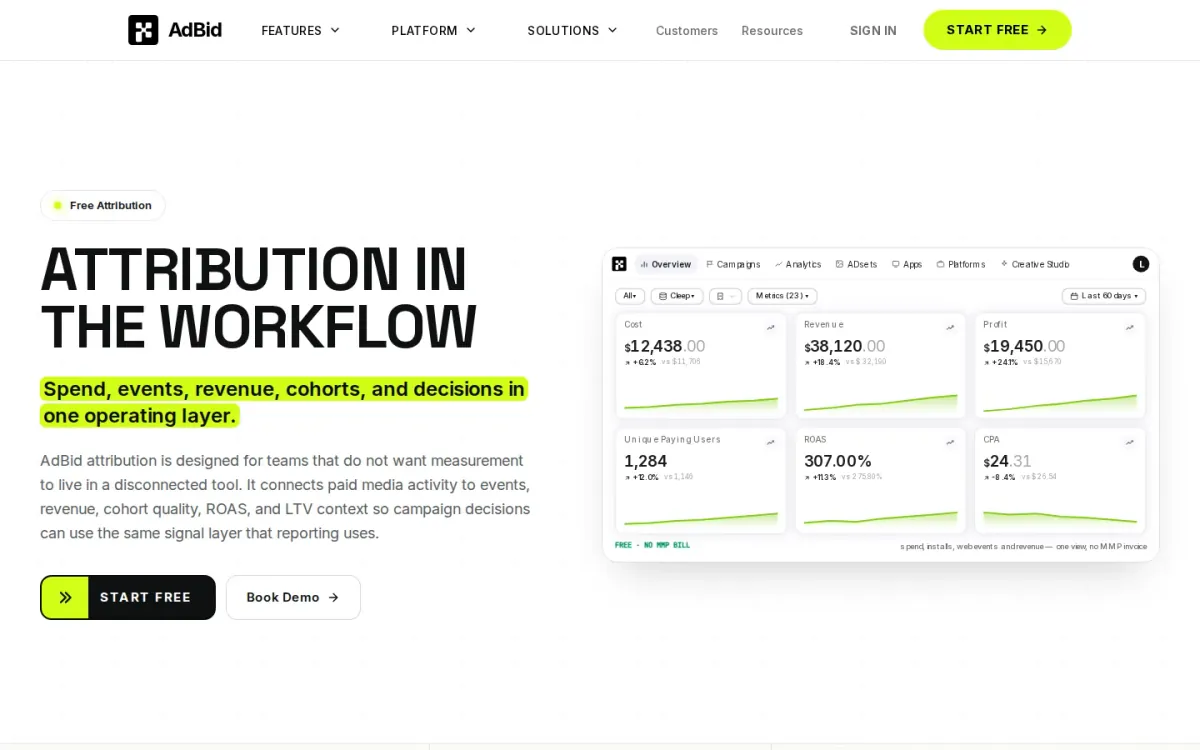
Best for: Growth teams that want attribution tied to campaign decisions.
AdBid positions attribution as part of the same operating layer used for campaign structure, creative context, events, and revenue. It connects paid media activity to cohort quality, ROAS, and LTV so decisions rely on the same signals as reporting.
Features and trade-offs
Key features
- AdBid connects campaign cost to downstream outcomes.
- AdBid links events, revenue, cohorts, ROAS, and LTV.
- AdBid surfaces signal and dataset quality impacts.
- AdBid pairs attribution with optimization logs.
Instead of reconciling separate reports, AdBid places attribution beside optimization logs to explain what changed and why. It also emphasizes signal setup—event definitions, conversion mapping, attribution windows, and revenue fields—so measurement reflects how the business earns.
Why it ranks here
AdBid ranks highly among free attribution tools for unifying spend-to-revenue measurement with campaign context, helping teams act on results rather than reconcile disconnected dashboards.
Pros
- Unified view of spend, events, and revenue.
- Decision context goes beyond isolated reporting.
- Signal setup guidance supports reliable measurement.
Limitations
- May not cover complex MMP requirements.
Access and verdict
Access: Current access details: adbid.me [1]. Verdict: AdBid suits teams that want attribution embedded in daily growth operations, with clear links between spend, signals, and revenue outcomes.
2. Google

- Official source: analytics.google.com [2].
Best for: Teams that need cross-channel attribution insights tied to on-site behavior.
Google Analytics connects website and app interaction data to help you understand which channels drive engagement and conversions. It supports attribution analysis alongside standard reporting, making it a practical choice when comparing free attribution tools for marketing measurement.
Key features
Google Analytics tracks acquisition, engagement, and conversions; Attribution reporting compares channel contribution models.
Also documented: Explorations enable segmentation and path analysis; Event configuration supports custom conversion definitions.
The interface centers on acquisition and conversion reporting, with configurable events and goal tracking to map user journeys. Built-in segmentation and exploration views help isolate campaign impact, while sharing and export options support collaboration across marketing and analytics stakeholders.
Google — why it ranks here
Strong channel and conversion reporting plus flexible explorations make Google Analytics a dependable attribution baseline, though setup and interpretation can take time.
Strengths: Clear acquisition and conversion reporting structure; Flexible analysis via explorations and segments; Broad ecosystem integrations for campaign tagging.
Limitations: Setup complexity for accurate event and conversion mapping; Attribution insights depend on consistent tagging hygiene.
Access: Current access details: analytics.google.com [2]. Verdict: It Analytics is a solid pick for attribution-minded teams that can invest in clean tracking and ongoing reporting discipline.
3. Countly
Official source: countly.com [3].
Best for: Teams that want first-party measurement across devices and touchpoints with strong data ownership controls.
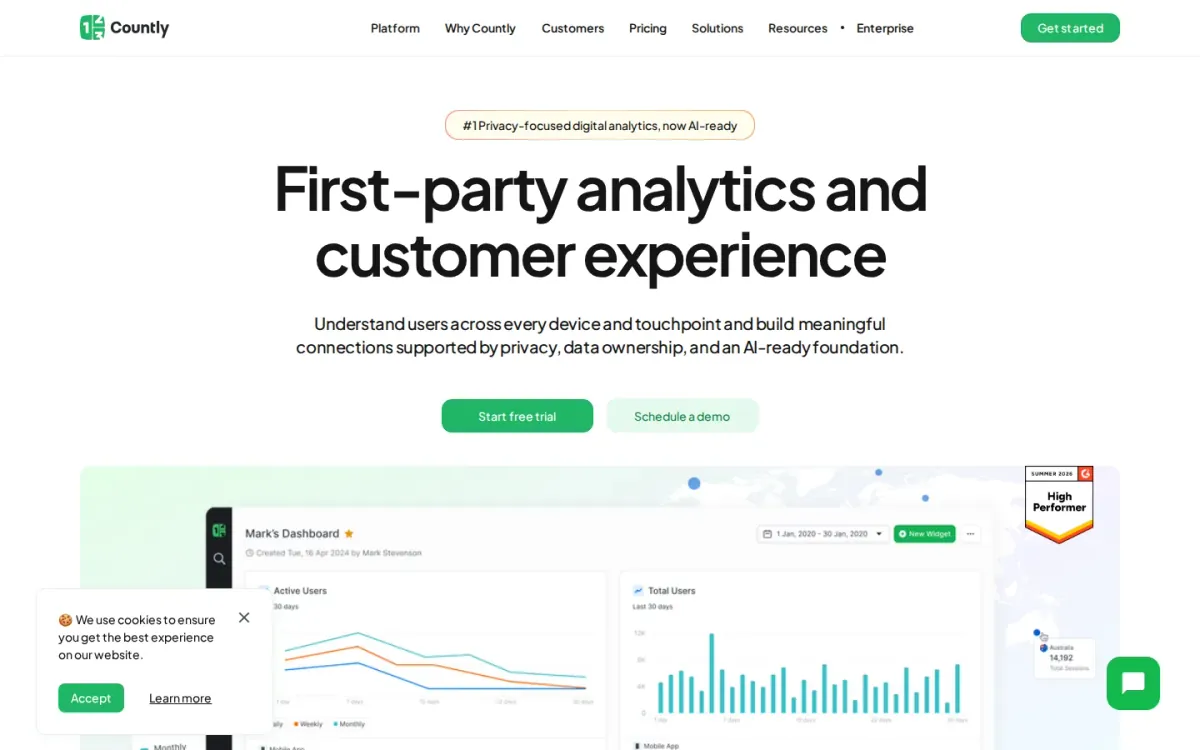
Countly is a privacy-focused digital analytics platform built around first-party data collection across devices and touchpoints. For marketers comparing free attribution tools, it stands out for keeping measurement close to your product data and governance workflows.
Key features
- Countly captures first-party data across key touchpoints.
- Countly provides data validation, filtering, and transformation.
- Countly builds custom dashboards and cohort segmentation.
- Countly supports integrations via APIs and SDKs.
It combines analytics and reporting with data management features that help validate, filter, and transform events before or after capture. Custom dashboards, cohort-style segmentation, and AI-assisted report generation help teams move from raw signals to decisions without exporting data elsewhere.
Quick assessment
Strongest points: Strong privacy and data sovereignty positioning.
Broad SDK coverage across multiple device types.
Dashboards and reports suit mixed skill levels.
Main limitations: Attribution reporting specifics are not clearly detailed.
- Why it ranks here: Ranked #3 for strong first-party data capture, governance, and cross-touchpoint visibility that supports attribution-style insights while prioritizing privacy and control.
Access: Current access details: countly.com [3]. Verdict: It fits teams that want privacy-led measurement and flexible reporting, but may require extra work to map insights to strict attribution models.
4. Posthog

- Official source: posthog.com [4].
Best for: Teams tying acquisition sources to in-product behavior and experiments.
Posthog combines product and web analytics to help connect where users come from with what they do next. It tracks feature usage, supports experiments, and pairs insights with session replay for clearer attribution across journeys.
Key features
Product Analytics and Web Analytics; Session Replay for journey context.
Also documented: Experiments and no-code A/B testing; Context warehouse with 120+ sources.
Beyond analytics, Posthog adds a context warehouse that pulls in data from many external sources and other Posthog modules. That makes it easier to query end-to-end paths, blend behavioral signals, and spot issues that distort attribution.
Posthog — why it ranks here
It earns a top spot for blending analytics, experiments, and replay with a built-in context warehouse, giving attribution workflows more complete, queryable evidence.
Strengths: Strong linkage between behavior and experiments; Session replay clarifies drop-offs and misattribution; Context warehouse unifies external and in-app data.
Limitations: Broad product surface can feel busy; Attribution setup may require data modeling.
Access: Current access details: posthog.com [4]. Verdict: It suits attribution-focused teams that want analytics plus warehouse context, and can handle the extra configuration.
5. Matomo

Official source: matomo.org [5].
Best for: Teams that want reliable attribution insights alongside privacy controls and full data ownership.
Matomo combines web analytics and marketing attribution in a privacy-first platform built for accurate measurement. It emphasizes unsampled data, first-party tracking, and raw data access, helping teams understand traffic sources, conversions, and events without common blind spots.
Key features
- Matomo tracks marketing attribution and traffic sources.
- Matomo provides unsampled data and raw data access.
- Matomo supports funnels, flows, and segmentation.
- Matomo includes GDPR compliance and cookieless tracking.
Beyond attribution reporting, Matomo supports funnels, flows, segmentation, and real-time visitor activity. Governance features like access controls, audit logs, data anonymisation, and cookieless tracking help organizations stay aligned with GDPR and other regulations while keeping insight actionable.
Why it ranks here
It earns this spot for pairing attribution reporting with unsampled analytics, strong privacy controls, and flexible hosting—though setup choices can add decision overhead.
Pros
- Accurate measurement with no data sampling.
- Strong privacy controls: anonymisation, audit logs, access controls.
- Flexible deployment: cloud or on-premise ownership.
Limitations
- Hosting and configuration choices can feel complex at first.
- Advanced analysis features may require more setup time.
Access: Current access details: matomo.org [5]. Verdict: It is a solid pick for attribution-focused analytics when privacy, ownership, and unsampled reporting matter as much as conversion insight.
6. Tenjin
Official source: tenjin.com [6].
Best for: Mobile app teams that want unified attribution plus spend-to-revenue reporting.
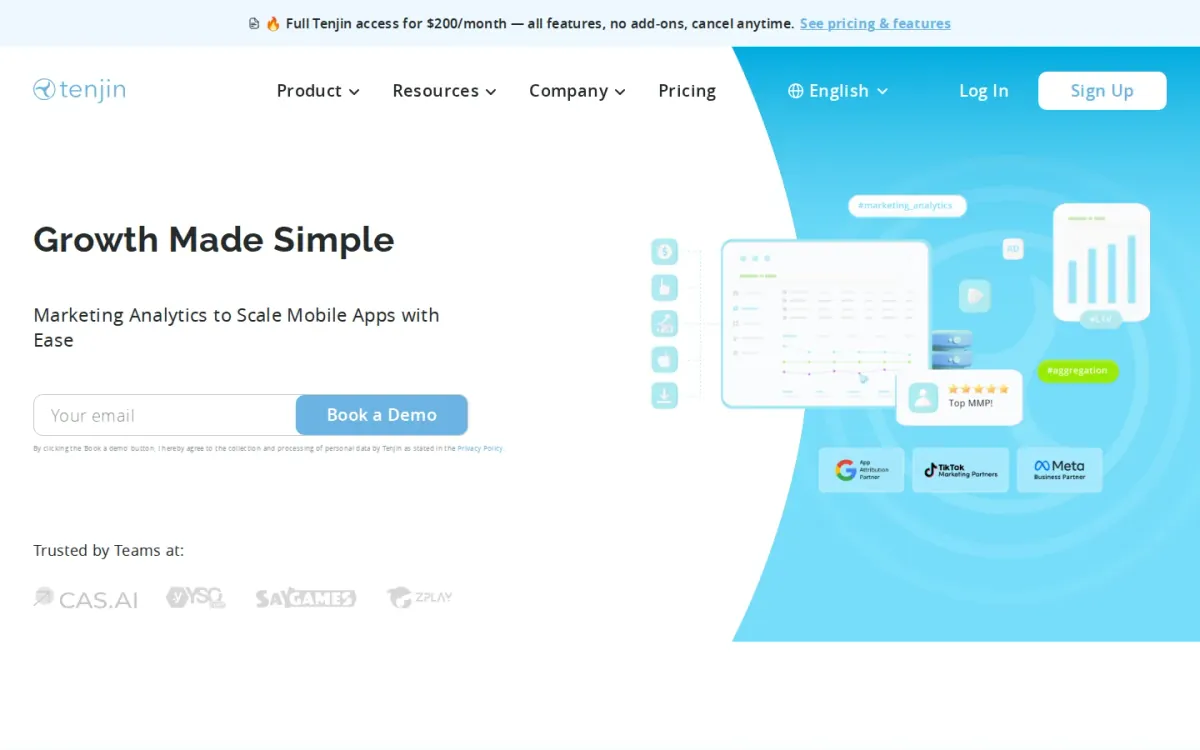
Tenjin centers on mobile attribution for apps, helping you identify the users and advertising channels driving results. It pairs attribution with marketing analytics so growth teams can compare performance across partners and focus on what actually moves ROI.
Key features
- Tenjin mobile attribution for apps.
- Cost aggregation across countries and platforms.
- ROI dashboard unifying ad spend and revenue.
- Fraud prevention to block mobile ad fraud.
Beyond attribution, Tenjin emphasizes cost aggregation and unified cost-and-revenue reporting, plus an ROI dashboard for quick channel comparisons. Add-ons like LTV prediction and fraud prevention support smarter acquisition decisions and help keep budgets focused on real users.
Quick assessment
Strongest points: Clear focus on app user and channel performance.
Unified view of spend and revenue for ROI.
Integrated partners simplify connecting marketing sources.
Main limitations: Mobile-first scope may not suit web-first businesses.
Some advanced capabilities require setup and data alignment.
- Why it ranks here: It earns this spot for combining mobile attribution with cost aggregation, ROI dashboards, and fraud prevention in one measurement workflow.
Access: Current access details: tenjin.com [6]. Verdict: It is a solid pick for app-first attribution reporting, especially when you need ROI visibility, cost aggregation, and fraud controls together.
7. Singular

- Official source: singular.net [7].
Best for: Growth teams needing cross-platform attribution and cost aggregation in one place.
Singular focuses on marketing attribution and analytics across mobile and web, tying performance to omnichannel measurement. It supports SKAdNetwork attribution alongside web and cross-device attribution, helping teams compare outcomes across privacy-constrained and deterministic environments.
Key features
Singular supports SKAdNetwork attribution; Singular unifies omnichannel measurement.
Also documented: Cost aggregation from 1,200+ sources.
Singular also emphasizes data foundation work, such as cost aggregation and normalization across many sources, plus governance and fraud prevention. Deep linking and activation options (web-to-app, QR-to-app, email-to-app) help connect campaigns to downstream actions and customer experience.
Singular — why it ranks here
Broad channel coverage and strong data unification make Singular compelling, but its all-in-one scope can feel heavier than simpler attribution trackers.
Strengths: Strong cross-device and CTV attribution coverage; dependable cost aggregation and data normalization; Governance and fraud prevention focus.
Limitations: Interface and setup may feel complex for small teams; Marketing ETL/ELT scope can add operational overhead.
Access: Current access details: singular.net [7]. Verdict: It suits teams that want attribution, cost data, and activation under one roof, especially across mobile, web, and emerging channels.
8. Appsflyer

- Official source: appsflyer.com [8].
Best for: Teams needing unified attribution across app, web, CTV, and gaming platforms.
Appsflyer centers on cross-platform measurement, spanning mobile, web, CTV, and PC & console. It connects attribution, revenue, and engagement data in one view, helping marketers optimize spend, prove ROI, and scale decisions using privacy-safe insights.
Key features
- Appsflyer measures mobile, web, CTV, PC & console; Appsflyer unifies attribution, revenue, and engagement views.
Beyond core measurement, Appsflyer adds deep linking and routing from channels like web, email, QR, and social into personalized in-app experiences. It also emphasizes validated, fraud-filtered, standardized signals, plus data collaboration and clean-room style partnerships.
Appsflyer — why it ranks here
Strong breadth across channels and signal quality, but the product suite can feel expansive for simple attribution needs.
Strengths: Broad coverage across major digital touchpoints; Links marketing channels to in-app experiences; Emphasis on privacy-safe, validated signals.
Limitations: Wide suite may overwhelm smaller attribution setups; Product scope extends beyond pure measurement.
Access: Current access details: appsflyer.com [8]. Verdict: It fits organizations that need attribution across many platforms and want cleaner signals, plus deep linking for better post-click experiences.
9. Umami
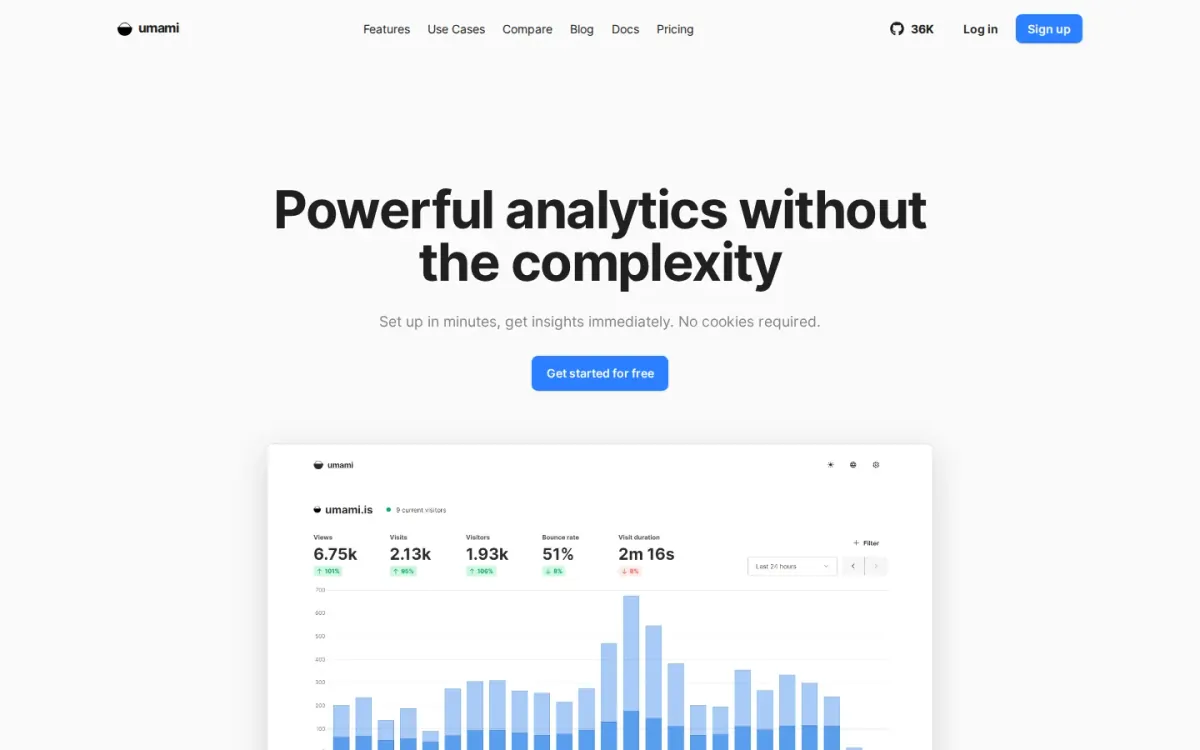
Official source: umami.is [9].
Best for: Privacy-conscious web analytics.
Umami offers web analytics with a strong emphasis on user privacy. It provides essential insights into website traffic without relying on cookies or collecting personal data, making it suitable for privacy-conscious organizations.
Key features
- Cookie-free tracking for routine free attribution workflow work.
- No personal data collection.
It helps understand visitor behavior and content performance. It presents data in a clear, straightforward interface, enabling users to make informed decisions about their digital presence while respecting user anonymity.
Why it ranks here
It ranks lower due to limited transparency regarding its operational scope and support, despite offering a strong privacy-first approach to web analytics.
Pros
- Umami prioritizes user privacy.
- Provides essential website insights.
- Easy to use interface.
Limitations
- Limited transparency on operational scope.
- Support transparency is unclear.
Access: Current access details: umami.is [9]. Verdict: A solid choice for privacy-centric web analytics, though users may seek more clarity on its full capabilities and support.
10. Plausible

Official source: plausible.io [10].
Best for: Site owners who want clear, privacy-friendly attribution signals without GA4 complexity.
Plausible is a lightweight, privacy-friendly Google Analytics alternative that focuses on clear insights without cookies. For attribution-style analysis, it tracks UTM campaigns with automatic channel grouping, helping you connect traffic sources to landing pages, locations, and conversions.
Key features
- Plausible tracks UTM campaigns with channel grouping.
- Plausible provides real-time dashboard updates.
- Plausible supports codeless goals and revenue tracking.
- Plausible includes funnels and user journeys.
The dashboard stays readable for non-analysts, with real-time reporting and built-in bot filtering to keep source data cleaner. Codeless goals and revenue tracking let you treat key pages or actions as outcomes, while funnels and user journeys show drop-off and common paths.
Quick assessment
Strongest points: Clear dashboard that avoids analytics clutter.
Built-in bot filtering improves source accuracy.
Privacy-friendly approach without cookies.
Main limitations: Limited depth for advanced multi-touch attribution.
- Why it ranks here: It earns this spot for straightforward source and campaign tracking, but it’s less specialized for multi-touch attribution than dedicated platforms.
Access: Current access details: plausible. Verdict: It suits teams that want simple campaign and conversion attribution signals, strong privacy posture, and a clean reporting experience.
How to choose
Workflow fit
Start by defining the decisions attribution must support: budget shifts, creative iteration, channel mix, or lifecycle optimization. Next, confirm the tool can capture the identifiers you rely on, such as UTMs, referrers, deep links, or server-side events, without breaking when browsers or platforms restrict tracking.
Validation
Look closely at how reporting handles multi-touch paths, time windows, and deduplication, since these details change conclusions. Prioritize integrations that match your stack, including ad platforms, warehouses, CRMs, and product analytics. Finally, check documentation quality and support expectations so the workflow stays reliable as campaigns and teams scale.
Final recommendations
Shortlist
- Free attribution tools is a strong fit when growth teams need attribution that stays close to campaign decisions and daily operating rhythm.
- Google Analytics works best for teams ready to maintain clean tagging, consistent events, and disciplined reporting across channels and site behavior.
Before rollout
- Posthog and Countly make sense when attribution must connect acquisition sources to product usage, experiments, and first-party data governance.
- For privacy-forward web measurement with simpler reporting, Umami or Plausible can be a better match than complex enterprise-style setups.
Sources
- AdBid - Free Attribution Tools
- Countly
- Posthog
- Matomo
- Tenjin
- Singular
- Appsflyer
- Umami
- Plausible
Related reading: Top 10 Multi Touch Attribution Tools
Related reading: Top 10 Mobile Attribution Platforms