
Choosing an analytics platform is less about flashy demos and more about whether the tool fits your data reality: messy naming, shifting attribution, and stakeholders who need answers quickly. This Top 10 focuses on tools that help teams move from dashboards to decisions with clearer explanations, repeatable reporting, and fewer dead ends. The goal is to highlight where each option tends to shine—ad performance, ecommerce measurement, self-serve BI, or embedded insights—without assuming one setup works for everyone. Use the sections below to match your team’s workflow, governance needs, and tolerance for setup effort before committing to an AI analytics tool.
Comparison table
| Rank | Tool | Best for | Key capabilities | Limitations | Access/source status |
|---|---|---|---|---|---|
| 1 | AdBid - AI Analytics Tool [1] | Performance marketers who want conversational campaign analysis tied to warehouse data | AdBid writes and runs read-only SQL; Chat-based funnel diagnosis and verdicts | Focuses on ad campaign analytics, not broad BI | Official source: adbid.me [1] |
| 2 | Madgicx [2] | Teams managing Meta ad accounts who want clearer performance insights and guided next steps | Madgicx AI Campaign Manager for Meta automation; Ad Analyzer for performance and opportunity auditing | Meta-centric focus limits cross-channel analytics | Official source: Madgicx.com [2] |
| 3 | Triplewhale [3] | Ecommerce teams that need unified measurement and real-time insight across ads, site, and retention | Moby 2 delivers real-time insights and forecasting; Compass unifies MMM, MTA, and incrementality | Ecommerce-first focus may limit non-retail applicability | Official source: Triplewhale.com [3] |
| 4 | Databox [4] | Teams that want self-serve performance reporting across many integrations | Databox AI Analyst for plain-English questions; Dashboards, reports, and KPI tracking | Metric definitions can take time to standardize | Official source: Databox.com [4] |
| 5 | Polaranalytics [5] | Shopify merchants who want consolidated marketing and store performance reporting across multiple shops and channels | Polaranalytics consolidates multichannel data into one dashboard; Customizable reports for key eCommerce metrics | Best fit skews toward Shopify-centric eCommerce workflows | Official source: Polaranalytics.com [5] |
| 6 | Adriel [6] | Digital marketing teams that need unified performance reporting across ad and analytics sources | Adriel connects and visualizes marketing data; Adriel AI Agents support decision-making | Marketing-centric scope may not fit broader analytics needs | Official source: Adriel.com [6] |
| 7 | Zenlytic [7] | Teams that want business users to ask data questions directly, with data teams retaining governance | Zoë answers questions and cites every number; Semantic layer for consistent, auditable context | Limited clarity on constraints and edge cases | Official source: Zenlytic.com [7] |
| 8 | Thoughtspot [8] | Teams that want explainable insights inside everyday workflows | Thoughtspot supports AI Answers and Liveboards; Thoughtspot provides a governed semantic layer | Many platform modules can add setup complexity | Official source: Thoughtspot.com [8] |
| 9 | Segwise [9] | Performance marketers who need cross-network creative insights and faster iteration | Segwise unifies creative data across platforms; AI tags hooks, CTAs, emotions, and more | Narrow focus on creative and ad performance | Official source: Segwise.ai [9] |
| 10 | Vaizle [10] | Marketers who want cross-channel reporting and competitive checks in one place | Vaizle analyzes Meta, Google, LinkedIn, Amazon ads; Vaizle runs competitive ads and profile analysis | Feature sprawl can feel less specialized | Official source: Vaizle.com [10] |
How we evaluated the tools
Each product is scored using a consistent rubric: task fit (30%) for how well it serves the primary use case; features and automation (20%) for analysis depth, alerts, and assisted workflows; ease of use (15%) for onboarding and day-to-day operation; integrations and workflow (15%) for connectors, exports, and collaboration; access transparency (10%) for clarity around data lineage, permissions, and explainability; and limits, support, and transparency (10%) for documented constraints, help resources, and reliability signals. Scores reflect documented capabilities and typical workflows described publicly.
- Source basis: checks start with adbid.me [1] and continue through every linked official product page.
Scores are editorial assessments on a 100-point scale rather than customer ratings. Product pages supply the feature and access facts, and the same weighted rubric applies to every entry.
The order reflects fit for this comparison, not market share or brand familiarity. Each product links back to an official source so readers can verify current details.
1. AdBid
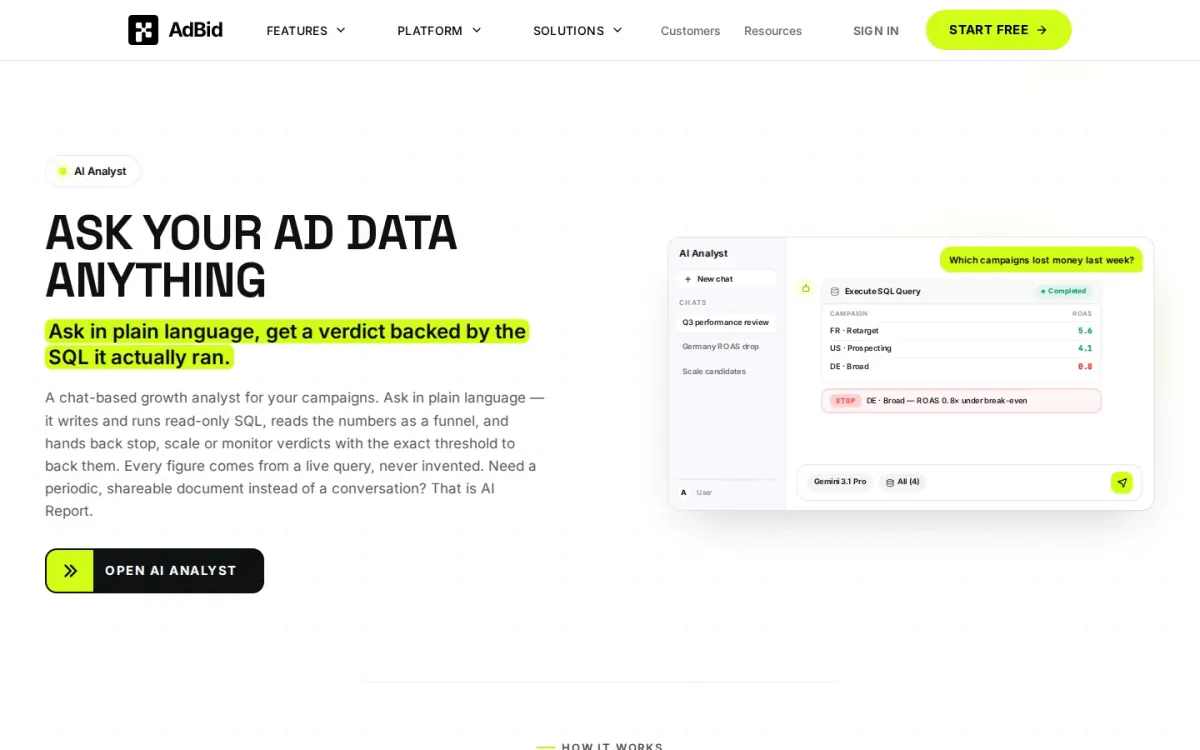
Best for: Performance marketers who want conversational campaign analysis tied to warehouse data.
AdBid AI Analyst turns ad-hoc campaign questions into a guided conversation: ask in plain language, and it decides what data it needs, writes read-only SQL, runs it, then diagnoses results as a funnel with a clear stop, scale, or monitor verdict.
Features and trade-offs
Key features
- AdBid writes and runs read-only SQL.
- Chat-based funnel diagnosis and verdicts.
- Reasoning steps and SQL shown on screen.
- Conversation history for ongoing analysis.
Transparency is the point. AdBid shows each reasoning step and the exact SQL it ran, so results aren’t a black box and figures come from live queries rather than invented numbers. Saved chat history lets teams reopen threads and compare changes week to week.
Why it ranks here
Ranks highly for explainable, query-backed recommendations and a workflow that replaces dashboard setup with direct questioning—ideal for fast investigations and ongoing optimization.
Pros
- Live-query numbers, never invented.
- Clear stop/scale/monitor guidance with thresholds.
- No dashboards or query language to learn.
Limitations
- Focuses on ad campaign analytics, not broad BI.
- Requires warehouse-connected data to answer well.
Access and verdict
Access: Current access details: adbid.me [1]. Verdict: A strong ai analytics tool for campaign teams that value transparency, drill-down chats, and actionable verdicts grounded in the SQL actually executed.
2. Madgicx

- Official source: madgicx.com [2].
Best for: Teams managing Meta ad accounts who want clearer performance insights and guided next steps.
Madgicx focuses on Meta ads performance, pairing analytics with guided optimization. It audits your account, surfaces opportunities, and points to concrete actions, helping marketers avoid getting lost in complex data while improving decision-making.
Key features
Madgicx AI Campaign Manager for Meta automation; Ad Analyzer for performance and opportunity auditing.
Also documented: Ad Fatigue detector to flag declining creatives; Meta Creative Tracker to monitor what works.
Beyond reporting, Madgicx supports an end-to-end creative workflow: generating ads, launching them across campaigns, and tracking creative performance. Features like ad fatigue detection and creative tracking help identify what’s working and scale winners with less guesswork.
Madgicx — why it ranks here
Strong fit for Meta-focused analysis, combining actionable insights, creative intelligence, and automation that turns findings into clear optimization steps.
Strengths: Actionable insights that reduce analysis overload; Creative generation plus automated ad launching; Clear next-step recommendations for optimization.
Limitations: Meta-centric focus limits cross-channel analytics.
Access: Current access details: madgicx.com [2]. Verdict: It is a practical ai analytics tool for Meta advertisers who want insights tied directly to optimization and creative execution.
3. Triplewhale

Official source: triplewhale.com [3].
Best for: Ecommerce teams that need unified measurement and real-time insight across ads, site, and retention.
Triplewhale brings real-time data from across an ecommerce business into one command center, pairing attribution and measurement with Moby AI for forecasting and insight. It’s designed to help teams act on what’s happening now, not yesterday.
Key features
- Moby 2 delivers real-time insights and forecasting.
- Compass unifies MMM, MTA, and incrementality.
- Triple Pixel improves cross-device identity resolution.
- 75+ Dashboards for self-serve analytics.
Triple Pixel’s identity resolution aims to capture customer interactions other tracking misses, while Compass unifies MMM, MTA, and incrementality. Self-serve analytics adds 75+ dashboards, and custom BI supports tailored reporting for marketers, ops, and analysts.
Quick assessment
Strongest points: Unified measurement reduces conflicting performance narratives.
60+ One-click integrations simplify data consolidation.
Real-time reporting supports faster operational decisions.
Main limitations: Ecommerce-first focus may limit non-retail applicability.
AI Visibility targets AI search, not general analytics needs.
Why it ranks here: Strong fit for ecommerce measurement: unified MMM/MTA/incrementality, broad integrations, and AI-assisted workflows.
Though the focus is narrower outside retail use cases.
Access: Current access details: triplewhale.com [3]. Verdict: For ecommerce brands, Triplewhale is a practical ai analytics tool that ties attribution, dashboards, and AI assistance into one workflow.
4. Databox
- Official source: databox.com [4].
Best for: Teams that want self-serve performance reporting across many integrations.
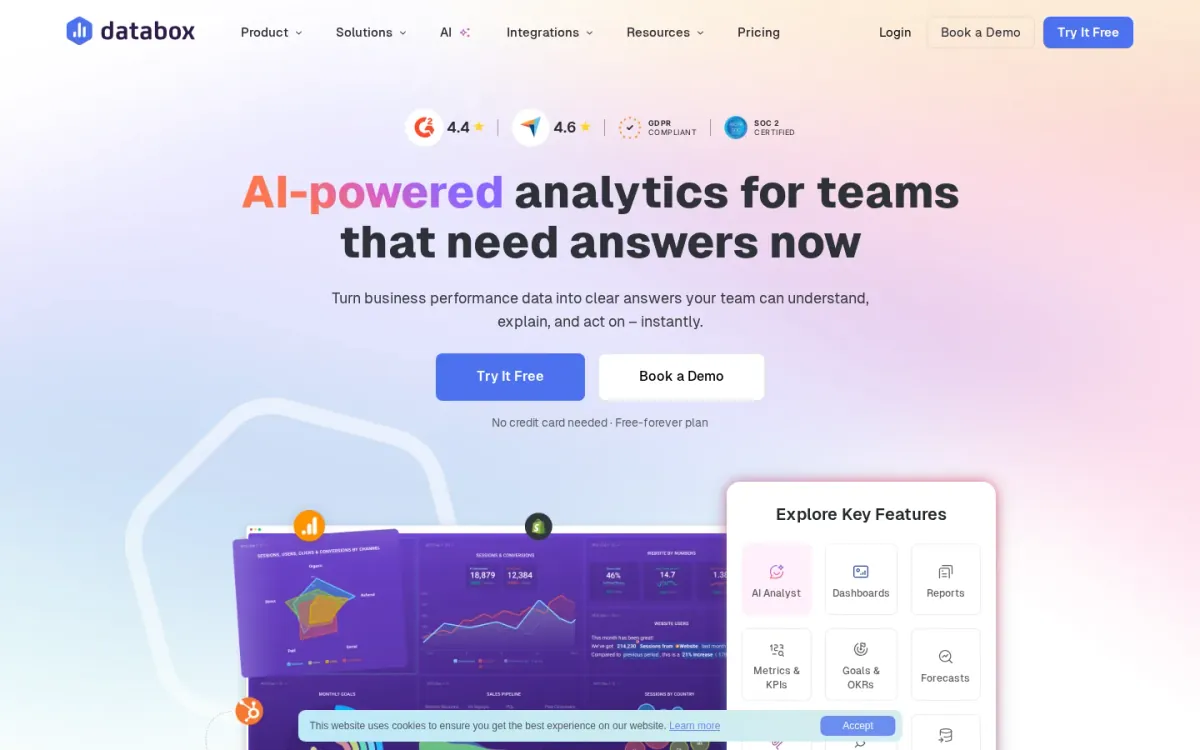
Databox focuses on AI-assisted business performance analysis, turning connected marketing, sales, and finance data into clear answers teams can act on. Ask questions in plain English, then translate responses into dashboards, reports, and tracked KPIs without constant spreadsheet wrangling.
Key features
Databox AI Analyst for plain-English questions; Dashboards, reports, and KPI tracking.
Also documented: Goals & OKRs with shared metrics; 130+ integrations across key platforms.
It supports a wide catalog of integrations across ad platforms, CRMs, analytics, databases, and spreadsheets, helping unify metrics in one place. Databox also adds goals and OKRs, forecasts, alerts, and data preparation so stakeholders can monitor progress and spot underperforming channels early.
Databox — why it ranks here
It earns this spot for broad integrations, approachable AI Q&A, and strong dashboarding, though deeper analysis may require careful metric standardization across sources.
Strengths: Strong dashboard templates and shareable visuals; Wide integration coverage across business systems; Plain-English querying speeds up routine analysis.
Limitations: Metric definitions can take time to standardize.
Access: Current access details: databox.com [4]. Verdict: It suits teams that need unified performance visibility and quick, AI-guided answers across many data sources.
5. Polaranalytics
Official source: polaranalytics.com [5].
Best for: Shopify merchants who want consolidated marketing and store performance reporting across multiple shops and channels.
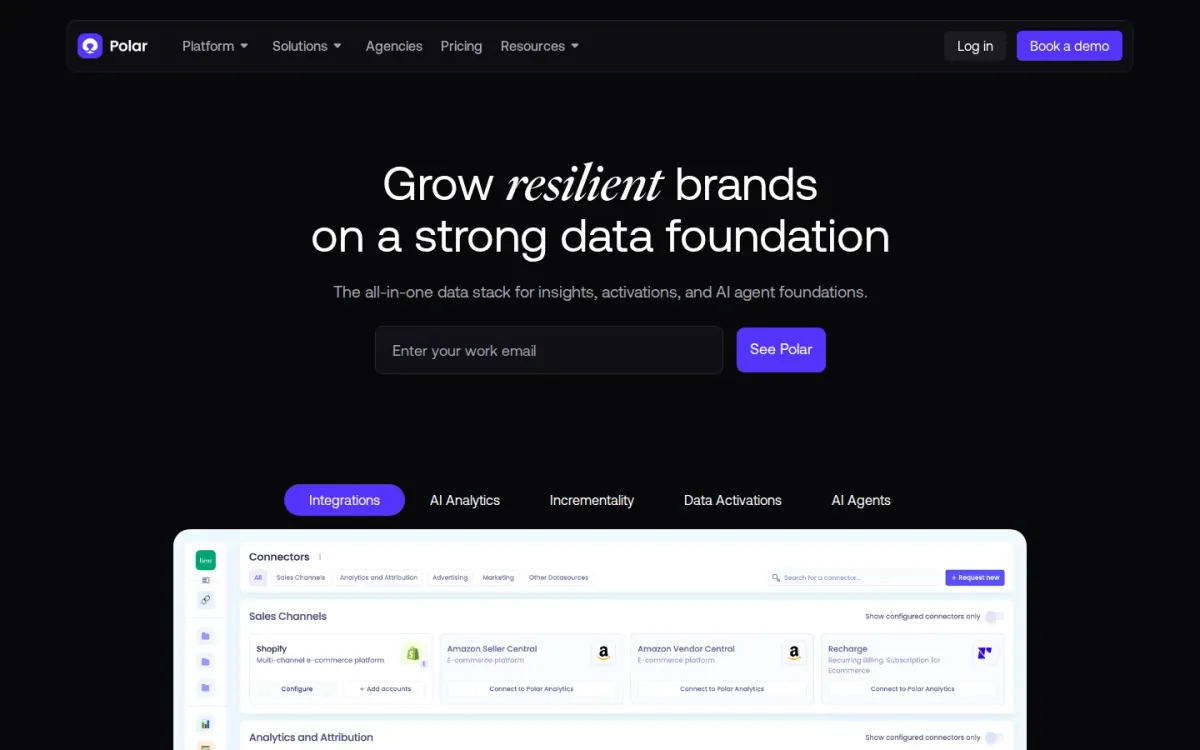
Polaranalytics focuses on consolidating eCommerce and marketing data into a single, streamlined dashboard. It’s frequently praised for being easy to set up, intuitive to use daily, and helpful for pulling key multichannel reports such as CAC, LTV, and ROAS.
Key features
- Polaranalytics consolidates multichannel data into one dashboard.
- Customizable reports for key eCommerce metrics.
- Integrations with Shopify, Analytics, and Klaviyo.
- Overview dashboards for multiple shops and markets.
For teams managing multiple storefronts or markets, Polaranalytics can provide an overview across shops while keeping reporting customizable. Users also highlight smooth onboarding, responsive support, and integrations that make it simpler to track performance and optimize acquisition strategy.
Why it ranks here
Ranked for strong Shopify-centric consolidation, customizable reporting, and quick onboarding support, though the positioning is narrowly centered on eCommerce analytics needs.
Pros
- Intuitive interface for daily reporting.
- Quick, responsive customer support.
- Easy setup with plug-and-play integrations.
Limitations
- Best fit skews toward Shopify-centric eCommerce workflows.
Access: Current access details: polaranalytics.com [5]. Verdict: It suits Shopify teams that need consolidated, customizable multichannel reporting and dependable support for ongoing performance tracking.
6. Adriel
Official source: adriel.com [6].
Best for: Digital marketing teams that need unified performance reporting across ad and analytics sources.
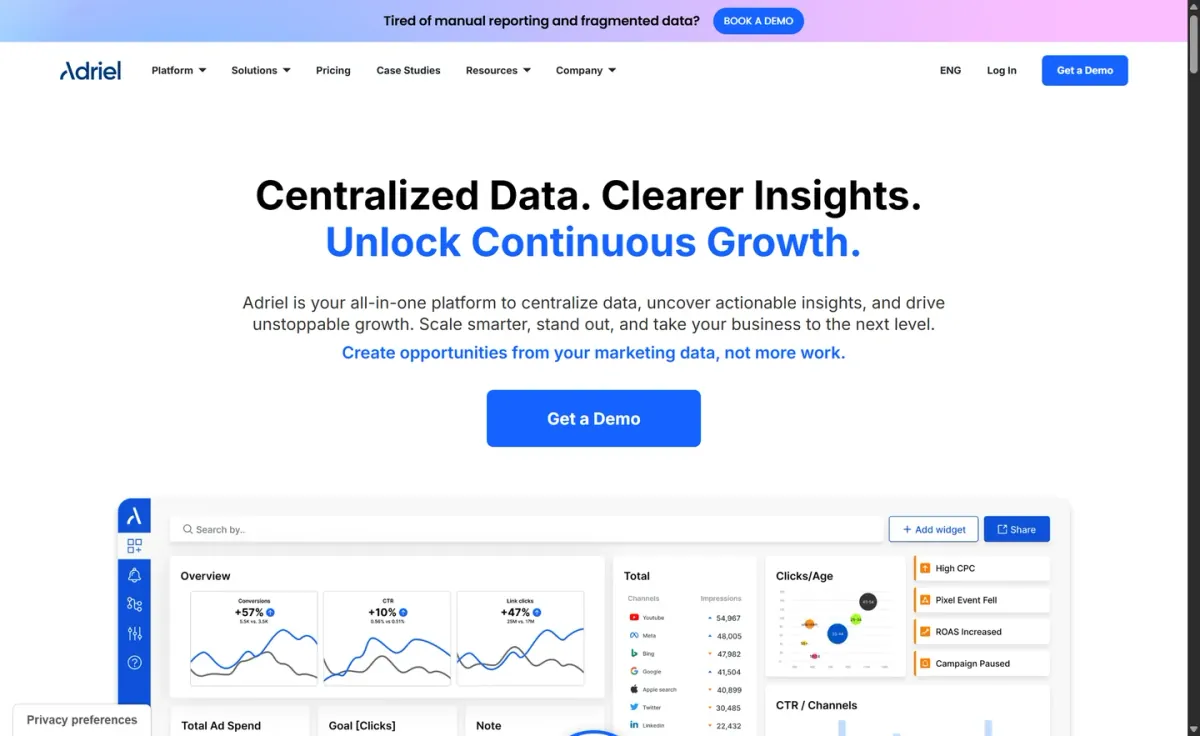
Adriel positions itself as a data integration and visualization platform for digital marketing teams, bringing fragmented marketing data into one place. Dashboards and ready-made templates help teams visualize KPIs quickly, reducing time spent building standardized reports.
Key features
- Adriel connects and visualizes marketing data.
- Adriel AI Agents support decision-making.
- AdOptimize sends alerts and optimization suggestions.
- Adriel DataStream builds ETL data pipelines.
Beyond reporting, Adriel adds AI Agents aimed at simplifying workflow and supporting smarter decisions, plus AdOptimize for alerts and optimization suggestions. Adriel DataStream supports ETL-style pipelines, helping teams connect sources and keep dimensions and metrics flowing into dashboards.
Quick assessment
Strongest points: Ready-made dashboard templates for quick KPI views.
Centralizes multiple ad platform dashboards in one view.
Automated connectors import dimensions and metrics.
Main limitations: Marketing-centric scope may not fit broader analytics needs.
Demo-led onboarding can slow initial evaluation.
Why it ranks here: It earns a mid-pack spot for combining marketing BI dashboards, ETL pipelines, and AI-driven alerts.
Its focus stays primarily on advertising and marketing data.
Access: Current access details: adriel.com [6]. Verdict: It suits teams that want consolidated marketing reporting plus AI-assisted monitoring and optimization suggestions, especially when multiple ad and analytics sources must stay aligned.
7. Zenlytic
- Official source: zenlytic.com [7].
Best for: Teams that want business users to ask data questions directly, with data teams retaining governance.
Zenlytic focuses on helping non-analysts get answers from company data in the way they naturally ask questions, reducing analyst bottlenecks. Reviewers highlight an “end-user focused” experience that supports marketing and ops teams without requiring an analyst for every request.
Key features
Zoë answers questions and cites every number; Semantic layer for consistent, auditable context.
Also documented: Connects to Snowflake, BigQuery, Redshift, Databricks; Role-based access, SSO/SAML, SOC 2 Type II.
Zoë, Zenlytic’s analytics agent, investigates questions, cites every number, and builds deliverables you can inspect end-to-end. It connects to common warehouses and fits into existing workflows, while enterprise-grade security features like role-based access and SSO/SAML support controlled sharing.
Zenlytic — why it ranks here
It ranks well for approachable, agent-driven analysis and strong governance, but public detail on product limitations is thin compared with some rivals.
Strengths: End-user focused experience for business teams; Quick to roll out across key teams; Strong security and permission controls.
Limitations: Limited clarity on constraints and edge cases.
Access: Current access details: zenlytic.com [7]. Verdict: It suits organizations seeking self-serve insights with traceable answers and tight access control, especially when business teams need to move faster.
8. Thoughtspot
- Official source: thoughtspot.com [8].
Best for: Teams that want explainable insights inside everyday workflows.
Thoughtspot positions itself as an agentic analytics platform that delivers live, explainable AI insights inside the tools teams already use. It emphasizes trusted answers grounded in verified definitions, helping people understand performance, spot change, and act confidently.
Key features
Thoughtspot supports AI Answers and Liveboards; Thoughtspot provides a governed semantic layer.
Also documented: Thoughtspot enables embedded analytics via SDK; Thoughtspot integrates with Slack and Salesforce.
It spans AI Answers, Liveboards, automated insights, and embedded analytics on a shared governed foundation. A semantic layer governs business logic, joins, calendars, calculations, and security before questions get asked, supporting consistent results across experiences.
Thoughtspot — why it ranks here
Strong governance and embedded experiences stand out, but the breadth of concepts and components can feel heavier than simpler, dashboard-only analytics products.
Strengths: Governed definitions improve consistency across teams; Embedded analytics fits apps, portals, and products; Explainable AI insights support decision-making.
Limitations: Many platform modules can add setup complexity; Enterprise-grade controls may feel heavy for small teams.
Access: Current access details: thoughtspot.com [8]. Verdict: It suits organizations prioritizing governed, explainable insights across apps and workflows, especially when embedded analytics and consistent definitions matter most.
9. Segwise
Official source: segwise.ai [9].
Best for: Performance marketers who need cross-network creative insights and faster iteration.
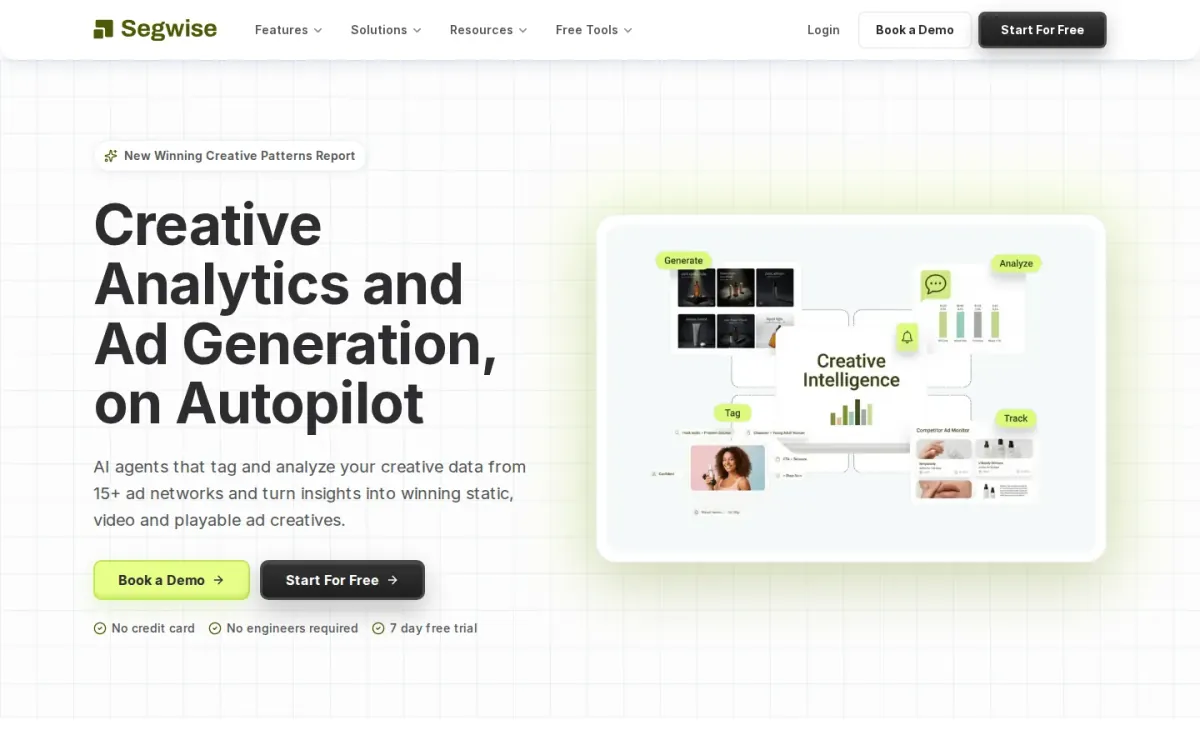
Segwise focuses on creative performance intelligence, using AI agents to tag and analyze assets across 15+ ad networks. It unifies creative and performance data, then maps elements like hooks, CTAs, and emotions to outcomes for clearer creative decisions.
Key features
- Segwise unifies creative data across platforms.
- AI tags hooks, CTAs, emotions, and more.
- Visual clustering groups renamed creatives.
- Fatigue tracking across every ad network.
Reporting stays practical: Segwise supports dashboards built from multiple ad networks and data sources, plus visual recognition to cluster creatives even when naming differs. Automated fatigue tracking helps teams spot wear-out signals and prioritize refreshes across networks.
Why it ranks here
Strong for cross-network creative tagging, clustering, and fatigue tracking, but its emphasis on ad creatives makes it less broad than general analytics platforms.
Pros
- Clear tag-level links to performance metrics.
- No-code integrations across major ad networks.
- Dashboards combine multiple data sources.
Limitations
- Narrow focus on creative and ad performance.
Access: Current access details: segwise.ai [9]. Verdict: It is a solid pick for teams optimizing ad creatives, especially when consistent tagging, cross-network reporting, and fatigue monitoring matter day to day.
10. Vaizle
Official source: vaizle.com [10].
Best for: Marketers who want cross-channel reporting and competitive checks in one place.
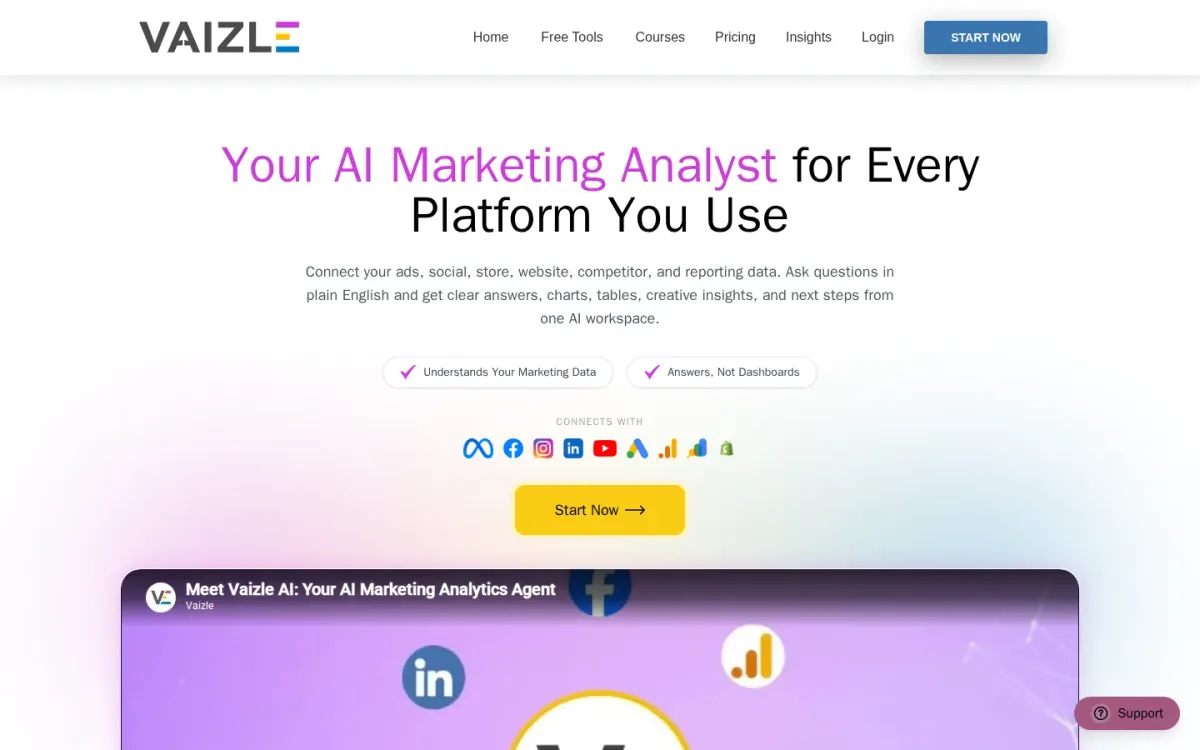
Vaizle positions itself as an AI agent for end-to-end marketing analysis, spanning ads, social media, and site performance signals. It covers Facebook, Instagram, LinkedIn, YouTube, Google Ads, and Amazon Ads analytics alongside page and profile analysis.
Key features
- Vaizle analyzes Meta, Google, LinkedIn, Amazon ads.
- Vaizle runs competitive ads and profile analysis.
- Vaizle syncs data to Google Sheets.
- Vaizle exports reports to MS Excel.
For reporting workflows, Vaizle emphasizes data connectors that sync marketing data to Google Sheets and exports to MS Excel. It also includes competitive analytics like ad spy and competitor views, plus utilities such as best-time-to-post and ROI calculators.
Quick assessment
Strongest points: Wide coverage across ads and social platforms.
Concrete spreadsheet sync and export options.
Competitive analytics plus best-time-to-post utilities.
Main limitations: Feature sprawl can feel less specialized.
Why it ranks here: It earns a lower spot for breadth over depth: it touches many channels and exports well.
The offering reads like a large toolbox rather than a focused analytics suite.
Access: Current access details: vaizle. Verdict: It suits teams needing multi-platform marketing intelligence and spreadsheet-ready outputs, especially when competitive snapshots matter as much as reporting.
How to choose
Workflow fit
Start by defining the job: campaign optimization, ecommerce measurement, executive reporting, or self-serve BI with governance. Next, map your data sources and decide whether you need warehouse-native querying, prebuilt connectors, or embedded analytics in other tools.
Validation
Check how answers are explained—look for traceable queries, clear metric definitions, and audit-friendly history. Consider who will use it daily: marketers may prefer guided insights, while data teams may prioritize modeling control and permissions. Finally, confirm how the tool handles edge cases like attribution changes, naming inconsistencies, and multi-account rollups without forcing constant manual cleanup.
Final recommendations
Shortlist
- If your priority is conversational drill-down tied to warehouse truth, start with AdBid.
- Ai Analytics Tool and verify that its SQL traceability matches your governance needs.
- For Meta-heavy teams, choose a workflow that connects insights to concrete next steps, especially around creative iteration and account structure.
Before rollout
- Ecommerce brands should prioritize unified measurement across ads, site, and retention, with clear attribution logic and dependable reporting consistency.
- BI-led organizations should favor governed self-serve search, consistent metric definitions, and integrations that keep stakeholders in their existing tools.