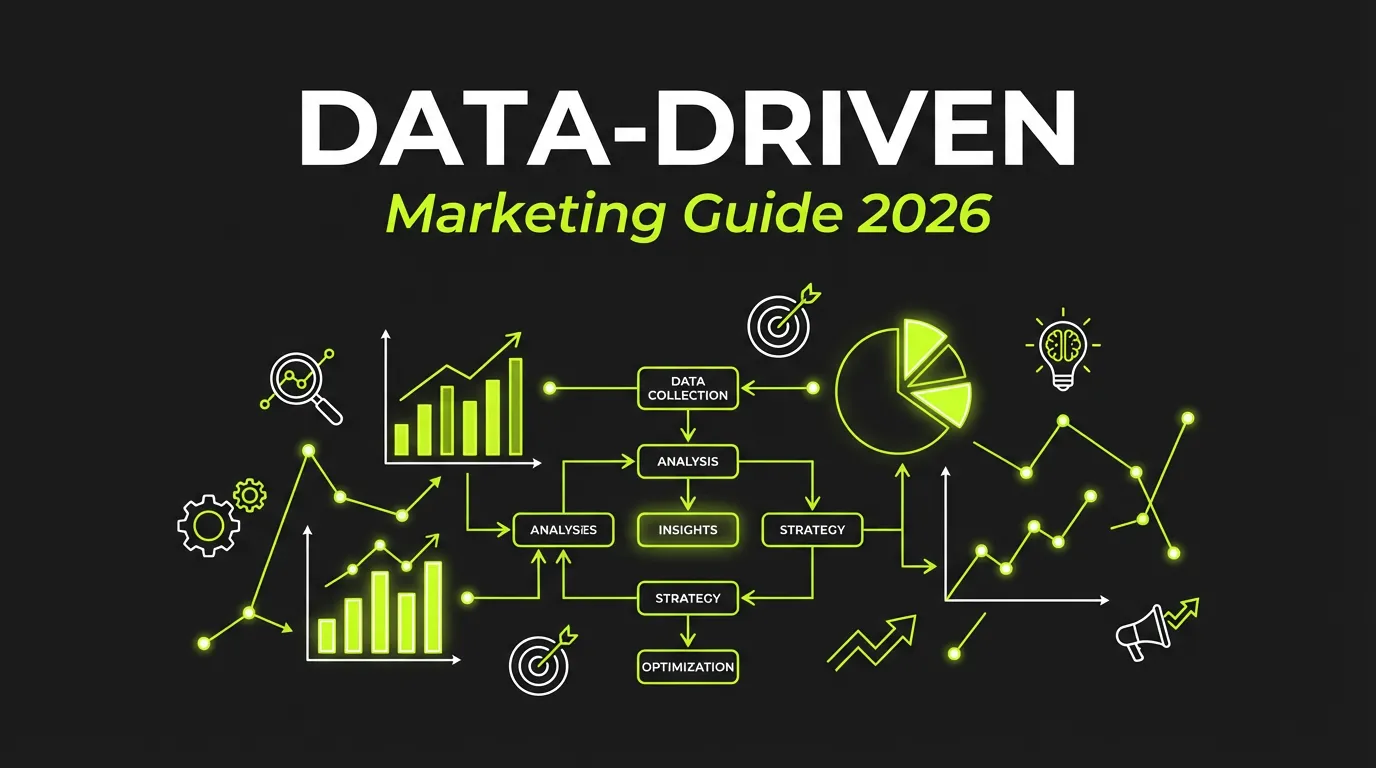

Data-Driven Marketing Guide 2026
"Data-driven" gets thrown around so often that the phrase has lost most of its meaning. Yet the gap between brands that talk about data and brands that actually use it keeps widening. The difference shows up in conversion rates, retention, and how confidently teams make budget decisions.
This guide breaks data-driven marketing into the parts that matter in 2026: building a first-party data foundation, turning predictions into action, integrating AI without losing human judgment, and measuring what your platforms can no longer measure for you. The goal is practical clarity, not another wall of buzzwords.
Key Takeaways
- First-party data is now the foundation of every serious marketing program, not an optional layer.
- Activation matters more than collection: stored data you never use generates zero value.
- Predictive models like churn risk and lifetime value let you act before behavior happens, not after.
- Platform attribution is breaking down, so incrementality testing and mixed methods fill the gap.
- AI works best as an amplifier of human decisions, handling scale while people set strategy.
What Does Data-Driven Marketing Actually Mean in 2026?
Data-driven marketing means making decisions from observed behavior rather than assumptions, then measuring whether those decisions worked. In 2026, that loop runs faster and leans harder on first-party signals. The privacy shift away from third-party cookies forced a rebuild, and teams that adapted now own their customer relationships directly.
The mindset matters as much as the tooling. Data-driven does not mean data-obsessed. It means pairing human judgment with relevant evidence so you make fewer bad bets. A marketer who reads a dashboard but cannot explain what to do next is not yet data-driven, just data-aware.
From Reporting to Decisions
Most teams already have reports. Fewer have a clear path from a number on a screen to a changed campaign, a new audience, or a paused ad. The useful question is not "what happened" but "what do we do because of it." Every metric you track should map to a decision someone can make.
If you track a number nobody acts on, drop it. Vanity metrics crowd out the signals that drive real outcomes.
Why Is First-Party Data the Foundation?
First-party data is information you collect directly from your own audience: website behavior, app usage, email engagement, purchase history, and loyalty activity. It became the foundation because third-party cookies are disappearing and consumers increasingly expect transparency about how their data gets used. Owning the relationship is now both a competitive edge and a baseline requirement.
The advantage compounds over time. Direct relationships give you cleaner signals, fewer middlemen, and consent you can actually rely on. Brands that started building this muscle early entered 2026 with richer profiles and better targeting than competitors still leaning on rented audiences.
Where First-Party Data Comes From
Different sources carry different value. Your website reveals intent and preferences. Your app, when you have one, captures engagement depth that few other channels match. CRM and loyalty data tie behavior to real purchases, which makes them especially valuable for modeling.
| Source | Data type | Relative value |
|---|---|---|
| Website | Behavior, preferences | High |
| App | Usage, engagement | Very high |
| Engagement, preferences | High | |
| CRM | Purchase history, support | Very high |
| Loyalty program | Transactions, preferences | Very high |
Turning Sources Into a Strategy
A working first-party strategy moves through four stages. First, collection: every meaningful touchpoint should capture something useful. Second, organization: unify scattered records into single customer profiles, often through a customer data platform. Third, activation: segment, personalize, and feed models. Fourth, privacy: clear consent at every step, not as an afterthought.
For a deeper walkthrough of activation tactics, see our first-party data advertising strategy breakdown. The collection stage gets its own detailed treatment in our customer data collection strategy guide.
How Do Predictive Analytics Change the Game?
Predictive analytics use historical patterns to estimate what a customer will do next, letting you act before behavior happens instead of reacting after. Rather than reporting that a customer churned last month, a churn model flags the risk while you can still intervene. That shift from rear-view reporting to forward-looking signals is what separates mature programs from basic ones.
The models do not need to be exotic to be useful. A handful of well-built predictions cover most marketing decisions, and each one ties to a concrete action you can take this week.
Models Worth Building First
| Model | What it predicts | How you use it |
|---|---|---|
| Conversion probability | Likelihood to buy | Bid weighting, prioritization |
| Churn prediction | Risk of leaving | Retention outreach |
| Lifetime value | Future customer worth | Acquisition targeting |
| Next best action | Optimal next touchpoint | Journey orchestration |
Start with the model that maps to your biggest leak. If retention is the problem, build churn prediction first. If you waste spend chasing low-value customers, lifetime value modeling pays for itself fastest.
Predictions Are Only Useful When They Trigger Action
A prediction sitting in a report changes nothing. Wire each model into a workflow: a churn flag should trigger an email or an offer, a high-value-prospect score should raise a bid. The value lives in the response, not the score.
Where Does AI Fit Without Replacing Judgment?
AI fits best where scale and speed exceed human limits, handling millions of micro-decisions while people set direction and guardrails. In 2026, that means real-time bid adjustments, individual-level recommendations, and rapid creative testing. The strategy, brand voice, and ethical boundaries still come from humans, because models optimize what you tell them to, not what you actually want.
Treat AI as an amplifier. Used well, it removes grunt work and surfaces patterns you would miss. Used carelessly, it scales your mistakes just as efficiently as your wins.
Practical AI Applications
| Application | What AI handles | Likely impact |
|---|---|---|
| Personalization at scale | Individual recommendations | Higher conversion |
| Predictive scoring | Future behavior estimates | Sharper decisions |
| Creative optimization | Variation testing | Better performance |
| Bid optimization | Real-time adjustments | Lower acquisition cost |
Keeping Humans in the Loop
Set clear constraints before you automate. Define spend ceilings, brand-safety rules, and audiences the system must never touch. Review outputs regularly, because a model drifting in the wrong direction can burn budget fast and quietly. Automation without oversight is just risk at machine speed.
Why Is Attribution Getting Harder?
Attribution is getting harder because privacy changes and cross-device journeys have broken the clean tracking that platforms once provided. Click-based models increasingly miss touchpoints, double-count conversions, or credit the wrong channel entirely. Relying on a single platform's self-reported numbers in 2026 is a recipe for misallocated budget.
The honest response is to stop chasing one perfect number. Combine several imperfect methods, understand the bias in each, and triangulate toward decisions you can defend.
Common Attribution Models
| Model | How it assigns credit | Best for |
|---|---|---|
| Last-click | All credit to final touch | Simple setups |
| First-click | All credit to first touch | Awareness focus |
| Linear | Equal credit across touches | Balanced view |
| Data-driven | Algorithm-determined weights | High-volume accounts |
Going Beyond Platform Attribution
When tracking falls short, three approaches help. Incrementality testing uses holdout groups to measure what a channel actually caused. Marketing mix modeling applies statistical analysis across channels and time. Survey-based attribution simply asks customers how they found you. Each has blind spots, so use them together.
For the full methodology, our attribution modeling guide walks through model selection and validation step by step.
How Do You Bring It All Together?
You bring it together with a single view that connects data, predictions, and outcomes, so the whole team works from the same evidence. Scattered spreadsheets and platform tabs create conflicting numbers and slow decisions. A unified dashboard turns raw signals into the few metrics that actually drive your next move.
The operational goal is speed of response. The faster you can see a result and act on it, the more iterations you run, and iteration is where data-driven programs compound their advantage over static ones.
Build the Dashboard Around Decisions
Design reporting around the choices you make, not the data you happen to have. Group metrics by the question they answer: where to spend more, where to cut, who to retain, what to test next. Our marketing analytics dashboard guide covers how to structure these views without drowning in charts.
When data, models, and reporting share one source of truth, the team stops debating whose numbers are right and starts debating what to do. That is the real payoff of going data-driven.
Frequently Asked Questions
What is the difference between data-driven and data-informed marketing?
Data-driven marketing lets evidence lead most decisions, while data-informed marketing uses data as one input alongside experience and intuition. In practice the gap is small. Both reject pure guesswork. The key is having a clear path from a metric to an action, so insights actually change what you do.
Do I need a customer data platform to start?
No. You can begin with the tools you already have, such as your CRM, analytics, and email platform, and unify the most valuable sources first. A customer data platform helps once you outgrow manual stitching and need consistent profiles across channels. Start with the data that drives your biggest decisions, then add infrastructure as complexity grows.
How much data do I need before predictive models work?
It depends on the model and your conversion volume, but the principle is consistent: more clean, relevant history produces better predictions. Low-volume accounts may get unreliable results from data-driven attribution or scoring. When you lack volume, lean on simpler models and validate with holdout tests before trusting the output.
Is platform attribution still worth using in 2026?
Yes, as one signal among several, not as the final word. Platform numbers are convenient and directional, but privacy limits and cross-device gaps make them incomplete. Pair them with incrementality testing or marketing mix modeling so you can catch over-reporting and allocate budget with more confidence.
The Bottom Line
Data-driven marketing in 2026 rests on a few durable principles. Build a first-party data foundation so you own your customer relationships. Prioritize activation over collection, because stored data you never use is just storage cost. Add predictive capability to act ahead of behavior, integrate AI to handle scale, and adopt mixed-method measurement now that platform attribution alone cannot be trusted.
None of this requires a massive team or a perfect stack. It requires connecting data to decisions and shortening the loop between them. Start with one source, one model, and one clear decision, then expand as the wins stack up.
Ready to unify your advertising data into a single workflow? Explore AdBid's AI ads manager to plan, launch, and optimize from one place.