
The Complete Guide to Google Ads Automation Tools and Strategies (2026)
Google Ads has grown far too complex for spreadsheets and manual bid edits. Modern accounts juggle thousands of keyword and audience signals that shift by the hour, and no human can react fast enough to keep pace. That's why automation has moved from a nice-to-have into the backbone of profitable campaigns. The real question for 2026 isn't whether to automate. It's which tools to trust, where to keep human judgment, and how to stack native and third-party systems without losing control of your budget.
Key Takeaways
- Automation now covers bidding, creative assembly, audience targeting, and reporting across most Google Ads account types.
- Google's native tools (Smart Bidding, Performance Max) handle the heavy lifting, but they work best with clean conversion data feeding them.
- Third-party platforms and scripts add the guardrails, alerts, and cross-campaign logic that Google leaves out.
- The winning approach layers all three: native bidding, custom rules, and AI oversight working together.
Why Does Google Ads Automation Matter in 2026?
Automation matters because the scale and speed of modern auctions outstrip what any manual workflow can manage. Every impression triggers a real-time decision shaped by device, location, intent, and dozens of other signals. Teams that rely on automation free their time for strategy, creative testing, and account structure, the work that actually moves results.
Manual management breaks down for three reasons. First, bid decisions happen at auction time, far faster than anyone can adjust by hand. Second, the volume of keywords, placements, and audiences in a mature account is simply too large to review individually. Third, market conditions change overnight, and a campaign left unattended bleeds budget before anyone notices.
Citation capsule: Automation in Google Ads has shifted from optional to foundational because auction decisions occur in real time, at a frequency no manual process can match. Practitioners report that the largest gain is reclaimed time, which gets redirected toward strategy, creative iteration, and account structure rather than repetitive bid edits.
Think about the alternative for a moment. Could you really log in every hour to nudge bids across hundreds of campaigns? Automation isn't replacing the marketer. It's removing the tasks that burn hours and add little value, so the marketer can focus on the decisions machines still can't make well.
For a broader view of where automation fits in your overall strategy, see our performance marketing guide.
What Are Google's Native Automation Tools?
Google's own automation sits inside the platform and draws directly on auction-time signals that third-party tools can only estimate. These native systems form the foundation most advertisers build on, because they respond to data Google never fully exposes externally. Understanding them is the starting point for any automation plan.
Smart Bidding Strategies
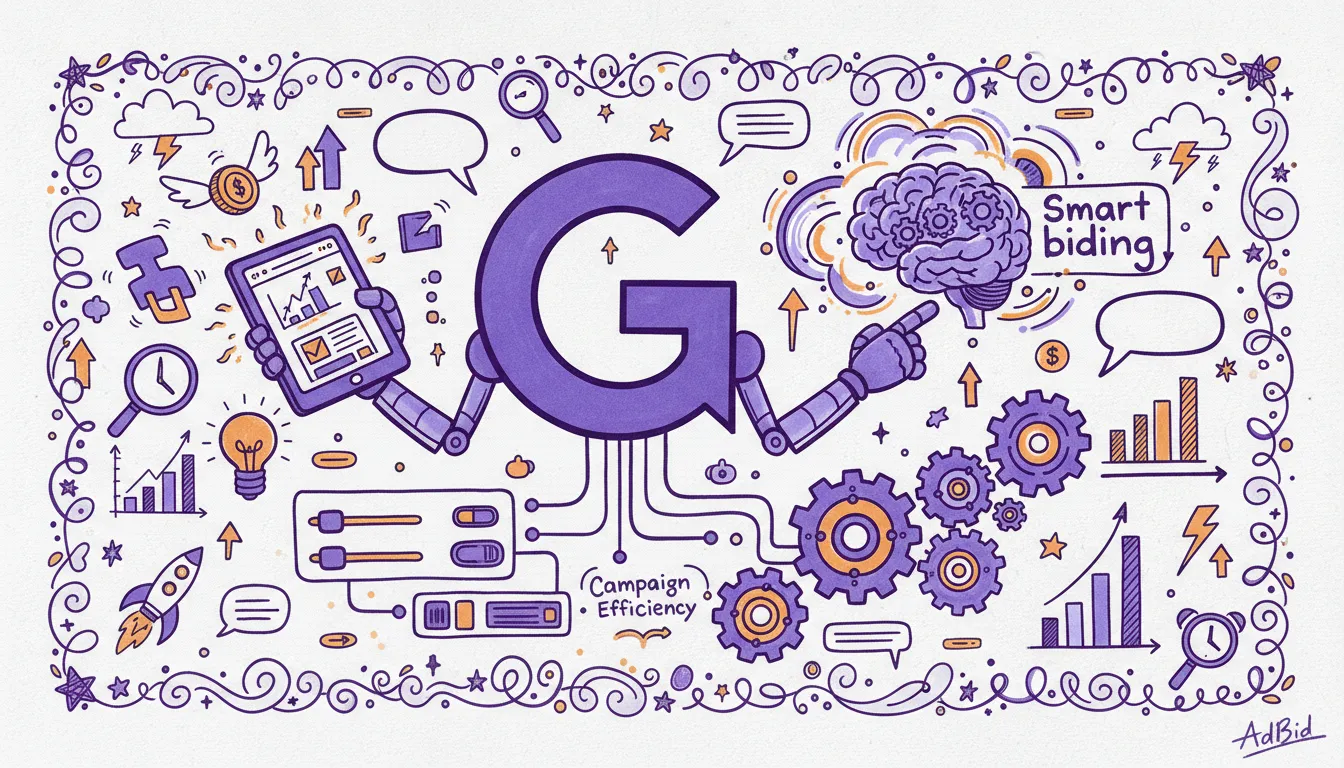
Smart Bidding uses machine learning to set bids for each auction based on the likelihood of a conversion. Instead of one fixed bid, the system adjusts in real time for the specific user, device, time, and context. The four core strategies cover most goals:
- Target CPA: optimizes toward a cost per acquisition you define.
- Target ROAS: chases a return-on-ad-spend ratio, ideal for revenue-driven accounts.
- Maximize Conversions: spends the full budget to win as many conversions as possible.
- Maximize Conversion Value: prioritizes total revenue over raw conversion count.
The catch is that Smart Bidding is only as good as the data feeding it. Weak or misconfigured conversion tracking starves the algorithm of the signals it needs. Get your measurement right first by following our conversion tracking setup guide, then turn the bidding loose.
Performance Max Campaigns
Performance Max is Google's most automated campaign type. It runs across every channel Google owns, including Search, Display, YouTube, Gmail, Discover, and Maps, from a single campaign. You supply assets and goals, and the AI assembles and serves combinations across all that inventory.
The trade-off is control. Performance Max hands creative selection and placement decisions to Google, which speeds setup but reduces visibility into where ads run. To get the most from it without losing the plot, work through our Performance Max guide for 2026 before launching.
Citation capsule: Performance Max consolidates Search, Display, YouTube, Gmail, Discover, and Maps into one AI-driven campaign, trading granular placement control for reach and automation. Advertisers feed it assets and conversion goals, and Google's models handle combination and serving decisions across the full inventory.
What Third-Party Automation Tools Add
Third-party tools fill the gaps Google's native systems leave open, especially around cross-campaign logic, custom alerts, and account-wide rules. Where Smart Bidding optimizes within a strategy, external platforms watch the whole account and act on conditions Google won't surface on its own. They add a layer of guardrails and oversight that protects your spend.
Rules Engines
Rules engines let you define if/then logic that runs automatically. A rule might pause keywords once cost crosses a threshold without conversions, raise bids on top performers, or send an alert when spend spikes. They handle the routine maintenance that's easy to forget and expensive to miss.
AI Optimization Platforms
AI platforms go beyond Google's automation by analyzing patterns across campaigns, accounts, and even external data. They surface insights and recommendations that a single-campaign view misses, and many automate the response too. This is the space where tools like our AI Agents Ads Manager operate, watching your account continuously and acting on anomalies in real time.
Scripts
Google Ads scripts are custom JavaScript that automate tasks the interface can't. Common uses include custom reporting, bulk changes, budget pacing, and weather- or inventory-based bid adjustments. Scripts demand technical skill, but they deliver precise control for needs no off-the-shelf tool covers.
Citation capsule: Third-party automation contributes cross-campaign logic, custom alerting, and account-wide rules that native Google tools omit. Rules engines automate routine maintenance like pausing underperformers, AI platforms add pattern detection across accounts, and scripts deliver bespoke control through custom JavaScript for tasks the standard interface cannot perform.
How Do You Build an Effective Automation Stack?
An effective stack layers native bidding, third-party rules, and AI oversight rather than relying on any single tool. Each layer covers what the others miss: Google handles auction-time bids, rules engines enforce your guardrails, and AI platforms catch the patterns nobody set a rule for. The combination beats any one component used alone.
Start With Clean Data
Every automation layer depends on accurate conversion data. Before activating Smart Bidding or any AI tool, confirm your tracking fires correctly and counts the right actions. Strong Quality Score and reliable measurement give the algorithms the foundation they need to make good decisions.
Give Algorithms Room to Learn
Automated systems need a learning period before they perform. Switching strategies too often resets that learning and wastes the time invested. In practice, teams that let a strategy settle for a couple of weeks before judging it see far steadier results than those who tinker daily.
Layer in Oversight and Guardrails
Automation without monitoring is a recipe for surprise. Set rules and alerts that flag anomalies, then review them regularly. The goal is supervised autonomy: the machines run the routine, and you step in when something looks off. For a deeper walkthrough of optimization workflows, see our PPC optimization complete guide.
Keep Humans on Strategy
The last layer is judgment. Automation handles execution, but humans still own account structure, creative direction, audience strategy, and the calls that require business context. The most successful accounts treat automation as a partner, not a replacement.
Best Practices for Google Ads Automation
A short checklist keeps your automation honest. Practitioners who follow a disciplined process consistently outperform those who flip switches and walk away. Treat these as the operating rules for any automated account:
- Start with high-volume campaigns. Automation needs data, so begin where conversions are plentiful and the algorithm can learn fast.
- Verify tracking before automating. Bad data produces bad bids. Fix measurement first, every time.
- Layer gradually. Add native bidding, then rules, then AI oversight. Introducing everything at once makes problems impossible to diagnose.
- Monitor for anomalies daily. Even fully automated accounts need a human glance to catch what the rules didn't anticipate.
- Document your logic. Write down why each rule and strategy exists, so future reviews aren't guesswork.
Frequently Asked Questions
Is Smart Bidding better than manual bidding?
For most accounts with sufficient conversion volume, Smart Bidding outperforms manual bidding because it adjusts to auction-time signals no human can process in real time. Manual bidding still has a place in very low-volume campaigns or highly specialized situations where data is too thin for the algorithm to learn reliably.
How long does Google Ads automation take to show results?
Automated strategies need a learning period before they stabilize, generally a couple of weeks of consistent data. During this window, performance can swing as the system gathers signals. Avoid changing strategies or budgets mid-learning, since major edits reset the process and delay reliable results.
Do I still need third-party tools if I use Performance Max?
Often, yes. Performance Max automates within Google's ecosystem, but it offers limited visibility and no cross-account logic. Third-party tools add alerting, guardrails, and account-wide rules that protect spend and surface insights Google doesn't expose, making them a useful complement rather than a replacement.
Can automation fully replace a human marketer?
No. Automation excels at execution, real-time bidding, routine maintenance, and pattern detection, but it can't set strategy, judge creative quality, or weigh business context. The strongest accounts pair automated execution with human oversight, letting each focus on what it does best.
Bringing It All Together
Google Ads automation in 2026 isn't a single tool you switch on. It's a layered system where native bidding, third-party rules, AI oversight, and human judgment each play a defined role. Get your conversion data clean first, then build outward: Smart Bidding or Performance Max for auction-time decisions, rules engines for guardrails, and AI platforms for the patterns nobody anticipated. Above all, keep a human watching the whole picture.
Ready to put a unified automation stack to work? Explore the AI Agents Ads Manager to see how continuous, intelligent oversight fits into your account, or jump straight into your dashboard to get started.