
Key Takeaways
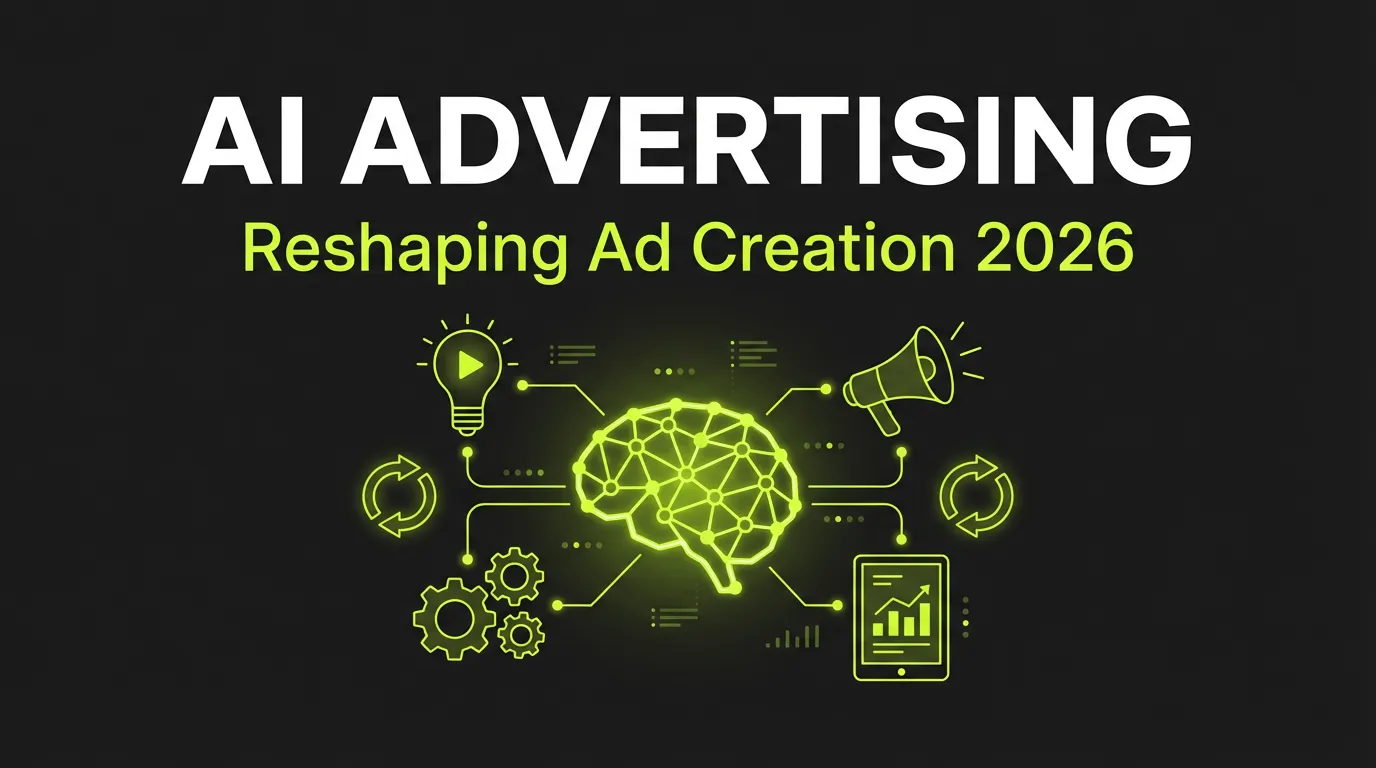
- AI has moved from backend optimization to core creative processes
- Platform tools (Meta, Google) offer free AI creative features
- Third-party tools specialize in video avatars, product visuals, and copy generation
- AI outputs frequently miss brand tone without human guidance
- Asset-level reporting remains limited — you often can't see which AI variations won
The State of AI in Advertising
:::highlight The Shift AI in advertising isn't new — algorithms have optimized bidding and targeting for years. What's new is AI in creative: generating the actual ads you show to customers. :::
Every platform now offers AI creative tools. Third-party tools multiply your options. The question isn't whether to use AI — it's how to use it effectively.
AdBid was built for exactly this workflow: take a look inside to plan, launch, and measure campaigns end to end.
Let me share what I've learned from testing AI creative tools across dozens of campaigns.
Platform AI Tools
Meta's AI Creative Features
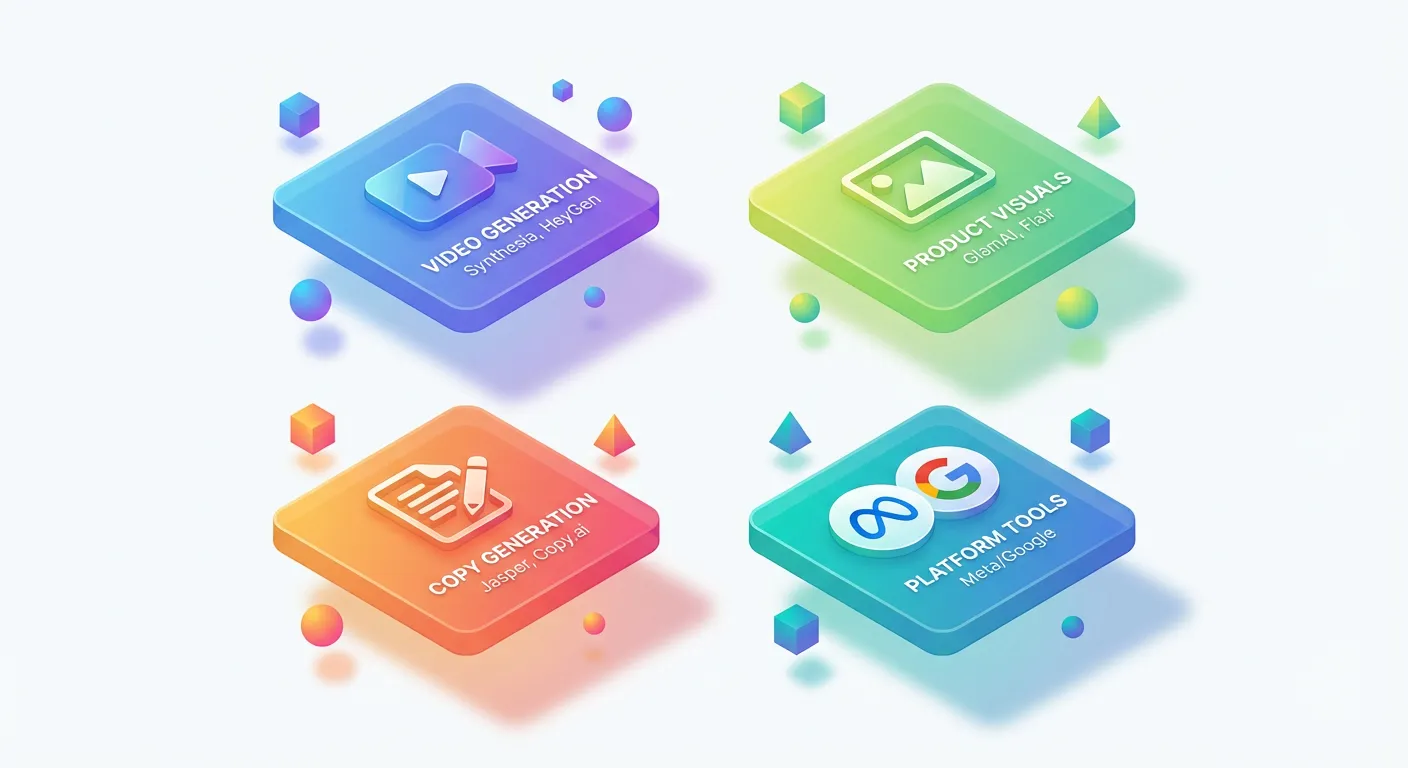
Meta's Advantage+ suite now includes creative generation:
What it does:
- Automatically crops and resizes images
- Adjusts text placement and overlays
- Adds animations to static images
- Generates new image backgrounds
- Creates copy variations from your inputs
:::info Meta AI Reality These tools can increase your creative variations without additional production. But they don't replace strategic creative direction — they multiply what you give them. :::
The limitation: Meta gives limited insight into how creative decisions are made during delivery. You often can't see which AI-generated variation drove results.
Google's AI Creative Features
Google's AI tools across Performance Max, Search, and Demand Gen:
- Suggests headlines and descriptions
- Creates image variations
- Generates missing assets automatically
- Tests combinations at scale
:::warning Google Attribution Gap Like Meta, Google's asset-level reporting remains limited. You may know your campaign performed well but not which specific AI-generated headline drove conversions. :::
Third-Party AI Tools
Specialized tools go beyond platform features:
Video Generation
Mirage Studio, Synthesia, HeyGen:
- Generate videos with AI avatars
- Create spokesperson content without filming
- Localize videos into multiple languages
Best for: Explainer content, testimonials at scale, localization
Product Visuals
GlamAI, Flair.ai, Photoroom:
- Generate product images without photoshoots
- Create lifestyle contexts for e-commerce
- Produce variations for testing
Best for: E-commerce with large catalogs, testing visual concepts before production
Copy Generation
Jasper, Copy.ai, AdCreative.ai:
- Generate ad copy variations
- Predict performance based on patterns
- Create headlines, descriptions, and CTAs at scale
Best for: High-volume testing, overcoming creative blocks, initial ideation
What AI Does Well
Volume and Variation
:::highlight AI's Sweet Spot AI excels at generating variations. If you have a winning concept, AI can create 50 versions to test faster than any human team. :::
Pattern Recognition
AI can identify winning patterns across your historical creative:
- Which words appear in top performers?
- What image styles drive engagement?
- Which CTAs convert best?
Localization
AI translation and localization has improved dramatically:
- Generate ads in multiple languages
- Adapt cultural references
- Scale global campaigns efficiently
Speed
What takes a creative team days, AI can do in minutes. For testing, this speed advantage is significant.
What AI Does Poorly
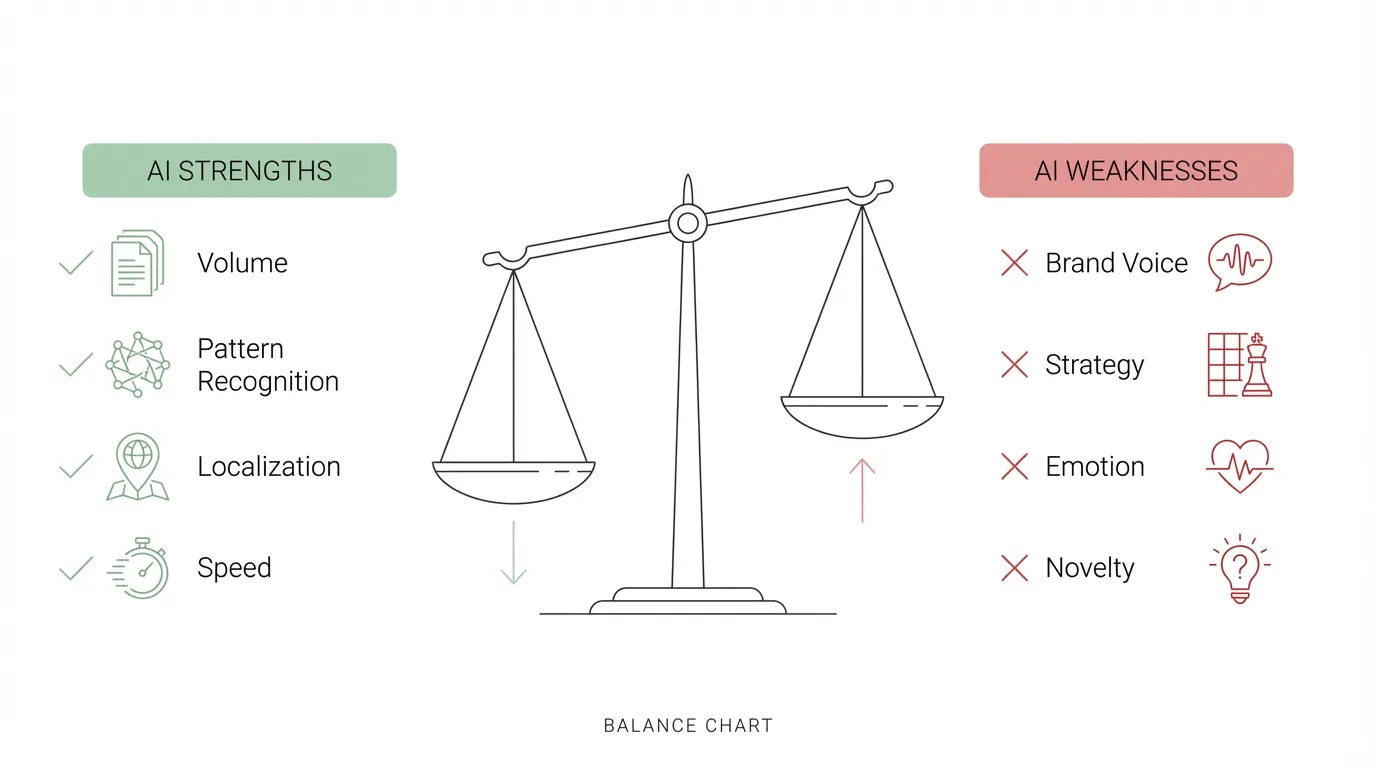
Brand Voice
:::warning The Tone Problem AI-generated copy frequently misses brand voice. As one creative director noted: "The tone of the headlines or descriptions can miss our brand's unique voice." :::
AI learns from general patterns, not your specific brand guidelines. Outputs often feel generic without human refinement.
Strategic Thinking
AI generates content based on patterns. It doesn't understand:
- Your competitive positioning
- Why your audience cares
- Strategic trade-offs
- Brand narrative arcs
Emotional Resonance
The best creative makes people feel something. AI can imitate emotional patterns but rarely creates genuine emotional connection.
Novel Concepts
AI remixes existing patterns. Truly original creative ideas — the kind that break through — still come from human insight.
Integrating AI Into Your Workflow
The Hybrid Approach
Best results come from AI + human collaboration:
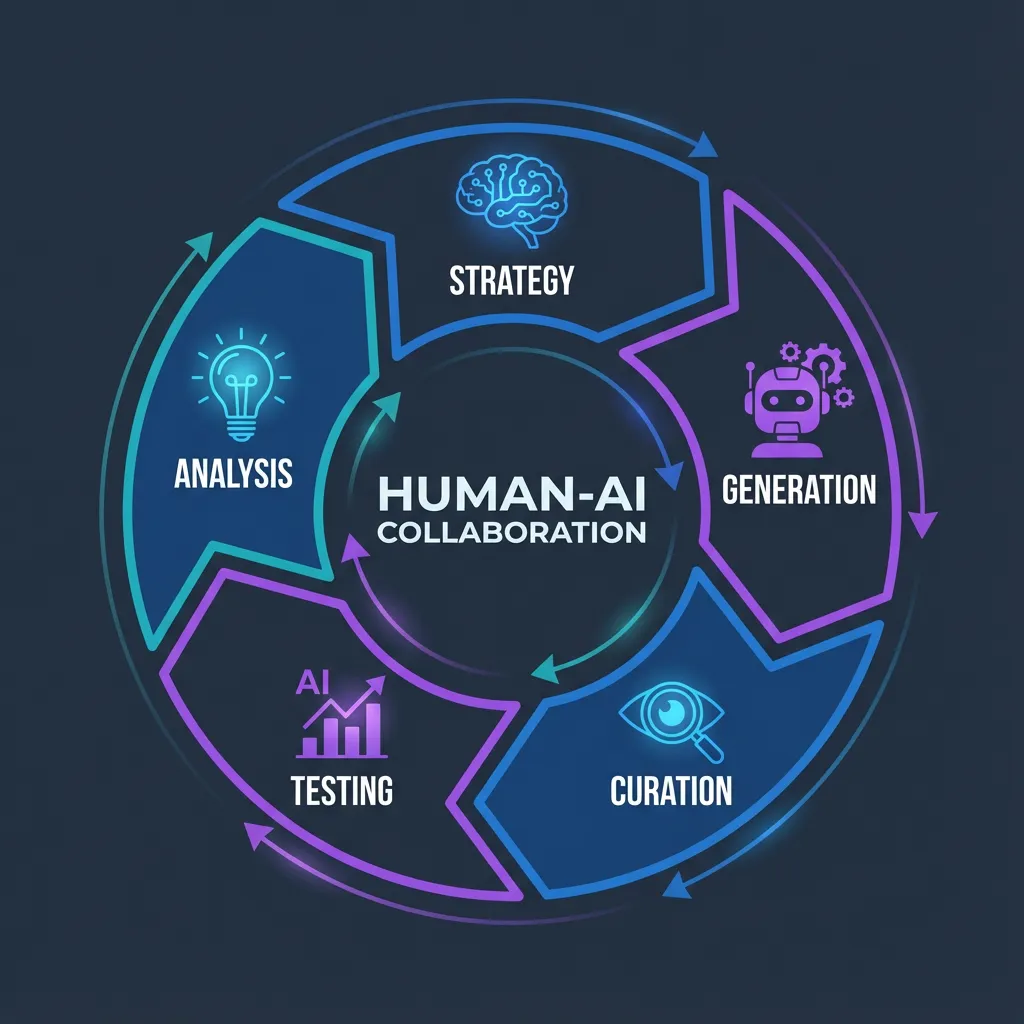
- Strategy (Human): Define objectives, audiences, messaging angles
- Generation (AI): Create variations based on strategic direction
- Curation (Human): Select, refine, and approve AI outputs
- Testing (AI): Deploy variations and optimize at scale
- Analysis (Human): Interpret results and adjust strategy
Where to Start
:::tip Practical Starting Points
- Use platform AI tools for image variations and copy suggestions
- Test one third-party tool for your highest-volume creative need
- Always review AI outputs before deployment
- Track which AI-assisted creative performs vs. human-created :::
Quality Control
Build review into your process:
- Does it match brand voice?
- Are claims accurate and compliant?
- Does it make sense to a human reader?
- Would you be proud to have your name on it?
The Disclosure Requirement
:::warning AI Transparency Meta and other platforms now require disclosure when ads contain AI-generated or AI-manipulated content. Factor this into your workflow. :::
This requirement reflects growing consumer awareness and regulatory interest in AI transparency.
Measuring AI Creative Performance
The Attribution Challenge
Most platforms don't provide clear asset-level attribution for AI-generated variations. You know the campaign worked but not which specific AI variation drove results.
Workarounds
- Run structured tests with AI vs. human creative
- Use separate ad sets for different creative approaches
- Track qualitative feedback alongside performance metrics
The Future Direction
AI creative tools are improving rapidly:
Near-term:
- Better brand voice adaptation
- Improved asset-level reporting
- More sophisticated video generation
Longer-term:
- End-to-end campaign creation
- Automated creative strategy
- Real-time creative optimization
The Bottom Line
AI doesn't replace creative teams — it augments them. The winners use AI for scale and speed while maintaining human oversight for strategy, quality, and brand integrity.
:::tip The Right Mindset Think of AI as a junior creative with unlimited energy and no strategic judgment. It can produce volume, but it needs direction and supervision. :::
The advertisers getting results aren't fully automating creative — they're building workflows that leverage AI's strengths while compensating for its weaknesses.
Want to see how AI-assisted creative performs across your campaigns? AdBid's creative analytics track performance by creative type and source. Try AdBid free for 14 days.