
Part of our Meta Ads Platform guide series.
Turning these tactics into a repeatable acquisition system is where AdBid's AI ads manager earns its keep — planning, launching, and optimizing campaigns in one place.
What Is Meta's Opportunity Score?
Let me save you some confusion right away: Meta's Opportunity Score is NOT a performance metric.
:::warning Common Misconception High Opportunity Score ≠ High Performance. I've seen accounts at 95+ barely break even, while accounts at 40 print money. :::
I've seen too many marketers panic when their score drops to 45, thinking their campaigns are failing. Meanwhile, their ROAS is sitting at a healthy 4x. The disconnect is real, and it matters.
The Opportunity Score is a 0-100 rating that measures how closely your account follows Meta's best practices and recommendations. Think of it as a "compliance score" rather than a "performance score."
"Opportunity score itself does not reflect your actual or future performance (Meta Business Help)." — Meta (Official Documentation)
So why does it exist? It's Meta's way of nudging you toward their automated features — particularly the Advantage+ suite. Nothing wrong with that, but you need to understand what you're measuring.
Where to Find It
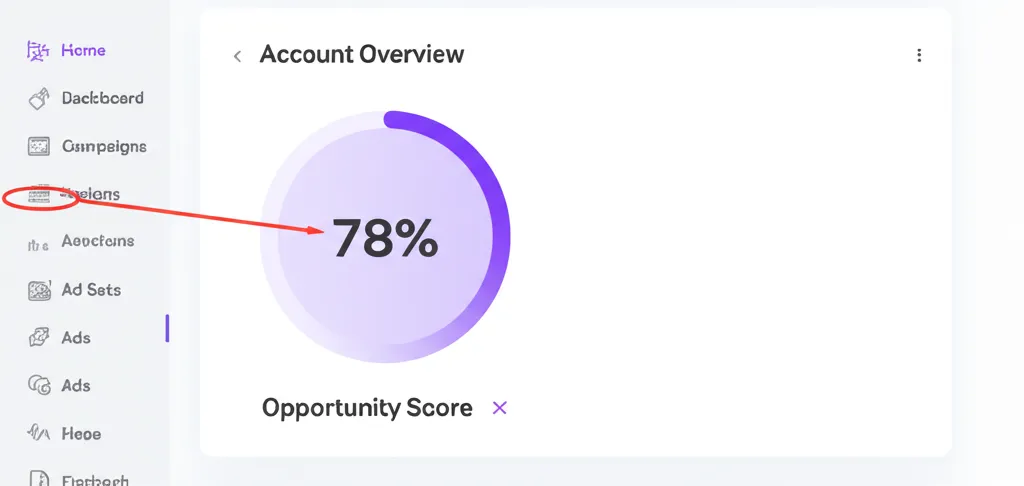
You'll find your Opportunity Score in the Account Overview section of Meta Ads Manager. It appears as a percentage at the top of the page, and you can drill down to see scores at the campaign and ad set levels.
The score updates in real-time as you apply (or ignore) Meta's recommendations.
How the Score Is Calculated
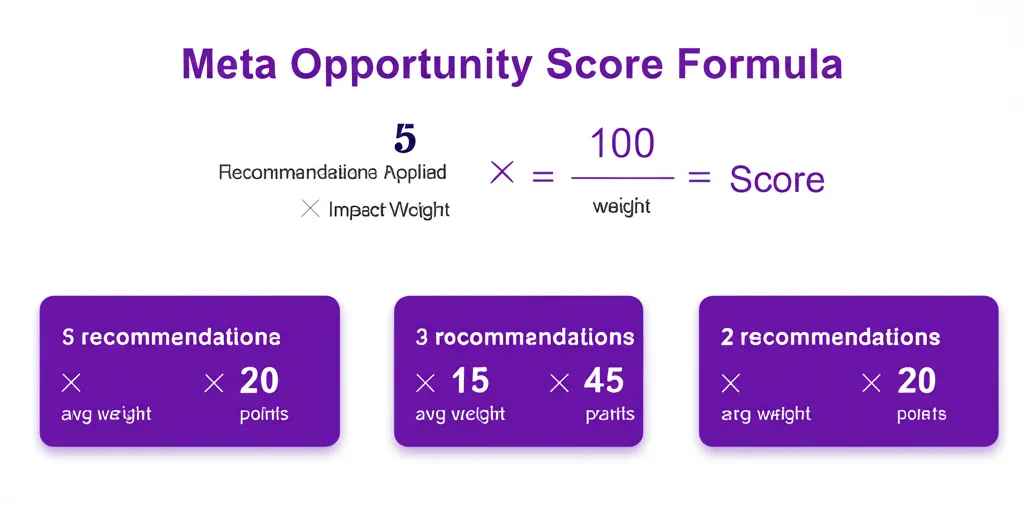
Here's the formula in simple terms:
Your score = How many Meta recommendations you've applied × Their estimated impact weight
Each recommendation has a different point value based on Meta's estimate of its potential performance impact. Apply a high-impact recommendation, your score jumps. Ignore it, it stays flat.
:::highlight Key Insight The algorithm doesn't know your business. It doesn't know your margins, your brand guidelines, or your target audience quirks. It's applying general best practices that work across millions of advertisers — which may or may not apply to you. :::
Understanding Score Ranges
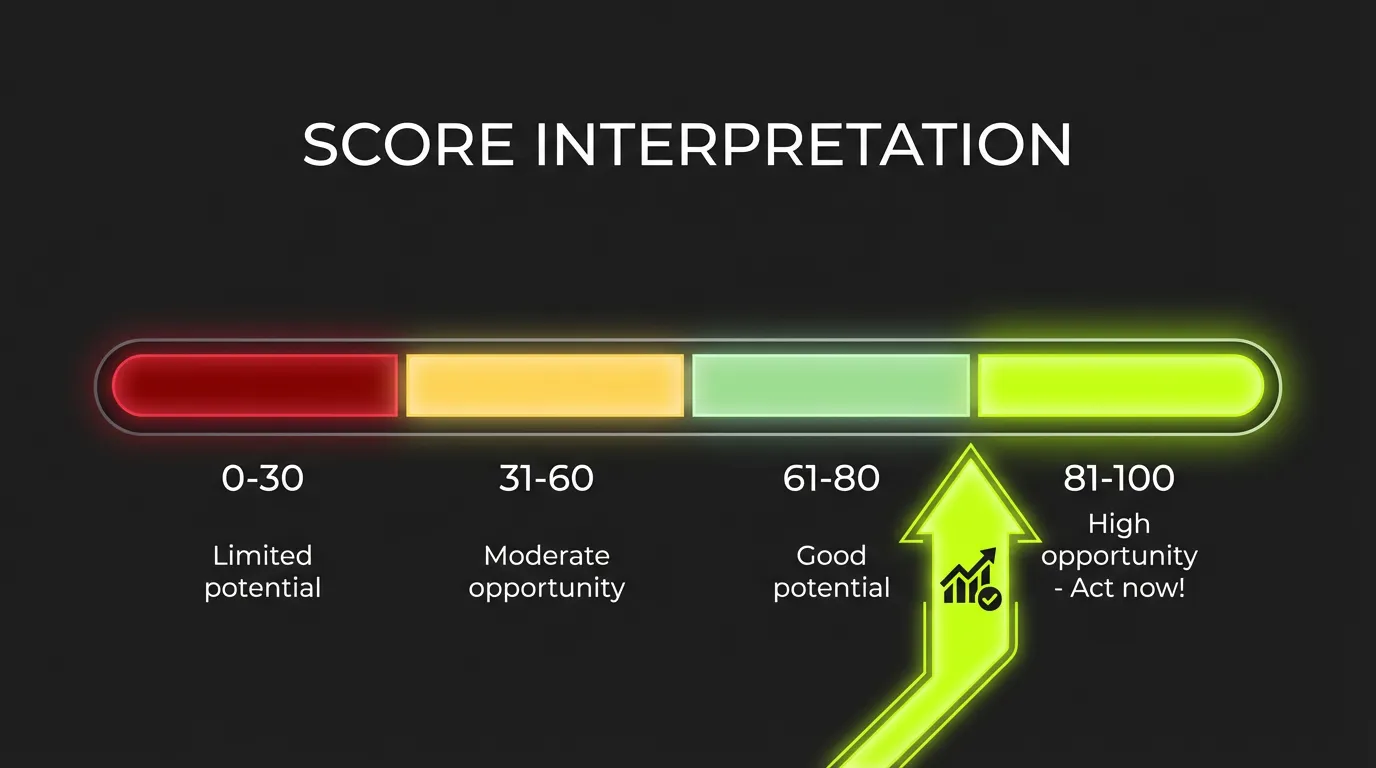
| Score Range | What It Means | My Take |
|---|---|---|
| 90-100 | Following almost all Meta recommendations | You're either new to advertising or very trusting of automation |
| 60-89 | Good alignment with room to optimize | Most experienced advertisers land here |
| 30-59 | Functional but "inefficient" by Meta's standards | Often intentional — niche targeting, specific strategies |
| 0-29 | Significant "gaps" in Meta's view | Could be problematic, or could be deliberate |
The Three Myths That Trip Up Marketers
Myth 1: High Score = High Performance
I've managed accounts with 95+ Opportunity Scores that barely broke even. I've also seen accounts at 40 that were printing money.
"A perfectly optimized campaign structure means nothing if nobody wants what you're selling."
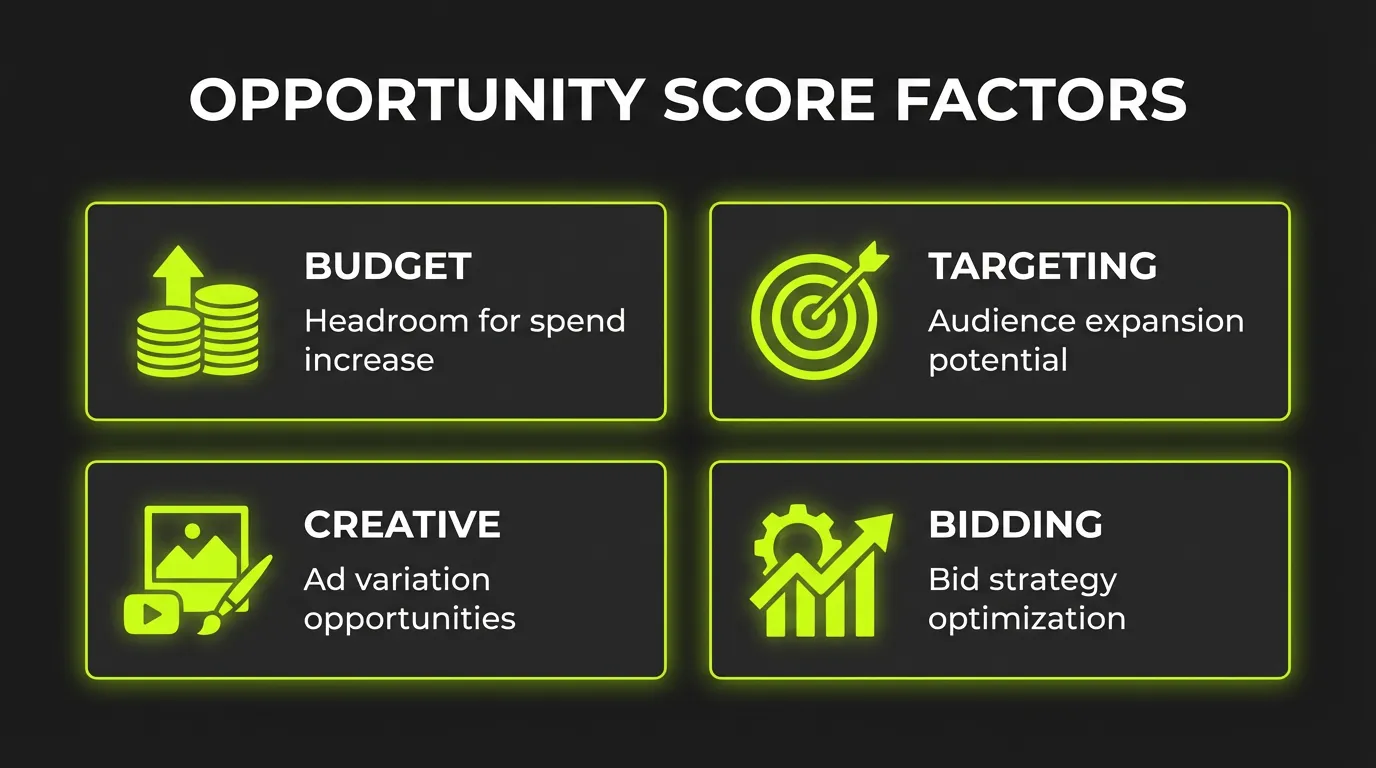
Why? Because the score doesn't account for:
- Your creative quality
- Your offer strength
- Product-market fit
- Landing page conversion rates
- Your actual target audience behavior
Myth 2: Low Score = Bad Campaigns
:::tip When Low Scores Are Intentional If you're running highly targeted B2B campaigns, testing unconventional creatives, deliberately avoiding certain placements, or using manual bidding — your low score might be a feature, not a bug. :::
Sometimes a low score is exactly what you want. Meta's "best practices" may not apply to your specific situation.
Myth 3: You Should Apply Every Recommendation
Meta's recommendations are generated by algorithms that optimize for the average advertiser. But you're not average — you have specific goals, constraints, and context, and your Meta ads automation should reflect them.
:::info Recommendations I Routinely Ignore
- "Expand your audience" when I know my niche converts better
- "Add more placements" when testing shows certain placements tank performance
- "Increase budget" when I'm already at capacity :::
Be selective. Use your judgment.
The Advantage+ Connection
Here's the elephant in the room: most Opportunity Score recommendations push you toward Advantage+ features.
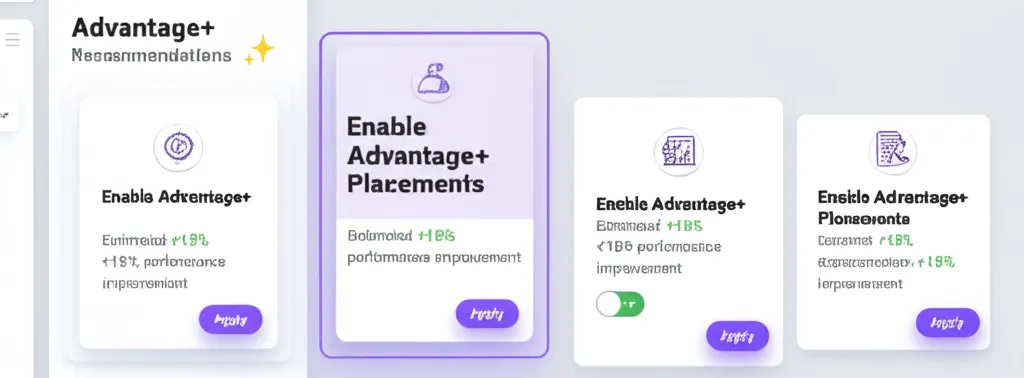
- Advantage+ Placements: Let Meta choose where your ads appear
- Advantage+ Audience: Expand targeting beyond your manual selections
- Advantage+ Campaign Budget: Give Meta full control over budget allocation
- Advantage+ Creative: Let AI modify your creative assets
These features work well for many advertisers, especially those with high volume and broad appeal. But they're not magic, and they're not right for everyone.
:::warning My Rule of Thumb Test Advantage+ features methodically. Run controlled experiments. Don't just enable everything because it boosts your Opportunity Score. :::
Meta's Performance 5 Framework
If you want to actually improve performance (not just your score), focus on these five areas that Meta's internal research supports:
1. Account Simplification
Keep your campaign structure simple. Fewer campaigns with broader targeting gives the algorithm more data to learn from. Meta suggests keeping less than 20% of your budget in learning phase.
2. Creator Content
Branded partnership ads using creator/influencer content consistently outperform traditional branded creative. Real people > polished productions in most cases.
3. Creative Diversification
Vary your formats — Reels, UGC, product shots, lifestyle. Different formats reach different placements and audience segments. This actually prevents ad fatigue more than anything else.
4. Conversions API Quality
:::highlight This Is The Unsexy One That Actually Matters Most Ensure your Pixel AND Conversions API are both sending clean data. Redundancy improves signal quality. Watch your Event Match Quality scores — aim for 6.0 or higher. :::
5. Measurement Validation
Stop trusting last-click attribution blindly. Use Conversion Lift studies when possible. Understand that cross-device journeys make traditional attribution incomplete.
My Optimization Framework
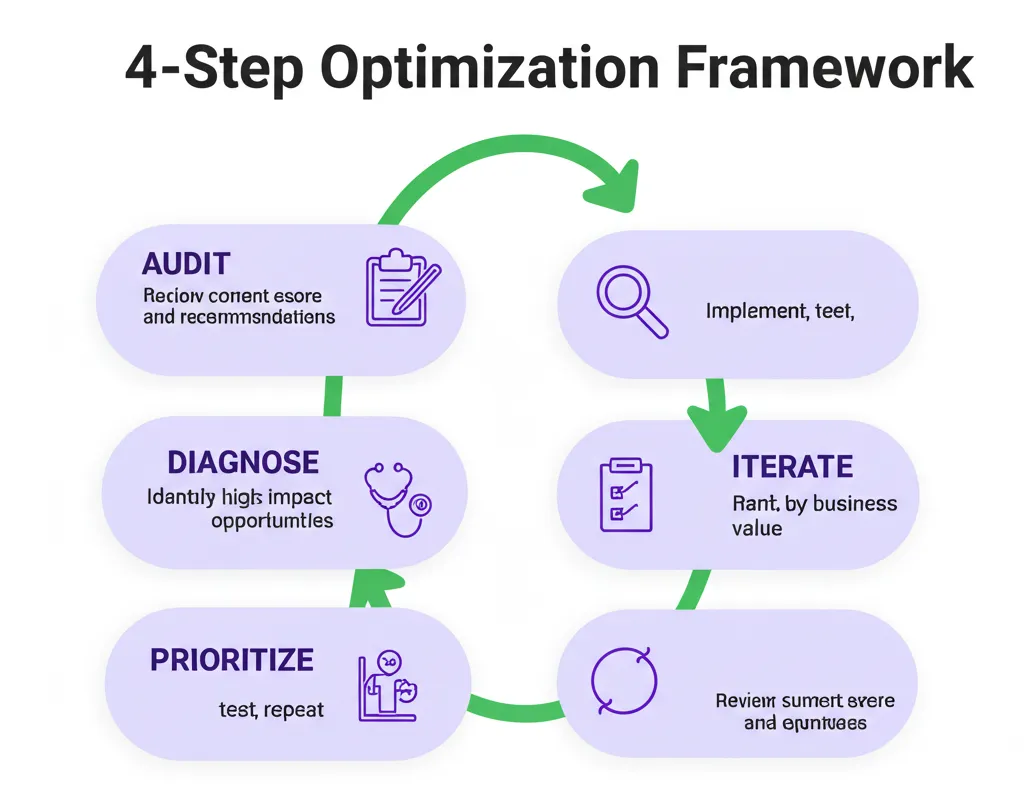
Instead of chasing a higher Opportunity Score, here's how I approach account optimization:
Step 1: Audit
Look at your scores across account, campaign, and ad set levels. Identify patterns. Where are the gaps?
Step 2: Diagnose
For each low-scoring area, ask: Is this a technical issue, a structural choice, or an intentional business decision?
Step 3: Prioritize
Fix data accuracy first. Tracking issues compound everything else. Then address:
- Conversions API and Pixel setup
- Audience overlap issues
- Budget distribution problems
Step 4: Iterate
Test changes one at a time. Give them several days to stabilize. Measure cost per result and conversion rates — not Opportunity Score.
The Bottom Line
Meta's Opportunity Score is a useful health indicator, but it's not the scoreboard that matters.
"Think of it like a fitness tracker that counts your steps. Steps matter, but they're not the same as actual fitness. You can hit 10,000 steps walking in circles and still be out of shape."
Use the Opportunity Score as one input among many. Let it flag potential issues. But always validate against your actual business metrics: ROAS, CPA, revenue, profit.
:::tip Final Thought The algorithm doesn't run your business. You do. Focus on what actually matters — conversions and profit — not a compliance score. :::
Summary
Want to track all your Meta metrics in one place — including Opportunity Score alongside actual performance? Try AdBid free for 14 days and see the full picture.