
Part of our Meta Ads Platform guide series.
Meta Andromeda is the machine-learning ads retrieval engine that Meta introduced in late 2024 to decide which ads are pulled from its inventory for each person on Facebook, Instagram, and Threads. Built on NVIDIA Grace Hopper hardware, it replaced the older retrieval stage with a deep neural network that can evaluate far more candidate ads per request; Meta's engineering team reports a 10,000x increase in model capacity, a 6% improvement in recall, and an 8% improvement in ad quality on selected segments (Engineering at Meta). In practice, Andromeda shifted the job of finding the right audience from the advertiser's targeting settings to the creative itself: the system matches ads to people based on what the ad is, so diverse creative now does the work that lookalikes and interest stacks used to do. This guide explains how Andromeda works, what changed for media buyers, and how to structure campaigns and creative to win under the new rules.
To run this repeatably, AdBid's automated rules let you set conditions once and let campaigns self-optimize.
If you've been running Facebook or Instagram ads in the past few months, you've probably noticed something different. Campaigns that used to crush it with narrow audience targeting are suddenly underperforming. Meanwhile, those "lazy" broad targeting campaigns you dismissed are now outpacing everything else.
Welcome to the Andromeda era.
Meta quietly rolled out Andromeda in late 2024, and it fundamentally changed how ads are selected and delivered across Facebook, Instagram, and Threads. This isn't just another algorithm tweak—it's a complete re-engineering of Meta's ad delivery infrastructure.
In this comprehensive guide, we'll break down exactly what Andromeda is, how it works under the hood, and most importantly, how you can adapt your media buying strategy to thrive in this new landscape.
What Is Meta Andromeda?
Meta Andromeda is a next-generation AI-powered ad retrieval engine designed to transform how ads are selected and delivered to users. Think of it as Meta's new "smart brain" that decides which ad to show to which person—and it does this faster, smarter, and with more precision than ever before.
The Technical Foundation
At its foundation, Andromeda is a machine learning (ML) system built for personalized ads retrieval. According to Meta's engineering blog, Andromeda runs on the NVIDIA Grace Hopper Superchip (Engineering at Meta) to enable cutting-edge ML innovation in their ads infrastructure.
Here's what that means in practical terms:
- Massive processing power: Andromeda can analyze billions of data points in milliseconds
- Deep neural networks: Instead of surface-level signals, it understands complex patterns in user behavior
- Real-time optimization: The system continuously learns and adapts as users interact with content
How It Differs From the Old System
Before Andromeda, Meta's ad delivery worked primarily through a filtering approach:
Old System:
- Take your targeting criteria (demographics, interests, behaviors)
- Filter down to a matching audience
- Run an auction among ads competing for that audience
- Deliver the winning ad
Andromeda System:
- Analyze every user interaction at a granular level
- Build rich behavioral profiles based on pause patterns, engagement signals, time-of-day preferences
- Search through millions of ad candidates to find the most relevant matches
- Deliver hyper-personalized ads that align with individual user preferences
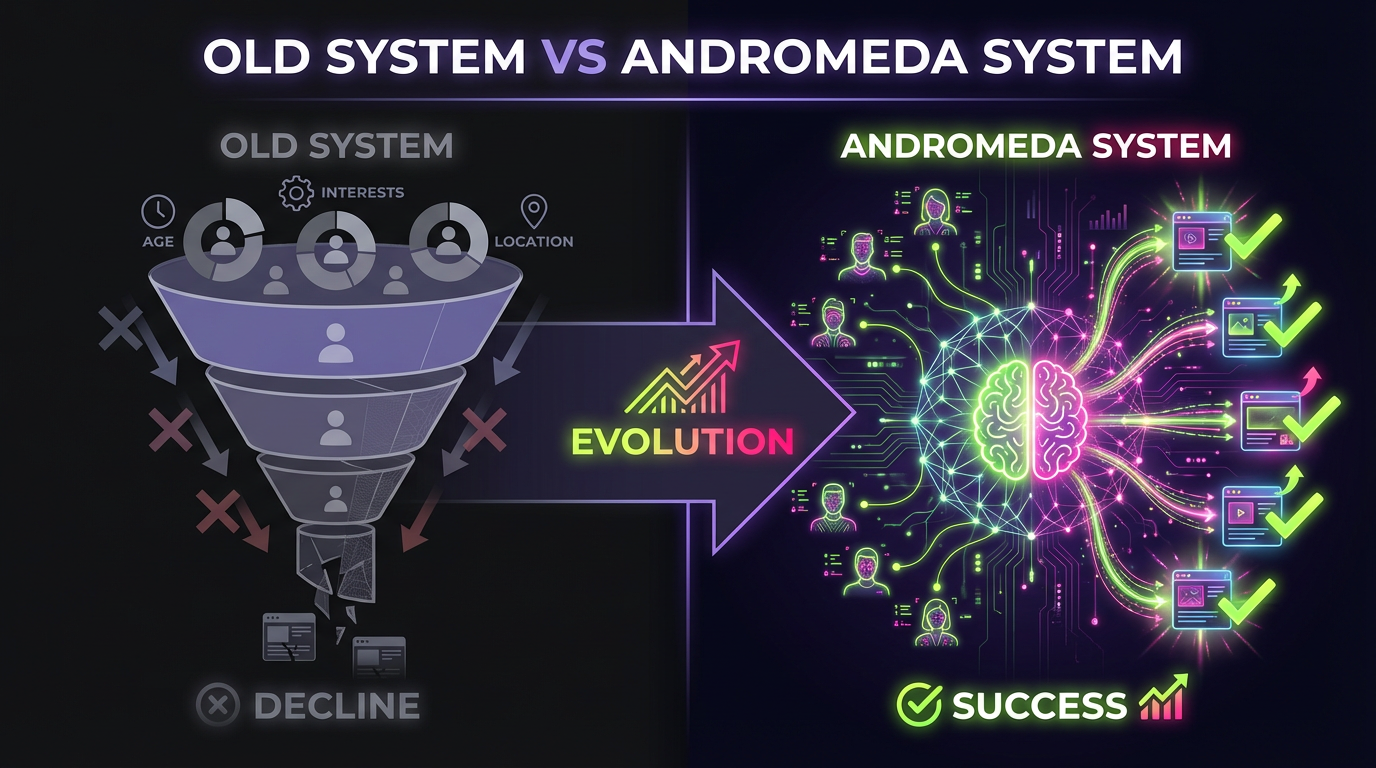
The key shift? Andromeda moves from group-level targeting to individual-level precision. It's no longer about reaching "women 25-34 interested in fitness"—it's about reaching this specific person with this specific creative at this exact moment.
How Andromeda Actually Works
Understanding Andromeda's mechanics is crucial for optimizing your campaigns. Let's break down the four-stage process:
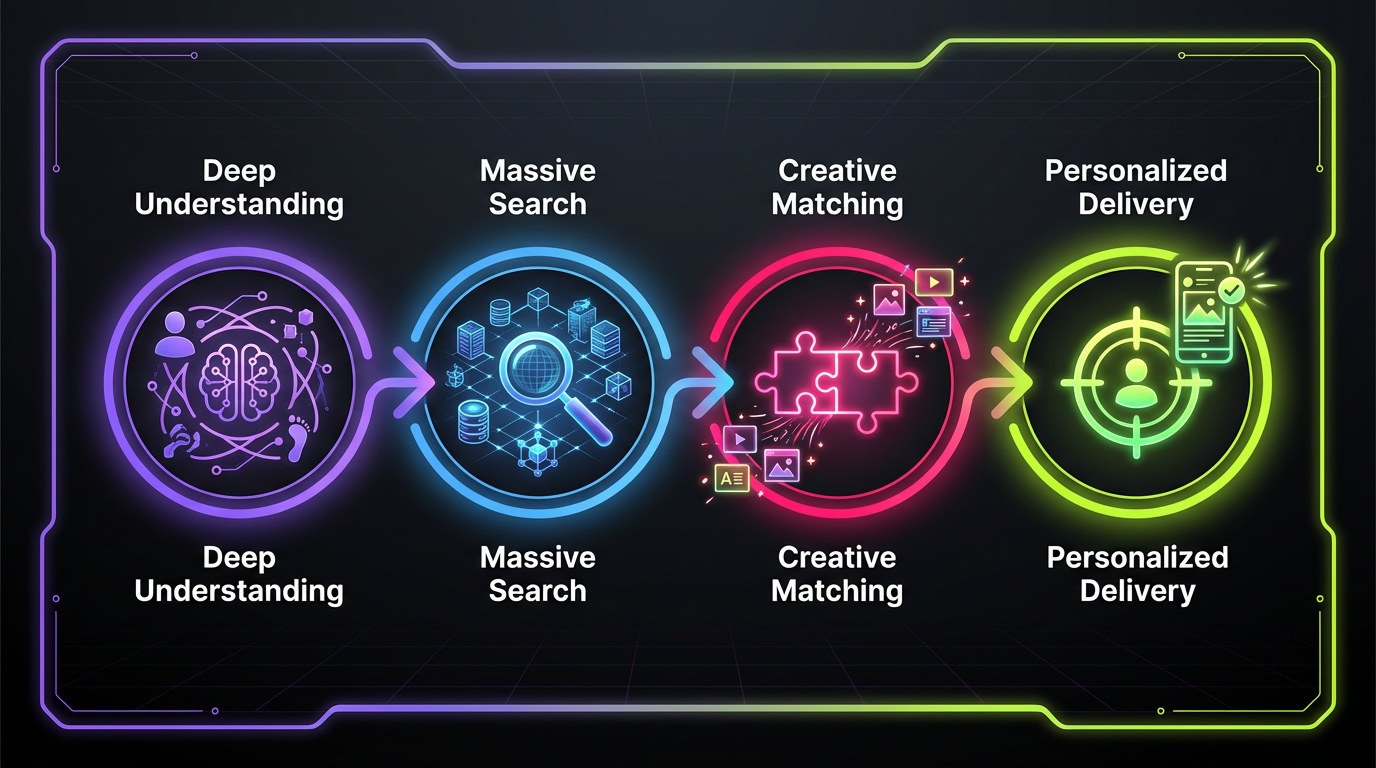
Stage 1: Deep Understanding
Andromeda doesn't just know that a user clicked on a shoe ad. It understands:
- Engagement patterns: What type of content makes them pause scrolling
- Visual preferences: Color schemes, image styles, video formats they respond to
- Temporal behavior: When they're most receptive to different types of messaging
- Emotional context: The tone and sentiment that resonates with them
This creates a multi-dimensional profile that goes far beyond traditional interest-based targeting.
Stage 2: Massive Search
When an ad placement opportunity arises, Andromeda performs a lightning-fast search through its entire ad inventory. We're talking millions of potential ads evaluated in milliseconds.
The system uses hierarchical indexing to efficiently narrow down candidates:
- Broad filtering: Eliminate obviously irrelevant ads
- Relevance scoring: Rank remaining candidates based on predicted engagement
- Quality assessment: Factor in ad quality, landing page experience, and advertiser history
Stage 3: Creative Matching
This is where Andromeda gets interesting—and why creative diversity matters more than ever.
The system analyzes your creatives across multiple dimensions:
- Visual elements: Colors, composition, faces, objects
- Copy tone: Urgency, humor, emotional appeal, technical language
- Format fit: How well the creative suits the placement
- Message alignment: How the value proposition matches user intent
Andromeda then matches these creative attributes to user preferences, essentially finding the creative that "speaks" to each individual user.
Stage 4: Personalized Delivery
The final stage delivers the winning ad with optimal timing. Andromeda considers:
- User's current session context
- Predicted conversion probability
- Auction dynamics and bid competitiveness
- Frequency and fatigue factors
The result? Ads that feel less like interruptions and more like relevant recommendations.
What Changed for Advertisers
Let's be direct about what Andromeda means for your day-to-day media buying:
The Death of Micro-Targeting
Remember spending hours building detailed audience segments? Custom audiences based on website visitors who viewed specific product pages, looked-alike audiences stacked with interest layers, exclusions for previous purchasers?
That granular targeting approach is now largely counterproductive.
Why? Because Andromeda's AI is better at finding your ideal customers than your manual targeting ever was. When you restrict the audience, you're actually limiting Andromeda's ability to discover high-converting users you never would have targeted yourself.
The Rise of Creative-First Strategy
Here's the new reality:
| Old Approach | New Approach |
|---|---|
| Targeting is the main lever | Creative is the main lever |
| Test audiences first | Test creatives first |
| Narrow audiences, broad creatives | Broad audiences, diverse creatives |
| Campaign structure drives performance | Creative diversity drives performance |
Your creative IS your targeting now. Andromeda reads your ads and uses them to find the right people. A fitness-focused creative will be shown to fitness-interested users, regardless of how you set up your targeting.
Advantage+ Integration
Andromeda powers Meta's Advantage+ suite, including:
- Advantage+ Shopping Campaigns: Fully automated catalog campaigns
- Advantage+ Creative: AI-enhanced creative optimization
- Advantage+ Audience: Automated audience expansion
- Advantage+ Placements: Cross-platform placement optimization
If you're not leveraging Advantage+ features, you're fighting against the system rather than with it.
How to Optimize Your Campaigns for Andromeda
Now for the actionable part. Here's how to structure your campaigns for success in the Andromeda era:
1. Embrace Creative Diversity
Lazy variations (changing a color, swapping one word) no longer cut it. Andromeda penalizes creative similarity and rewards genuine diversity.
What counts as diverse creatives:
- Different visual styles (lifestyle vs. product-focused vs. UGC)
- Different messaging angles (benefits vs. features vs. social proof)
- Different formats (static vs. video vs. carousel)
- Different hooks (question vs. statistic vs. bold claim)

Aim for 5-10 genuinely different creative concepts per ad set, not 50 minor variations of the same idea.
2. Simplify Campaign Structure
The optimal structure for Andromeda:
Campaign (CBO - Campaign Budget Optimization)
└── Ad Set 1 (Broad targeting, all placements)
    ├── Creative 1 (Concept A - Video)
    ├── Creative 2 (Concept B - Static)
    ├── Creative 3 (Concept C - Carousel)
    ├── Creative 4 (Concept D - UGC)
    └── Creative 5 (Concept E - Testimonial)
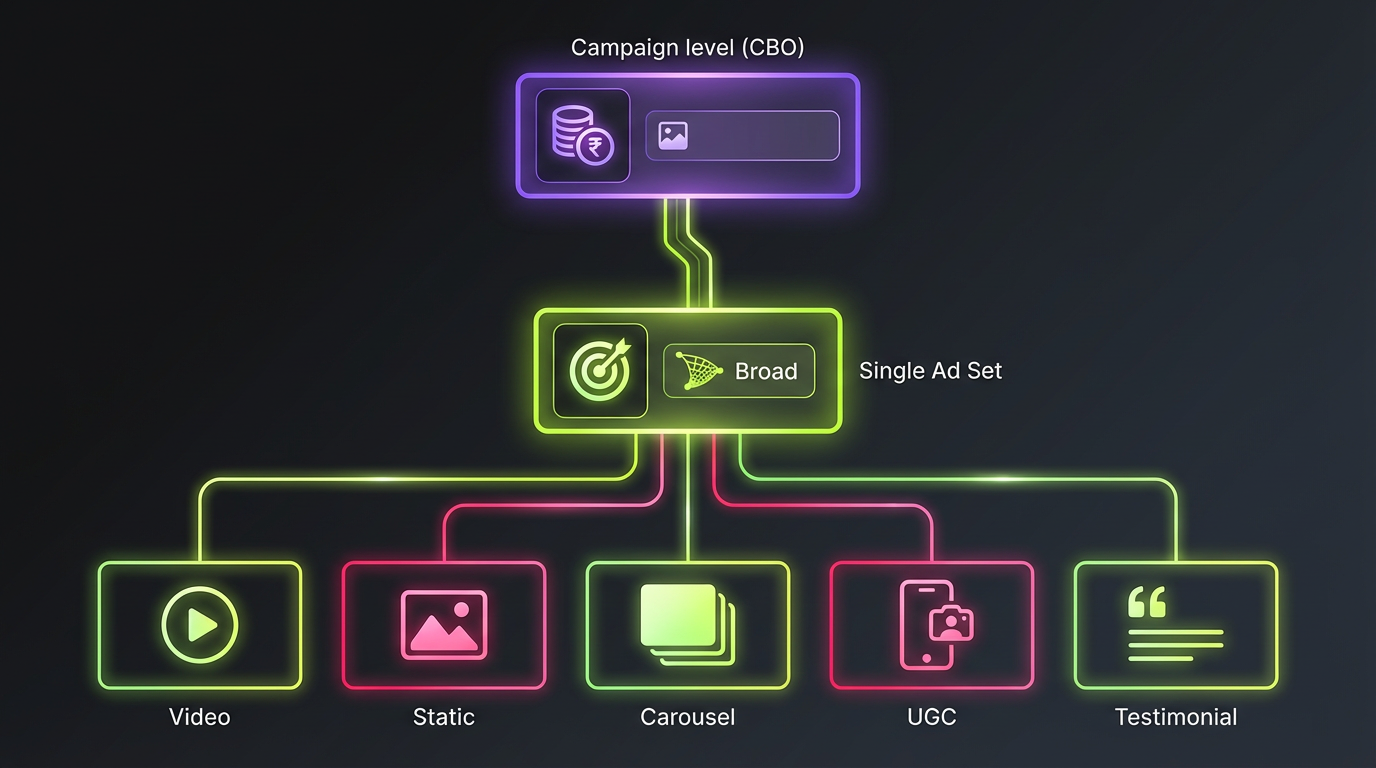
Key principles:
- Use Campaign Budget Optimization (CBO) to let Meta allocate spend
- Keep ad sets broad—avoid audience fragmentation
- Enable all placements (Advantage+ placements)
- Let the AI do the work
3. Test at Scale, Kill Fast
Andromeda requires more creative volume but rewards speed:
- Launch: Deploy 5-10 new creatives weekly
- Analyze: Wait for statistically significant data (usually 1,000+ impressions)
- Kill: Pause underperformers ruthlessly
- Scale: Double down on winners with fresh variations
4. Feed the Algorithm Quality Signals
Andromeda learns from your data. The better your signals, the better its decisions:
- Implement Conversions API (CAPI): Server-side tracking improves data quality
- Define clear conversion events: Focus on valuable actions, not vanity metrics
- Allow adequate learning budget: Aim for 50+ conversions per week per ad set
5. Common Mistakes to Avoid
Over-segmentation: Running 10 ad sets for 10 audiences splits learnings and starves Andromeda of data. Consolidate into 1-3 ad sets maximum.
Premature optimization: Changing things before statistical significance leads to false conclusions. Wait for at least 1,000 impressions and ideally 50+ conversions.
Creative fatigue blindness: Running the same winning creative until it dies wastes budget. Monitor frequency metrics—when frequency exceeds 3-4x, rotate in fresh creatives.
Fighting automation: Overriding Advantage+ recommendations consistently works against the system.
6. Advanced Strategies
Dynamic Creative Optimization (DCO)
Leverage DCO to let Andromeda mix and match elements:
- Upload multiple headlines, images, and descriptions
- Let the AI find winning combinations
- Monitor which elements perform best
Budget Allocation Framework
| Campaign Type | Budget % | Purpose |
|---|---|---|
| Advantage+ Shopping | 50-60% | Core scaling engine |
| Manual Sales | 25-30% | Creative testing ground |
| Retargeting | 10-15% | High-intent capture |
| Brand Awareness | 5-10% | Top-of-funnel seeding |
The Challenge: Why Manual Media Buying Falls Behind
Here's the uncomfortable truth: Andromeda processes more data in one second than a media buyer can analyze in a month.
The Scale Problem
Consider what Andromeda evaluates for a single ad delivery:
- User's behavioral history across billions of interactions
- Real-time context of the current session
- Creative attributes across multiple dimensions
- Auction dynamics among competing advertisers
- Predictive models for engagement and conversion
A human media buyer—no matter how skilled—cannot match this level of analysis at scale.
The Speed Problem
Andromeda makes decisions in milliseconds and learns continuously. Meanwhile:
- Manual campaign analysis typically happens daily or weekly
- A/B tests take days or weeks to reach significance
- Creative iteration cycles span weeks or months
By the time you've identified a trend and acted on it, the algorithm has already adapted.
How AdBid Beats Andromeda at Its Own Game
So how do you compete with an AI that processes billions of signals 24/7?
You fight AI with AI.
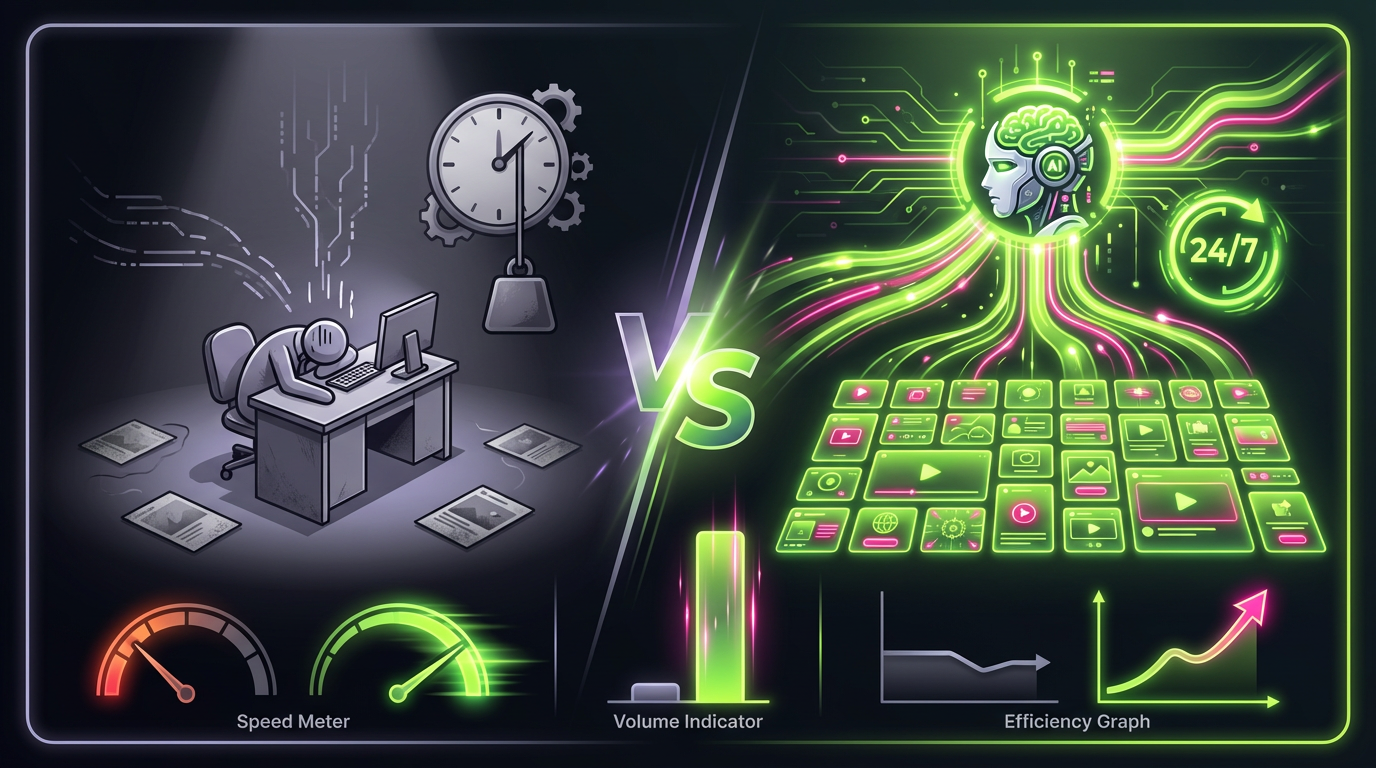
This is exactly why we built AdBid—an ML-powered platform designed to work with Andromeda's logic, not against it.
AdBid's Approach: Speaking Andromeda's Language
AdBid's core technology mirrors how Andromeda thinks:
1. Embedding-Based Creative Analysis
Just like Andromeda breaks down creatives into dimensional attributes, AdBid analyzes every creative through advanced embeddings:
- Visual embeddings capture colors, composition, objects, faces, emotions
- Text embeddings analyze hooks, CTAs, messaging tone, persuasion angles
- Performance embeddings correlate creative attributes with conversion outcomes
The result? AdBid understands why certain creatives perform—not just that they perform.
2. AI-Powered Creative Generation
Armed with embedding intelligence, AdBid automatically generates new creative variants optimized for Andromeda's preferences:
- Identifies winning creative attributes from your top performers
- Generates new concepts that combine proven elements in fresh ways
- Produces the creative diversity Andromeda rewards—at scale
3. 24/7 Campaign Intelligence
While you sleep, AdBid monitors:
- Real-time performance across every metric and dimension
- Creative fatigue signals before they tank your campaigns
- Anomaly detection for spend, CPA, ROAS fluctuations
- Budget pacing and allocation optimization
4. Massive Parameter Analysis
AdBid processes the same complexity that makes manual optimization impossible:
- Hundreds of creative variations analyzed simultaneously
- Thousands of audience-creative-placement combinations evaluated
- Performance correlations across time periods, devices, and contexts
- Predictive modeling for future performance
Real-World Impact
Creative Production:
- Manual: 5-10 new creatives per month
- AdBid: 50+ data-optimized variants per week
Performance Analysis:
- Manual: Daily/weekly spreadsheet reviews
- AdBid: Real-time monitoring with instant alerts
Optimization Speed:
- Manual: Changes implemented in days
- AdBid: Automated responses in minutes
The math is simple: Andromeda rewards advertisers who can iterate faster, test more, and optimize in real-time. That's exactly what AdBid's Meta ads automation delivers.
Conclusion: Adapt or Fall Behind
Meta Andromeda represents the biggest shift in paid social advertising since the introduction of lookalike audiences. The rules have fundamentally changed:
Key Takeaways:
- Creative is now king: Your ads are your targeting
- Simplify campaign structure: Let the AI do the heavy lifting
- Embrace automation: Advantage+ features work with Andromeda
- Diversify creatives: Genuine variety, not lazy iterations
- Fight AI with AI: Manual optimization can't keep pace
Andromeda isn't going away—it's just getting smarter. Advertisers who adapt will thrive. Those who cling to outdated targeting-first strategies will watch their CPAs climb and ROAS decline.
Ready to beat Andromeda at its own game? Try AdBid and see how AI-powered media buying transforms your campaign performance.