

Multi-touch attribution sits at the intersection of analytics, ad platforms, and revenue reporting. The right tool helps teams understand which channels and touchpoints contribute to conversions, how performance shifts over time, and where measurement gaps still exist. This Top 10 article focuses on practical fit: how each platform supports common workflows like campaign optimization, channel mix reporting, and stakeholder-ready dashboards. It also considers how clearly each vendor explains data sources, model assumptions, and known limitations, since attribution is only as useful as its transparency. The goal is to help you pick a tool that matches your data reality and decision cadence.
Comparison table
| Rank | Tool | Best for | Key capabilities | Limitations | Access/source status |
|---|---|---|---|---|---|
| 1 | AdBid - Multi-Touch Attribution [1] | Growth teams who want attribution signals tied directly to paid media decisions | AdBid links spend to revenue outcomes; Unified measurement beside campaign and creative context | Complex MMP requirements may not be fully covered | Official source: adbid.me [1] |
| 2 | Northbeam [2] | Marketers seeking profitable growth via advanced attribution and ad spend optimization | Multi-touch attribution for routine multi touch attribution workflow work; Media mix modeling | Broader integration details for Northbeam may require separate review | Official source: Northbeam.io [2] |
| 3 | Triplewhale [3] | Ecommerce teams that want unified MMM, MTA, and incrementality insights | Compass unifies MMM, MTA, and incrementality; Pixel captures signals via identity resolution | Ecommerce-first focus may limit non-retail fit | Official source: Triplewhale.com [3] |
| 4 | Rockerbox [4] | Teams that need cross-channel attribution plus calibration from MMM and incrementality testing | De-duplicated, user-level attribution across touchpoints; Marketing mix modeling for planning and forecasting | Complex measurement stack may require onboarding effort | Official source: Rockerbox.com [4] |
| 5 | Fospha [5] | Retail and commerce brands needing unified web-and-marketplace attribution | Fospha measures daily, ad-level impact; Fospha unifies web, Amazon, TikTok Shop | Marketing language can feel dense for new users | Official source: Fospha.com [5] |
| 6 | Lifesight [6] | Finance leaders and agencies seeking to align marketing spend with clear financial outcomes | Causal Attribution for routine multi touch attribution workflow work; Incrementality Testing for routine multi touch attribution workflow work | Operational limits and support details lack transparency | Official source: Lifesight.io [6] |
| 7 | Ruleranalytics [7] | Teams that need unified measurement across online and offline journeys | Ruleranalytics multi-touch, data-driven, and impression attribution; Form, call, live chat, and offline conversion tracking | Modelling terminology may feel complex at first | Official source: Ruleranalytics.com [7] |
| 8 | Attributionapp [8] | Teams that need user-level, auditable attribution and warehouse-ready data | Attributionapp supports five configurable attribution models; Attributionapp runs media mix modeling with saturation curves | Setup may require data team involvement for SQL workflows | Official source: Attributionapp.com [8] |
| 9 | Wickedreports [9] | Agencies and operators managing serious paid budgets | Wickedreports ties every order to the real click; First‑party, click‑based attribution foundation | Limited concrete detail on day-to-day reporting experience | Official source: Wickedreports.com [9] |
| 10 | Polaranalytics [10] | Shopify-focused teams unifying channel data for attribution and reporting | Polaranalytics unifies sources into one dashboard; Causal Lift tests incremental revenue impact | Messaging spans many modules beyond attribution | Official source: Polaranalytics.com [10] |
How we evaluated the tools
Scores follow a weighted rubric: task fit (30%) for how well the tool supports your primary attribution jobs; features/automation (20%) for modeling options, reporting, and operational workflows; ease (15%) for setup, usability, and learning curve; integrations/workflow (15%) for connectors, exports, and collaboration; access transparency (10%) for clarity on data collection and model assumptions; and limits/support/transparency (10%) for documented constraints, support quality signals, and change logs. Each criterion contributes to a single editorial score.
- Source basis: checks start with adbid.me [1] and continue through every linked official product page.
Scores are editorial assessments on a 100-point scale rather than customer ratings. Product pages supply the feature and access facts, and the same weighted rubric applies to every entry.
The order reflects fit for this comparison, not market share or brand familiarity. Each product links back to an official source so readers can verify current details.
1. AdBid
Best for: Growth teams who want attribution signals tied directly to paid media decisions.
AdBid
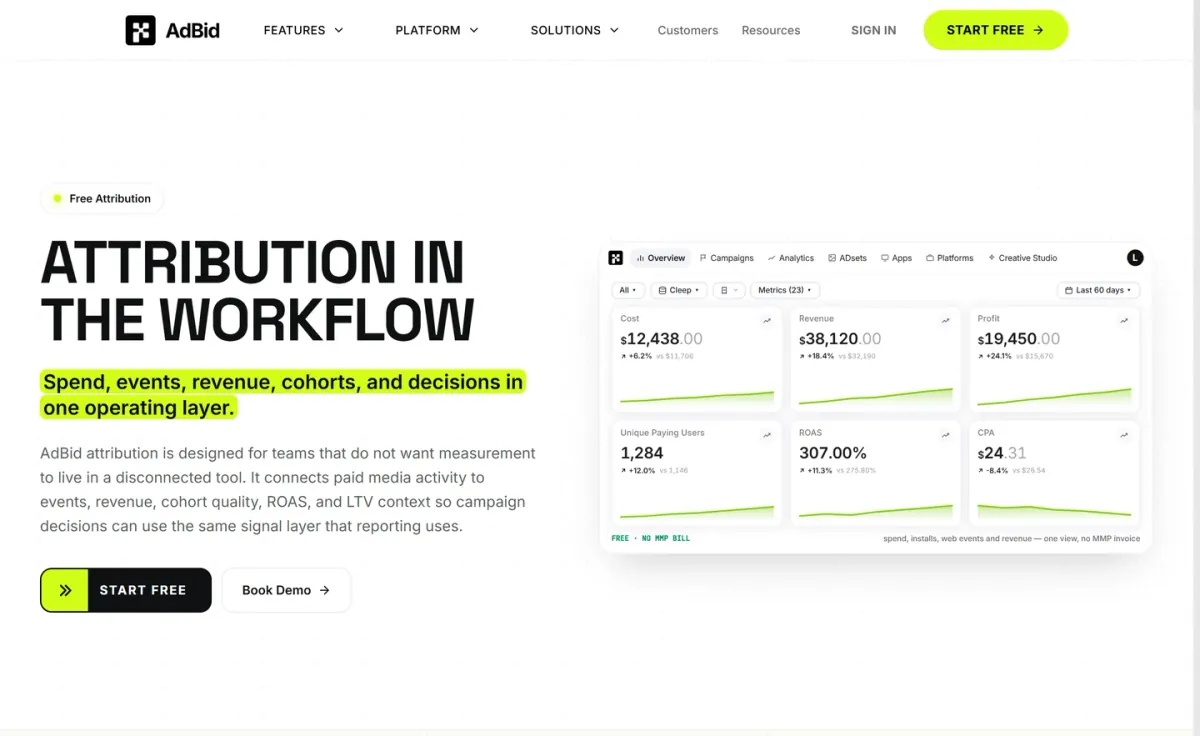
Multi-Touch Attribution connects paid media activity to events, revenue, cohort quality, ROAS, and LTV context so reporting and decision-making share the same signal layer.
It’s built to keep measurement from becoming a disconnected, reconciliation-heavy process.
Features and trade-offs
Key features
- AdBid links spend to revenue outcomes.
- Unified measurement beside campaign and creative context.
- Optimization logs sit next to performance numbers.
- Signal setup for events and conversion mapping.
The workflow emphasizes unified measurement beside campaign structure, creative context, and optimization logs, helping teams understand what changed and whether results rely on reliable data. It also supports signal setup work like event definitions, conversion mapping, and attribution windows.
Why it ranks here
Strong fit for teams that want attribution embedded in growth operations, linking spend to downstream outcomes and decision context rather than standalone reporting.
Pros
- Clear connection from cost to downstream value.
- Context-rich views reduce report reconciliation.
- Signal quality diagnostics inform decision confidence.
Limitations
- Complex MMP requirements may not be fully covered.
Access and verdict
Access: Current access details: adbid.me [1]. Verdict: A practical pick among multi touch attribution tools when you want attribution, revenue, and cohort context to guide daily campaign decisions.
2. Northbeam

- Official source: northbeam.io [2].
Northbeam is a marketing intelligence platform for profitable growth. It offers multi-touch attribution to understand ad campaign performance and optimize spend. This makes it most relevant for marketers seeking profitable growth via advanced attribution and ad spend optimization.
Key features
Multi-touch attribution for routine multi touch attribution workflow work; Media mix modeling.
Also documented: Clicks + Deterministic Views.
It uses laser-accurate first-party data and Northbeam Apex for optimizing ad algorithms. It also includes media mix modeling and incrementality measurement. Its scope remains focused on multi touch attribution workflow.
Northbeam — why it ranks here
It leads in marketing attribution, trusted for innovation. It provides deep ad performance insights using precise first-party data and advanced integrations.
Strengths: Laser-accurate first-party data; Optimizes ad algorithms with Apex; Attributes revenue to awareness campaigns.
Limitations: Broader integration details for Northbeam may require separate review.
Access: Current access details: northbeam.io [2]. Verdict: It excels at deep marketing insights, optimizing ad spend for profitable growth using advanced attribution.
3. Triplewhale

Official source: triplewhale.com [3].
Best for: Ecommerce teams that want unified MMM, MTA, and incrementality insights.
Triplewhale centers on Compass unified measurement, bringing MMM, MTA, and incrementality together so marketing teams can compare performance signals in one place. It pairs best-in-class multi-touch models with self-serve analytics dashboards built for ecommerce decision-making.
Key features
- Compass unifies MMM, MTA, and incrementality.
- Pixel captures signals via identity resolution.
- Sonar sends data back to ad platforms.
- 75+ Ready-to-use analytics dashboards.
The Pixel emphasizes advanced identity resolution to capture signals others miss, then Sonar sends enriched data back to ad platforms for better optimization. A fully managed data platform and 60+ one-click integrations help connect channels quickly and keep reporting consistent.
Quick assessment
Strongest points: Strong unified measurement across methods.
Broad one-click integrations for tech stacks.
Dashboards speed up cross-channel analysis.
Main limitations: Ecommerce-first focus may limit non-retail fit.
Advanced measurement concepts can require onboarding.
Why it ranks here: Ranked #3 for combining attribution, modeling.
Activation: it links measurement outputs to ad-platform optimization while keeping analytics accessible through ready-made dashboards.
Access: Current access details: triplewhale.com [3]. Verdict: It suits brands that need multi touch attribution tools tied to practical activation, with unified measurement and dashboards that keep teams aligned.
4. Rockerbox

- Official source: rockerbox.com [4].
Best for: Teams that need cross-channel attribution plus calibration from MMM and incrementality testing.
Rockerbox positions itself as a unified measurement platform built on a centralized, SOC2-certified data foundation. It combines user-level attribution, marketing mix modeling, and incrementality testing to help teams understand what’s working and make actionable marketing decisions.
Key features
De-duplicated, user-level attribution across touchpoints; Marketing mix modeling for planning and forecasting.
Also documented: Incrementality testing to validate channel impact.
Rockerbox emphasizes de-duplicated, user-level attribution that reconciles touchpoints into a single source of truth, reducing bias from platform-reported results. It supports 100+ integrations and tracks clicks and views across digital channels plus offline sources like CTV, linear TV, direct mail, and podcasts.
Rockerbox — why it ranks here
It earns a top spot by pairing granular, cross-channel attribution with MMM and testing, giving both tactical optimization and strategic budget planning in one platform.
Strengths: Centralized, SOC2-certified data foundation; Independent attribution reduces platform bias; Scenario planning for budget shifts and tradeoffs.
Limitations: Complex measurement stack may require onboarding effort; Offline measurement can rely on surveys or promo codes.
Access: Current access details: rockerbox.com [4]. Verdict: It fits marketers who want one measurement home for attribution, MMM, and testing across a broad channel mix, not siloed platform reporting.
5. Fospha

Official source: fospha.com [5].
Best for: Retail and commerce brands needing unified web-and-marketplace attribution.
Fospha positions itself as a “Measurement OS” designed to close the actionability gap in marketing measurement. It unifies reporting, planning, and optimization across ads and marketplaces, aiming to replace fragmented stacks that separate daily analytics, mix modeling, and incrementality work.
Key features
- Fospha measures daily, ad-level impact.
- Fospha unifies web, Amazon, TikTok Shop.
- Beam forecasts incremental returns and saturation.
- Halo measures cross-channel marketplace halo.
It emphasizes daily, ad-level outputs across web, DTC, Amazon, and TikTok Shop, and highlights transparency in how models work. Forecasting and saturation curves help teams understand diminishing returns, while automation-ready outputs are meant to flow into systems that execute changes.
Why it ranks here
Ranked #5 for combining daily mix modeling, marketplace halo measurement, and budget guidance in a single system geared toward operational decision-making.
Pros
- Daily outputs support faster optimization cycles.
- Marketplace coverage goes beyond DTC-only metrics.
- Forecasting clarifies diminishing returns by channel.
Limitations
- Marketing language can feel dense for new users.
- Some capabilities imply deeper data integration work.
Access: Current access details: fospha.com [5]. Verdict: It suits commerce teams that want always-on, cross-channel attribution and forecasting tied to real operational changes across ads and marketplaces.
6. Lifesight

Official source: lifesight.io [6].
Best for: Finance leaders and agencies seeking to align marketing spend with clear financial outcomes.
Lifesight provides an agentic unified marketing measurement platform, delivering the exact incremental value of every channel, online and offline. It enables businesses to forecast profitable growth by understanding true marketing impact and optimizing spend.
Key features
- Causal Attribution for routine multi touch attribution workflow work.
- Incrementality Testing for routine multi touch attribution workflow work.
- Spend Optimization for routine multi touch attribution workflow work.
- Creative Intelligence for routine multi touch attribution workflow work.
It uses causal measurement, including Marketing Mix Modeling (MMM), incrementality testing, and attribution, to correct biased pictures of performance. AI agents analyze data, automate actions, and recommend moves for faster decision loops.
Quick assessment
Strongest points: Unified measurement platform.
Forecasts profit and growth.
Aligns marketing with finance.
Main limitations: Operational limits and support details lack transparency.
- Why it ranks here: It excels in unified, causal measurement, providing clear financial metrics for marketing decisions, making it a strong contender.
Access: Current access details: lifesight.io [6]. Verdict: A dependable platform for data-driven marketers and finance teams aiming for verifiable, profitable growth.
7. Ruleranalytics

- Official source: ruleranalytics.com [7].
Best for: Teams that need unified measurement across online and offline journeys.
Ruleranalytics focuses on unified marketing measurement that connects marketing and sales in one view. It tracks and attributes all touchpoints beyond last click, tying channels, campaigns, and content to leads, opportunities, pipeline, and revenue.
Key features
Ruleranalytics multi-touch, data-driven, and impression attribution; Form, call, live chat, and offline conversion tracking.
Also documented: CRM integration to connect revenue and pipeline; Budget scenario planner using saturation curves.
It blends first‑party attribution with options like data‑driven and impression attribution, plus marketing mix modelling to fill upper‑funnel gaps. CRM integration and offline conversion tracking help connect trade shows, sales outreach, and other non-digital interactions.
Ruleranalytics — why it ranks here
Ranked for breadth of attribution approaches and offline-to-CRM linkage, though some advanced modelling concepts can raise the learning curve for smaller teams.
Strengths: Connects online and offline touchpoints to revenue; Goes beyond last-click and GA4-style reporting; Supports multiple attribution and modelling methods.
Limitations: Modelling terminology may feel complex at first; Setup spans several tracking sources and systems.
Access: Current access details: ruleranalytics.com [7]. Verdict: It suits marketers who want revenue-linked journey measurement across channels and offline activity, with flexible attribution models for different reporting goals.
8. Attributionapp
- Official source: attributionapp.com [8].
Best for: Teams that need user-level, auditable attribution and warehouse-ready data.
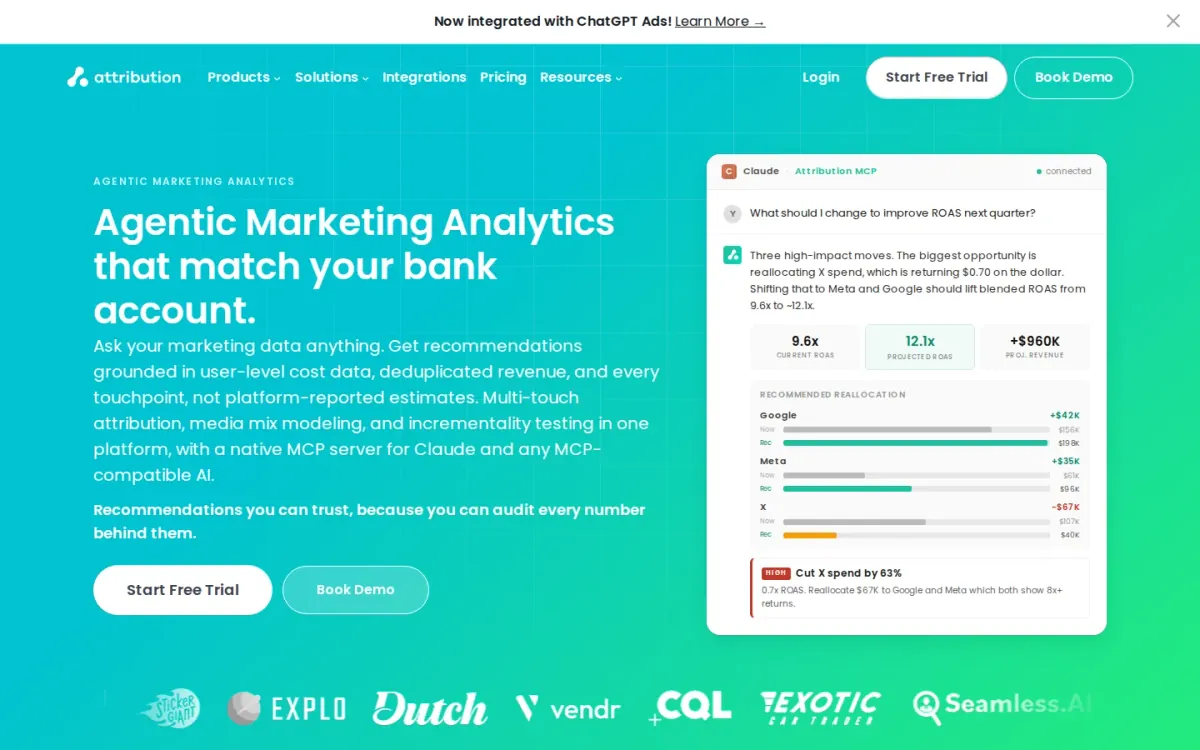
Attributionapp focuses on end-to-end marketing attribution visibility with an emphasis on data fidelity and auditability. It supports multiple attribution models and configurable rules, so product-led and trial-based journeys can avoid over-crediting post-signup visits.
Key features
Attributionapp supports five configurable attribution models; Attributionapp runs media mix modeling with saturation curves.
Also documented: Attributionapp measures incrementality via geo holdout tests.
Beyond reporting, Attributionapp pairs attribution with media mix modeling and incrementality testing to pressure-test channel impact. Raw visit-level and user-level exports flow to major warehouses and cloud storage, enabling SQL analysis, custom modeling, and downstream analytics workflows.
Attributionapp — why it ranks here
Ranked for combining configurable attribution models, incrementality testing, and full-fidelity raw exports, while keeping every number traceable back to user-level events.
Strengths: Audit trails tie results to individual touches; Raw exports include timestamps, UTMs, and identity; Conversion API sends weighted conversions to ad platforms.
Limitations: Setup may require data team involvement for SQL workflows; Model configuration options can feel complex at first.
Access: Current access details: attributionapp.com [8]. Verdict: It suits organizations that demand trustworthy, auditable attribution and warehouse-grade data, plus MMM and incrementality to validate channel impact.
9. Wickedreports

Official source: wickedreports.com [9].
Best for: Agencies and operators managing serious paid budgets.
Wickedreports positions itself as a verified source of truth for marketing measurement, arguing that ad networks “grade [their] own homework.” Its first‑party, click‑based approach ties every order to the real click that caused it for clearer channel accountability.
Key features
- Wickedreports ties every order to the real click.
- First‑party, click‑based attribution foundation.
- New vs repeat buyers by campaign and creative.
- Integrations and Google Ads Conversion API support.
It emphasizes decision certainty by separating new customers from repeat buyers down to campaign and creative. That granularity helps teams compare platform-reported results against owned, trustworthy data and act on performance signals with more confidence.
Why it ranks here
Strong first‑party, click‑level linkage and new-vs-repeat segmentation stand out, but the messaging leans heavily on philosophy over clearly listed product workflows.
Pros
- Clear stance against self-reported ad network metrics.
- Granular customer segmentation for acquisition analysis.
- Order-to-click linkage supports campaign accountability.
Limitations
- Limited concrete detail on day-to-day reporting experience.
- Marketing copy can feel more conceptual than practical.
Access: Current access details: wickedreports.com [9]. Verdict: It is a solid fit for teams that want owned, click-level attribution and customer-type breakdowns to pressure-test ad platform reporting.
10. Polaranalytics

Official source: polaranalytics.com [10].
Best for: Shopify-focused teams unifying channel data for attribution and reporting.
Polaranalytics centers on unifying marketing and commerce data into a single reporting layer, helping teams connect campaigns to outcomes across channels. It emphasizes consolidated reporting and “granular campaign insights” to support better budget allocation and creative iteration.
Key features
- Polaranalytics unifies sources into one dashboard.
- Causal Lift tests incremental revenue impact.
- Polar CAPI improves conversion data completeness.
- Klaviyo Audiences activates captured events.
It highlights incrementality testing via Causal Lift and data activations such as Klaviyo Audiences, alongside Conversion API and pixel options aimed at improving tracking completeness. An instant demo with demo data helps evaluate workflows before committing internal resources.
Quick assessment
Strongest points: Consolidates reporting to align teams faster.
Improves attribution accuracy via Pixel and CAPI.
Instant demo available with no signup.
Main limitations: Messaging spans many modules beyond attribution.
Limited detail on attribution methodology controls.
Why it ranks here: Strong at consolidating sources and improving tracking signals.
The attribution story leans on broader BI and activation modules rather than deep, dedicated modeling controls.
Access: Current access details: polaranalytics. Verdict: It suits ecommerce teams that want unified reporting plus incrementality and activation, but may feel broad for specialists seeking granular attribution configuration.
How to choose
Workflow fit
Start by naming the decisions attribution must support: daily bid and budget shifts, weekly channel planning, or quarterly forecasting. Next, map your data sources (ad platforms, web analytics, CRM, offline conversions, marketplaces) and confirm the tool can connect them without fragile workarounds.
Validation
Look closely at model transparency: you should be able to explain what’s counted, what’s inferred, and what’s excluded. Then evaluate workflow fit—dashboards for operators, exports for analysts, and reporting for finance. Finally, verify how the vendor communicates limitations, support processes, and ongoing product changes.
Final recommendations
Shortlist
- Multi-Touch Attribution when attribution needs to connect directly to paid media actions, with revenue and cohort context guiding daily decisions.
- Pick Northbeam if your priority is advanced attribution insights that support profitable growth planning and ad spend optimization across key channels.
- Consider Triplewhale when ecommerce teams need unified measurement views, keeping stakeholders aligned through shared dashboards and activation-oriented reporting.
Before rollout
- Use Rockerbox when you want one measurement home that combines attribution with calibration methods across a broad, cross-channel marketing mix.
- Look at Ruleranalytics or Attributionapp when auditability, warehouse-ready outputs, and revenue-linked journeys matter as much as the attribution model itself.
Sources
- AdBid - Multi-Touch Attribution
- Northbeam
- Triplewhale
- Rockerbox
- Fospha
- Lifesight
- Ruleranalytics
- Attributionapp
- Wickedreports
- Polaranalytics
Related reading: Top 10 Free Attribution Tools
Related reading: Mobile Attribution: App Tracking Guide