
Choosing an analytics tool for an online store is less about flashy dashboards and more about dependable answers: which channels drive profit, which customers stick, and what changed week to week. The best options connect ad spend, orders, margins, and customer behavior without forcing a data team to stitch everything together. This Top 10 ranking focuses on platforms built for commerce reporting, attribution, LTV and cohort analysis, and profit-aware decision-making. Use the sections below to understand how the list was scored, what to prioritize for your business model, and which tools tend to fit common team setups and growth stages.
Comparison table
| Rank | Tool | Best for | Standout feature | Pricing from | Free option | Rating |
|---|---|---|---|---|---|---|
| 1 | AdBid - Ecommerce Analytics Platform [1] | DTC brands tying ad spend to revenue outcomes | AdBid provides free attribution connecting spend to revenue | Free access | Start Free | 73/100 |
| 2 | Triplewhale | Shopify-first brands that want unified attribution and ready-made dashboards | Compass unifies MMM, MTA, and incrementality | $1 | Free plan | 71/100 |
| 3 | Polaranalytics | Mid-to-large brands that want unlimited users and long historical reporting | Unlimited user seats across plans | $2,770 per month (US) | — | 71/100 |
| 4 | Useamp [2] | DTC brands that want LTV and profit reporting tied to order volume | Predictive LTV modeling | $149 per month | Free trial | 70/100 |
| 5 | Peelinsights | Shopify Plus and Amazon businesses seeking detailed DTC and subscription analytics | Data Connectors: Shopify, Amazon, GA4, Ad Networks | $100 per month | Free trial | 70/100 |
| 6 | Daasity [3] | Growing brands needing unified data across retail, DTC, and digital channels | Native Daasity connections | $1,499 per month (US) | — | 70/100 |
| 7 | Glew [4] | Growing online retailers that want pre-built KPIs and segmentation across sales and marketing channels | Glew Pro pre-built KPIs and dashboards | — | offers a trial option | 69/100 |
| 8 | Sweetanalytics | Shopify merchants who want dashboards that scale with revenue | Sweetanalytics provides key sales dashboards | $1,299 per month (US) | Free trial | 69/100 |
| 9 | Conjura | Brands that want profit optimization reporting across stores and ad channels | Conjura syncs data daily | $2,990 per month (US) | — | 69/100 |
| 10 | Metorik | Shopify and WooCommerce merchants who want profit-aware reporting and segmentation | Metorik provides real-time analytics and flexible reports | $25 per month | Free trial | 68/100 |
How we evaluated the tools
Each product received an editorial score based on six weighted criteria. Task fit (30%) measured how well it supports core commerce reporting like attribution, LTV, cohorts, and profit views. Features and automation (20%) covered dashboards, alerts, forecasting, and repeatable reporting workflows. Ease of use (15%) assessed setup, learning curve, and day-to-day navigation. Integrations and workflow (15%) evaluated connectors to ad, store, and data tools plus export options. Value and pricing transparency (10%) considered clarity and predictability of costs. Limits, support, and transparency (10%) reviewed caps, documentation, and support expectations in plain terms.
- Source basis: checks start with adbid.me [1] and continue through every linked official product page.
Scores are editorial assessments on a 100-point scale rather than customer ratings. Product pages supply the feature and access facts, and the same weighted rubric applies to every entry.
The order reflects fit for this comparison, not market share or brand familiarity. Each product links back to an official source so readers can verify current details.
1. AdBid
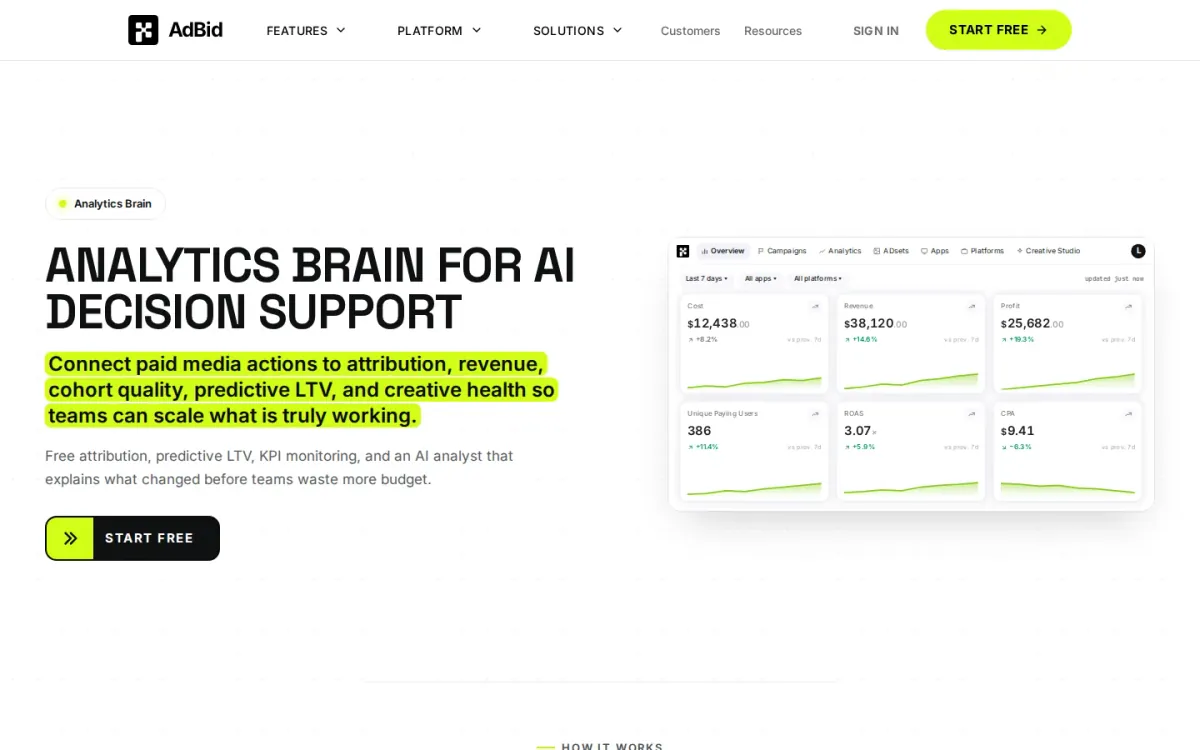
AdBid’s Analytics Brain links paid-media actions to attribution, revenue, cohort quality, predictive LTV, and creative health. It keeps cost, revenue, ROAS, and paying users in one view, helping teams scale based on downstream outcomes, not clicks.
Features and trade-offs
Key features
- AdBid provides free attribution connecting spend to revenue.
- AI Analyst explains what changed in performance.
- Cohort views show revenue quality over time.
- Creative monitoring tracks fatigue and KPI drift.
The built-in AI Analyst explains performance shifts—like ROAS drops, fading hook families, or outperforming geos—and points back to the metric, period, and segment behind each answer. Continuous monitoring flags creative fatigue and KPI drift before budgets bleed.
Why it ranks here
Strong fit for commerce growth teams: free attribution plus predictive LTV and an explainable AI Analyst that connects insights directly to campaign decisions.
Pros
- Unifies cost, revenue, ROAS, paying users.
- AI answers cite metrics, periods, segments.
- Catches creative decay before overspending.
Limitations
- Focuses heavily on paid-media decision workflows.
Access and verdict
Access: Current access details: adbid.me [1]. Verdict: AdBid is a practical ecommerce analytics platform for scaling ads with attribution, predictive LTV, and clear explanations of performance changes.
2. Triplewhale

Best for: Shopify-first brands that want unified attribution and ready-made dashboards.
Triplewhale is an ecommerce analytics platform that pulls marketing and sales signals into one command center. It pairs multi-touch attribution with unified measurement (MMM, MTA, incrementality) and 75+ ready-to-use dashboards for quick, cross-team reporting.
Key features
Compass unifies MMM, MTA, and incrementality; Attribution uses multi-touch models via Triple Pixel.
Also documented: Self-serve analytics includes 75+ dashboards; Integrations provide 60+ one-click connections.
Beyond reporting, Triplewhale adds Moby AI for real-time insights and forecasting, plus a fully managed, AI-optimized data warehouse. With 60+ one-click integrations and tools like Sonar Send/Optimize, it aims to improve data completeness for ad optimization and retention work.
Triplewhale — why it ranks here
Strong measurement stack plus broad integrations and prebuilt dashboards make Triplewhale a practical choice for fast, trustworthy performance visibility.
Strengths: Unified measurement reduces reporting fragmentation; Prebuilt dashboards speed up stakeholder answers; Moby AI supports forecasting and analysis chat.
Limitations: Advanced capabilities may require higher-tier plans.
Pricing and verdict
Verdict: A solid pick for brands that need attribution, measurement, and dashboards in one place, with AI assistance layered on top.
3. Polaranalytics

- Best for: Mid-to-large brands that want unlimited users and long historical reporting.
Polaranalytics is an ecommerce analytics platform built around a value-based model that scales pricing primarily by trailing 12-month GMV. Plans emphasize broad access—unlimited user seats and unlimited historical data—so teams can standardize reporting across stakeholders.
Key features
- Unlimited user seats across plans.
- Unlimited historical data retention.
- Dedicated Snowflake database instance.
- Ask Polar and AI agents.
Across plans, Polaranalytics includes unlimited connected data sources/connectors and dedicated backend infrastructure such as a dedicated Snowflake database instance. It also bundles AI functionality like Ask Polar, specialized AI agents, and Polar MCP features for quicker analysis and question-driven exploration.
Quick assessment
Strongest points: Unlimited seats simplify cross-team rollout.
Unlimited connectors support multi-source reporting.
Dedicated infrastructure improves data ownership.
Main limitations: GMV-based pricing may be costly at scale.
Higher tiers can exceed $6,500 per month.
Why it ranks here: Strong inclusions—unlimited seats, history, connectors, and dedicated infrastructure—help it stand out.
GMV-based pricing can climb quickly for larger brands.
Starting plan: $2,770 per month — US.
Verdict: A solid pick for growing brands that need broad access and deep history, as long as GMV-based pricing fits the budget.
4. Useamp
- Official source: useamp.com [2].
Best for: DTC brands that want LTV and profit reporting tied to order volume.
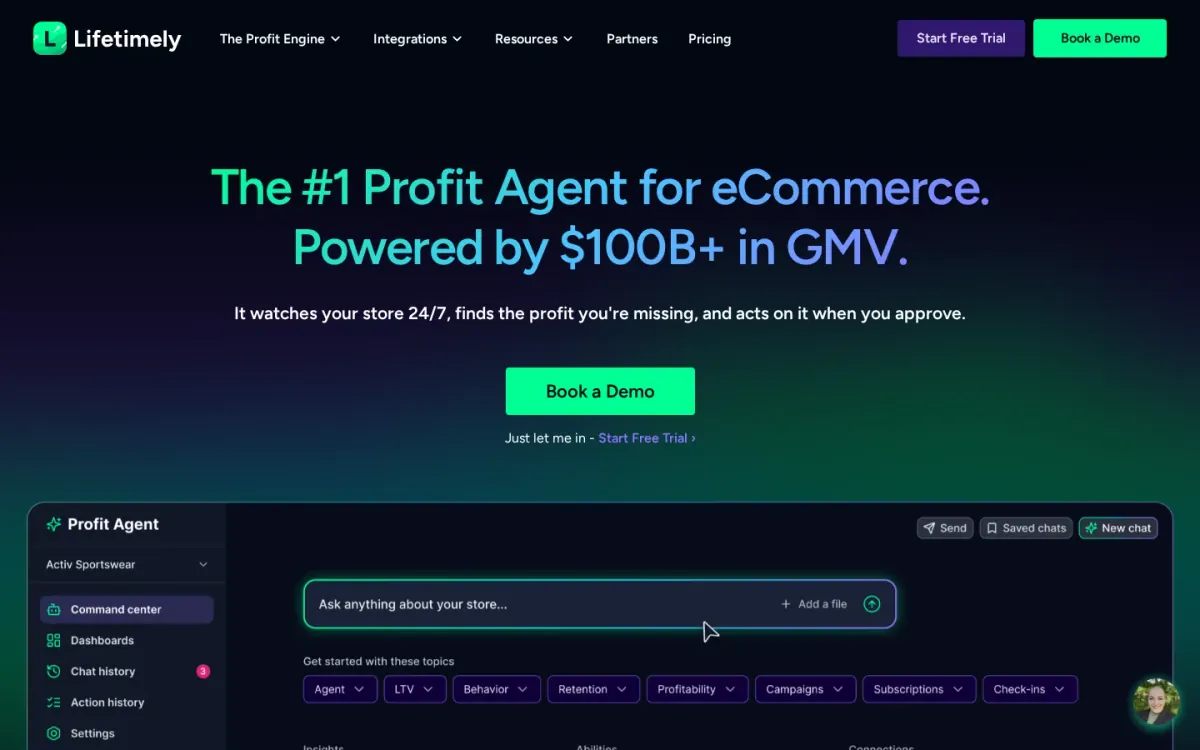
Useamp (Lifetimely) focuses on store performance measurement with usage-based pricing based on monthly order volume, not revenue. Every plan includes all features, so smaller teams can start simple and still access advanced reporting as they grow.
Key features
Predictive LTV modeling; Daily Profit & Loss reporting.
Also documented: Cohorts and segmentation analysis.
Core reporting spans predictive LTV modeling, customer behavior analytics, and daily Profit & Loss, plus cohorts, segmentation, and custom dashboards. Benchmarks and broad integrations—Meta, Google, Klaviyo, TikTok, Recharge, and more—help connect marketing and retention to financial outcomes.
Useamp — why it ranks here
Ranks highly for transparent, order-based pricing and a full feature set across tiers, but costs can rise quickly as order volume increases.
Strengths: All features included in every plan; Pricing based on orders, not revenue; Wide integrations across ads and email.
Limitations: Higher order volume pushes monthly costs up; Free plan limited to 50 orders monthly.
- Starting plan: $149 per month.
Verdict: It suits brands that want LTV, cohorts, and profit clarity in one place, as long as order-based pricing fits their growth curve.
5. Peelinsights
- Best for: Shopify Plus and Amazon businesses seeking detailed DTC and subscription analytics.
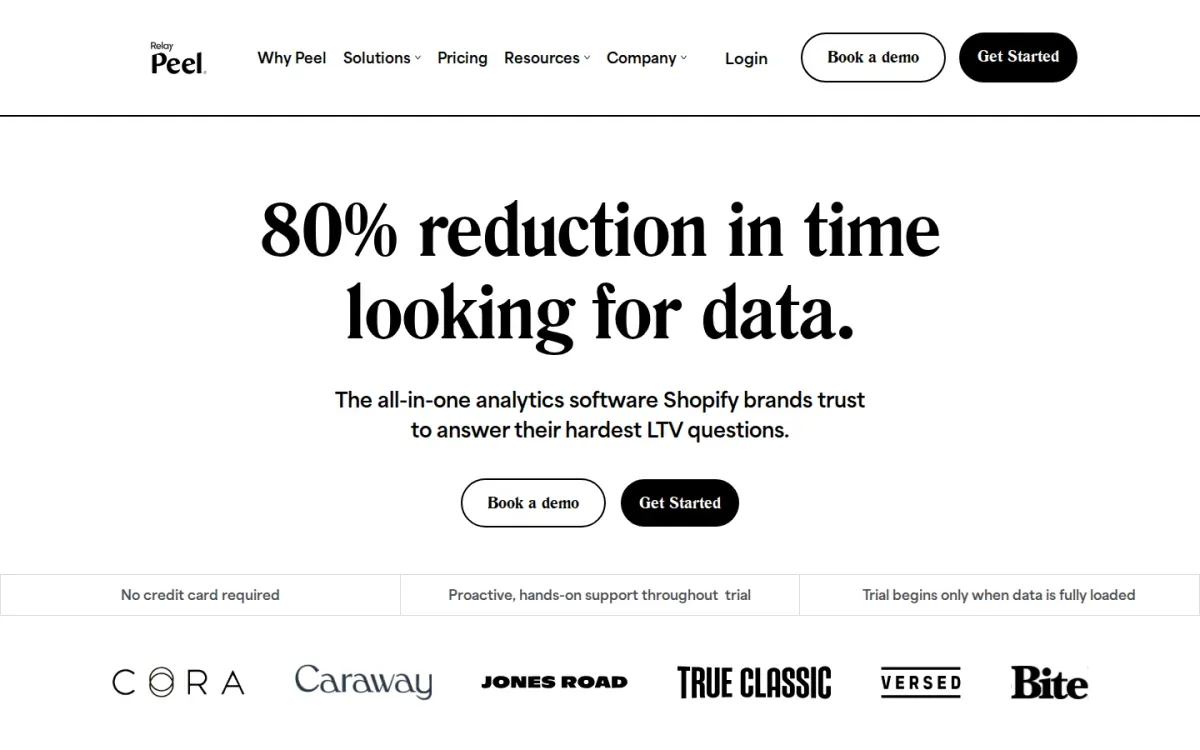
Peelinsights provides broad sales intelligence for online retailers, offering deep insights into customer behavior and product performance. It supports data integration from various sources, including Shopify, Amazon, and ad networks.
Key features
- Data Connectors: Shopify, Amazon, GA4, Ad Networks.
- Subscription Connectors: Smartrr, Recharge, Skio.
- DTC Analytics: 30+ Cohort KPIs, Product Metrics.
- Automated Insights: Daily Slack/Email digests.
It delivers automated insights and customizable dashboards, helping businesses optimize marketing campaigns and daily sales decisions. Peelinsights scales with business needs, from core plans to tailored enterprise solutions.
Why it ranks here
It offers dependable DTC and subscription analytics with extensive data connectors. Its automated insights and tailored reporting provide significant value for growing e-commerce operations.
Pros
- Peelinsights integrates major e-commerce and ad platforms.
- Offers extensive DTC and subscription analytics.
- Provides automated daily data refreshes.
Limitations
Pricing structure scales by monthly orders.
Tailored plan requires sales team contact.
Starting plan: $100 per month.
Verdict: An excellent sales intelligence solution for online stores, particularly those needing deep DTC and subscription performance insights.
6. Daasity
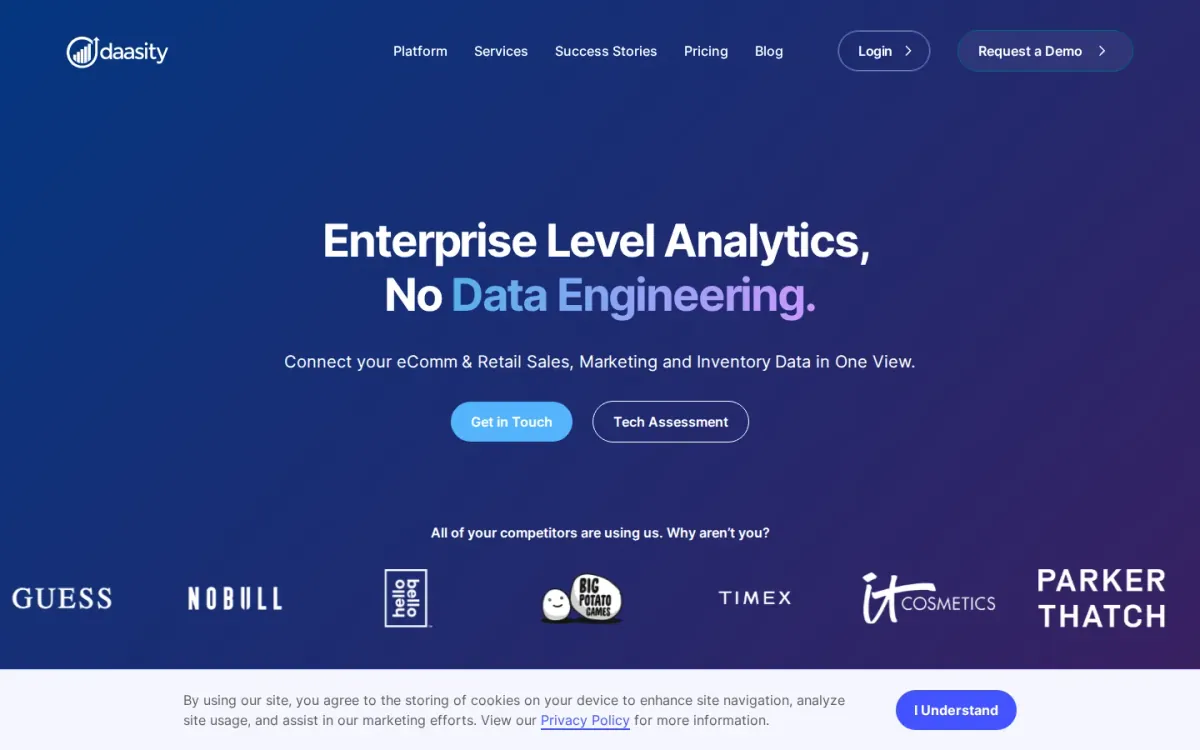
Official source: daasity.com [3].
Best for: Growing brands needing unified data across retail, DTC, and digital channels.
Daasity provides a retail intelligence platform offering tiered self-service plans and custom enterprise solutions. It integrates native connections, standard dashboards, and broad reporting for businesses.
Key features
- Standard dashboards and reports.
- Full data foundation access.
It unlocks a full data foundation, including built-in contribution margin tracking. Optional add-ons like Syndicated Data + AI Analyst enhance its analytical capabilities. A documented limitation is starter plan costs $1,499 monthly.
Quick assessment
Strongest points: Tailored for retail, DTC, digital channels.
Unlocks full data foundation.
Includes contribution margin tracking.
Main limitations: Starter plan costs $1,499 monthly.
Add-ons increase monthly price.
Why it ranks here: It offers dependable data unification for complex retail operations.
Its higher price point and additional costs for advanced features place it mid-tier.
Starter: $1,499 per month — US.
Verdict: A broad retail data solution, Daasity is best for established brands with significant data needs and budget.
7. Glew
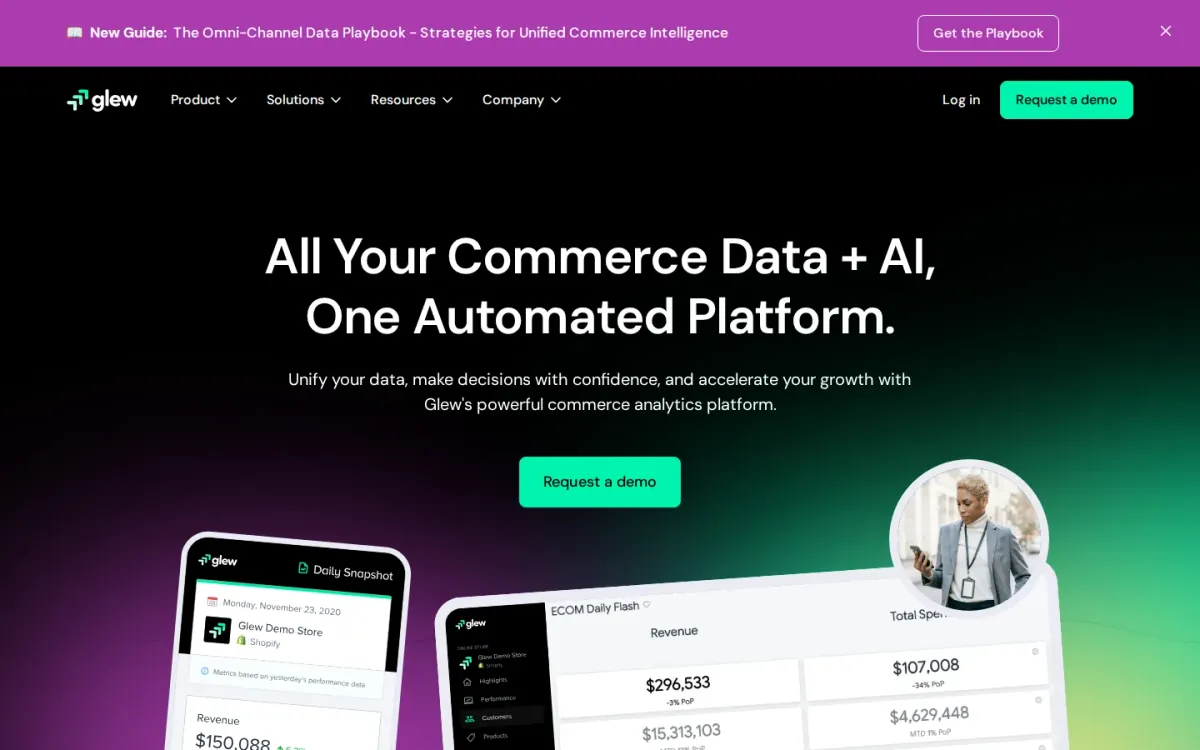
- Official source: glew.io [4].
Best for: Growing online retailers that want pre-built KPIs and segmentation across sales and marketing channels.
Glew Pro focuses on ready-made business intelligence for online stores, pairing pre-built KPIs with multichannel reporting, customer segmentation, and product analytics. It’s a practical way to standardize performance tracking when data lives across storefront and marketing systems.
Key features
Glew Pro pre-built KPIs and dashboards; Multichannel reporting across connected platforms.
Also documented: Customer segmentation and product analytics.
For teams that need deeper data plumbing, Glew Plus adds an enterprise data pipeline and warehouse approach, with custom reporting, automated ETL, and bundled Looker capabilities for cross-integration analysis. Expect a sales-led process rather than self-serve setup.
Glew — why it ranks here
Strong mix of out-of-the-box retail KPIs and an enterprise ELT/warehouse option, offset by limited public pricing detail.
Strengths: Pre-built KPIs reduce reporting setup time; Segmentation supports customer and product deep dives; Enterprise path for custom reporting and pipelines.
Limitations: No public tier-by-tier dollar pricing; Annual prepayment required for Glew Pro.
Access: Current access details: glew.io [4]. Verdict: It suits retailers who want quick KPI dashboards now and a supported data pipeline later, if quote-based pricing is acceptable.
8. Sweetanalytics
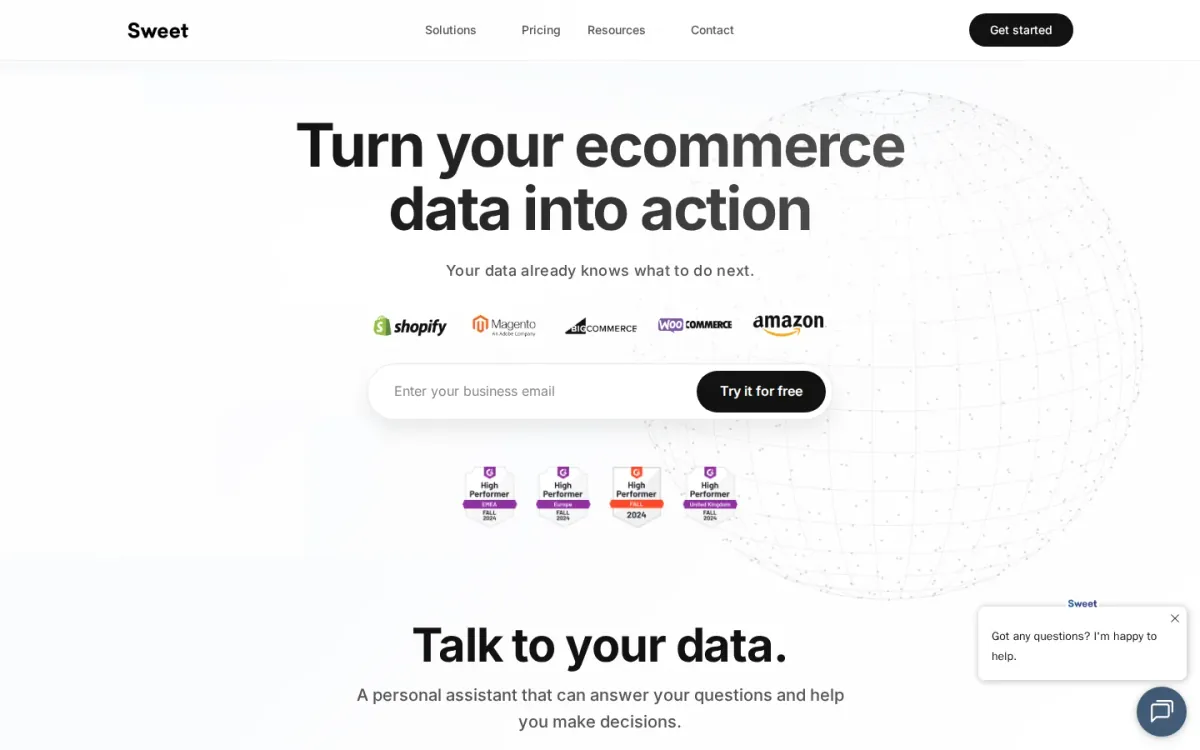
Best for: Shopify merchants who want dashboards that scale with revenue.
Sweetanalytics focuses on store reporting with revenue-based tiers, so pricing scales as sales grow. Self-serve options include a 14-day free trial, making it easier to evaluate dashboards and reporting before committing to a monthly plan.
Key features
Sweetanalytics provides key sales dashboards; Sweetanalytics includes a customer summary dashboard.
Also documented: Sweetanalytics consolidates GA3 and GA4 reporting; Sweetanalytics supports unlimited integrations on paid tiers.
The Free Plan includes key sales dashboards, a customer summary dashboard, and consolidated Google Analytics reporting for GA3 and GA4. Paid self-serve tiers add all Sweet dashboards, unlimited integrations, and basic Sweet support, with automatic tier scaling above set revenue bands.
Sweetanalytics — why it ranks here
Strong dashboard coverage and unlimited integrations, but revenue-banded pricing and higher tiers can reduce cost predictability for growing stores.
Strengths: Revenue-banded tiers scale with business growth; 14-day free trial for self-serve plans; Automatic plan scaling when revenue exceeds bands.
Limitations: Higher-revenue tiers can become expensive; Enterprise pricing requires a custom quote.
- Pro: $1,299 per month — US.
Verdict: It suits Shopify teams that want ready dashboards and GA consolidation, but budget carefully as revenue-band upgrades kick in.
9. Conjura
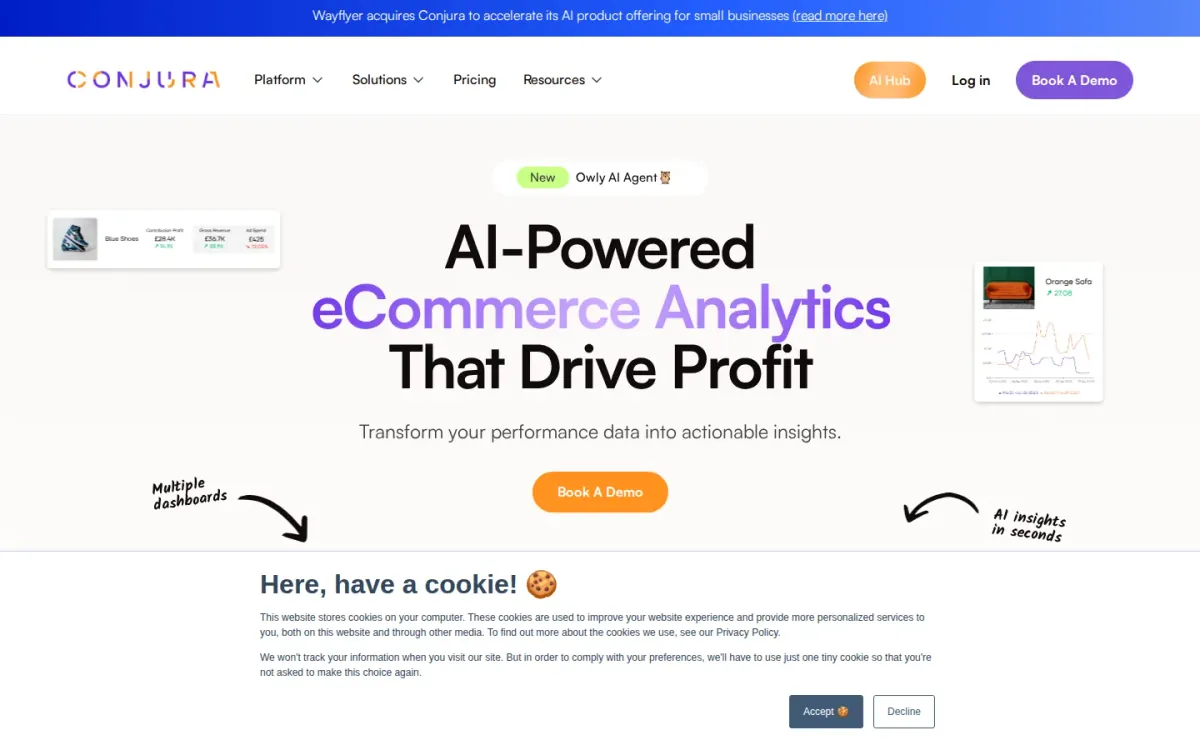
- Best for: Brands that want profit optimization reporting across stores and ad channels.
Conjura is a commerce analytics and profit optimization product built around tiered plans and connectors to core commerce and ad platforms. Daily data sync and customizable dashboards help teams monitor performance without stitching together spreadsheets.
Key features
- Conjura syncs data daily.
- Customizable dashboards for commerce KPIs.
- Connectors for core commerce and ad platforms.
- Slack, marketplace, ERP, and OMS connectors.
Plans scale from Essentials to Growth and Scale, adding unlimited users, multi-store support, and connectors such as Slack, marketplaces, and—at the top tier—ERP and OMS integrations. Dedicated onboarding and email support aim to reduce setup friction.
Why it ranks here
Strong connector coverage and multi-store readiness, but pricing transparency and entry cost can be hurdles for smaller operators.
Pros
- Multi-store support on Growth and above.
- Unlimited users on Growth and Scale.
- Dedicated onboarding on Growth plan.
Limitations
Scale plan pricing requires application.
Pricing can scale by annual GMV tier.
Starting plan: $2,990 per month — US.
Verdict: It suits growing commerce teams that need connected reporting and profit visibility, but it’s less friendly for budget-first buyers.
10. Metorik
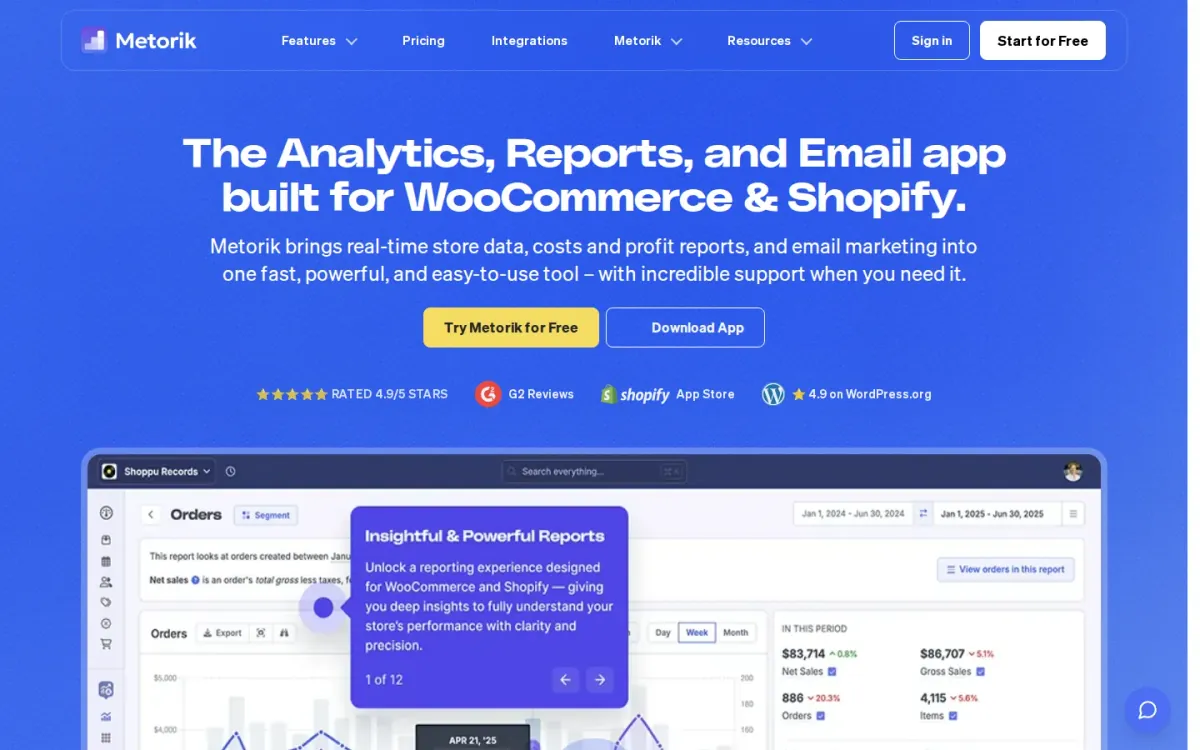
- Best for: Shopify and WooCommerce merchants who want profit-aware reporting and segmentation.
Metorik combines real-time store reporting with flexible analytics and reports, helping teams move beyond basic dashboards. It supports goals and targets, customer cohorts for retention and LTV, and product reporting that highlights sales, profit, and stock in one place.
Key features
- Metorik provides real-time analytics and flexible reports.
- Metorik tracks COGS, ad spend, shipping, fees.
- Metorik supports customer cohorts for retention and LTV.
- Metorik exports segmented store data to CSV.
For operators who care about margins, Metorik adds cost and profit reports that track COGS, ad spend, shipping, and fees. Superpower segmenting and data exporting to CSV make it easier to slice performance and share clean datasets across teams.
Quick assessment
Strongest points: Profit reporting ties costs to performance.
Customer cohorts clarify retention trends.
Segmentation is flexible across store attributes.
Main limitations: Starter plan pricing starts at $25 per month.
Platform focus centers on Shopify and WooCommerce.
Why it ranks here: It earns a lower spot for narrower store focus, but its profit tracking, cohorts, and segmentation deliver strong day-to-day commerce insight.
Starter: $25 per month.
Verdict: It suits merchants who want profit-aware reporting, cohorts, and segmentation, especially on Shopify or WooCommerce, and can start from $25/month with a free trial.
How to choose
Workflow fit
Start by defining the decisions the tool must support: channel budget shifts, retention work, merchandising, or finance-grade profit reporting. Then map your data sources—storefront, ad platforms, email/SMS, subscriptions, marketplaces—and confirm the integrations you actually need.
Validation
Check whether pricing scales by GMV, orders, revenue bands, or seats, and whether that matches your growth curve. Look for clear attribution and LTV logic, plus the ability to audit calculations when numbers are questioned. Finally, consider who will use it daily and whether exports, alerts, and scheduled reports fit existing workflows without extra manual steps.
Final recommendations
Shortlist
- Ecommerce Analytics Platform is the best starting point for DTC teams that need ad spend tied to revenue outcomes and explainable performance shifts.
- Triplewhale fits Shopify-first brands that want attribution and ready dashboards in one place, with optional assistance features layered in.
Before rollout
- Polaranalytics and Useamp are strong for teams prioritizing broad access, long history, cohorts, and LTV, but confirm GMV or order-based pricing.
- Metorik is a practical option for Shopify or WooCommerce merchants who want profit-aware segmentation and a low-cost entry point with a free trial.