
Choosing an attribution tool is less about flashy dashboards and more about whether the data can be trusted, shared, and acted on across teams. The best options connect ad spend to outcomes, support privacy-safe measurement, and keep links and routing consistent across channels. This guide explains how the shortlist was assembled and what to look for before committing to a platform. It also highlights common decision points: install and event tracking depth, fraud controls, SKAdNetwork readiness, deep linking needs, and how easily data moves into analytics, BI, and ad workflows without creating reporting drift.
Comparison table
| Rank | Tool | Best for | Key capabilities | Limitations | Access/source status |
|---|---|---|---|---|---|
| 1 | AdBid - Mobile Attribution Platforms [1] | Growth teams that want spend-to-revenue decisions tied to day-to-day media buying | AdBid connects campaign cost to downstream outcomes; AdBid surfaces attribution windows and conversion priorities | May not cover complex MMP requirements | Official source: adbid.me [1] |
| 2 | Appsflyer [2] | Teams that need unified attribution, ROI measurement, and deep linking across app, web, CTV, and gaming platforms | Appsflyer supports mobile, web, CTV attribution; Appsflyer unifies attribution, revenue, engagement data | Enterprise scope may add operational complexity | Official source: Appsflyer.com [2] |
| 3 | Adjust [3] | Marketers needing dependable app install and event tracking | Adjust tracks app installs; Measures in-app user events | Initial configuration complexity | Official source: Adjust.com [3] |
| 4 | Branch [4] | Teams that need defensible cross-channel attribution and reliable deep links across web, ads, and messaging | Branch connects paid, organic, email, web, app touchpoints; Branch provides attribution focused on provable ROI | AI-enhanced linking claims lack detail in-page | Official source: Branch.io [4] |
| 5 | Singular [5] | Teams that need unified attribution, cost, and performance data across channels and devices | Unifies cost aggregation from 1,200+ sources; Measures SKAdNetwork and cross-device attribution | Breadth of capabilities can feel complex at first | Official source: Singular.net [5] |
| 6 | Apptrove [6] | Marketers who need install attribution plus post-install analytics in one place | Apptrove unifies campaign data and user behavior dashboards; SKAN analytics supports privacy-focused attribution workflows | Some feature details feel high-level on-site | Official source: Apptrove.com [6] |
| 7 | Airbridge [7] | teams prioritizing a focused mobile attribution workflow | Airbridge keeps the documented mobile attribution workflow focused; Airbridge provides official access for direct workflow review | Broader integration details for Airbridge may require separate review | Official source: Airbridge.io [7] |
| 8 | Tenjin [8] | Mobile app developers focused on hybrid monetization and AI-driven campaign management | broad mobile attribution; Unified ROI dashboard | Broader integration details for Tenjin may require separate review | Official source: Tenjin.com [8] |
| 9 | Solar Engine [9] | Teams that want a straightforward app attribution reference point without heavy setup | Solar Engine serves a user-supplied reference page; Solar Engine focuses on app attribution vendor context | Not described as an end-to-end measurement platform | Official source: solar-engine.com [9] |
| 10 | Incrmntal [10] | Advertisers who need cross-channel measurement without user-level tracking | Incrmntal runs micro-experiments without pausing campaigns; Incrmntal measures iOS, Android, web, TV, CTV | Limited public detail on specific integrations and reporting depth | Official source: Incrmntal.com [10] |
How we evaluated the tools
Each platform was scored using a weighted rubric designed for practical buying decisions. Task fit (30%) checks alignment with the core job: attribution, measurement, and activation needs. Features and automation (20%) covers tracking depth, fraud controls, privacy tooling, and workflow automation. Ease of use (15%) evaluates setup clarity and day-to-day navigation. Integrations and workflow (15%) reviews partner coverage and data export paths. Access transparency (10%) looks at documentation and clarity around data handling. Limits, support, and transparency (10%) assesses known constraints, support channels, and disclosure quality.
- Source basis: checks start with adbid.me [1] and continue through every linked official product page.
Scores are editorial assessments on a 100-point scale rather than customer ratings. Product pages supply the feature and access facts, and the same weighted rubric applies to every entry.
The order reflects fit for this comparison, not market share or brand familiarity. Each product links back to an official source so readers can verify current details.
1. AdBid
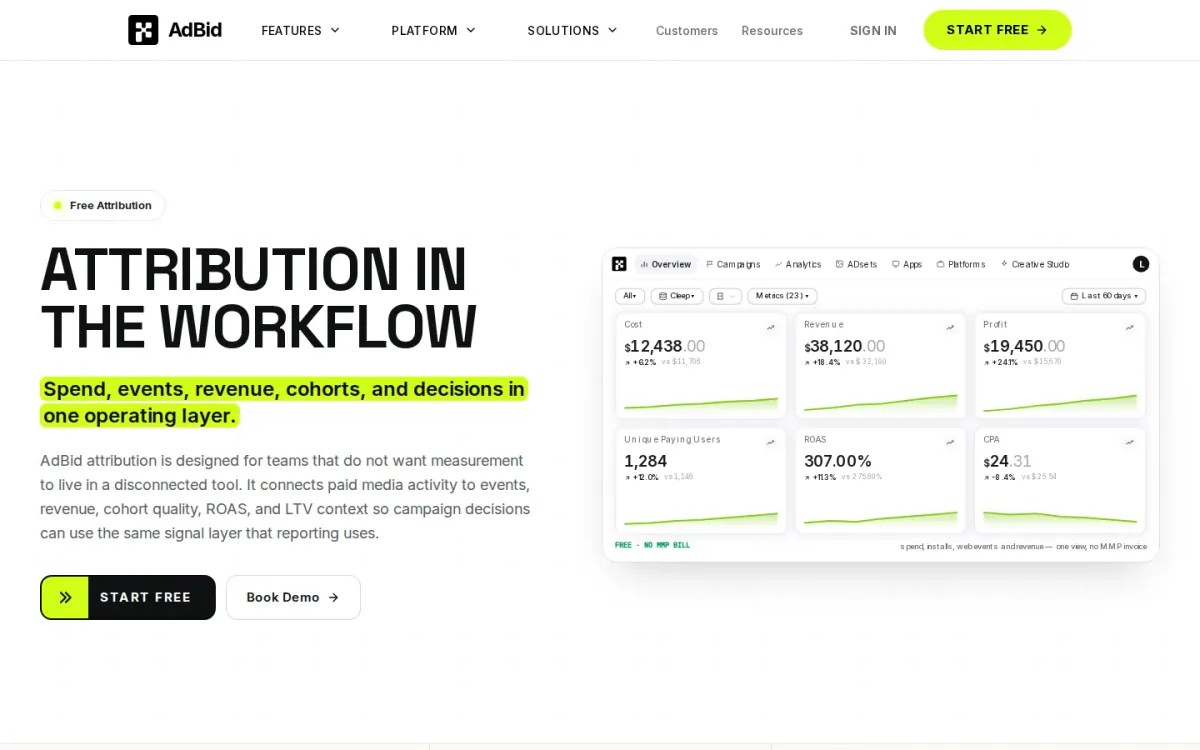
Best for: Growth teams that want spend-to-revenue decisions tied to day-to-day media buying.
AdBid positions attribution as part of the same operating layer used for campaign structure, creative context, events, revenue, and optimization logs. It connects paid media activity to events, cohort quality, ROAS, and LTV so decisions use the same signals as reporting.
Features and trade-offs
Key features
- AdBid connects campaign cost to downstream outcomes.
- AdBid surfaces attribution windows and conversion priorities.
- AdBid supports CAPI and server-side signal workflows.
- AdBid monitors missing or mismatched event inputs.
Signal setup is treated like product infrastructure: event definitions, dataset setup, conversion mapping, attribution windows, and revenue fields are surfaced in the workflow. AdBid also supports server-side signals and CAPI, helping teams trace performance shifts back to specific settings changes.
Why it ranks here
It stands out among mobile attribution platforms by unifying spend, events, and revenue with optimization context, reducing time lost reconciling disconnected reports.
Pros
- Unified view of spend, events, and revenue.
- Optimization logs sit beside performance numbers.
- Traceable settings reduce reporting disagreements.
Limitations
- May not cover complex MMP requirements.
Access and verdict
Access: Current access details: adbid.me [1]. Verdict: AdBid is a strong fit when attribution must directly inform growth operations, not live as a separate reporting destination.
2. Appsflyer

- Official source: appsflyer.com [2].
Best for: Teams that need unified attribution, ROI measurement, and deep linking across app, web, CTV, and gaming platforms.
Appsflyer brings mobile attribution platforms into a broader measurement suite spanning mobile, web, CTV, and PC & console. It connects attribution, revenue, and engagement data in one view to help optimize spend and prove ROI with privacy-safe insights.
Key features
Appsflyer supports mobile, web, CTV attribution; Appsflyer unifies attribution, revenue, engagement data.
Also documented: Appsflyer includes fraud protection and signal governance.
Beyond measurement, Appsflyer adds a Deep Linking Suite to route users from web, email, QR, social, and referrals into personalized in-app experiences, including deferred deep linking and link management. Data collaboration and fraud protection support cleaner, more dependable signals.
Appsflyer — why it ranks here
Strong cross-platform measurement and deep linking breadth, plus fraud-filtered, standardized signals; setup and governance depth can feel heavy for smaller teams.
Strengths: Cross-platform coverage beyond mobile apps; Deep linking options across many channels; Fraud-filtered, standardized measurement signals.
Limitations: Enterprise scope may add operational complexity; Broad suite can be more than some teams need.
Access: Current access details: appsflyer.com [2]. Verdict: It suits organizations that want end-to-end measurement plus deep linking, backed by governance and fraud protection across multiple platforms.
3. Adjust
Official source: adjust.com [3].
Best for: Marketers needing dependable app install and event tracking.
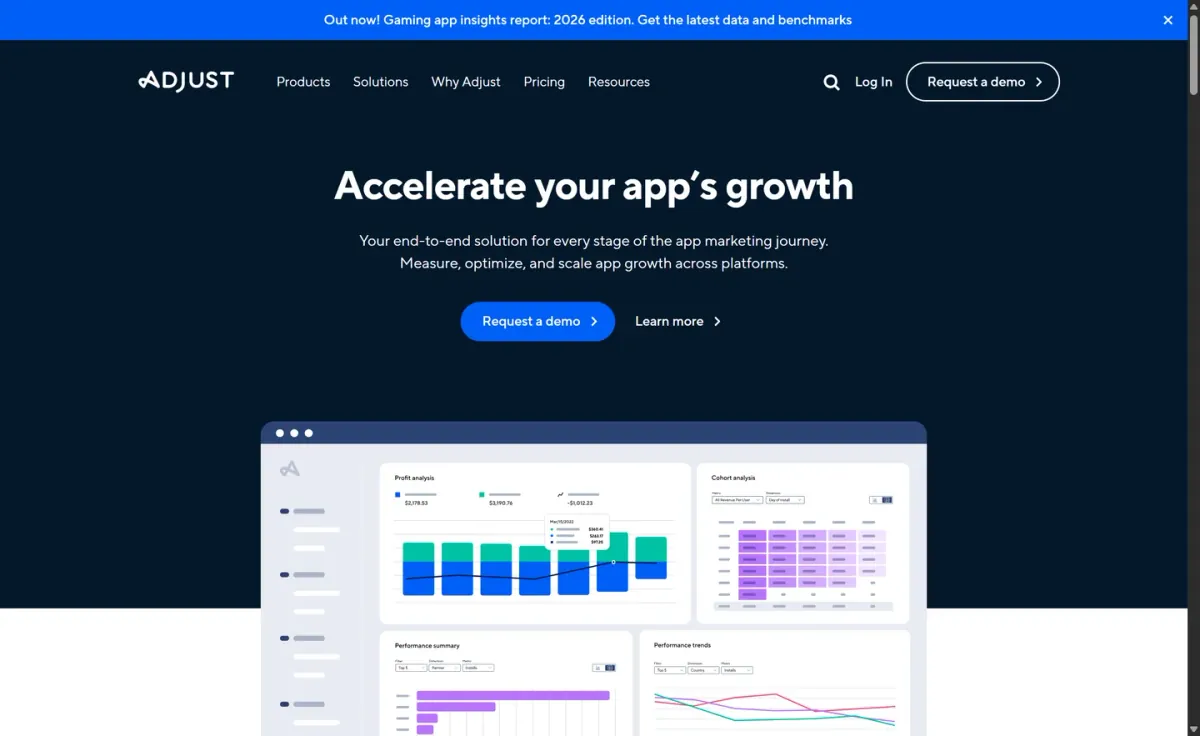
Adjust provides broad analytics for mobile app campaigns, helping businesses understand user acquisition sources. It tracks installs, in-app events, and user journeys. This makes it most relevant for marketers needing dependable app install and event tracking.
Key features
- Adjust tracks app installs.
- Measures in-app user events.
- Provides campaign performance analytics.
It helps optimize ad spend by attributing conversions accurately to marketing efforts. Adjust supports fraud prevention mechanisms to ensure data integrity and reliable insights. A documented limitation is initial configuration complexity.
Quick assessment
Strongest points: Accurate attribution modeling.
Integrates with many ad networks.
Main limitations: Initial configuration complexity.
Requires continuous data monitoring.
- Why it ranks here: Its strong focus on accurate attribution and fraud prevention makes it a reliable choice for optimizing mobile marketing ROI.
Access: Current access details: adjust.com [3]. Verdict: Reliable platform for precise mobile marketing attribution and fraud detection. The final choice depends on the surrounding workflow and constraints.
4. Branch

- Official source: branch.io [4].
Best for: Teams that need defensible cross-channel attribution and reliable deep links across web, ads, and messaging.
Branch positions itself as a mobile measurement and deep linking platform built to connect the full journey from first touch to conversion. It ties together paid, organic, email, web, and app touchpoints so marketers can prove ROI with data they can defend.
Key features
Branch connects paid, organic, email, web, app touchpoints; Branch provides attribution focused on provable ROI.
Also documented: Data exports schedule delivery to your destinations.
Deep links route users into the right in-app destination from email, social, ads, web, and SMS, aiming to prevent broken experiences by handling thousands of edge cases. Branch also supports branded short links, QR codes, and scheduled data exports for reporting workflows.
Branch — why it ranks here
It earns a strong spot for pairing end-to-end journey measurement with dependable deep linking that reduces friction from click to conversion.
Strengths: Clear focus on full-funnel journey measurement; Deep linking handles many edge cases reliably; Branded links and QR codes support activation.
Limitations: AI-enhanced linking claims lack detail in-page.
Access: Current access details: branch.io [4]. Verdict: It suits growth teams that want attribution plus deep linking in one place, especially when cross-channel journeys and app routing matter.
5. Singular

Official source: singular.net [5].
Best for: Teams that need unified attribution, cost, and performance data across channels and devices.
Singular combines attribution and marketing analytics to help growth teams measure ROI across mobile, web, CTV, PC, and console. It unifies cost, performance, creative, and attribution data for real-time visibility into the full customer journey.
Key features
- Unifies cost aggregation from 1,200+ sources.
- Measures SKAdNetwork and cross-device attribution.
- Supports web, CTV, PC, and console attribution.
- Enables deep linking and web-to-app activation.
It emphasizes a data foundation that normalizes and deduplicates inputs, backed by governance, fraud protection, privacy controls, and enterprise-grade security. Singular also supports deep linking and activation flows like web-to-app, QR-to-app, and email-to-app.
Why it ranks here
Strong cross-device measurement plus broad cost aggregation and governance make Singular a dependable pick for complex, multi-channel reporting needs.
Pros
- Broad omnichannel measurement across screens and devices.
- Data normalization and deduplication improve reporting consistency.
- Governance, fraud protection, and privacy controls included.
Limitations
- Breadth of capabilities can feel complex at first.
Access: Current access details: singular.net [5]. Verdict: It suits organizations that want unified, governed attribution data and omnichannel measurement, especially when reporting spans multiple devices and acquisition paths.
6. Apptrove
Official source: apptrove.com [6].
Best for: Marketers who need install attribution plus post-install analytics in one place.
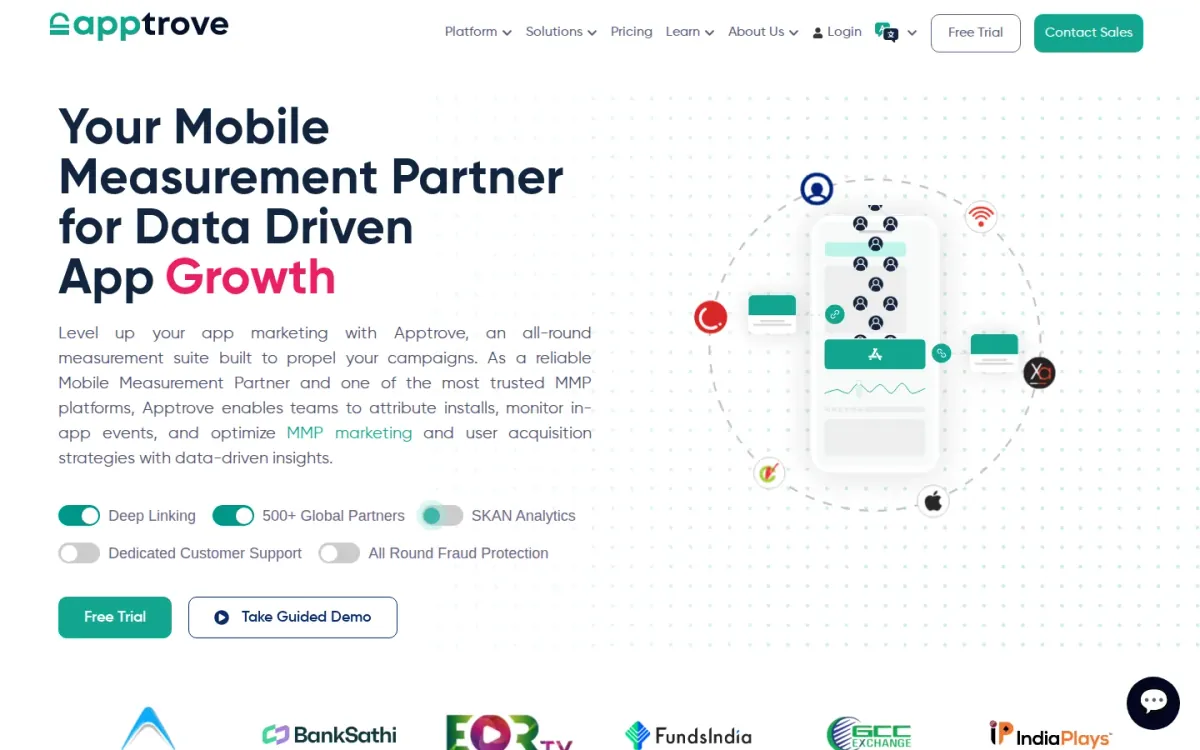
Apptrove positions itself as a mobile measurement partner focused on data-driven app growth. It helps teams attribute installs, monitor in-app events, and connect campaign data with user behavior analytics in a unified dashboard for clearer performance decisions.
Key features
- Apptrove unifies campaign data and user behavior dashboards.
- SKAN analytics supports privacy-focused attribution workflows.
- Deep linking improves post-click to in-app journeys.
- Fraud protection helps reduce invalid acquisition signals.
Reporting emphasizes real-time visibility and cross-channel measurement, with SKAN analytics for privacy-centric environments. Apptrove also highlights deep linking, cohort and retention analysis, and fraud protection to support safer user acquisition and more reliable ROI optimization.
Quick assessment
Strongest points: Unified dashboard ties installs to in-app outcomes.
Strong partner ecosystem for channel connectivity.
Real-time reporting supports faster optimization.
Main limitations: Some feature details feel high-level on-site.
Advanced setup may require support involvement.
Why it ranks here: It earns this spot for combining attribution, SKAN-ready measurement, and fraud protection with broad partner connectivity.
Though some teams may want deeper documentation clarity.
Access: Current access details: apptrove.com [6]. Verdict: It is a solid pick for teams wanting attribution, SKAN insights, and fraud defenses packaged into a single measurement suite.
7. Airbridge
- Official source: airbridge.io [7].
Best for: teams prioritizing a focused mobile attribution workflow.
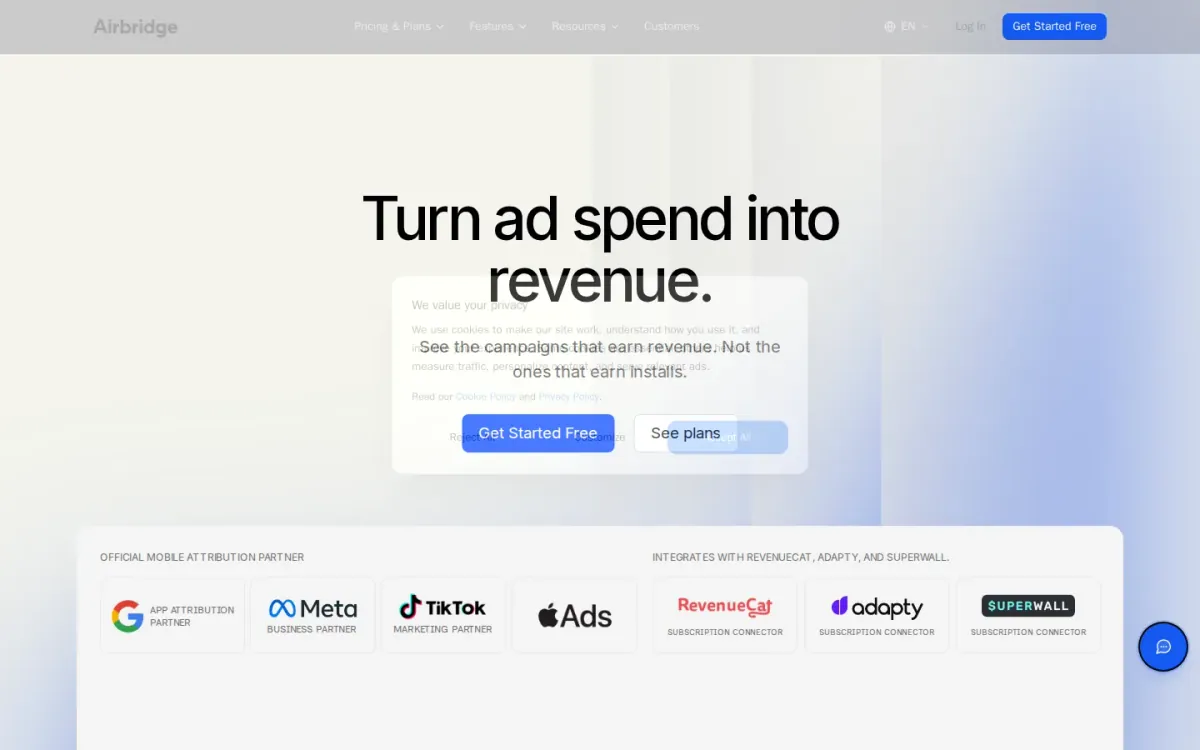
Airbridge is included because its official product materials directly address mobile attribution workflow. The available information shows a defined task flow, identifiable controls, and enough product-specific context to compare its role with the other entries in this ranking.
Key features
Airbridge keeps the documented mobile attribution workflow focused; Airbridge provides official access for direct workflow review.
Also documented: Airbridge has a defined scope for side-by-side comparison.
Airbridge's strongest fit is a team whose primary requirement matches that documented scope. Buyers should compare the listed capabilities with the stated limitations, then confirm that access conditions and surrounding services fit their operating environment.
Airbridge — why it ranks here
Its rank reflects documented task fit, usable workflow detail, access transparency, and the balance between available capabilities and stated limitations.
Strengths: Airbridge's focused scope keeps the primary job easy to identify; Direct access to Airbridge supports pre-adoption workflow review.
Limitations: Broader integration details for Airbridge may require separate review.
Access: Current access details: airbridge.io [7]. Verdict: Shortlist Airbridge when its documented scope matches the core job and its limitations remain acceptable for the intended workflow.
8. Tenjin
- Official source: tenjin.com [8].
Best for: Mobile app developers focused on hybrid monetization and AI-driven campaign management.
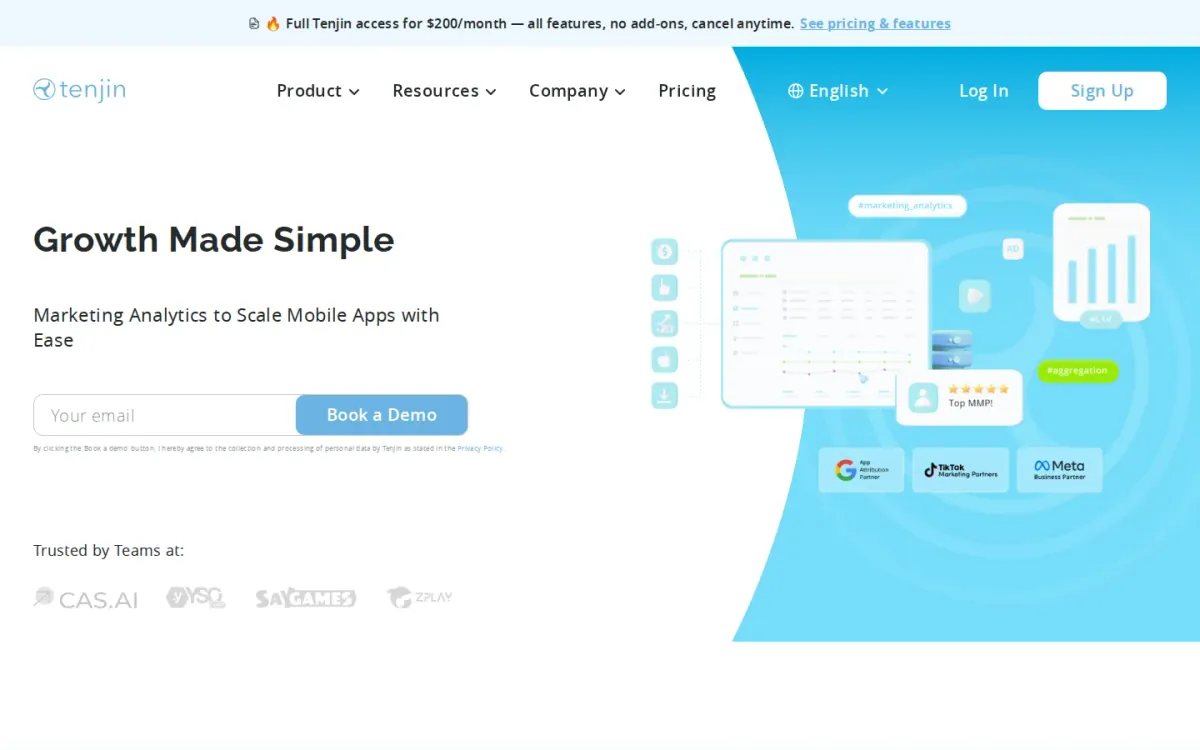
Tenjin offers end-to-end app measurement solutions, helping mobile apps scale with ease. It provides broad mobile attribution to identify top users and advertising channels, plus a unified ROI dashboard for ad spend and revenue insights.
Key features
Broad mobile attribution; Unified ROI dashboard.
Also documented: Ad monetization suite; AI-assisted fraud filters.
It also includes an Ad Monetization Suite for hybrid monetization strategies. Notably, Tenjin is the first app measurement partner to enable AI assistants to manage campaigns and fraud filters directly.
Tenjin — why it ranks here
It provides strong app measurement capabilities, including unique AI assistant integration for campaign management, but its overall feature set may be less broad than top competitors.
Strengths: Identifies best users and ad channels; Unified view of ad spend and revenue; First MMP with AI assistant write access.
Limitations: Broader integration details for Tenjin may require separate review.
Access: Current access details: tenjin.com [8]. Verdict: A solid choice for app developers seeking AI-enhanced campaign management and dependable ad monetization tools.
9. Solar Engine
Official source: solar-engine.com [9].
Best for: Teams that want a straightforward app attribution reference point without heavy setup.
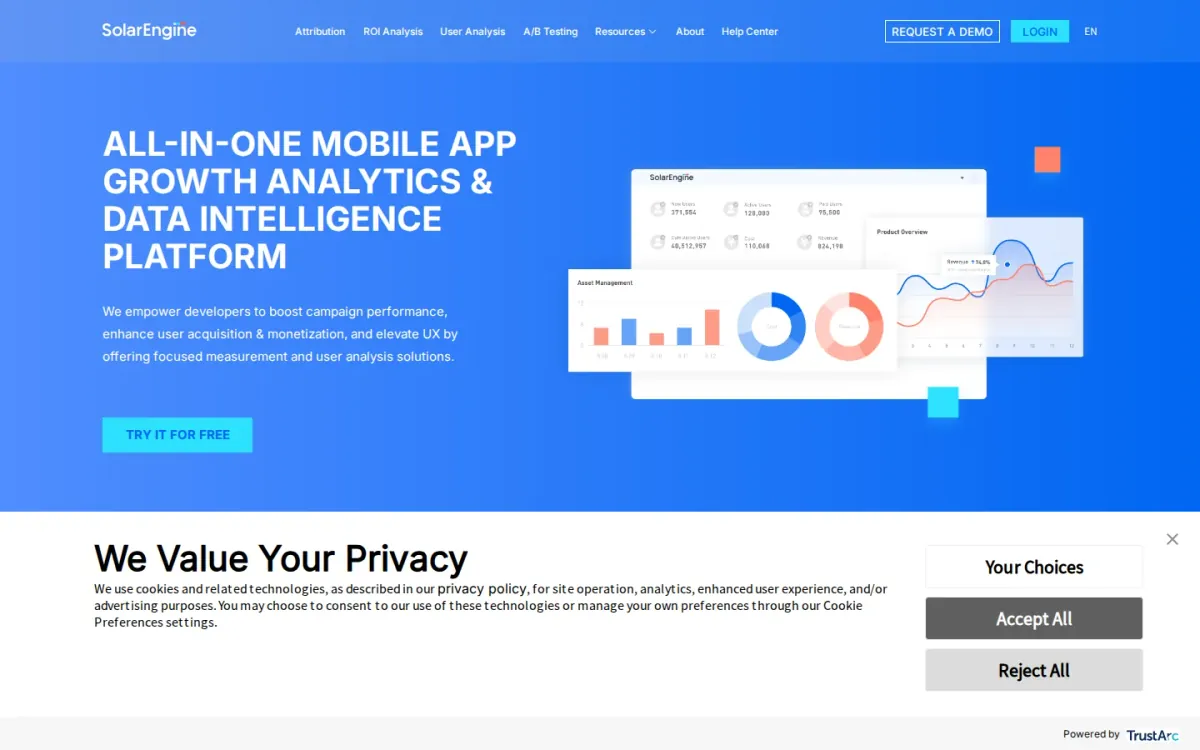
Solar Engine positions itself as a user-supplied reference page for app attribution and measurement solutions. That framing suggests a lightweight way to orient stakeholders, compare options at a glance, and keep notes centralized for marketing and analytics discussions.
Key features
- Solar Engine serves a user-supplied reference page.
- Solar Engine focuses on app attribution vendor context.
- Solar Engine supports lightweight option comparison framing.
Because it’s presented as a reference page rather than a full measurement suite, Solar Engine is best treated as a starting hub for evaluation. Use it to align on terminology, shortlist vendors, and document requirements before deeper technical validation and implementation work.
Why it ranks here
It earns a lower spot because it reads more like a curated reference than a full-featured attribution and analytics system.
Pros
- Clear positioning as a reference resource.
- Good for early-stage vendor shortlisting.
- Simple way to centralize attribution notes.
Limitations
- Not described as an end-to-end measurement platform.
- Limited detail on integrations and reporting.
Access: Current access details: solar-engine.com [9]. Verdict: It works best as an evaluation hub, not a primary attribution system for ongoing campaign measurement.
10. Incrmntal

Official source: incrmntal.com [10].
Best for: Advertisers who need cross-channel measurement without user-level tracking.
Incrmntal positions itself as an AI attribution platform built for privacy-first measurement, focusing on contribution rather than last-click matching. It aims to show the true impact of each advertising channel using aggregated data, not user-level identifiers.
Key features
- Incrmntal runs micro-experiments without pausing campaigns.
- Incrmntal measures iOS, Android, web, TV, CTV.
- Incrmntal unifies online and offline channels in one dashboard.
- Incrmntal analyzes external events like seasonality and promotions.
It supports cross-platform and offline measurement in one dashboard, spanning iOS, Android, web, TV/CTV, influencers, and more. It also factors in external events like seasonality and promotions, then surfaces actionable insights to guide budget allocation decisions.
Quick assessment
Strongest points: No-code setup with no SDK requirement.
Incrementality approach avoids user-level data dependence.
Actionable insights support ongoing budget allocation.
Main limitations: Limited public detail on specific integrations and reporting depth.
- Why it ranks here: Strong on privacy-led, cross-channel incrementality and lightweight onboarding, but the product story leans more on concepts than concrete workflow details.
Access: Current access details: incrmntal. Verdict: It suits teams prioritizing incrementality and privacy-led measurement across channels, especially when they want guidance for reallocating spend based on contribution.
How to choose
Workflow fit
Start by defining the measurement question that must be answered reliably: channel ROI, cohort LTV, incrementality, or deep-link driven re-engagement. Confirm the platform supports your privacy requirements, including SKAdNetwork workflows and consent-aware measurement where applicable.
Validation
Map required integrations early—ad networks, analytics, CDP, BI, and internal data pipelines—so attribution outputs match how decisions are made. Check how fraud prevention is handled and what controls exist for validation and auditing. Finally, assess operational fit: setup complexity, ownership across teams, and whether reporting can stay consistent as campaigns scale.
Final recommendations
Shortlist
- Mobile Attribution Platforms when attribution needs to feed daily budget decisions and media operations without extra reporting handoffs.
- If deep linking is central to growth, prioritize platforms that keep routing stable across ads, web, and messaging touchpoints.
Before rollout
- For organizations with complex channel mixes, favor tools that unify cost, attribution, and governance into a consistent reporting layer.
- consider incrementality-led measurement approaches that still guide spend allocation with defensible methodology.
Sources
- AdBid - Mobile Attribution Platforms
- Appsflyer
- Adjust
- Branch
- Singular
- Apptrove
- Airbridge
- Tenjin
- Solar Engine
- Incrmntal
Related reading: Mobile Attribution: App Tracking Guide
Related reading: Top 10 Free Attribution Tools