
- Meta Description: AdBid and nine other MCP marketing tools compared by features, limitations, access, and practical fit, with who each one fits best.
The Model Context Protocol gives AI systems a standardized way to interact with external data sources and tools. Marketing teams can now connect large language models directly to campaign platforms, analytics dashboards, and CRM systems. Instead of copying data between interfaces, users ask questions and receive actionable insights through a unified connection. Ten tools currently implement this protocol to streamline marketing operations. Each entry below reflects a specific approach to bridging AI capabilities with practical marketing workflows. The focus remains on functional utility rather than hype.
Comparison table
| Rank | Tool | Best for | Key capabilities | Limitations | Access/source status |
|---|---|---|---|---|---|
| 1 | AdBid - Meta Ads MCP [1] | Meta Ads teams wanting AI-driven campaign analysis and guarded write actions via MCP | Hosted remote MCP over Streamable HTTP; read and analysis tools with guarded writes | Cannot create or delete ad objects | Official source: AdBid.me [1] |
| 2 | Pipeboard [2] | Paid marketing teams using AI assistants for ad management | Connects major ad platforms; Integrates with AI assistants | Capabilities vary by platform | Official source: Pipeboard.co [2] |
| 3 | Markifact [3] | Marketing teams seeking production-ready execution and single-account management | Connects Meta Ads to AI assistants; Manages campaigns, creatives, ad sets | Not Meta's official MCP | Official source: Markifact.com [3] |
| 4 | Supermetrics [4] | Technical teams building custom AI agents | Single connection to multiple ad platforms; OAuth 2.0 per-user authentication | Requires technical setup for custom agents | Official source: Supermetrics.com [4] |
| 5 | Windsor [5] | AI clients needing multi-channel marketing data access and analysis | Hundreds of data connectors; Natural language data queries | No standalone user interface | Official source: mcp.Windsor.ai [5] |
| 6 | HubSpot [6] | AI model integration with CRM data | Secure AI access to CRM data; Developer Platform CLI interaction | Requires latest Developer Platform version | Official source: developers.HubSpot.com [6] |
| 7 | Klaviyo [7] | Email marketers automating campaign creation and flow analysis | Connects AI clients to Klaviyo APIs; Generates email campaigns from prompts | Limited to Klaviyo ecosystem data | Official source: developers.Klaviyo.com [7] |
| 8 | Metricool [8] | Social media managers seeking AI-driven conversational insights | Connects AI models for social tasks; Schedules posts via conversation | Lacks visual dashboard | Official source: Metricool.com [8] |
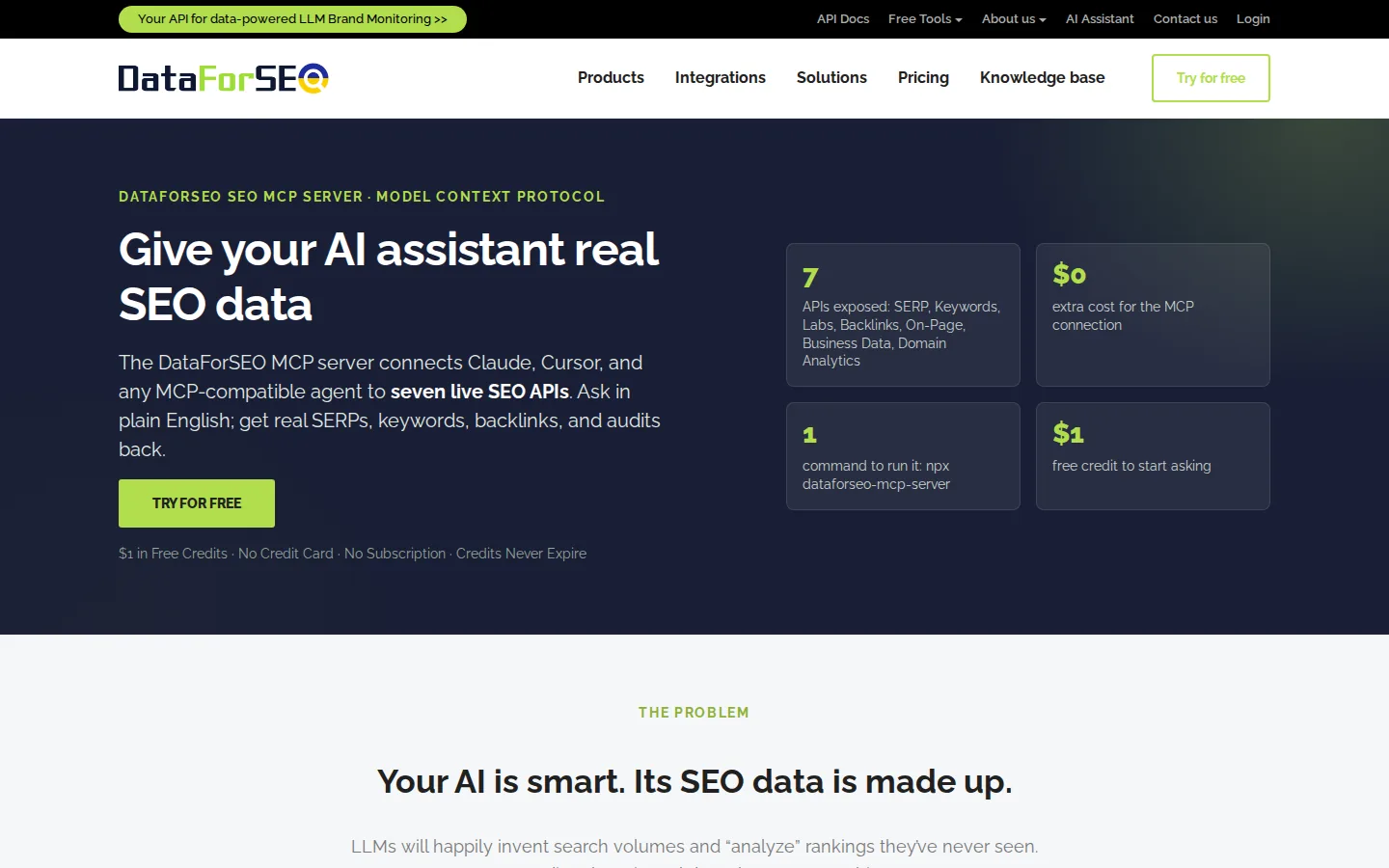
| 9 | Dataforseo [9] | Developers and marketers integrating SEO data into various platforms | Integrates SEO APIs into tools; Ready-made connectors for routine SEO workflows | Requires technical setup | Official source: Dataforseo.com [9] |
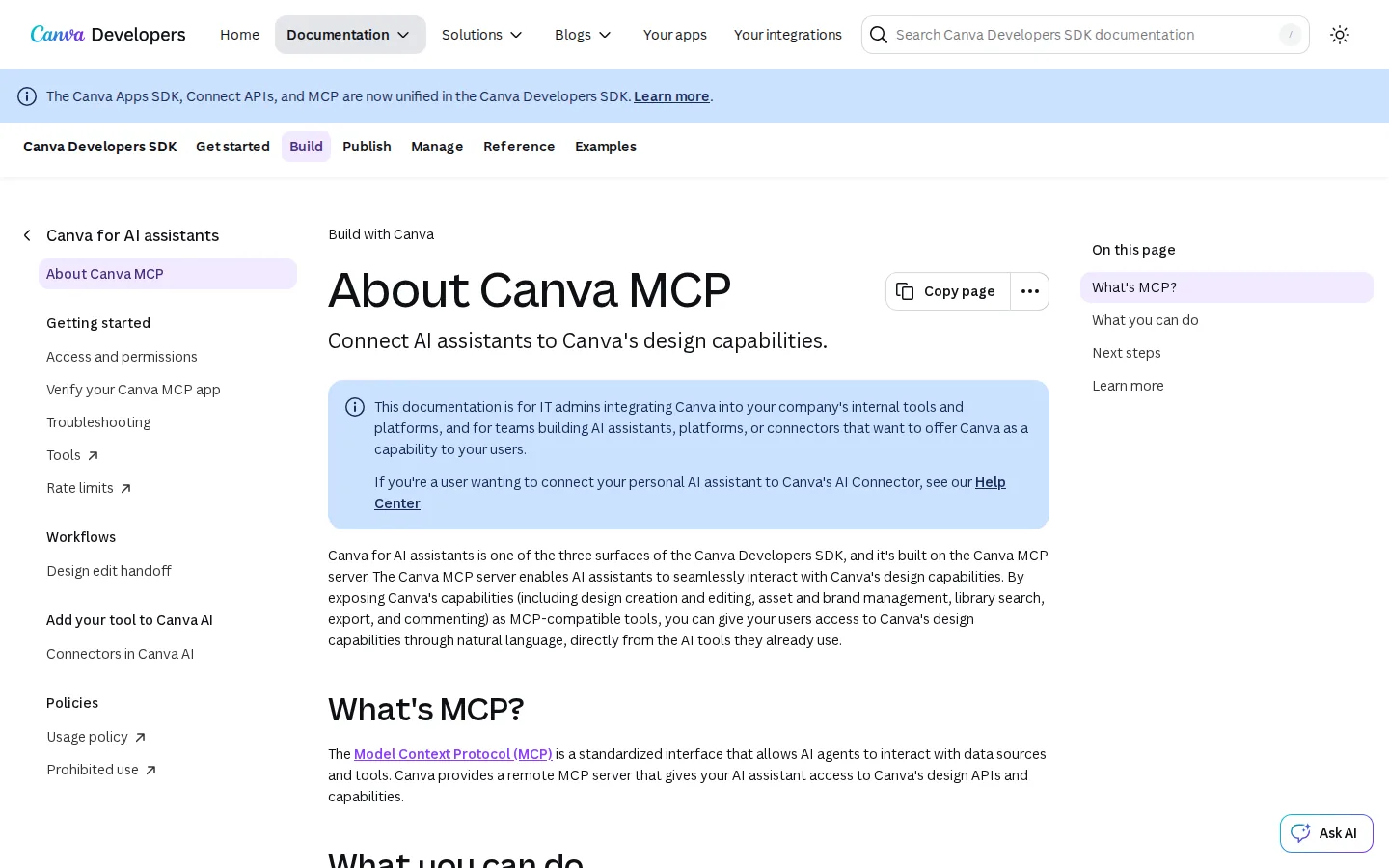
| 10 | Canva [10] | Teams integrating design generation into AI workflows | Programmatic design generation from text; Natural language design editing | Requires technical setup for integration | Official source: Canva.dev [10] |
How we evaluated the tools
Scoring relied on six weighted criteria. Task fit carried the most weight at 30%, assessing alignment with common marketing needs. Features and automation accounted for 20%, evaluating depth of functionality. Ease of use comprised 15%, focusing on setup and daily interaction. Integrations and workflow fit contributed 15%, measuring compatibility with existing stacks. Access transparency made up 10%, reviewing documentation and entry points. Limits and support formed the final 10%, examining constraints and help resources.
- Source basis: checks start with adbid.me [1] and continue through every linked official product page.
Scores are editorial assessments on a 100-point scale rather than customer ratings. Product pages supply the feature and access facts, and the same weighted rubric applies to every entry.
The order reflects fit for this comparison, not market share or brand familiarity. Each product links back to an official source so readers can verify current details.
1. AdBid
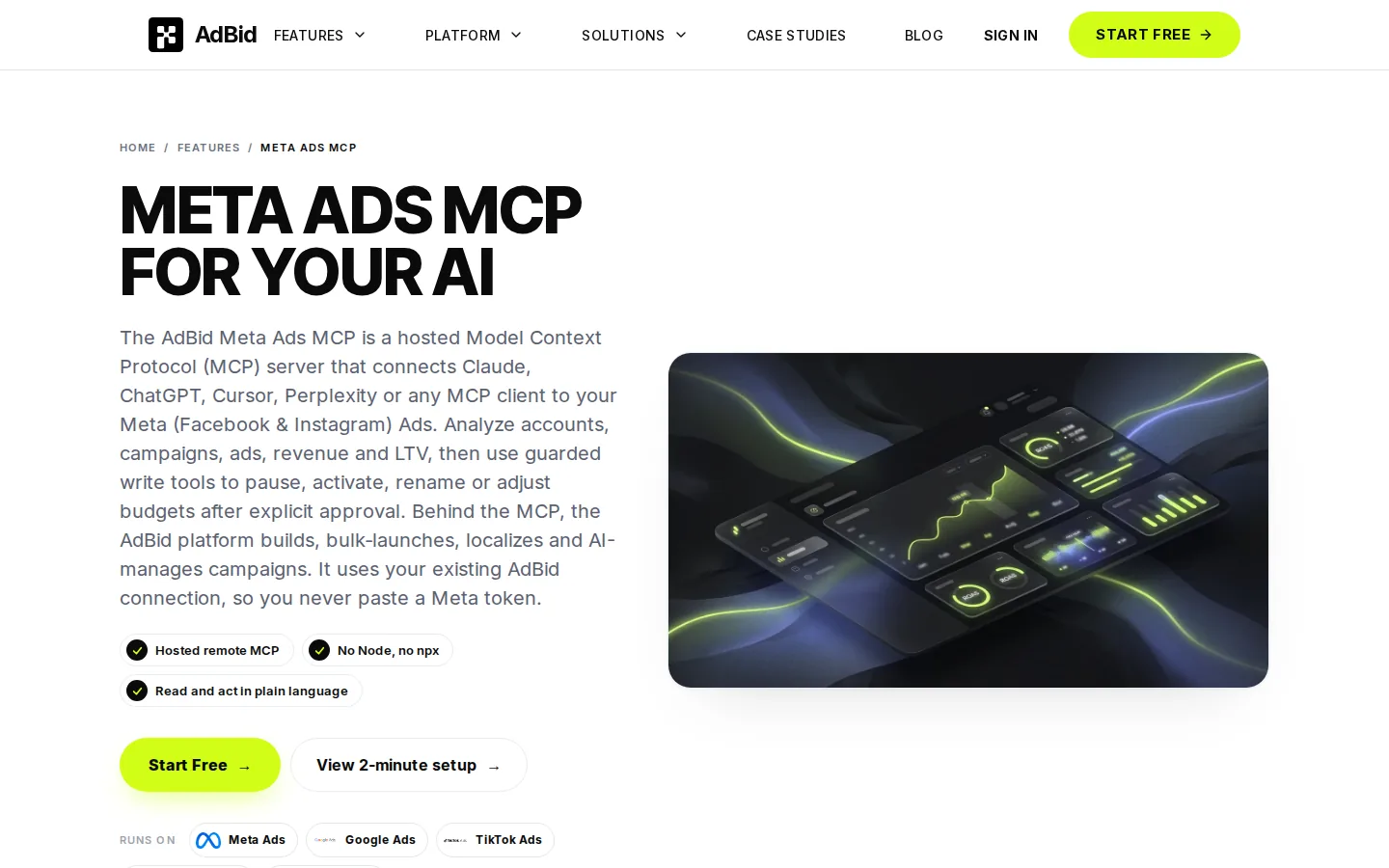
Best for: Meta Ads teams wanting AI-driven campaign analysis and guarded write actions via MCP.
AdBid connects Claude, ChatGPT, or Cursor directly to Meta Ads through a hosted MCP server. Marketers can analyze campaigns and revenue in plain language without pasting tokens. It pairs read tools with guarded writes for pausing, renaming, or adjusting budgets.
Features and trade-offs
Key features
- Hosted remote MCP over Streamable HTTP.
- Dedicated read tools and analysis prompts for campaign data.
- Guarded write tools requiring explicit confirmation.
- Bulk launch across many ad accounts.
Behind the MCP layer, AdBid builds, bulk-launches, localizes, and AI-manages campaigns across Meta, Google, TikTok, and Snapchat. One key reads every connected account, and every change requires explicit confirmation. This keeps automation safe while scaling ad operations.
Why it ranks here
Combines dedicated read and analysis tools with a full campaign platform, giving Meta Ads teams both depth and control in one connection.
Pros
- No Meta token pasting needed.
- Works with Claude, ChatGPT, Cursor, Perplexity.
- Revocable MCP keys for access control.
Limitations
- Cannot create or delete ad objects.
- Value transparency scores low.
Access and verdict
Access: Access conditions are documented on adbid.me [1]. Verdict: AdBid delivers practical Meta Ads automation through MCP, balancing AI-assisted analysis with safe, approval-gated campaign management.
2. Pipeboard
- Official source: pipeboard.co [2].
Best for: Paid marketing teams using AI assistants for ad management.
Pipeboard integrates AI assistants like Claude and ChatGPT with major ad platforms, including Meta Ads and Google Ads. It uses Model Context Protocol to enable AI to interact with advertising data and execute actions.
Key features
Connects major ad platforms; Integrates with AI assistants.
Also documented: Enables AI campaign actions; Uncovers wasted ad spend.
Marketing teams can launch campaigns, identify wasted spend, and request changes directly through their preferred AI assistant. Pipeboard streamlines ad account management with AI-driven insights across platforms.
Pipeboard — why it ranks here
It stands out for direct Model Context Protocol integration, enabling AI assistants to manage diverse ad platforms effectively.
Strengths: Pipeboard streamlines ad account management; AI assistants manage campaign changes; Supports multiple advertising platforms.
Limitations: Capabilities vary by platform; Requires careful permission setup.
Access: The terms that apply now sit on pipeboard.co [2]. Verdict: Essential for teams seeking AI-powered automation across multiple paid marketing channels. The final choice depends on the surrounding workflow and constraints.
3. Markifact
Official source: markifact.com [3].
Best for: Marketing teams seeking production-ready execution and single-account management.
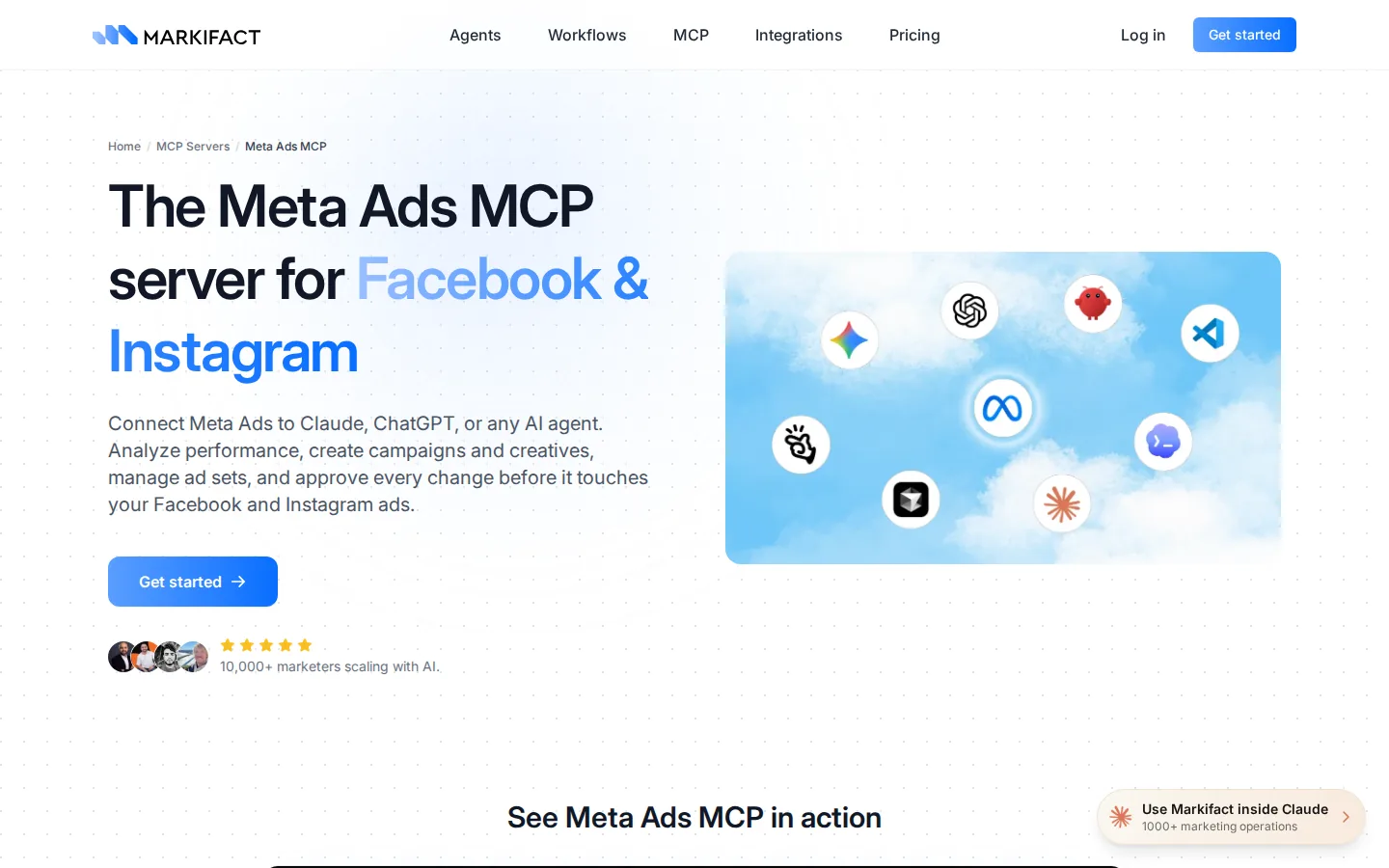
Markifact connects Meta Ads to AI assistants like Claude and ChatGPT via the Model Context Protocol. Users can manage campaigns, create ad creatives, optimize ad sets, and handle Advantage+ features using natural language prompts.
Key features
- Connects Meta Ads to AI assistants.
- Manages campaigns, creatives, ad sets.
- Full read and write ad account access.
- Researches, launches, reports, optimizes ads.
It offers full read and write access to ad accounts, supporting research, launch, reporting, and optimization workflows. It functions as a third-party marketing automation solution, approved by Meta.
Quick assessment
Strongest points: Uses plain English for ad management.
Approved Meta tech provider status.
Integrates with multiple AI clients.
Main limitations: Not Meta's official MCP.
Setup varies across AI clients.
- Why it ranks here: Markifact provides reliable Meta Ads management through AI, offering full ad account control and workflow integration for marketing teams.
Access: Official access details are listed on markifact.com [3]. Verdict: A capable third-party solution for AI-driven Meta Ads execution and optimization.
4. Supermetrics
- Official source: supermetrics.com [4].
Best for: Technical teams building custom AI agents.
Supermetrics MCP connects AI agents directly to live marketing platforms through a single authenticated interface. It eliminates manual exports by enabling real-time queries across advertising and analytics tools. No individual API integrations are required for each.
Key features
Single connection to multiple ad platforms; OAuth 2.0 per-user authentication.
Also documented: Real-time live API data queries; Server-to-server API key support.
Supermetrics MCP is built for teams that already run custom AI agents and need a reliable data layer underneath. Its OAuth 2.0 authentication and live API queries suit engineering-led workflows where accuracy matters more than a polished chat interface.
Supermetrics — why it ranks here
It offers broad source coverage and strict data accuracy, though its developer-focused setup limits accessibility for non-technical marketing teams seeking simple chat interfaces.
Strengths: Prevents AI hallucinations with live data; Maintains connectors for all platforms automatically.
Limitations: Requires technical setup for custom agents; Less intuitive than chat interfaces.
Access: Current access terms come from supermetrics.com [4]. Verdict: Supermetrics MCP delivers reliable, live marketing data to AI agents, but demands technical expertise that general marketers may lack.
5. Windsor
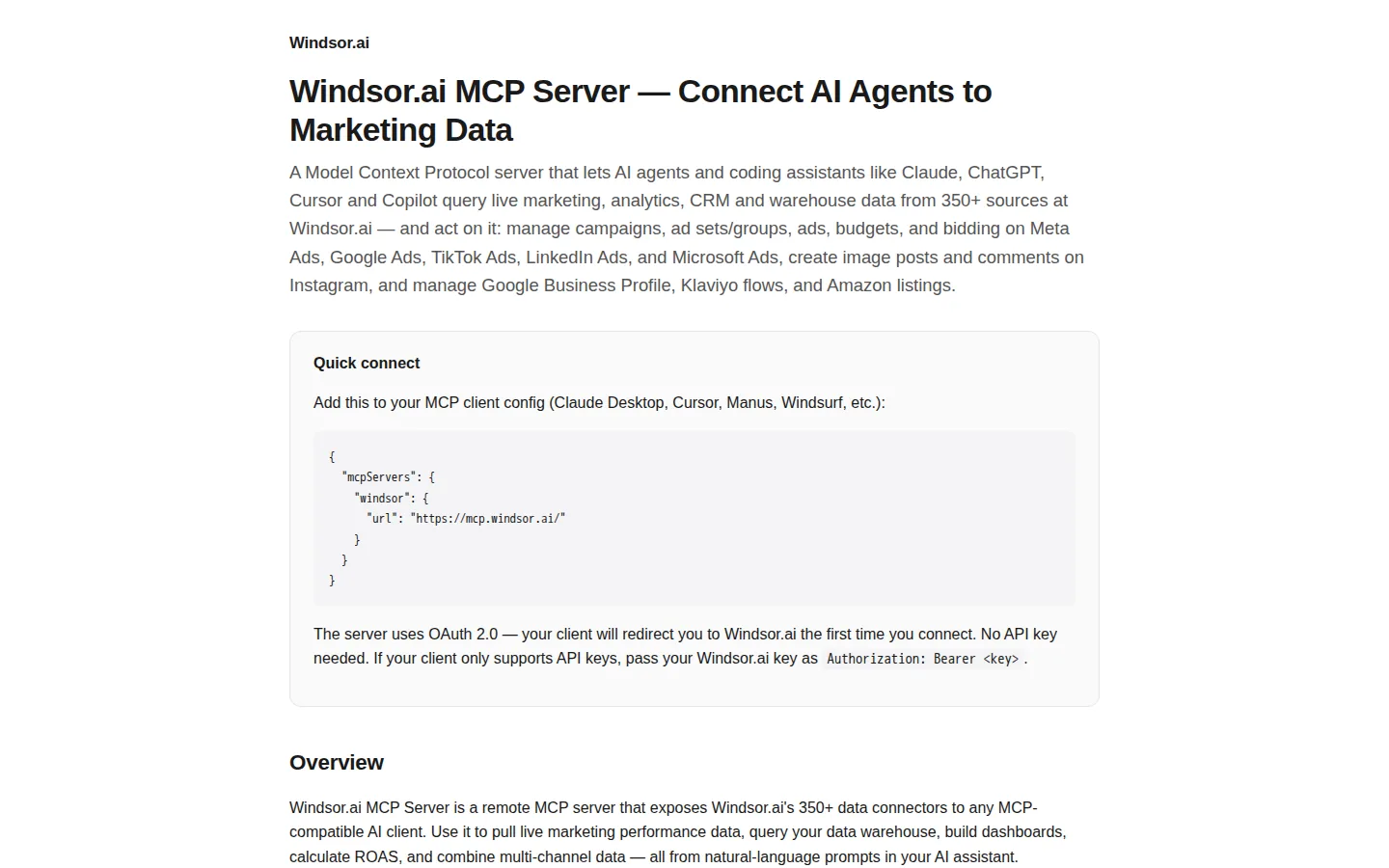
Official source: mcp.windsor.ai [5].
Best for: AI clients needing multi-channel marketing data access and analysis.
Windsor.ai MCP Server connects hundreds of data sources to any compatible AI client. Users can pull live marketing performance data, query data warehouses, and build dashboards directly from natural language prompts.
Key features
- Hundreds of data connectors.
- Natural language data queries.
This server facilitates calculating ROAS and combining multi-channel data for unified reports. It supports various AI assistants like Claude, ChatGPT, and Google Gemini, integrating smoothly into existing marketing performance management workflows.
Why it ranks here
Windsor integrates a broad connector library with AI clients, enabling natural language queries for complex marketing performance management tasks and custom field creation.
Pros
- Connects diverse marketing data sources.
- Enables data queries via prompts.
- Supports many AI client platforms.
Limitations
- No standalone user interface.
- Relies on AI client for interaction.
Access: Documented access terms appear on mcp.windsor.ai [5]. Verdict: An essential server for AI-driven marketing performance management, centralizing diverse data sources for intelligent analysis.
6. HubSpot
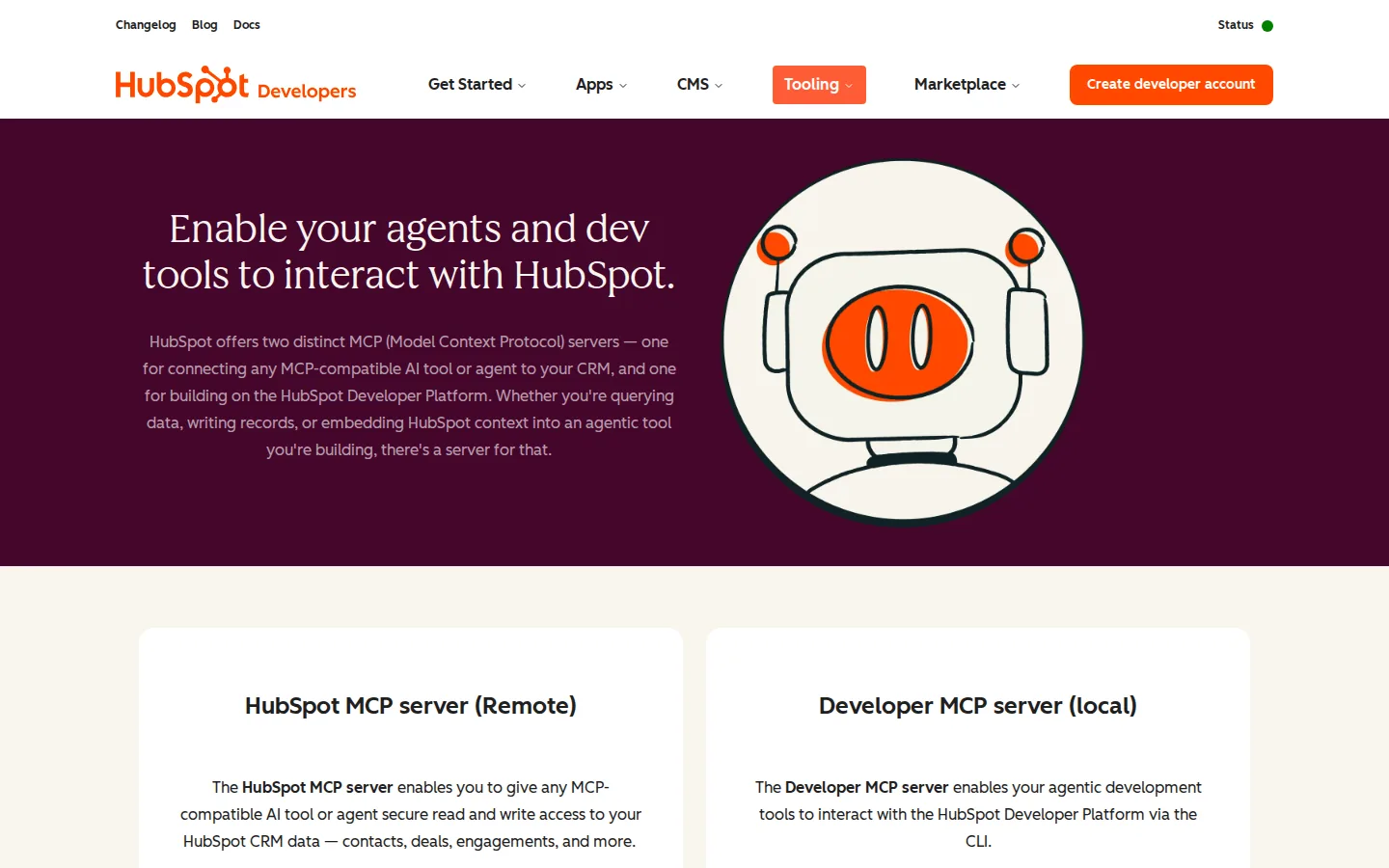
Official source: developers.hubspot.com [6].
Best for: AI model integration with CRM data.
HubSpot provides two distinct MCP servers enabling secure AI interactions with CRM data and the Developer Platform. These servers allow AI tools to fetch real-time contact, deal, and engagement information. The result is streamlined workflows and enhanced data accessibility for technical teams.
Key features
- Secure AI access to CRM data.
- Developer Platform CLI interaction.
- Real-time data fetching capabilities.
HubSpot MCP is purpose-built for teams already operating inside the HubSpot ecosystem. Its dual-server architecture separates CRM data access from developer tooling, letting each audience connect without overlap. Teams outside HubSpot will find limited value here.
Quick assessment
Strongest points: Supports diverse AI tool integrations.
Enables custom agent development.
Main limitations: Requires latest Developer Platform version.
- Why it ranks here: HubSpot excels in secure, standardized AI integration with CRM data Offering tailored servers for both general AI tools and developer platforms.
Access: Access conditions are documented on developers.hubspot.com [6]. Verdict: Its MCP servers are ideal for technical teams seeking secure AI-driven CRM interactions within the HubSpot ecosystem.
7. Klaviyo
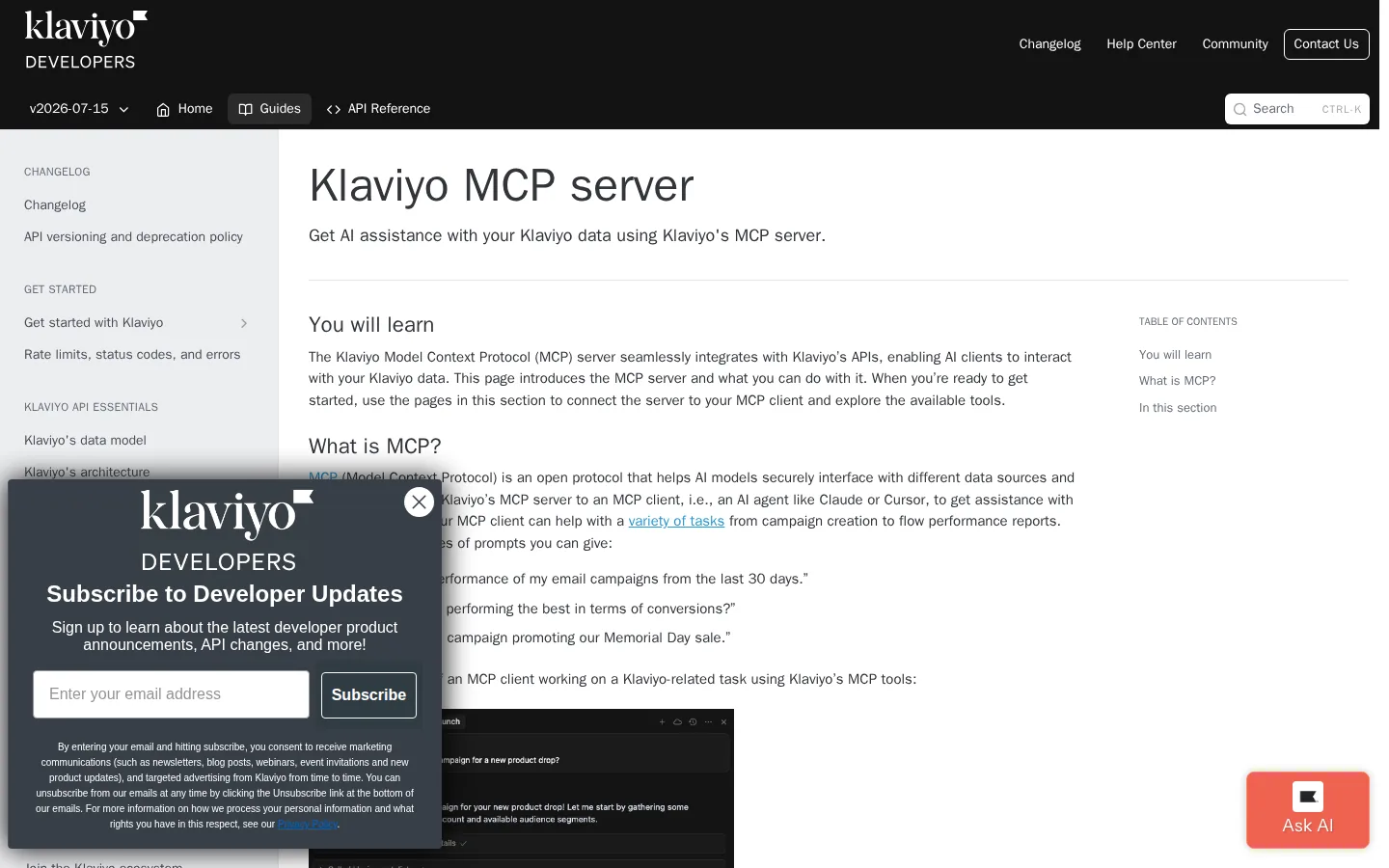
- Official source: developers.klaviyo.com [7].
Best for: Email marketers automating campaign creation and flow analysis.
Klaviyo connects its APIs to AI clients like Claude, letting users query campaign performance and create email flows through simple prompts. This integration targets marketers who need direct data access without manual dashboard navigation.
Key features
Connects AI clients to Klaviyo APIs; Generates email campaigns from prompts.
Also documented: Queries flow conversion performance; Exposes read-only and write tools.
Marketers can ask which flows convert best or request new email drafts for upcoming sales. The server exposes specific Klaviyo tools, enabling AI agents to read metrics and execute actions directly within the email marketing environment.
Klaviyo — why it ranks here
Directly connects AI agents to Klaviyo's email data, streamlining campaign creation and performance analysis without leaving the chat interface.
Strengths: AI agents execute email tasks directly; Prompts generate specific campaign drafts.
Limitations: Limited to Klaviyo ecosystem data; Requires external AI client setup.
Access: The terms that apply now sit on developers.klaviyo.com [7]. Verdict: Klaviyo's MCP server bridges AI chat interfaces with email marketing data, simplifying campaign creation and performance tracking.
8. Metricool
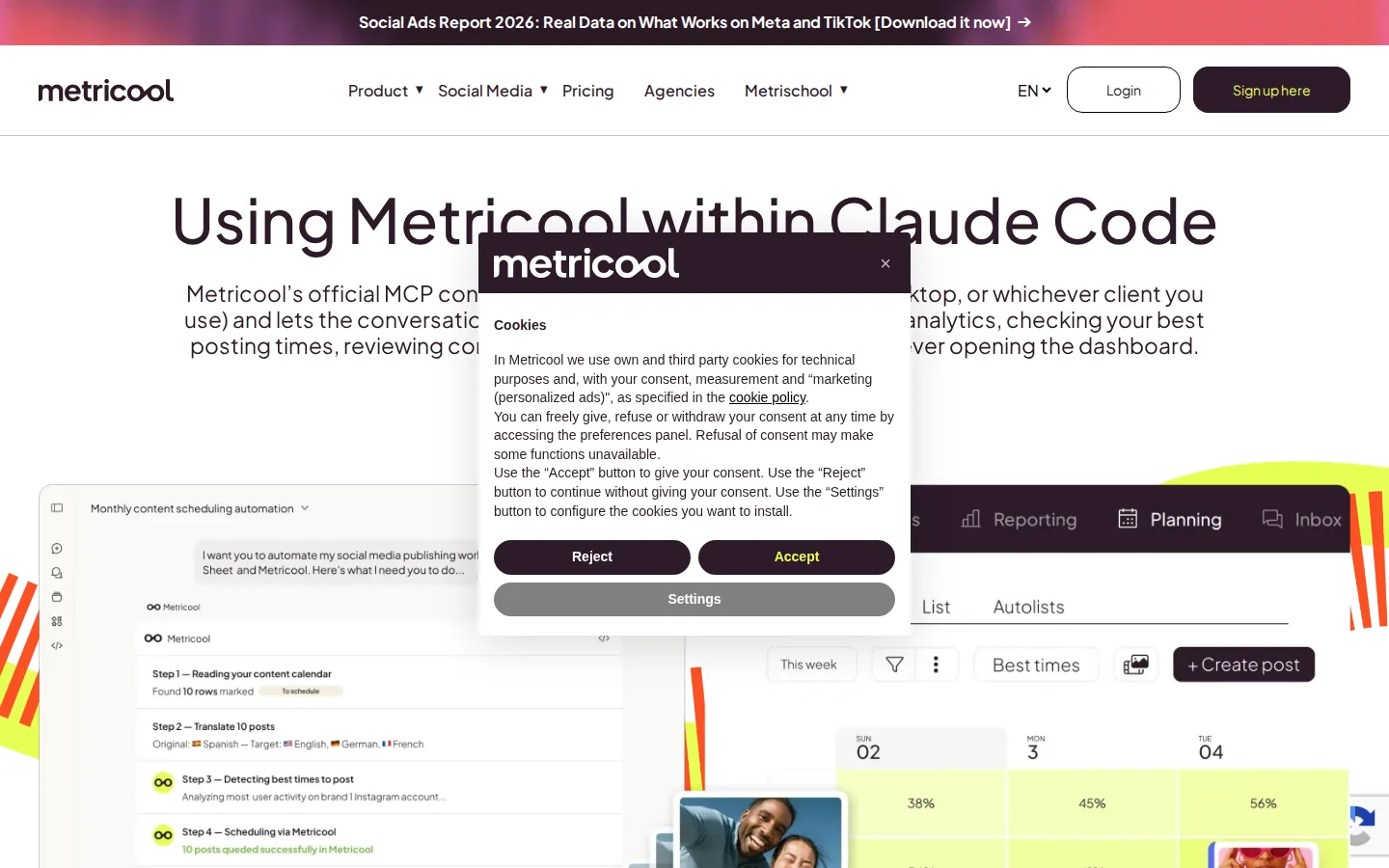
- Official source: metricool.com [8].
Best for: Social media managers seeking AI-driven conversational insights.
Metricool's MCP links your account with AI models like Claude. It enables social network management, post scheduling, and performance analysis through natural language conversations.
Key features
Connects AI models for social tasks; Schedules posts via conversation.
Also documented: Analyzes social media metrics; Compares competitor data.
Users query metrics, compare competitor data, and check ad campaign performance across platforms like Instagram, TikTok, and Meta Ads. Metricool simplifies complex social tasks through conversation rather than dashboard navigation.
Metricool — why it ranks here
It offers a unique conversational approach to social media management. Its broad platform support and natural language interface make it accessible to non-technical users.
Strengths: Plain language interaction; No coding knowledge required; Bypasses dashboard navigation.
Limitations: Lacks visual dashboard.
Access: Official access details are listed on metricool.com [8]. Verdict: Metricool provides an innovative, conversational interface for social media management, simplifying analytics and scheduling through AI interaction.
9. Dataforseo
Official source: dataforseo.com [9].
Best for: Developers and marketers integrating SEO data into various platforms.
Dataforseo provides a marketing channel platform for integrating its SEO APIs into popular tools. It offers ready-made connectors for accessing high-quality SEO data without extensive code.
Key features
- Integrates SEO APIs into tools.
- Ready-made connectors for routine SEO workflows.
- Connects with ChatGPT, Gemini.
- Docker and NPX deployment.
It supports AI chat models like ChatGPT and Gemini, plus development environments such as Cursor. Users can deploy it remotely via HTTP or locally with NPX or Docker.
Why it ranks here
Its strong API integration across diverse platforms, coupled with flexible deployment, serves technical users needing specialized SEO data.
Pros
- Integrates Dataforseo APIs without code.
- Accesses high-quality SEO data.
- Supports multiple AI and dev platforms.
Limitations
- Focuses exclusively on Dataforseo APIs.
Access: Current access terms come from dataforseo.com [9]. Verdict: A capable solution for developers needing specific SEO data integration across multiple marketing channels.
10. Canva
Official source: canva.dev [10].
Best for: Teams integrating design generation into AI workflows.
Canva MCP exposes design creation, editing, and asset management capabilities to AI assistants through a standardized Model Context Protocol server. It enables natural language interaction with Canva's extensive library and brand tools.
Key features
- Programmatic design generation from text.
- Natural language design editing.
- Brand kit and asset management.
- Multi-format design export capabilities.
Developers can programmatically generate designs, apply targeted edits, search libraries, manage brand kits, and export assets in multiple formats. The server supports collaborative workflows by integrating feedback loops directly into AI-driven design processes.
Quick assessment
Strongest points: Integrates with existing AI assistants.
Supports complex design workflows.
Manages brand assets centrally.
Main limitations: Requires technical setup for integration.
Rate limits apply to operations.
Why it ranks here: Canva offers broad design capabilities through MCP but requires technical integration for AI assistant connectivity.
Its position reflects its documented fit for design-focused workflows.
Access: Documented access terms appear on canva. Verdict: Strong choice for teams building AI-powered design workflows with technical resources.
How to choose
Workflow fit
If you run Meta Ads and need guarded write actions with AI analysis, start with AdBid. If you manage campaigns across Meta, Google, and TikTok simultaneously and want AI assistants handling execution, Pipeboard or Markifact fits better. For email marketing automation inside Klaviyo, Klaviyo's own MCP server is the direct path. Social media managers who want conversational scheduling and competitor analysis should look at Metricool.
Data and analytics scenarios
Teams that need multi-channel performance data fed into AI agents should compare Windsor and Supermetrics. Windsor suits analysts who want natural language queries across hundreds of sources without building custom code. Supermetrics fits engineering teams that already run custom agents and need OAuth-authenticated live data feeds. If your data lives in HubSpot's CRM, HubSpot's dual MCP servers remove the need for any third-party connector.
SEO and design scenarios
Developers integrating SEO data into AI tools or internal platforms should evaluate Dataforseo. Its ready-made connectors and flexible deployment options (HTTP, NPX, Docker) reduce setup time. Teams that need AI-generated or AI-edited design assets within a workflow should choose Canva MCP, provided they have technical resources for integration.
Validation checklist
Before committing, confirm three things. First, verify that the tool covers your primary advertising or analytics platform. Second, check whether the access model matches your team's technical capacity—hosted servers like AdBid require less setup than self-deployed options like Dataforseo. Third, assess the provider's transparency regarding data handling and protocol compliance to ensure long-term viability.
Final recommendations
Shortlist
- AdBid suits Meta Ads teams needing AI analysis with guarded write actions.
- Pipeboard fits paid marketing teams using AI assistants for multi-platform ad management.
- Markifact works for teams seeking production-ready Meta Ads execution with full read-write access.
- Supermetrics serves technical teams building custom AI agents that need live, authenticated data.
- Windsor helps analysts querying multi-channel marketing data through natural language prompts.
When another option fits better
- Choose HubSpot if your CRM data already lives there and you need AI access without a third-party layer.
- Choose Klaviyo if email flow analysis and campaign generation are your primary use cases.
- Choose Metricool if social media scheduling and competitor comparison matter more than ad platform depth.
- Choose Dataforseo if your team needs SEO-specific data piped into AI tools or internal dashboards.
- Choose Canva if design generation and brand asset management belong inside your AI workflow.
Before rollout
Start with a single use case rather than connecting every platform at once. Confirm that your AI client supports the MCP transport method the tool uses. Review permission scopes before granting write access, especially for tools that modify live campaigns.