

Agentic marketing is the subset of AI-driven marketing where agents set the plan, act on it, and adjust it in real time. No human edits the workflow mid-execution. Unlike traditional automation that routes decisions back to a person before acting, agentic systems complete the decision cycle autonomously. The agent coordinates data, tools, and approvals across your marketing stack and responds to live performance signals as they emerge. This shift is an operating model change, not just a tool upgrade. It determines how efficiently marketing contributes to overall business performance.[1][2]
Key Takeaways
After reading this guide, you should be able to distinguish agentic systems from traditional automation, evaluate vendor claims, and identify which scenarios benefit most from autonomous execution.
- Agentic marketing resolves the full loop without human intervention. The agent adjusts mid-flight instead of waiting for a person to read a recommendation and update the workflow manually.[2]
- The agent orchestrates channels from a unified context. Email, paid social, and on-site messaging become interchangeable execution surfaces rather than siloed systems.[4]
- As noted in the capabilities section, launch cycles can compress from weeks to days when an agent handles brief-to-launch coordination.[4]
- The best AI agent for marketing passes two tests: it raises an opportunity you did not ask about, and that opportunity comes from your own customer behavior rather than a generic model.[3][7]
- Marketers define the desired outcome and the constraints — not the workflow. Over time, the agent improves at the same goal without manual rule updates.[4]
Defining Autonomous Marketing Agents
An autonomous marketing agent perceives data, makes decisions, and executes multi-step workflows without constant human intervention. It differs from conventional automation, which follows predefined rules and routes decisions back to a person. The agent adapts mid-flight based on live performance signals, completing the full decision cycle on its own.[2]
Before agentic AI, marketing "AI" usually meant generative AI. A marketer asked for an output — a subject line, a landing page draft, an ad headline. The model produced it, and the human integrated it into an existing workflow. Agentic AI flips that relationship: the AI runs the workflow, and the human supervises strategy.[4]
Agentic systems coordinate across channels in a single workflow because the agent treats each channel as a tool, not as a separate platform with its own logic.[4] When a customer visits a website, an inbound decision — which offer, which channel — must resolve in tens of milliseconds against a pre-computed profile. The agent's planning and content generation run in the background loop in seconds.[2]
Key characteristics of autonomous marketing agents include:
- Real-time adaptation: Agents execute multi-step workflows, coordinating data, tools, and approvals to respond to live performance signals.[1]
- End-to-end execution: The agent adjusts mid-flight without human editing of the workflow.[2]
- Operational guidelines: Agents operate within brand guidelines that humans define and refine. These guidelines must be operational — covering brand voice, terminology, and messaging constraints.[2]
- Opportunity identification: The most effective agents identify opportunities not explicitly requested. They derive insights from customer behavior rather than generic models.[3]
- Integrated functionality: A powerful agent can be built directly into platforms like Slack or Teams. It pulls reports, finds creative assets, or initiates approval cycles without requiring logins to multiple systems.[1]
A unified customer data platform integrates these autonomous capabilities directly into the data foundation. This enables dynamic, responsive customer interactions without round-trip API calls that add latency and expose PII at each hop.[2]
The Agentic Workflow Lifecycle
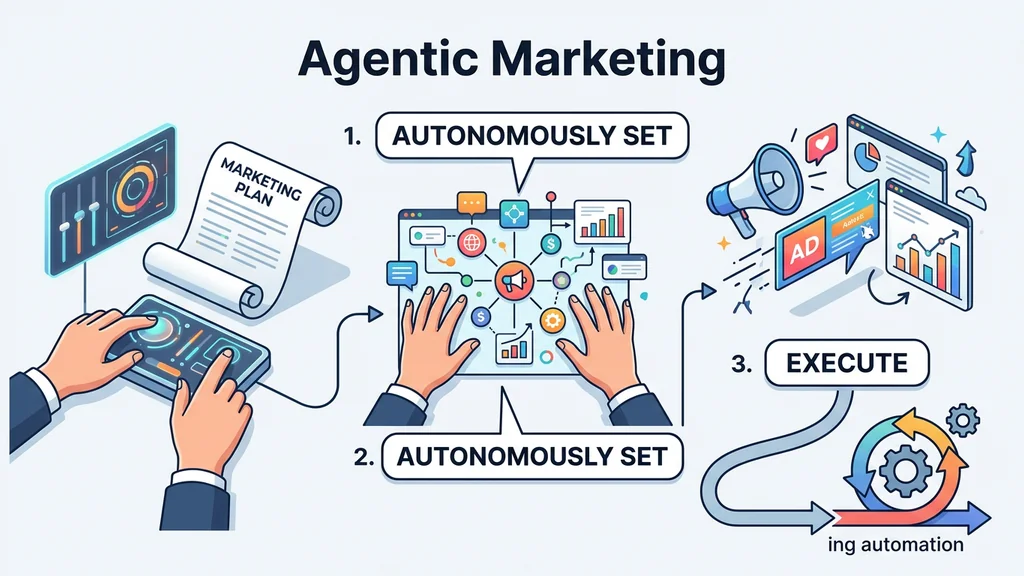
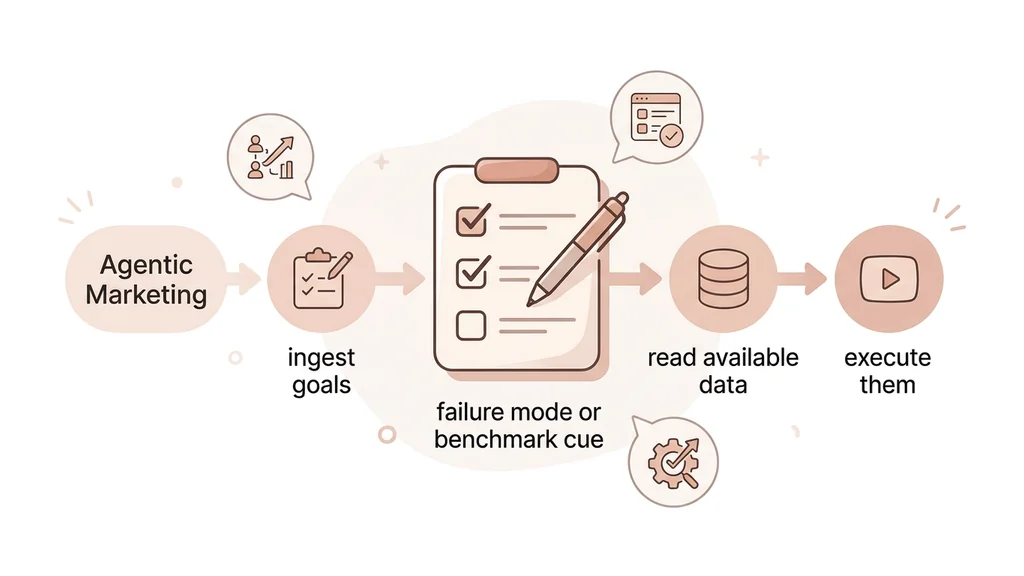
The agentic workflow lifecycle follows a repeatable loop: ingest goals, read available data and tools, decide a sequence of steps, execute them, and return results for review. The agent then uses performance feedback to refine its next cycle without manual rule updates.[2]
Goal ingestion and data reading. The agent reads whatever data and tools it can reach. It decides a sequence of steps, carries them out, and returns the result for review. This initial phase pulls campaign objectives, audience parameters, and channel constraints into a single planning context.[2]
Cross-channel coordination. Channels function as interchangeable execution surfaces within one workflow. The agent does not manage each platform separately. Email, paid social, and on-site messaging draw from the same decision context.[4]
Execution and maturation. Tools are the faster, cheaper starting point. A capable one closes its own narrow loop on data that stays in the stack. Draft-on-request tools become agents that write, test, and ship copy autonomously as the system matures.[2]
Model-driven reasoning. Software that answers well needs a good model. The underlying model quality determines whether the agent can reason about trade-offs between channels, budgets, and audience segments. It must go beyond following a decision tree.[3]
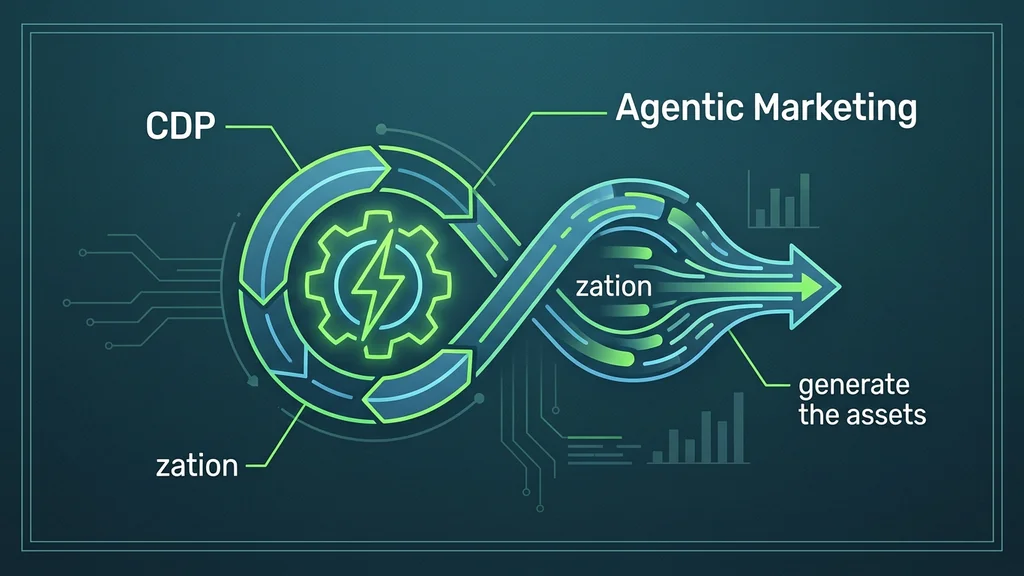
Continuous optimization. Over time, the agent gets measurably better at the same goal without a marketer manually updating workflow rules. Agentic systems unify workflow automation with real-time decisioning. The feedback loop compresses from weekly reporting cycles to continuous optimization.[4][5]
Key Functional Capabilities Explained
Agentic marketing capabilities span dynamic content personalization, cross-channel budget allocation, and predictive audience segmentation. Each agent operates autonomously within parameters set by humans. Launch cycles compress from weeks to days when the agent takes a campaign brief, researches the audience, generates assets, and triggers channels in one coordinated workflow.[4] This compression happens because the agent handles research, asset generation, and channel activation as a single sequence rather than a series of handoffs between specialists.
The table below maps function-level capabilities. Each is a narrower slice of the same shift, scoped by function, engine, or output rather than by autonomy level.[2]
| Capability | What the AI agent does | Speed context | Autonomy level |
|---|---|---|---|
| Dynamic personalization | Resolves which offer and channel to show per visitor | Tens of milliseconds against a pre-computed profile | Real-time inbound decision at point of interaction |
| Content generation | Writes, tests, and ships copy across formats | Background loop in seconds | Full content-to-launch without human editing |
| Budget allocation | Shifts spend across channels based on live signals | Continuous mid-campaign adjustment | Autonomous within guardrails |
| Audience segmentation | Scores and groups audiences from behavioral data | Batch or real-time depending on use case | Agent proposes, human approves |
| Campaign orchestration | Coordinates data, tools, and approvals in real time | Multi-step workflow execution | End-to-end without human editing |
Some tools automate a single function — copy generation, bid management, send-time optimization, or audience scoring. They sit beside the platform rather than replacing it.[2] As you shortlist vendor options, request demonstrations of how solutions handle autonomous workflows relevant to your operations.[1] The distinction between a point tool and a full agentic system determines whether you get isolated efficiency gains or compounding returns across the stack.
These platforms continuously learn from user behavior, intent, and preferences. They tailor messages, timing, and offers dynamically to the "segment of one."[5]
High-Impact Application Scenarios
Agentic marketing delivers the strongest returns in scenarios requiring real-time decisioning and mid-campaign learning. Batch use cases like churn scoring and lifetime-value modeling run fine on composable stacks. The latency gap only bites for real-time inbound decisioning and mid-campaign adjustment.[2] Specific ROI figures vary by vendor, industry, and baseline maturity. The scenarios below illustrate where the architecture creates the most leverage.
E-commerce cart abandonment recovery. A shopper adds items to cart and leaves. The agent detects the abandonment signal and selects the optimal re-engagement channel. It personalizes the message with the specific items viewed and adjusts send timing based on historical open patterns. Maximum frequency constraints — such as two messages per week with a 24-hour gap between sends — are encoded as hard guardrails.[2] The agent tests message variants autonomously. There is no separate experimentation phase because the experiment is built into the workflow.[4]
B2B lead nurturing at scale. A marketing team defines a goal: increase Q2 revenue by 10% using email and SMS. They set a maximum of two touches per week and a $100K budget.[2] The agent sequences touchpoints across the buyer journey. It adjusts messaging based on engagement signals and reallocates budget between channels as performance data accumulates. Insights that used to require a RevOps person to assemble manually become inputs to an automated decision.[4] As Docket's team puts it, this is the difference between a tool that makes a marketer 20% faster and a platform that lets your marketing org handle 10x the volume without 10x the headcount.[6] One named result: Demandbase reported that after deploying an agentic platform, the top complaint from sales reps — that Solutions Consultants responded too slowly — disappeared entirely within three quarters.[6]
Scaling personalized campaigns across markets. For multi-market campaigns, the agent generates localized content variants and tests them against regional performance data. It shifts budget toward the best-performing combinations. AI-led content generation with personalized copy and creatives enables this at scale.[5] The agent orchestrates channels from a unified context rather than managing each regional platform separately.[4]
Multi-touch attribution optimization. Cross-team friction, disconnected systems, and reactive decision-making delay launches and limit experimentation.[1] An agentic system unifies attribution data from all touchpoints into a single decision context. The agent identifies which channel combinations drive conversions and reallocates spend in real time. Each adjustment replaces a workflow that previously required either heavy manual lift or rigid, brittle automation.[4]
Current Limitations and Risks
Agentic marketing shifts execution to AI agents while humans supervise strategy. That shift introduces real constraints around privacy, bias, and brand control. Brands that ignore these constraints risk regulatory penalties and audience trust erosion before they see any efficiency gain.
The core tension is structural. Agentic AI flips the traditional relationship: the AI runs the workflow, and the human supervises strategy.[4] That inversion works well when guardrails are explicit. It creates exposure when they are not. A brand voice that depends on nuance, cultural sensitivity, or regulated claims cannot rely on autonomous output without a review layer. The generation model is now a commodity every brand shares.[2] Differentiation must come from strategy and oversight, not from the model itself.
Data privacy remains a primary concern. Agents that personalize at scale need access to behavioral signals. Any gap in consent management or data residency compliance becomes a liability. Algorithmic bias compounds the problem: if training data skews toward one demographic, the agent amplifies that skew across every channel it touches.
- If a vendor cannot explain their governance model in concrete terms, they are not agentic. This is the single most useful filter when evaluating platforms.[6]
- Prioritize vendors that support transparent reporting formats. This gives teams a clearer view of where and when automation is most effective.[1]
- Choose platforms that demonstrate strong integrations, true autonomy, robust governance, and measurable business impact. Skip any vendor that cannot show all four.[1]
- Human oversight should remain mandatory for creative strategy, especially in regulated industries. A single non-compliant message carries legal consequences.
- Define escalation rules before deployment. Specify which decisions an agent can make alone and which require human sign-off. Audit those boundaries quarterly.
A practical evaluation step: ask any vendor how their Salesforce integration handles custom objects, and whether it syncs activity history in real-time or on a delay.[6] The answer reveals whether the agent operates on live data or stale snapshots. Also ask the vendor to walk through a specific scenario where their agent made an incorrect decision. If they cannot name one, their system has not been tested under real conditions.
Marketers set goals, define guardrails, review key decisions, and retain veto power. This "human-in-the-loop" approach is a deliberate design choice — not a limitation of the technology.[4]
Frequently asked questions
How does agentic marketing differ from traditional marketing automation?
Traditional marketing automation and AI marketing both route decisions back to a human before acting. Agentic marketing resolves the full loop without human intervention. The agent adjusts mid-flight instead of waiting for a person to read a recommendation and update the workflow. The practical implication: marketing automation requires marketers to know the right path in advance and build it as a workflow. Agentic systems take goals as input, not workflows.[2][4]
What capabilities should I look for in an agentic marketing platform?
Choose a platform that passes two tests. It can raise an opportunity you did not ask about. What it raises comes from your own customer behavior rather than a generic model.[3] Also prioritize strong integrations, true autonomy rather than just automation, robust governance, and measurable business impact.[1] If a vendor cannot explain their governance model in concrete terms, they are not truly agentic.[6]
How do agentic systems handle brand guidelines and governance?
Agents operate within brand guidelines that humans define and refine. For agents, those guidelines only work if they are operational. They must cover brand voice, terminology, maximum message frequency, prohibited tactics like dark patterns, and sensitivity to customer context. For example: do not send promotional emails to someone who just complained.[2] The agent operates autonomously within these parameters.
Can agentic marketing reduce campaign launch times?
Yes. As noted in the capabilities section, launch cycles can compress from weeks to days when an agent handles the full brief-to-launch sequence.[4] This compression happens because the agent orchestrates channels from a unified context. It does not require separate platform management for each channel.
What is the difference between AI-assisted tools and true agentic systems?
AI-assisted tools automate a single function — copy generation, bid management, send-time optimization, or audience scoring. They sit beside the platform rather than replacing it.[2] A system with only two or three such capabilities is closer to AI-assisted automation. True agentic systems unify workflow automation with real-time decisioning. They complete the decision cycle without human workflow edits.[4][5]
Conclusion
Agentic marketing moves beyond isolated automation by letting AI agents plan, execute, and refine campaigns autonomously within human-defined guardrails. The shift reshapes how marketing teams operate and contribute to business outcomes. For marketing leaders operating under budget pressure, this translates into operational leverage — more campaigns, more insight, and more output without proportional increases in cost.[1] When evaluating platforms, prioritize strong integrations, true autonomy, robust governance, and measurable business impact. The organizations that succeed will treat this as an operating model transformation, not a software purchase.[1][2]
Related reading:
- Google Performance Max Review
- Meta Ads Automation
- How to Set Up Meta Conversions API
- ad creative testing
- advantage+ shopping campaigns
- facebook ad optimization