
Key Takeaways
:::highlight Campaign Planning Essentials Successful campaigns start with clear objectives, deep audience understanding, and realistic timelines. 65% of campaign failures trace back to poor planning, not poor execution. The best creative can't overcome unclear strategy. :::
- Start with objectives — What does success look like?
- Know your audience — Generic campaigns produce generic results
- Plan the full journey — One touchpoint rarely converts
- Build in flexibility — Optimization requires room to adjust
- Measure what matters — Align metrics to objectives
Pricing scales with spend, not seats — see how AdBid works for teams running paid acquisition seriously.
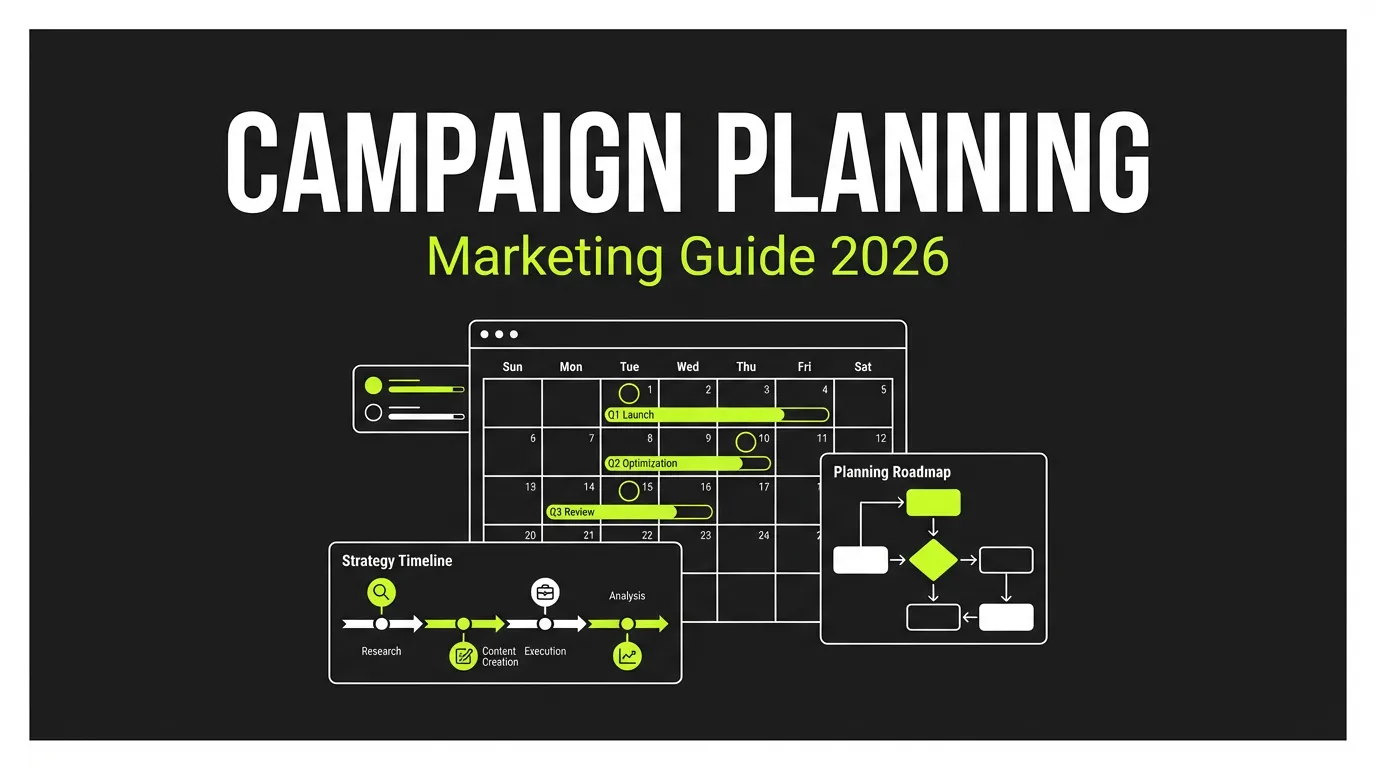
The Campaign Planning Framework
Phase 1: Strategy Development
Define what you're trying to achieve and why.
Key questions:
- What business objective does this support?
- Who are we trying to reach?
- What do we want them to do?
- How will we know if it worked?
Phase 2: Audience Research
Understand who you're speaking to.
Research methods:
- Customer data analysis
- Surveys and interviews
- Social listening
- Competitive analysis
- Persona development
Phase 3: Creative Development
Develop messages and assets.
Deliverables:
- Creative brief
- Key messages
- Visual concepts
- Ad formats
- Landing pages
Phase 4: Media Planning
Determine where and when to reach your audience.
Considerations:
- Channel selection
- Budget allocation
- Timing and flighting
- Frequency management
Phase 5: Execution
Launch and manage the campaign.
Activities:
- Campaign setup
- Quality assurance
- Launch monitoring
- Real-time optimization
Phase 6: Measurement
Evaluate results and learn.
Components:
- Performance tracking
- Attribution analysis
- Reporting
- Post-campaign analysis
Phase 1: Strategy Development
Setting Campaign Objectives
Use the SMART framework:
| Element | Description | Example |
|---|---|---|
| Specific | Clear, precise goal | "Increase trial sign-ups" |
| Measurable | Quantifiable | "By 500 trials" |
| Achievable | Realistic | "Based on historical rates" |
| Relevant | Tied to business goals | "Supports Q2 revenue target" |
| Time-bound | Deadline | "Within 6 weeks" |
Objective Types
| Objective | Primary KPI | Campaign Focus |
|---|---|---|
| Awareness | Reach, impressions | Brand visibility |
| Consideration | Engagement, traffic | Education, interest |
| Conversion | Sign-ups, purchases | Action |
| Retention | Repeat, LTV | Loyalty |
| Advocacy | Referrals, reviews | Word of mouth |
:::tip Objective Clarity If you can't clearly articulate what success looks like, stop and clarify before planning further. Vague objectives lead to vague results. :::
Budget Framework
Determine investment level:
Budget Considerations:
├── What's the value of the objective? (revenue potential)
├── What's the cost to achieve? (CPX benchmarks)
├── What's affordable? (budget constraints)
└── What's the risk tolerance? (testing vs. proven)

Rule of thumb:
Conservative: 2-3% of target revenue
Moderate: 5-7% of target revenue
Aggressive: 10%+ of target revenue
Phase 2: Audience Research
Audience Definition
Move beyond demographics:
| Layer | Example Questions |
|---|---|
| Demographics | Who are they? (age, location, income) |
| Psychographics | What do they value? (attitudes, interests) |
| Behaviors | What do they do? (purchase habits, media use) |
| Needs | What problems do they have? |
| Journey | Where are they in the buying process? |
Persona Development
Create detailed audience profiles:
Persona: Marketing Manager Maria
├── Demographics: 32, urban, $85K income
├── Goals: Prove marketing ROI, get promoted
├── Challenges: Limited budget, attribution complexity
├── Information sources: LinkedIn, podcasts, peers
├── Buying behavior: Research heavy, needs approval
├── Key messages: Efficiency, proof, career growth
└── Channels: LinkedIn, Google, email, webinars
Competitive Analysis
Understand the landscape:
| Analysis | Purpose |
|---|---|
| Competitor messaging | What are they saying? |
| Share of voice | How much are they spending? |
| Creative approach | What's working for them? |
| Channel presence | Where are they reaching audience? |
| Positioning gaps | Where can you differentiate? |
Phase 3: Creative Development
The Creative Brief
Document creative direction:
| Section | Content |
|---|---|
| Objective | What must this creative accomplish? |
| Audience | Who are we speaking to? |
| Insight | What human truth are we leveraging? |
| Message | What's the one thing they should remember? |
| Support | Why should they believe us? |
| Tone | How should it feel? |
| Mandatories | Required elements (logo, legal, etc.) |
Message Hierarchy
Prioritize your communication:
Primary message: The one thing you must communicate
├── Supporting point 1: Rational benefit
├── Supporting point 2: Emotional benefit
├── Supporting point 3: Proof point
└── Call to action: What to do next
Creative Development Process
| Stage | Activities |
|---|---|
| Briefing | Share brief, align on direction |
| Concepting | Generate multiple creative directions |
| Review | Evaluate against brief, select direction |
| Production | Build final assets |
| QA | Test across formats, proofread |
:::warning Creative Pitfalls
- Trying to say too much (focus!)
- Creating for yourself, not audience
- Ignoring platform best practices
- Insufficient format variations
- No testing plan :::
Phase 4: Media Planning
Channel Selection
Match channels to objectives and audience:
| Channel | Best For | Audience Signal |
|---|---|---|
| Paid Search | High intent | Active searching |
| Paid Social | Awareness + conversion | Passive + targetable |
| Display | Awareness, retargeting | Broad reach |
| Video | Storytelling, awareness | Attention |
| Native | Content, consideration | Reading content |
| Retention, conversion | Existing relationship |
Media Mix Planning
Balance channels:
Example Mix (Conversion Campaign):
├── Paid Search: 40% (high intent capture)
├── Paid Social: 30% (demand generation)
├── Display/Retargeting: 15% (re-engagement)
├── Native: 10% (content promotion)
└── Email: 5% (existing audience)
Timing and Flighting
Plan campaign timing:
| Pattern | Description | Best For |
|---|---|---|
| Continuous | Steady spend over time | Always-on awareness |
| Flighting | Periods of activity and rest | Seasonal, budget-limited |
| Pulsing | Continuous + periodic spikes | Ongoing + promotional |
| Front-loaded | Heavy start, taper down | Launch, urgency |
Budget Allocation
Distribute budget strategically:
Allocation Framework:
├── By channel: Based on expected efficiency
├── By audience: More to high-value segments
├── By time: Match to demand patterns
├── By creative: More to proven winners
└── Testing reserve: 10-20% for optimization
Phase 5: Execution
Campaign Setup Checklist
Pre-launch verification:
| Category | Checks |
|---|---|
| Tracking | Pixels installed, conversions tracked |
| Creative | Assets uploaded, approved, QA'd |
| Targeting | Audiences defined, exclusions set |
| Budget | Budgets set, pacing configured |
| Bidding | Strategies selected, targets set |
| Landing pages | Live, tracking, fast loading |
Launch Protocol
Structured launch approach:
Launch Day:
├── Hour 1: Verify all campaigns active
├── Hour 4: Check initial delivery
├── Hour 8: Review early performance
└── Day 1: Full performance review

First Week:
├── Daily monitoring
├── Initial optimization
├── Troubleshooting issues
└── Learning phase management
Optimization Framework
Ongoing improvement:
| Timeframe | Focus |
|---|---|
| Daily | Delivery, pacing, errors |
| Weekly | Performance vs. KPIs, bid adjustments |
| Bi-weekly | Creative refresh, audience optimization |
| Monthly | Strategic review, reallocation |
:::tip Optimization Discipline Don't change everything at once. Make single changes, measure impact, then iterate. Changing multiple variables prevents learning. :::
Phase 6: Measurement
KPI Framework
Align metrics to objectives:
| Objective | Primary KPI | Secondary KPIs |
|---|---|---|
| Awareness | Reach | Impressions, frequency |
| Engagement | CTR | Time on site, views |
| Traffic | Sessions | New users, bounce rate |
| Leads | Conversions | CPL, lead quality |
| Revenue | ROAS | Revenue, transactions |
Reporting Cadence
| Report | Frequency | Content |
|---|---|---|
| Dashboard | Daily | Key metrics, alerts |
| Performance | Weekly | KPIs vs. targets, trends |
| Optimization | Bi-weekly | Test results, recommendations |
| Executive | Monthly | Summary, insights, asks |
| Post-campaign | End | Full analysis, learnings |
Attribution Considerations
Understand contribution:
Attribution Models:
├── Last-click: Credit to final touchpoint
├── First-click: Credit to discovery touchpoint
├── Linear: Equal credit across touchpoints
├── Data-driven: Algorithmic weighting
└── Incrementality: True lift measurement

Best practice: Use multiple views, triangulate
Campaign Planning Templates
Campaign Brief Template
Campaign Brief: [Name]

1. Business Objective
   What business goal does this support?

2. Campaign Objective
   Specific, measurable campaign goal

3. Target Audience
   Who are we trying to reach?

4. Key Message
   What's the one thing to communicate?

5. Call to Action
   What do we want them to do?

6. Channels
   Where will we reach them?

7. Timeline
   Start date, end date, milestones

8. Budget
   Total budget, allocation

9. Success Metrics
   How will we measure success?
Campaign Timeline Template
| Week | Creative | Media | Execution |
|---|---|---|---|
| -4 | Brief, concepting | Planning | - |
| -3 | Development | RFPs, selection | - |
| -2 | Production | Setup | Testing |
| -1 | QA, revisions | Final setup | Soft launch |
| 0 | - | Launch | Monitor |
| 1-4 | Refresh | Optimization | Report |
| +1 | - | Wrap | Analysis |
Common Campaign Planning Mistakes
1. Unclear Objectives
"We want to increase brand awareness and drive sales"
Problem: Competing objectives lead to unfocused campaigns.
Solution: Prioritize one primary objective. Others are secondary.
2. Insufficient Planning Time
"Campaign launches Monday, brief is due Friday"
Problem: Rushed planning leads to poor creative and targeting.
Solution: Plan 6-8 weeks minimum for significant campaigns.
3. No Testing Plan
"We'll optimize once we launch"
Problem: Without a plan, optimization is reactive not strategic.
Solution: Pre-plan tests (creative, audience, bidding) before launch.
4. Over-Allocation to One Channel
"We're putting everything into Facebook"
Problem: Single-channel risk, limited learning.
Solution: Diversify channels, test new ones with small budgets.
5. Ignoring Post-Campaign Analysis
"Campaign ended, on to the next one"
Problem: Miss learnings that improve future campaigns.
Solution: Mandatory post-campaign reviews within 2 weeks of end.
The Bottom Line
Effective campaign planning in 2026 requires:
- Clear objectives — Know what success looks like
- Deep audience understanding — Generic = ineffective
- Strong creative development — Invest in quality creative
- Strategic media planning — Right channels, right timing
- Disciplined execution — Attention to detail, optimization
- Rigorous measurement — Learn and improve continuously
:::tip The Planning Mindset "A campaign is only as good as its planning. The best execution in the world can't save unclear objectives or wrong audience targeting. Invest time upfront to save money and heartache later." :::
"The campaigns that succeed aren't the ones with the biggest budgets. They're the ones with the clearest thinking, the best audience understanding, and the most disciplined execution."
AdBid helps you plan, execute, and measure marketing campaigns. Track performance across channels and optimize in real-time. Start your campaign planning.