
Media Budget Allocation Guide 2026
Where should your next marketing dollar go? It's the question that decides whether a campaign scales or stalls. Marketing budgets sit near 7.7% of company revenue, according to Gartner's 2024 CMO Spend Survey (Gartner, 2024), yet most teams still split that money by habit rather than evidence. This guide walks through frameworks, channel strategies, and the planning rhythm that turn allocation from a guessing game into a repeatable system. We've organized it so you can act on one section at a time, starting today.
Key Takeaways
- Marketing spend averages 7.7% of revenue, per Gartner's 2024 CMO Spend Survey, a sensible starting baseline.
- The 70-20-10 rule splits budget across proven, growth, and experimental bets.
- Marketing mix modeling reveals each channel's true contribution and saturation point.
- Channels interact, so cutting one often quietly weakens another.
- Quarterly reviews with guardrails beat annual set-and-forget planning.
How Much Should You Spend on Marketing?
Most companies allocate 7.7% of revenue to marketing, based on Gartner's 2024 CMO Spend Survey (Gartner, 2024). That figure is a reference point, not a rule. Your right number depends on growth ambition, margin structure, and how crowded your category is. Aggressive growth often pushes spend higher, while mature businesses pull it lower.
Revenue-Based Baseline
Start with a percentage of gross revenue, then adjust for context. Aggressive growth plays usually run 10-15%. Stable or mature businesses sit closer to 5-7%. Highly competitive categories often demand 10% or more just to hold share of voice. A strong organic presence can let you spend less without losing ground.
Think of the baseline as a frame, not a verdict. Two companies with identical revenue can justify very different budgets depending on payback expectations and runway. The point is to anchor the conversation in numbers before debating tactics.
The 70-20-10 Rule
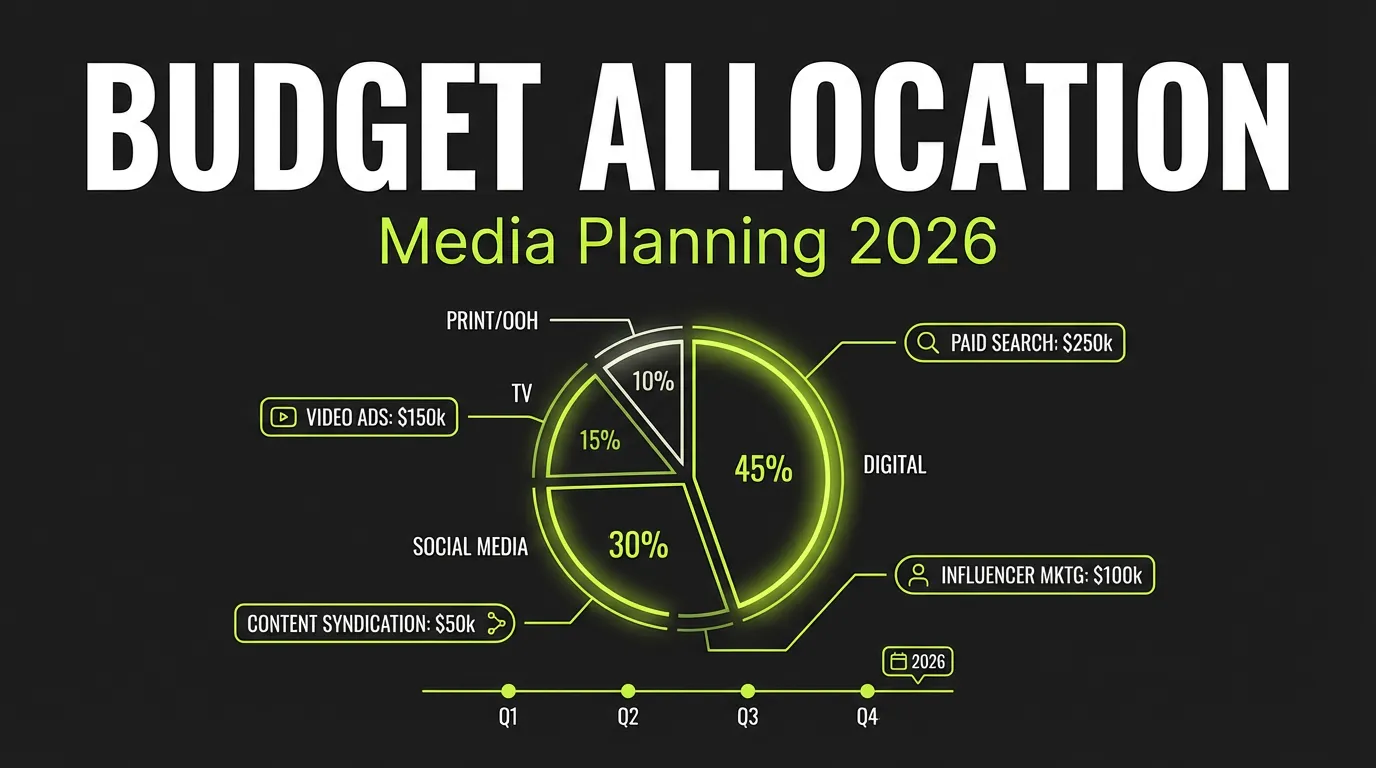
Balance stability against discovery with a simple split. Put 70% into proven performers: channels with established returns and predictable, low-risk revenue. Direct 20% toward growth bets, like scaling a test that worked or expanding reach into adjacent audiences. Reserve the final 10% for experiments in new channels and tactics.
That last 10% feels expendable when targets are tight. Resist the urge to cut it. Today's experimental line item is where next year's proven performer is born. Without it, your media mix slowly calcifies around channels that may already be past their peak.
How Do You Allocate Budget Across Channels?
Spread budget across the funnel rather than chasing a single metric. Search, retargeting, and email typically absorb the largest share because they convert existing demand. Awareness channels build the demand those lower-funnel channels later capture. Cross-channel work matters here: paid social touchpoints can lift conversion rates meaningfully when paired with other media, a pattern Nielsen has documented across multi-touch studies (Nielsen, 2023).
By Funnel Stage
Map each channel to the job it does. Awareness channels like CTV, display, and social usually take 20-30% of budget. Consideration content and video sit in a similar band. Conversion channels, search, retargeting, and email, often command 40-50% because intent is highest there. Retention through email, loyalty, and CRM rounds out the mix at 10-15%.
These ranges are starting points. A demand-gen-heavy business shifts upward toward awareness, while a category with strong existing intent leans into conversion. Use the stage map to spot obvious gaps, not to lock in fixed percentages.
By Business Goal
Let the objective steer the split. For new customer acquisition, increase prospecting through social, CTV, and display, accept a higher cost per acquisition, and lean less on retargeting that recycles existing demand. For a profitability focus, double down on high-return channels and optimize toward margin rather than raw revenue. For market expansion, fund new geographies, localization, and market-specific channels.
The same dollar serves different masters depending on the goal. Naming the objective first prevents the common trap of optimizing one campaign for revenue while another quietly burns cash chasing growth it was never meant to deliver. For a deeper structure on this, see our performance marketing guide.
Why Does Marketing Mix Modeling Improve Allocation?
Marketing mix modeling quantifies what each channel actually contributes, including effects you cannot see in last-click reports. A McKinsey analysis found that integrated, data-driven marketing approaches can lift marketing-driven revenue by 10-30% (McKinsey, 2022). MMM exposes ROI by channel, the spend level where returns flatten, and the cross-channel synergies that platform dashboards routinely miss.
What MMM Tells You
A well-built model answers four practical questions. It estimates return by channel, so you stop guessing which line items earn their keep. It identifies saturation curves, showing where the next dollar stops paying off. It captures cross-channel effects, and it isolates external factors like seasonality or pricing that inflate or deflate apparent performance.
That last point matters more than teams expect. A holiday spike can flatter a channel that simply happened to be running. Modeling strips out the noise so credit lands where it belongs. Our marketing mix modeling guide covers the build process in detail.
Using MMM for Allocation
Move through three steps. First, model the current state using two to three years of spend and results plus external variables. Second, hunt for opportunities: underspending on high-return channels, overspending past saturation, or synergies left on the table. Third, run scenario tests before you commit.
What-if analysis is where modeling earns its cost. Most modern platforms let you simulate different allocations and preview the likely impact before a single dollar moves. Testing on a model is far cheaper than testing in market.
Cross-Channel Effects
Never optimize a channel in isolation. Upper-funnel media frequently drives lower-funnel demand, so a budget cut that looks efficient on a spreadsheet can quietly drag down search performance and conversion volume. The channels that look least accountable are often the ones feeding the ones that look most accountable.
This interdependence is exactly why measurement should sit above any single platform. A holistic view, supported by a true cross-platform advertising strategy, keeps you from rewarding the last click while starving the touchpoints that made it possible.
What Is the Right Budget Planning Rhythm?
Treat planning as a cycle, not an annual event. Companies that revisit allocation frequently adapt faster to shifting performance, and the discipline compounds. Set the frame once a year, then adjust quarterly within guardrails and optimize monthly at the tactical level. This cadence keeps you responsive without whipsawing channels that need time to prove out.
Annual Planning
Build the foundation in the prior fourth quarter. Review full-year performance, refresh your MMM analysis, model scenarios for the year ahead, set channel allocations, then break them into quarterly plans. Feed the process with real inputs: revenue targets, growth goals, the competitive landscape, historical results, and market trends.
Annual planning sets direction. It should not pretend to predict every shift. The goal is a defensible starting allocation that quarterly reviews can refine.
Quarterly and Monthly Adjustments
Each quarter, compare actuals against plan, flag over- and under-performers, and adjust within guardrails of roughly plus or minus 15%. Update forecasts and document what you learned so the next cycle starts smarter. Monthly, stay tactical: real-time platform optimization, creative and audience testing, and disciplined budget pacing.
Guardrails matter. Without them, a strong month tempts teams to overcorrect and starve channels that need patience. Steady, bounded adjustments beat dramatic swings nearly every time.
What Are the Most Common Allocation Mistakes?
The costliest errors are quiet ones. The biggest is "last year plus 10%," which ignores performance data entirely and locks in yesterday's assumptions. Closely behind is cutting marketing during downturns, which surrenders share of voice exactly when competitors retreat and attention is cheaper to win.
Mistakes Worth Avoiding
Watch for platform bias, the habit of trusting channels that grade their own homework. Counter it with independent measurement like MMM and incrementality testing. Avoid ignoring synergies by analyzing channels together rather than in isolation. And never zero out the experimental budget; if every dollar chases proven channels, you stop discovering new winners.
Most of these mistakes share a root cause: optimizing for what is easy to measure instead of what actually drives the business. A coherent omnichannel advertising approach helps by tying fragmented signals into one accountable view of performance.
Frequently Asked Questions
What percentage of revenue should go to marketing?
A common baseline is 7.7% of revenue, per Gartner's 2024 CMO Spend Survey (Gartner, 2024). Adjust from there: aggressive growth often runs 10-15%, while mature businesses sit near 5-7%. Category competitiveness and organic strength shift the right number in either direction.
How does the 70-20-10 rule work?
The rule splits budget into 70% proven performers, 20% growth bets, and 10% experiments. Proven channels protect predictable revenue, growth allocations scale what already works, and the experimental slice funds testing new channels. The 10% is where future proven performers are typically discovered.
When should I use marketing mix modeling?
Use MMM once you run several channels and need to understand their combined effect. It quantifies channel-level returns, saturation points, and cross-channel synergies, and McKinsey links data-driven approaches to 10-30% revenue gains (McKinsey, 2022). Smaller, single-channel businesses can wait until complexity grows.
How often should I rebalance my budget?
Set the frame annually, adjust quarterly within guardrails of roughly plus or minus 15%, and optimize monthly at the tactical level. This rhythm keeps you responsive to performance shifts without overcorrecting on a single strong or weak month that may not reflect a real trend.
The Bottom Line
Effective allocation rests on five habits. Build a data foundation through MMM, incrementality, and attribution. Adopt a clear framework like 70-20-10. Review on a regular cadence, annual planning backed by quarterly adjustments. Keep a holistic view that respects cross-channel effects. And protect budget for experimentation so your mix never goes stale.
If you currently allocate by gut or last year's numbers, start small. Rank channels by incremental return, shift a slice of budget from your weakest to your strongest performer, and measure for several weeks before deciding again. Want the analysis done for you? Let the AI Agents Ads Manager surface cross-channel performance and turn your spend into a system that improves every quarter.