
Key Takeaways
:::highlight The False Dichotomy Brand and performance marketing aren't opposites—they're partners. Research shows 60% of sales come from long-term brand building effects. But performance marketing captures the demand that brand marketing creates. :::
- Brand builds demand — Creates preference before purchase intent
- Performance captures demand — Converts existing intent to action
- Both are measurable — Different timelines, different metrics
- Optimal split varies — By category, maturity, and business model
- Over-indexing on either fails — Pure brand = no accountability; pure performance = diminishing returns
For teams optimizing spend around payback quality, AdBid's predictive LTV helps connect acquisition decisions to customer value.
Brand Marketing vs Performance Marketing
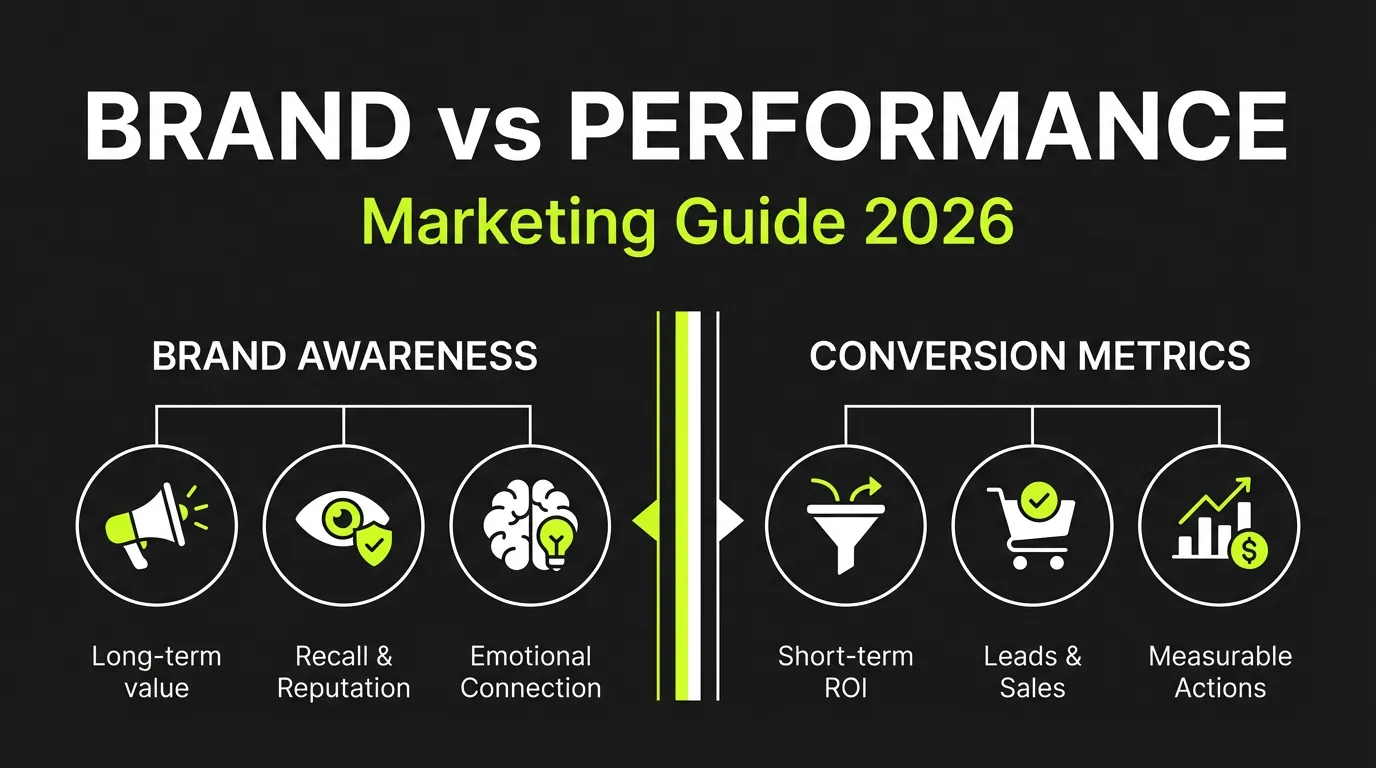
Brand Marketing
Purpose: Build awareness, recognition, and preference for your brand among people not currently in-market.
Timeline: Long-term (months to years)
Measurement: Brand awareness, consideration, preference, share of voice
Activities:
- Brand advertising (TV, OOH, digital video)
- Sponsorships and partnerships
- Content marketing
- PR and earned media
- Brand storytelling
Performance Marketing
Purpose: Drive immediate action from people with existing intent or interest.
Timeline: Short-term (days to weeks)
Measurement: Conversions, ROAS, CPA, revenue
Activities:
- Paid search
- Paid social (conversion campaigns)
- Retargeting
- Affiliate marketing
- Direct response email
:::info The Key Distinction Brand marketing creates future customers. Performance marketing converts current customers.
If you only do performance, you harvest what others planted. If you only do brand, you plant but never harvest. :::
The Research: Why Both Matter
Les Binet and Peter Field Research
Decades of IPA (Institute of Practitioners in Advertising) data shows:
| Finding | Implication |
|---|---|
| 60% of sales come from long-term brand building | Brand creates the base (IPA (Binet & Field)) |
| 40% come from short-term activation | Performance captures demand |
| Optimal split is roughly 60:40 brand:performance | Balance drives growth |
| Brand-only OR performance-only underperforms | Need both |
The "Long and Short" of It
Performance-Only Effect:
Year 1: Strong results
Year 2: Results plateau
Year 3: Diminishing returns
Year 4: Declining results

Why: You've captured existing demand, no new demand created.

Brand + Performance Effect:
Year 1: Moderate results
Year 2: Building momentum
Year 3: Compounding growth
Year 4: Sustained growth

Why: Brand creates new demand for performance to capture.
Category Considerations
Optimal split varies by category:
| Category | Brand : Performance | Rationale |
|---|---|---|
| FMCG/CPG | 70:30 | Low consideration, brand recall matters |
| B2B Services | 60:40 | Long cycles, trust important |
| D2C E-commerce | 50:50 | Online conversion + brand differentiation |
| SaaS | 45:55 | Demo requests, trials matter |
| Retail | 50:50 | Traffic + conversion both critical |
When to Invest in Brand Marketing
Signals You Need More Brand
- Declining brand search volume — Fewer people searching for you
- Rising CAC — Demand capture getting expensive
- Competitor gains — Losing share of voice
- Low unaided awareness — Category buyers don't know you
- Price pressure — Commoditization forcing discounts
Brand Marketing Tactics
| Tactic | Best For | Timeline |
|---|---|---|
| Video advertising (YouTube, CTV) | Emotional storytelling | 6-12 months |
| OOH/Billboard | Local/regional awareness | 3-6 months |
| Podcast advertising | Niche audience trust | 6-12 months |
| Sponsorships | Association with events/causes | 12+ months |
| Content marketing | Thought leadership | 12+ months |
| PR | Credibility, earned reach | Ongoing |
:::tip Brand Investment Timing The best time to invest in brand is when performance is working well. You have cash flow to fund longer-term investments. The worst time is when performance fails—you can't afford to wait. :::
When to Invest in Performance Marketing
Signals You Need More Performance
- High brand awareness, low conversion — People know you, don't buy
- Launch/promotion periods — Time-sensitive activation
- High-intent moments — Category or seasonal demand
- Competitive conquest — Capturing competitor demand
- Unit economics proven — Can profitably scale
Performance Marketing Tactics
| Tactic | Best For | Timeline |
|---|---|---|
| Paid search | High-intent capture | Days-weeks |
| Retargeting | Converting engaged visitors | Days-weeks |
| Paid social (conversion) | Demand generation | Weeks |
| Affiliate marketing | Extended reach | Ongoing |
| Direct response email | Customer activation | Days |
| Shopping ads | E-commerce conversion | Days-weeks |
Measuring Brand and Performance Together
Short-Term Metrics (Performance)
| Metric | What It Measures |
|---|---|
| Conversions | Direct actions |
| ROAS | Return on ad spend |
| CPA | Cost per acquisition |
| Revenue | Immediate sales |
| Leads | Direct response |
Long-Term Metrics (Brand)
| Metric | What It Measures |
|---|---|
| Brand awareness | Recognition |
| Consideration | Willingness to consider |
| Brand preference | Likelihood to choose |
| Share of voice | Media presence vs competitors |
| NPS | Customer advocacy |
| Price premium | Willingness to pay more |
Connecting Both
Track how brand metrics influence performance:
Correlation Analysis:
├── Brand awareness ↑ → CAC ↓
├── Share of voice ↑ → Organic traffic ↑
├── Brand search volume ↑ → Conversion rate ↑
├── NPS ↑ → LTV ↑

Brand lift → Performance efficiency
:::info Brand Measurement Challenge Brand metrics are leading indicators. They predict future performance but don't directly cause this week's sales. Track both, but recognize different timelines. :::
Building an Integrated Strategy
The Balanced Approach
Top of Funnel (Brand):
├── Reach: New audiences who don't know you
├── Message: Why you exist, what you stand for
├── Measurement: Awareness, reach, engagement
└── Timeline: Ongoing investment

Middle of Funnel (Brand + Performance):
├── Reach: Aware audiences considering options
├── Message: Why you're different/better
├── Measurement: Consideration, traffic, engagement
└── Timeline: Ongoing with campaign spikes

Bottom of Funnel (Performance):
├── Reach: High-intent, ready to buy
├── Message: Why buy now, specific offer
├── Measurement: Conversions, ROAS, revenue
└── Timeline: Always on + promotional peaks
Budget Allocation Framework
Start with baseline, adjust based on business stage:
| Stage | Brand % | Performance % | Notes |
|---|---|---|---|
| Launch | 30% | 70% | Need to prove product-market fit |
| Growth | 40% | 60% | Building while scaling |
| Scale | 50% | 50% | Balanced investment |
| Mature | 60% | 40% | Defend brand, maintain share |
| Decline | 30% | 70% | Efficiency focus |
Testing the Balance
Experiment to find your optimal mix:
- Baseline: Current split
- Test A: +10% brand, -10% performance
- Test B: -10% brand, +10% performance
- Measure: 6-12 month impact
- Optimize: Adjust based on results
The Performance Marketing Trap
Why Companies Over-Index on Performance
| Reason | Problem |
|---|---|
| Measurability | Brand is harder to measure, so it gets cut |
| Quarterly pressure | Performance shows quick results |
| Attribution | Brand doesn't get credit in last-click |
| Organizational | CMO tenure short, need quick wins |
Signs You're in the Trap
- CAC increasing year over year
- Brand search declining
- Heavy reliance on discounts
- Competitors gaining awareness
- Performance hitting ceiling
:::warning The Death Spiral Over-index on performance → Harvest existing demand → CAC rises → Cut more brand to fund performance → Even higher CAC → Eventually, diminishing returns on everything. :::
Escaping the Trap
- Acknowledge the problem — Recognize performance can't grow forever
- Commit to brand investment — Protected budget, patient metrics
- Set realistic expectations — 6-12 months for brand impact
- Measure brand health — Track awareness, consideration
- Connect to performance — Show brand lift improves performance efficiency
The Brand Marketing Trap
Why Companies Over-Index on Brand
| Reason | Problem |
|---|---|
| Legacy | "That's how we've always done it" |
| Ego | Big campaigns feel important |
| Measurement avoidance | "Brand can't be measured" |
| Agency bias | Creative agencies push brand |
Signs You're in the Trap
- High awareness, low conversion
- Weak digital presence
- Can't compete on performance channels
- Brand investment can't be connected to outcomes
- Competitor performance eating market share
Escaping the Trap
- Add accountability — Measure brand activity
- Invest in digital — Build performance capability
- Track full funnel — Connect brand to conversion
- Balance team — Brand + performance marketers
- Attribution modeling — Understand contribution
Common Mistakes
1. Treating Them as Either/Or
"We're a brand marketing company" or "We're performance-driven"
Reality: Every company needs both. The ratio varies, but zero is never the answer.
2. Wrong Measurement, Wrong Conclusion
"Brand advertising doesn't work—no conversions last week"
Reality: Brand advertising works on different timeline. Measuring brand with performance metrics misses the point.
3. No Strategic Allocation
"We just run what works"
Reality: Without intentional allocation, performance will always win short-term attribution battles, even if it's suboptimal.
4. Inconsistent Brand Investment
"We do brand campaigns when we have extra budget"
Reality: Brand compounds with consistency. On-off investment undermines long-term building.
The Bottom Line
Brand vs performance is a false choice in 2026:
- Brand creates demand that performance captures
- Performance captures demand that brand creates
- Optimal ratio varies by category, stage, and context
- Both are measurable — different metrics, different timelines
- Over-indexing on either leads to diminishing returns
- Integration wins — coordinated strategy beats siloed execution
:::tip The Balanced Mindset "Think of brand as the engine and performance as the steering wheel. You need both to get anywhere. An engine without steering goes in circles. Steering without an engine goes nowhere." :::
"The companies that grow consistently aren't the ones who master brand OR performance. They're the ones who master brand AND performance, knowing when each is needed and how they work together."
AdBid helps you track both brand and performance metrics. See how awareness drives conversion and optimize your full-funnel strategy. Start your analysis.