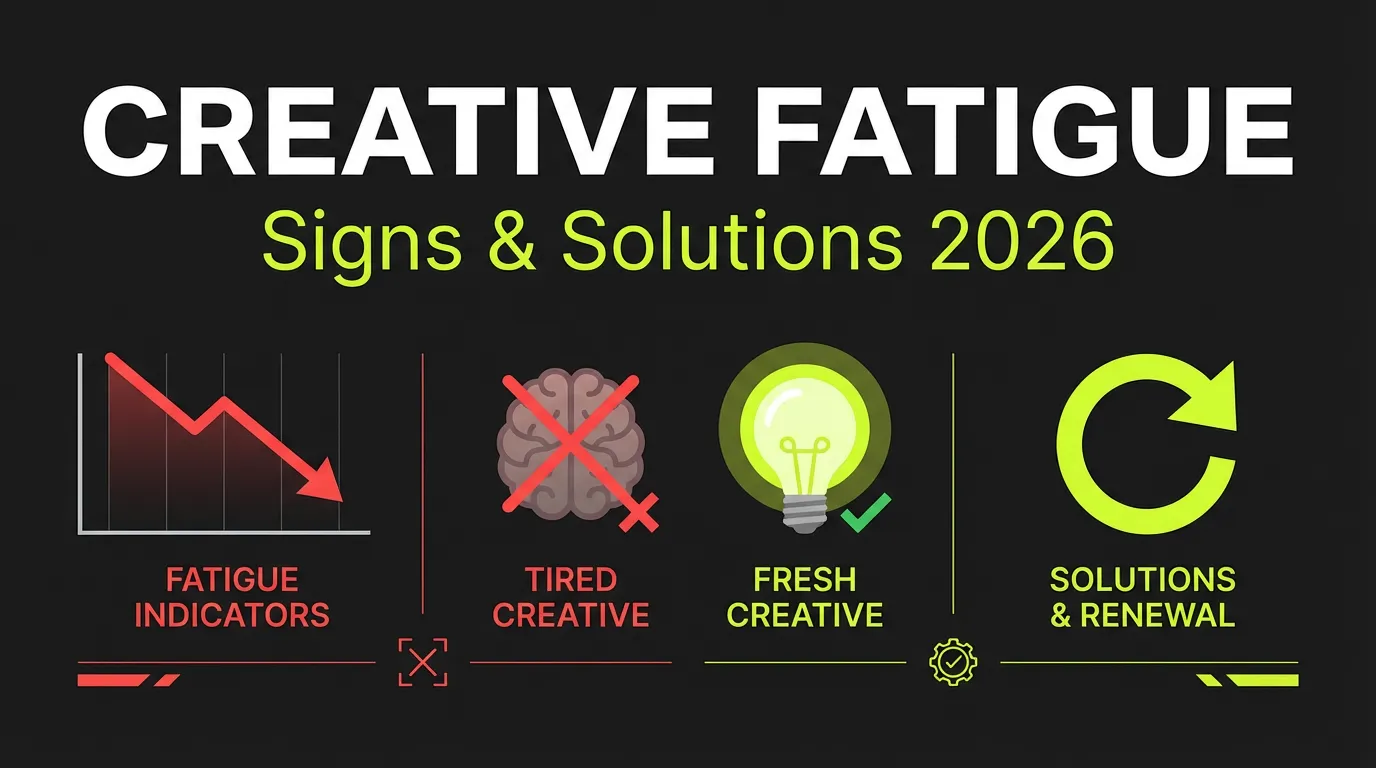

Key Takeaways
- Top-performing ads lose 38% of their effectiveness after just 5 weeks unchanged
- Creative fatigue leads to CTR drops of 10-15% week-over-week
- Hooks fatigue fastest, CTAs slowest — prioritize refresh accordingly
- Platform differences matter: TikTok fatigue is overnight, Meta is gradual
- A 70% effective partial refresh is often better than waiting for complete overhaul
What Is Creative Fatigue?
:::highlight The Definition Creative fatigue happens when your audience sees the same ads repeatedly, causing a drop-off in interest and engagement. It's not that your ad stopped being good — your audience just stopped caring. :::
After four repeated exposures, the likelihood of conversion drops by about 45% (Analytics at Meta). By the time you notice performance tanking, you've already wasted budget.
For teams that need more campaign-ready variations, AdBid's AI creative factory helps turn briefs into hooks, copy, and ad assets faster.
I've watched accounts bleed money because teams didn't recognize fatigue quickly enough. Here's how to spot it and fix it.
Warning Signs: How to Identify Fatigue
Primary Indicators
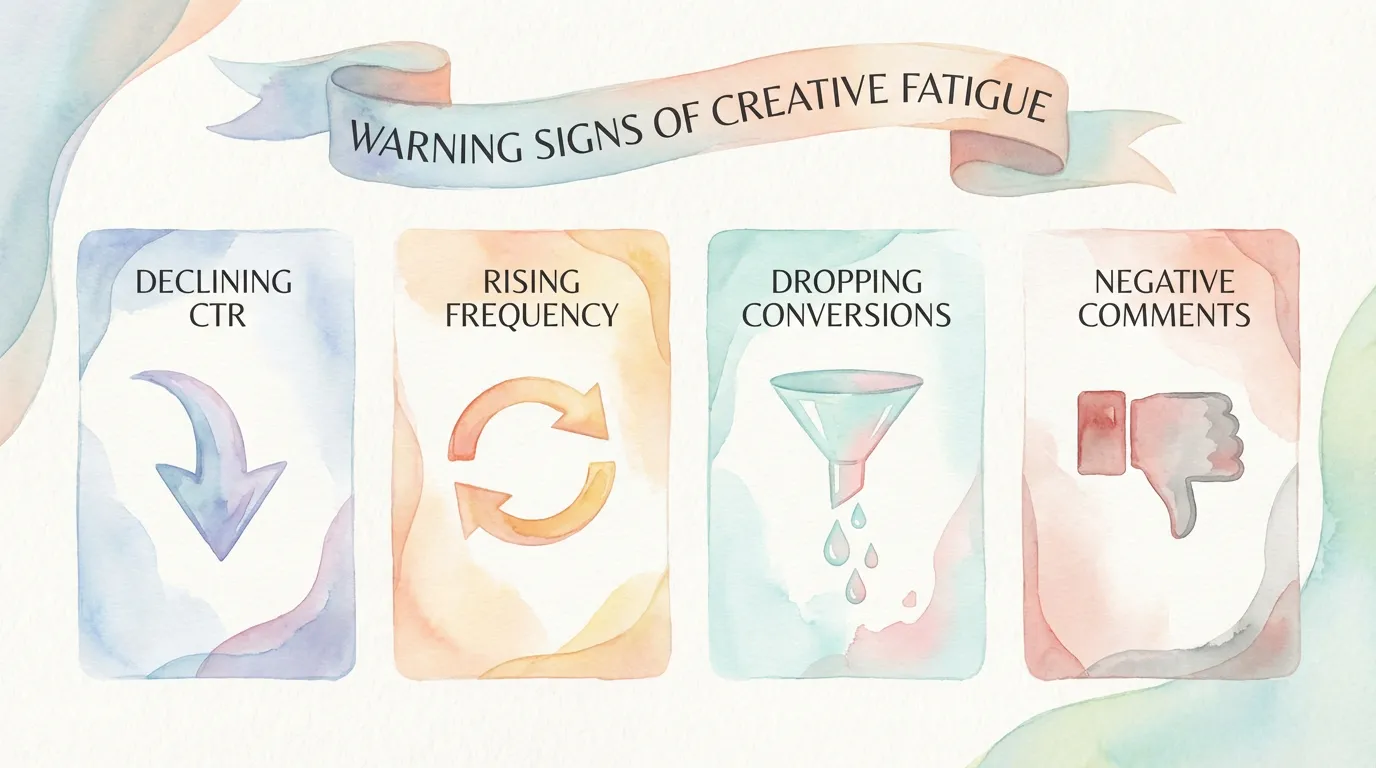
1. Declining Click-Through Rate (CTR) The first and most reliable signal:
- Week 1-2: Baseline CTR
- Week 3: CTR drops 10-15%
- Week 4+: CTR drops 20%+
:::warning Red Flag CTR drops of 10-15% week-over-week signal fatigue is setting in. Don't wait for it to get worse. :::
2. Rising Cost Per Click (CPC) As engagement decreases, platforms charge more:
- Same budget, fewer clicks
- Algorithm struggles to find engaged users
- Competition for remaining interested users increases
3. Increased Frequency Same users seeing your ads repeatedly:
- Frequency > 2.5-3.0 = danger zone
- High frequency + declining CTR = confirmed fatigue
4. Declining ROAS/Rising CPA The business impact:
- Lower conversion rates
- Higher cost per acquisition
- Diminishing returns on spend
Secondary Indicators
- Fewer likes, shares, comments on social ads
- Higher impression volume with lower engagement
- Increased "hide ad" or negative feedback actions
Platform-Specific Fatigue Patterns
Meta (Facebook/Instagram)
:::info Meta Fatigue Timeline On Meta, you might notice a gradual decline in CTR and higher CPAs over weeks. Performance typically lasts 2-4 weeks before returns diminish, though some creatives can remain effective for up to 6 weeks. :::
Learning Phase: 5-7 days for Feed ads Peak Performance: Days 7-21 Fatigue Onset: Week 3-4 Action Required: Week 4-5
TikTok
:::danger TikTok Warning On TikTok, fatigue can strike overnight. Users expect fast and fresh experiences. Engagement metrics can die in 24 hours. :::
Peak Performance: Days 1-7 Fatigue Onset: Week 2 Action Required: Weekly creative rotation
Snapchat
Similar to TikTok but slightly longer lifecycle: Peak Performance: Days 1-10 Fatigue Onset: Days 10-14 Action Required: Every 10-14 days
Google (Display/YouTube)
Slower fatigue due to larger inventory: Peak Performance: Weeks 1-4 Fatigue Onset: Week 4-6 Action Required: Monthly rotation
Understanding Why Fatigue Happens
Frequency Overload
The simplest cause: people have seen your ad too many times.
Frequency Benchmarks:
| Frequency | Status | Action |
|---|---|---|
| 1.0-2.0 | Healthy | Monitor |
| 2.0-3.0 | Warning | Prepare refresh |
| 3.0-4.0 | Danger | Refresh now |
| 4.0+ | Critical | Pause and replace |
Message Exhaustion
Your value proposition has been absorbed. Those who would convert already have. The remaining audience isn't interested.
Creative Wear-Out
The visual and copy elements no longer surprise or engage. What was novel is now expected.
Audience Saturation
You've reached everyone in your target who's likely to engage. Further impressions are diminishing returns.
Fatigue Rates by Creative Element
Not all elements fatigue equally:
:::tip Refresh Priority Hooks fatigue fastest due to pure frequency and need regular refreshes. Visuals need periodic tweaks. CTAs fatigue more slowly but subtle changes can improve response. :::
Fastest Fatigue:
- Hooks (first 3 seconds) — Weekly refresh needed
- Headlines — Bi-weekly refresh
- Primary text — Bi-weekly refresh
Slower Fatigue: 4. Visuals/Video — Monthly refresh 5. CTAs — Can last 4-6 weeks 6. Landing pages — Quarterly refresh typically sufficient
Refresh Strategies
The Three Types of Refresh
1. Partial Refresh (70% Effective) Change headline, primary text, or CTA while keeping visuals.
- Effort: Low
- Risk: Low
- Timeline: 1-2 days to implement
- Best for: Early fatigue signs
2. Complete Overhaul (90% Effective) New visuals, copy, and messaging approach.
- Effort: High
- Risk: Medium (new creative might not perform)
- Timeline: 1-2 weeks
- Best for: Severe fatigue, major campaigns
3. Format Refresh (60% Effective) Convert static images to video or carousel format.
- Effort: Medium
- Risk: Low
- Timeline: 3-5 days
- Best for: Extending winning concepts
Low-Lift Refresh Tactics
When you need quick wins:
- Turn images into splitscreens
- Add visual interest (borders, animations)
- Swap models or presenters
- Layer in new information
- Change color schemes
- Test different aspect ratios
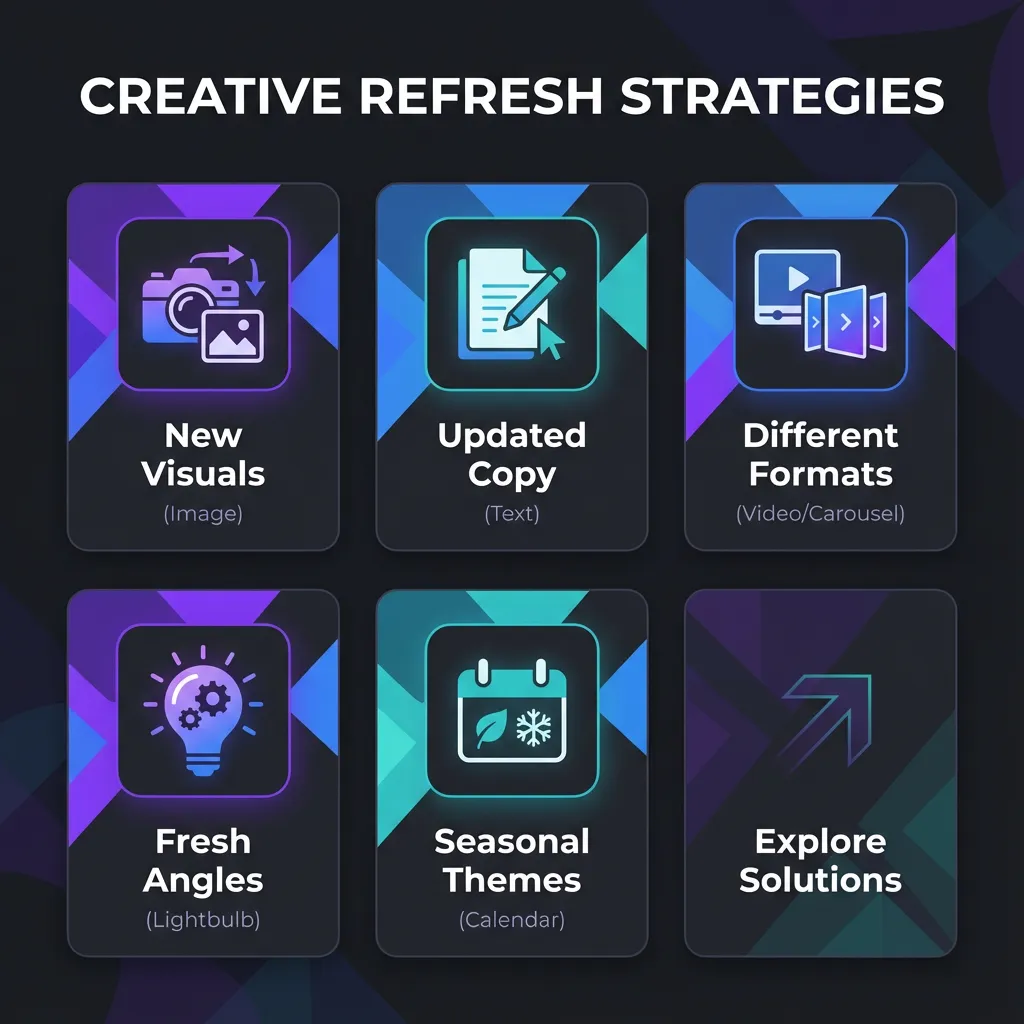
"Ad copy often fatigues faster than visuals, so having a diverse copy bank can help visuals live longer."
The Refresh Rotation System
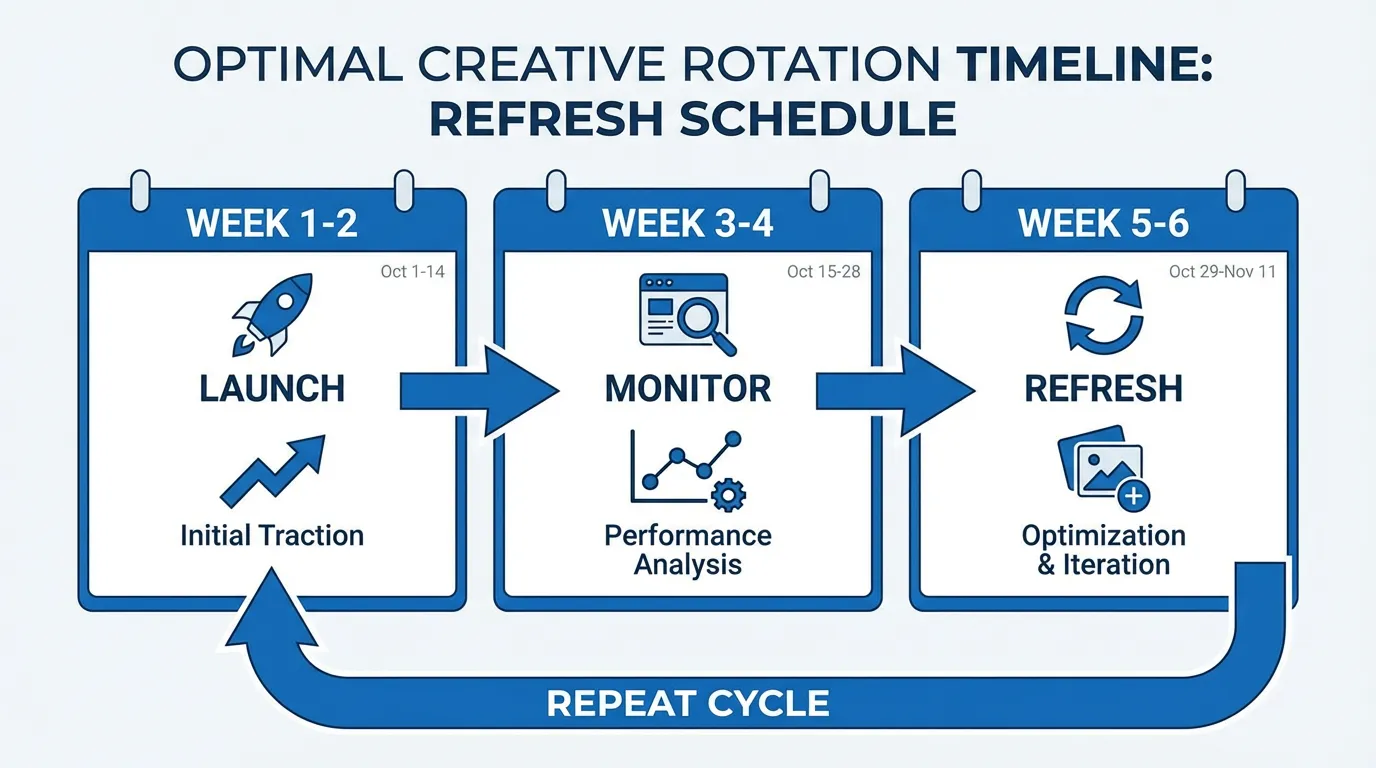
Weekly:
- Update hooks on top-performing ads
- Test 2-3 new headline variations
- Refresh primary text
Bi-weekly:
- Introduce new visual variations
- Test new video intros
- Rotate secondary creative elements
Monthly:
- Complete creative refresh for core campaigns
- Test entirely new concepts
- Review and retire underperformers
Prevention: Building a Fatigue-Resistant System
Creative Volume Requirements
:::tip Production Math Aim to have biweekly and monthly creative ready to go, and ramp up production ahead of key holidays, seasons, and brand-specific moments. :::
Minimum Monthly Production:
- 4-6 new video concepts (TikTok/Reels)
- 8-12 static variations
- 2-3 new carousel sets
- Hook library refresh (5-10 new hooks)
Testing Framework
Weekly Creative Testing Cadence:
- Monday: Review last week's performance, identify fatigue
- Tuesday: Brief new concepts based on learnings
- Wednesday: Creative production
- Thursday: Launch new tests
- Friday: Early performance analysis
Frequency Cap Strategy
Prevent overexposure proactively:
- Set frequency caps by platform
- Facebook/Instagram: 2-3x per week
- TikTok: 3-4x per week (shorter attention span)
- YouTube: 3x per week
:::info Cap Benefits Proper caps extend the lifespan of creatives while optimizing ad spend and create space to rotate in different ads. :::
Dynamic Creative Optimization (DCO)
Let platforms assemble variations:
- Upload multiple headlines, images, descriptions
- Platform tests combinations automatically
- Extends creative lifespan through variation
- Reduces production burden
Action Thresholds
When to Take Action
Pause Immediately:
- Costs have doubled vs. baseline
- CTR dropped 40%+ from peak
Reduce Spend 50%:
- 20-30% performance decline
- Frequency > 3.5
- CPM increasing significantly
Reduce Spend 25%:
- Early warning signals (10-15% decline)
- Frequency approaching 2.5
- Engagement trending down
Watch Closely:
- Slight variations in performance
- Frequency at 2.0
- Competition increasing in auction
Monitoring Dashboard
Key Metrics to Track Daily
| Metric | Baseline | Warning | Critical |
|---|---|---|---|
| CTR | Your average | -15% | -25% |
| CPC | Your average | +20% | +40% |
| Frequency | <2.0 | 2.5-3.0 | >3.0 |
| CPA | Your target | +25% | +50% |
| ROAS | Your target | -20% | -35% |
Automated Alerts
Set up notifications for:
- CTR drops below threshold
- Frequency exceeds 2.5
- CPA exceeds 150% of target
- Daily/weekly performance reports
Case Study: Managing Fatigue at Scale
The Scenario
E-commerce brand spending $200K/month across Meta, TikTok, and Google. Core creative starting to fatigue.
The Solution
Week 1: Diagnosis
- Identified CTR down 18% over 3 weeks
- Frequency at 2.8 on top ad sets
- CPA increased 23%
Week 2: Triage
- Reduced budget 30% on fatigued creative
- Launched 5 partial refreshes (new hooks)
- Set frequency caps at 2.5
Week 3: New Creative
- Launched 3 completely new concepts
- Expanded audience to reduce frequency
- Introduced UGC variations
Week 4: Results
- CTR recovered to 90% of original
- CPA down 15% from fatigue peak
- Sustainable rotation system established
The Bottom Line
Creative fatigue is inevitable. The question isn't whether your ads will fatigue — it's whether you'll catch it before it destroys your performance.
The brands winning in 2026 aren't running the same ads for months. They're constantly testing, refreshing, and rotating creative while maintaining consistent brand messaging.
:::tip Start Here This week, audit your top 5 ad sets. Check frequency and week-over-week CTR trends. If frequency is above 2.5 and CTR is declining, start a refresh immediately — don't wait for next month's creative review. :::
Prevention is cheaper than recovery. Build the system before you need it.
Want to automate creative fatigue detection? AdBid monitors your ad performance and alerts you when refresh is needed — before your ROAS tanks. Start your free trial.
When Does Fatigue Become Critical?
There's a difference between "act soon" and "act now." A campaign in early fatigue can often be saved with audience expansion or a light creative refresh. A campaign in critical fatigue is actively wasting money, and the only real fix is replacement. The dividing line is usually when cost per result rises sharply while results fall.
The critical stage tends to combine several signals at once. Frequency is high and still climbing. Cost per acquisition has jumped well above your baseline. Engagement has gone flat or turned negative. At that point, optimizing bids or shuffling placements is rearranging deck chairs. The creative itself needs to go.
One contrarian point worth making: chasing a fatigued ad with more budget almost always backfires. Spending more pushes frequency higher, which accelerates the decline you were trying to outrun. We've found that pulling back spend on a fatigued ad while a fresh variation ramps up protects your overall account efficiency far better than doubling down.
How Do You Replace a Tired Ad Without Losing Momentum?
The smoothest replacements happen when a fresh creative is already tested and waiting. Swapping in an untested ad at the moment of crisis means you're now debugging a new creative under pressure, which is the worst time to learn whether it works. Build your replacements in advance so the handoff is a decision, not an experiment.
A reliable replacement flow looks like this.
Keep a Live Pipeline
Maintain several active variations at any time, with new concepts entering testing on a regular cadence. When one fatigues, you already know which backup performs. This is the single biggest difference between teams that scale calmly and teams that firefight. Our ad creative testing guide lays out how to keep that pipeline full without burning your budget on tests.
Refresh the Hook, Not Just the Image
Fatigue often lives in the hook, the first three seconds or the headline. Sometimes a genuinely new angle revives a campaign, while a cosmetic swap of colors does nothing. Vary the message, the format, and the proof point, not only the visuals.
Stagger the Handoff
Don't kill the old ad and launch the new one in the same instant if you can avoid it. Let the fresh creative gather a little data first, confirm it's holding up, then taper the tired one down. This keeps your conversion volume stable during the transition.
Expand the Audience When Frequency Is the Cause
If the creative still tests well but frequency is the problem, the fix may be reach rather than replacement. Broaden targeting or build lookalikes from recent converters to give the same ad fresh eyes. For frequency-specific tactics, see our ad frequency capping guide.
How Do You Build a Repeatable Refresh System?
A refresh system turns fatigue management from a fire drill into a routine. The goal is to make creative rotation a scheduled habit, so you're never surprised by a sudden drop. Most strong systems run on three nested loops: a weekly check, a monthly audit, and a quarterly reset.
Here's a structure that holds up across account sizes.
Weekly Creative Review
Once a week, scan your active ads for the early signals: CTR drift, frequency climb, engagement fade. Flag anything trending the wrong way and promote a tested backup if needed. This is fast, fifteen minutes for most accounts, and it catches problems while they're still cheap to fix.
Monthly Performance Audit
Once a month, step back and look at the bigger picture. Which concepts have the longest useful life? Which formats fatigue fastest? Which audiences saturate quickest? This is where you learn the rhythm of your own account, and that knowledge makes your weekly reviews sharper.
Quarterly Strategy Refresh
Every quarter, revisit the strategy itself. New formats, new angles, new audience pools. Markets shift, competitors change their messaging, and the creative that defined your last quarter may no longer fit. Treat this as a clean-slate planning session.
As budgets grow, fatigue tends to arrive faster because you saturate audiences more quickly. That's why scaling and fatigue management are really the same discipline. Our Facebook ads scaling strategies guide connects the two directly.