
Part of our CTV Advertising guide series.
Key Takeaways
- Brand awareness campaigns require different KPIs than performance campaigns
- Traditional metrics (reach, frequency) must be supplemented with attention metrics
- Brand Lift studies measure advertising impact on awareness, consideration, and intent
- Privacy changes complicate measurement but don't make it impossible
- Build measurement into your media plan from the start, not after launch
:::info The Brand Imperative Performance marketing without brand building is optimizing for ever-diminishing returns. Brand awareness creates the demand that performance captures. :::
Ready to operationalize this? Start with AdBid: platform access is free, and you pay on managed spend.
Why Brand Awareness Still Matters
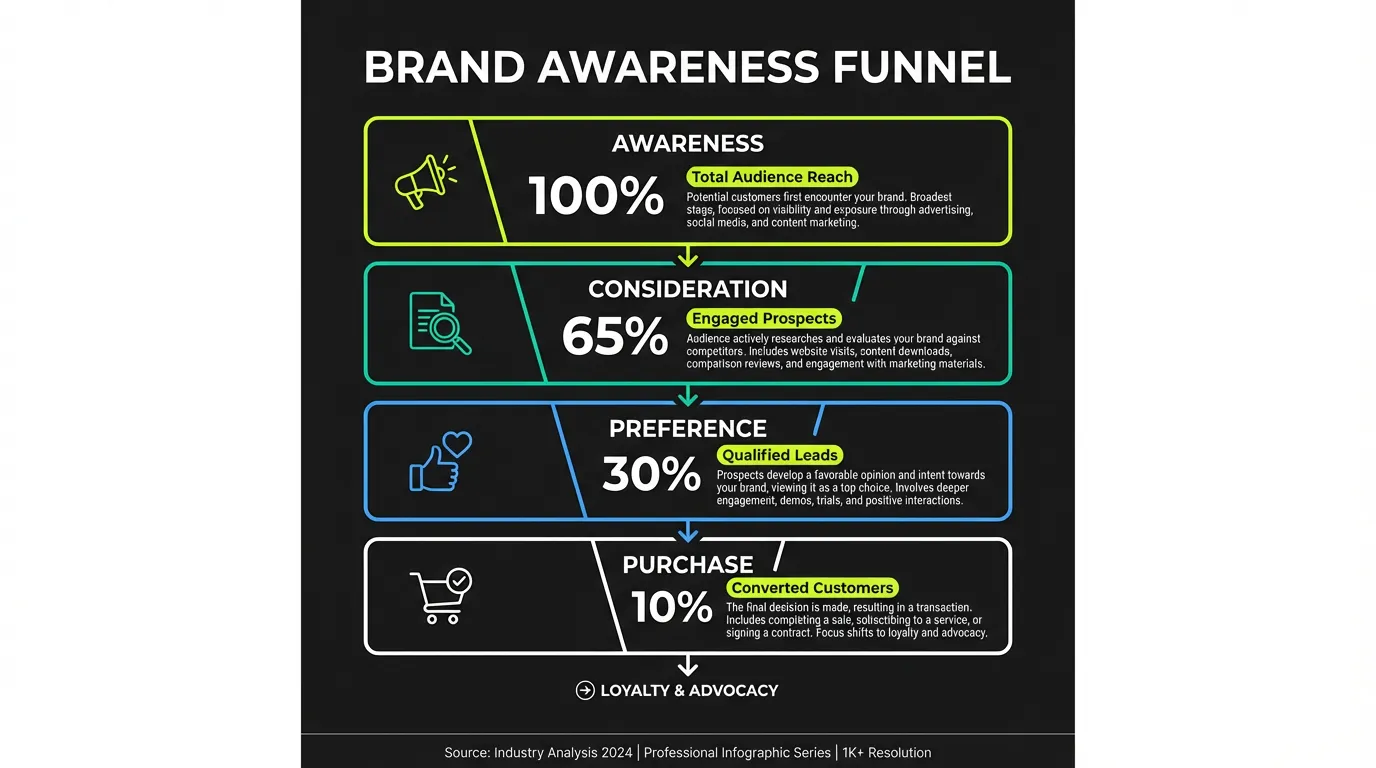
I've seen too many brands cut brand spending to fuel performance campaigns — then wonder why CAC keeps rising and LTV keeps falling. The answer is obvious in hindsight: they stopped creating demand and started only harvesting it.
The Brand-Performance Relationship
| Brand Investment | Performance Result |
|---|---|
| Strong brand awareness | Lower CPAs, higher conversion rates |
| Weak brand awareness | Rising CPAs, declining ROAS |
| Category leader brand | Price premium, loyalty |
| Unknown brand | Constant education spend |
The Compounding Effect
Brand advertising compounds over time:
- Year 1: High cost, low measurable return
- Year 2: Category association building
- Year 3: Organic search and direct traffic growth
- Year 4+: Lower CAC, higher LTV, price premium
:::highlight Long-Term Lens "One common mistake is thinking about measurement after a campaign has launched. The right approach is to build measurement directly into your media plan from the start." :::
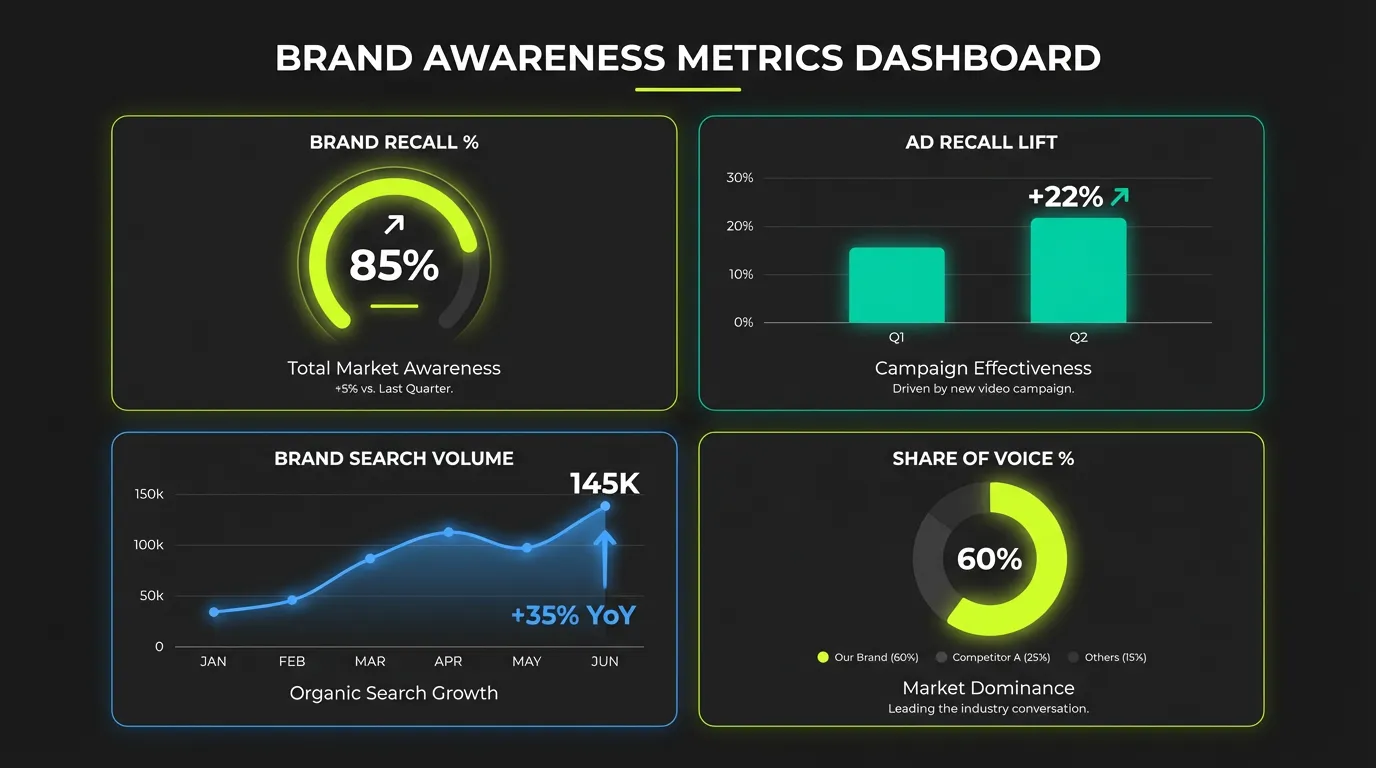
Brand Awareness KPIs
Reach & Frequency Metrics
The foundation — but not sufficient alone.
| Metric | Definition | Target |
|---|---|---|
| Reach | Unique users who saw your ad | Campaign-dependent |
| Frequency | Average times each user saw it | 3-7 for awareness |
| Reach % | % of target audience reached | 40-70% for major campaigns |
| Effective Reach | Reach at optimal frequency | Maximize this |
Attention Metrics (2026 Standard)
"By incorporating attention metrics — such as dwell time, gaze duration, and interaction depth — you get a clearer picture of not just if your brand is being seen, but how meaningfully it's being noticed."
| Attention Metric | What It Measures |
|---|---|
| Viewable time | How long ad was in view |
| Dwell time | Time spent looking at ad |
| Completion rate | % who watched full video |
| Interaction rate | Engagement with ad elements |
| Audio-on rate | Video watched with sound |
Brand Lift Metrics
The gold standard for upper-funnel measurement:
| Lift Type | Measures | Survey Question |
|---|---|---|
| Ad Recall | Did they remember seeing it? | "Have you seen an ad for [brand] recently?" |
| Awareness | Do they know the brand? | "Which brands in [category] are you aware of?" |
| Consideration | Would they consider buying? | "Would you consider purchasing from [brand]?" |
| Favorability | How do they feel about it? | "How favorable is your opinion of [brand]?" |
| Purchase Intent | Are they likely to buy? | "How likely are you to purchase from [brand]?" |
Platform-Specific Strategies
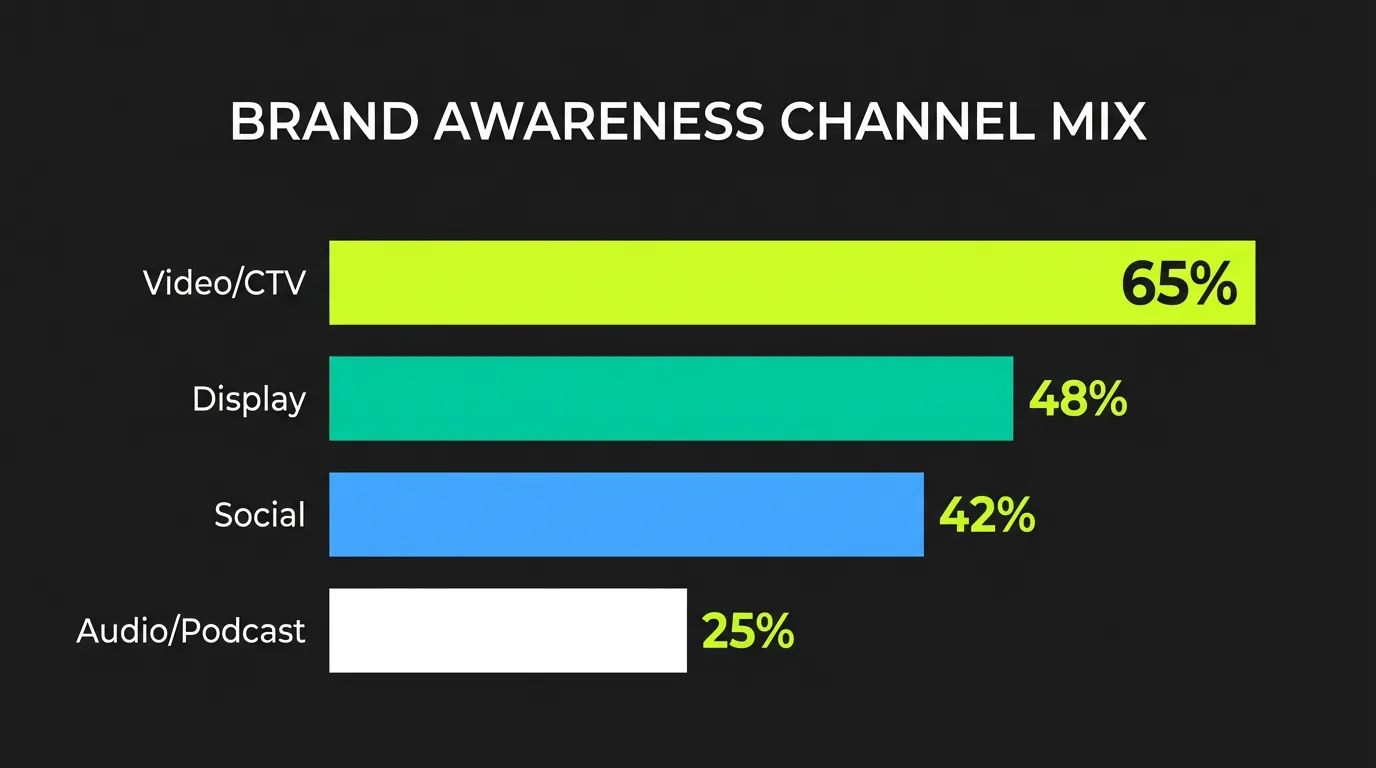
Meta Brand Awareness
Campaign Objectives:
- Brand Awareness: Optimizes for ad recall lift
- Reach: Maximizes unique users at frequency cap
- Video Views: Optimizes for video consumption
Best Practices:
- Use Reach objective with 2-4 frequency cap per week
- Target broad audiences for scale
- Exclude recent converters to focus on new prospects
- Run Brand Lift studies for campaigns >$50K
- Video creative outperforms static for awareness
:::tip Meta Brand Lift Meta's Brand Lift studies measure ad recall, awareness, and consideration through survey panels. Require minimum spend (~$30K+) and 7+ day duration. :::
Google/YouTube Brand Awareness
Campaign Types:
| Type | Best For | Optimization |
|---|---|---|
| Video Reach | Maximum reach efficiency | CPM |
| Brand Awareness | YouTube/Display awareness | Max lift |
| Video Views | Engaged video viewers | CPV |
| Demand Gen | Full-funnel video | Conversions |
YouTube Format Performance:
| Format | Awareness Impact | Cost |
|---|---|---|
| Bumper ads (6s) | High reach, moderate recall | Low CPM |
| TrueView (15-30s) | Strong recall, consideration | Mid CPV |
| Non-skip (15s) | High recall, some annoyance | Mid CPM |
| Masthead | Maximum reach, premium | High flat fee |
Connected TV (CTV)
Fastest-growing awareness channel:
- 30-second non-skip format
- TV-like attention, digital targeting
- Household-level reach
- Brand-safe, premium content
- CPMs: $25-$50 typical
Creative for Brand Awareness
Video Creative Framework
| Timeframe | Purpose | Content |
|---|---|---|
| 0-3 seconds | Hook | Attention-grabbing opening |
| 3-10 seconds | Brand | Logo, brand elements visible |
| 10-20 seconds | Message | Key value proposition |
| 20-30 seconds | CTA | Next step, memorable close |
The Branding vs. Response Balance
| Awareness Creative | Response Creative |
|---|---|
| Emotion-led | Benefit-led |
| Brand story | Product feature |
| Memorable moments | Clear CTA |
| Longer format OK | Short, punchy |
| Audio important | Works without sound |
:::warning Brand Consistency Every awareness touchpoint should reinforce the same brand elements: colors, logo placement, tone, key message. Inconsistency dilutes recall. :::
Audio Matters
For brand awareness, audio is critical:
- Music creates emotional connection
- Voiceover increases message retention
- Audio branding (sonic logo) builds recognition
- 85% of video viewed with sound on CTV
Measurement Approaches
Brand Lift Studies
How They Work:
- Divide audience: control (no ad) vs. exposed
- Survey both groups on brand metrics
- Measure difference = lift attributed to campaign
- Cost: Built-in to platform or third-party
Platform Brand Lift:
| Platform | Minimum Spend | Duration | Metrics |
|---|---|---|---|
| Meta | ~$30K+ | 7+ days | Ad recall, awareness, consideration |
| Google/YouTube | $10K+ | 7+ days | Ad recall, awareness, consideration, purchase intent |
| Amazon | Varies | 14+ days | Awareness, consideration, purchase intent |
| TikTok | $50K+ | 14+ days | Ad recall, awareness |
Marketing Mix Modeling (MMM)
For brands spending $1M+ annually:
- Isolates brand vs. performance contribution
- Long-term effect measurement
- Cross-channel comparison
- Privacy-compliant (aggregate data)
Incrementality Testing
Measure true brand advertising impact:
- Hold out a geo region or audience segment
- Run awareness campaign to test group
- Measure downstream performance difference
- Calculate incremental conversions
:::tip Measurement Stack Use Brand Lift for campaign-level insights, MMM for strategic allocation, and incrementality testing to validate assumptions. :::
Budget Allocation
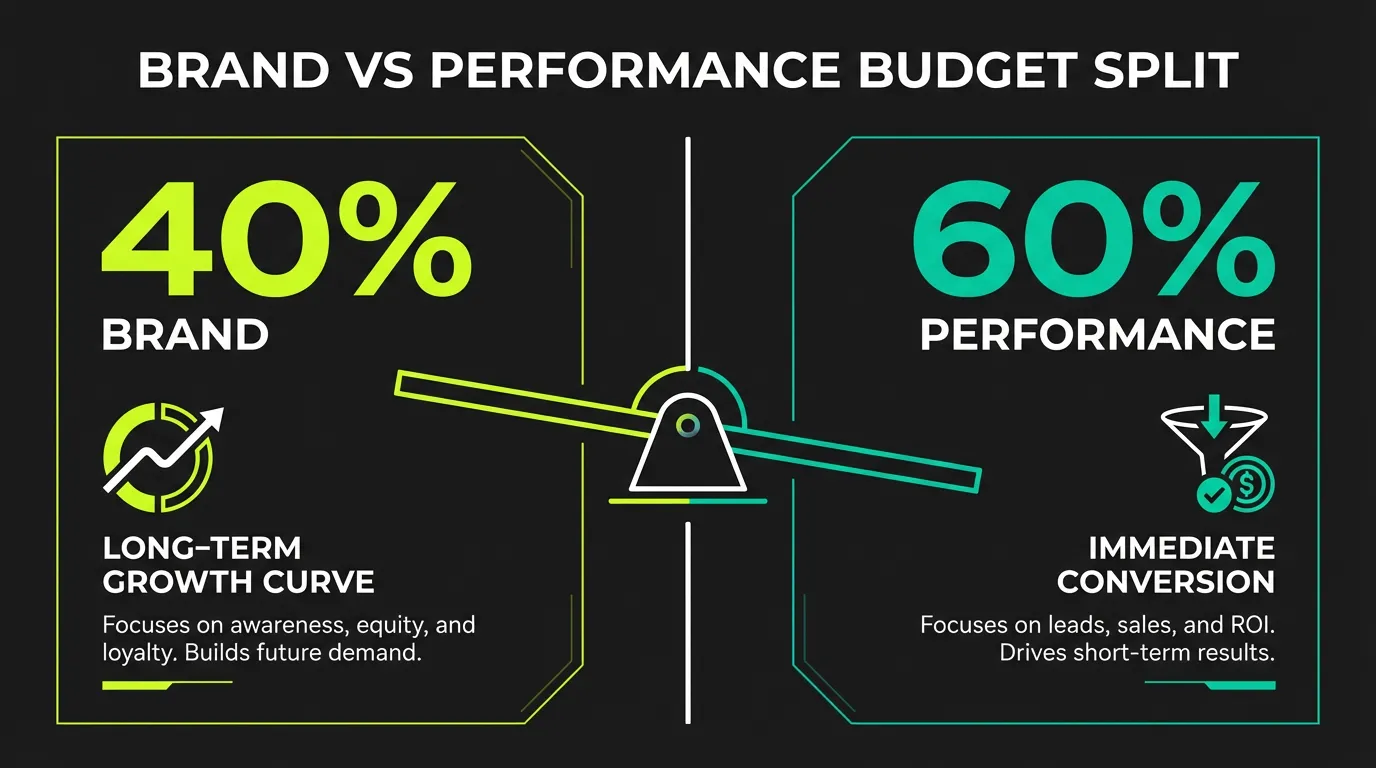
The 60/40 Debate
Traditional guidance: 60% brand, 40% performance.
Reality: Varies by:
- Business maturity (new = more brand)
- Category (considered = more brand)
- Competition (crowded = more brand)
- Margins (high margin = afford more brand)
Minimum Effective Dose
Brand advertising needs scale to work:
| Market Size | Minimum Brand Budget |
|---|---|
| Local | $50K-100K/year |
| Regional | $250K-500K/year |
| National | $1M-5M/year |
| Global | $10M+/year |
Budget Over Time
| Quarter | Brand % | Performance % | Why |
|---|---|---|---|
| Q1 | 50% | 50% | Build foundation |
| Q2 | 40% | 60% | Capitalize on awareness |
| Q3 | 60% | 40% | Pre-holiday brand building |
| Q4 | 30% | 70% | Harvest demand |
Common Mistakes
1. Expecting Immediate Results
Brand campaigns don't drive next-day conversions. Plan for 3-6 month measurement windows.
2. Wrong KPIs
Measuring brand campaigns by CPA/ROAS guarantees disappointment. Use brand metrics.
3. Insufficient Frequency
One impression does nothing. Need 3-7+ exposures for brand recall.
4. Inconsistent Messaging
Changing creative too often prevents message embedding. Wear-in takes time.
5. Under-Investment
Small brand budgets often just waste money. Concentrate on fewer channels with adequate reach.
:::danger The Cut-Brand Trap Cutting brand spend during downturns feels logical but destroys long-term competitiveness. Brands that maintain awareness during recessions emerge stronger. :::
Privacy Challenges
What's Harder Now
- Cross-platform reach/frequency measurement
- User-level attribution to brand exposure
- Long-term brand tracking cookies
- Panel data matching to campaigns
What Still Works
- Platform-native Brand Lift studies
- Aggregate reach metrics within platforms
- Survey-based brand tracking
- Marketing Mix Modeling
- Incrementality testing (geo-based)
- Search lift measurement
"Key challenges include privacy restrictions from cookie deprecation, GDPR, CCPA, and iOS privacy changes. But measuring brand awareness in 2026 isn't just possible — it's a prerequisite."
The Bottom Line
Brand awareness advertising in 2026 requires:
- Different KPIs — Reach, frequency, attention, brand lift — not CPA
- Measurement integration — Build tracking into the plan, not after
- Creative excellence — Emotion, brand consistency, audio matters
- Sufficient investment — Below threshold spend is wasted spend
- Long-term view — Brand compounds, performance depletes
- Privacy adaptation — Use platform studies, MMM, incrementality
"Choosing the right brand awareness metrics is crucial. These metrics help assess how well your brand is breaking through the noise — tracking awareness levels, calculating ROI, and benchmarking against competitors."
AdBid tracks your brand metrics alongside performance. See how upper-funnel investment drives lower-funnel results over time. Understand your full funnel.