
Part of our Meta Ads Platform guide series.
Key Takeaways
- Google Analytics now imports cost data from Meta and TikTok natively
- Marketing teams report up to 40% ROAS improvements with unified cross-platform data
- Each platform has its own attribution model, tracking window, and reporting methodology
- The industry is built on AI, immersive media, contextual targeting, and privacy-centric measurement
- Diversification beyond the duopoly of Google and Meta is essential
:::info The Unified Future "A unified cross-platform approach begins with defining clear campaign goals and understanding where your audience is most active." :::
Pricing scales with spend, not seats — see how AdBid works for teams running paid acquisition seriously.
The Multi-Platform Imperative
Running ads on a single platform is increasingly risky. Algorithm changes, policy updates, and cost fluctuations can devastate your results overnight. Smart advertisers diversify.
Platform Strengths
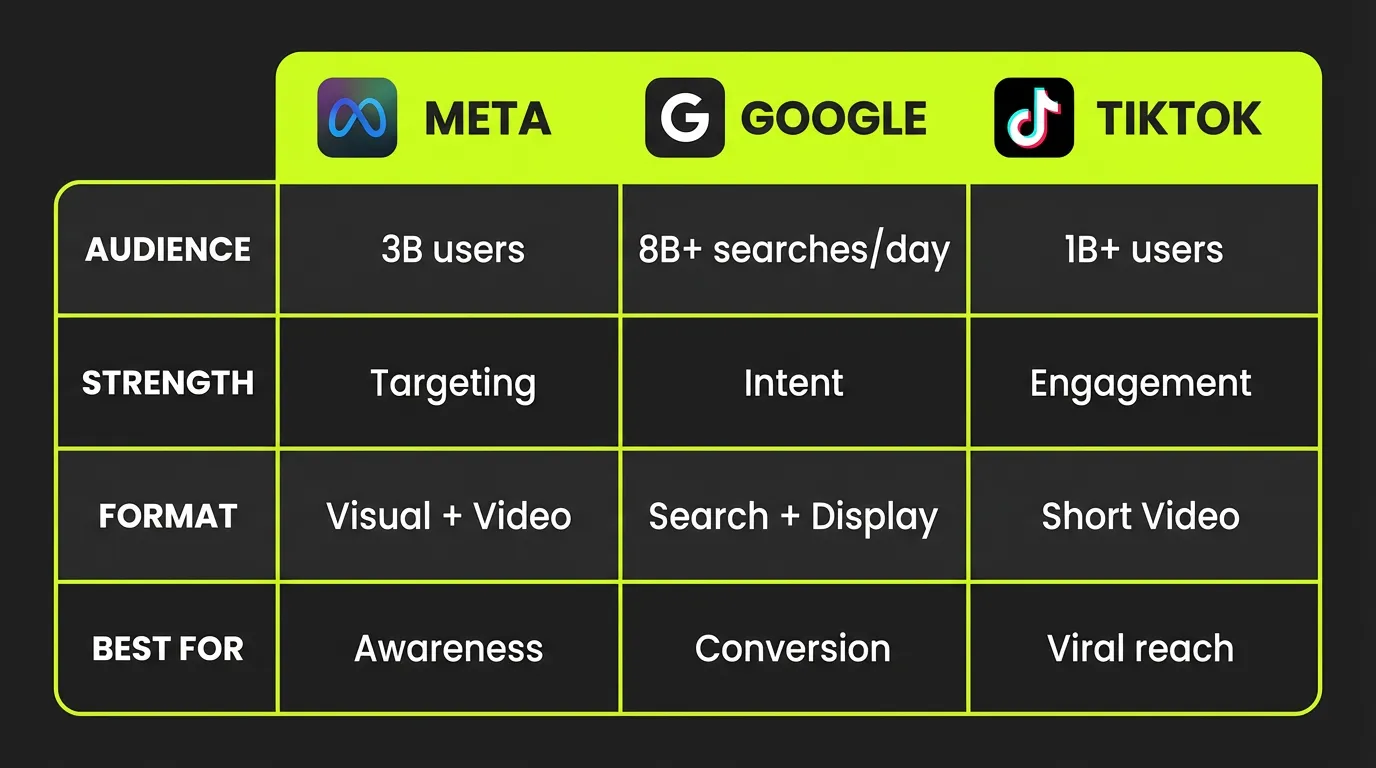
| Platform | Primary Strength | Best For |
|---|---|---|
| Intent capture | Active shoppers, B2B | |
| Meta | Audience scale | Awareness, e-commerce |
| TikTok | Discovery, Gen Z | Viral potential, trends |
| B2B targeting | Enterprise, professional | |
| Visual intent | Home, fashion, DIY | |
| Snapchat | Gen Z reach | App installs, young audiences |
Why Diversification Matters
"Brands will diversify their paid media strategies beyond the duopoly of Google and Meta, driven by a desire to reach untapped audiences and reduce the risks of relying solely on these two platforms."
Risks of Single-Platform Dependence:
- Algorithm changes tank performance
- Policy updates restrict targeting
- Competition drives up CPMs
- Account suspension = disaster
- Audience fatigue
Platform Role by Funnel Stage
The Cross-Platform Funnel
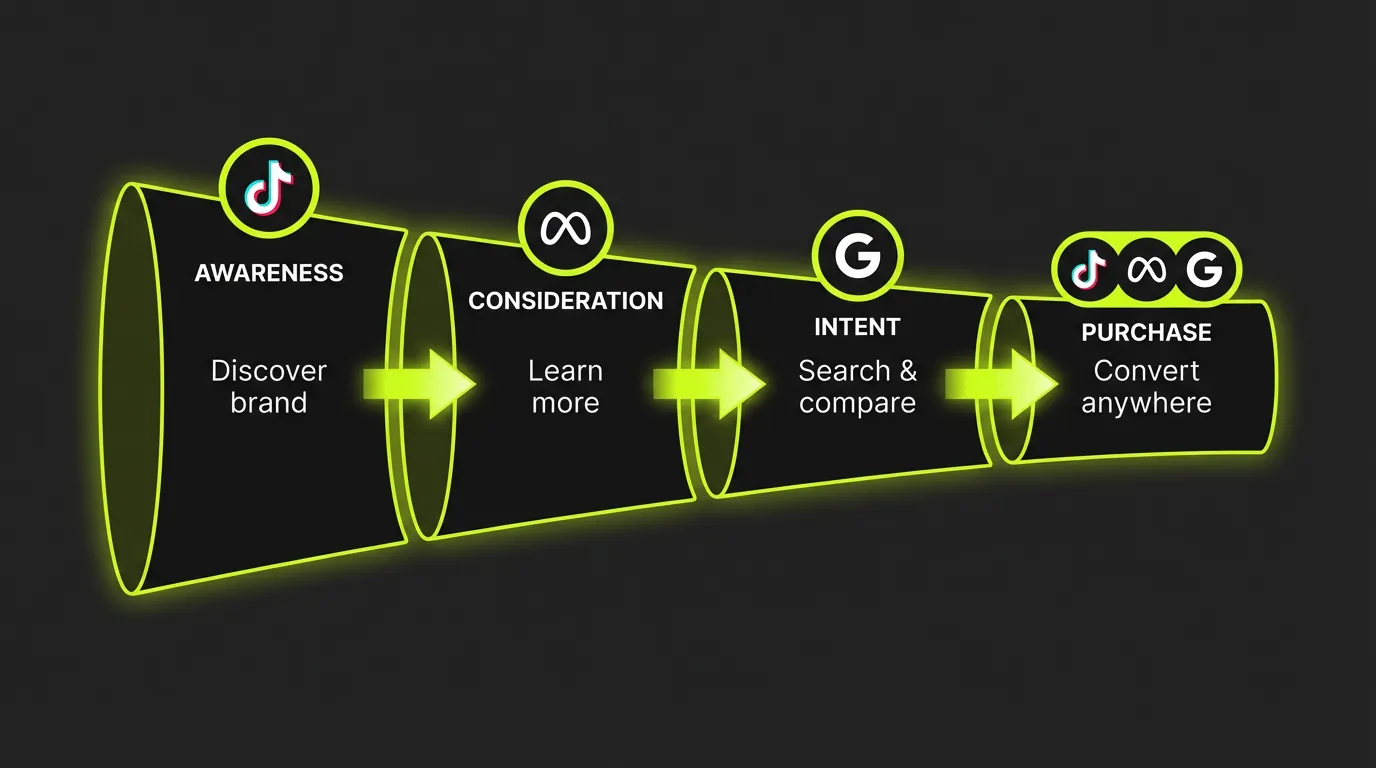
Awareness (TikTok, YouTube, Display)
          ↓
Interest (Meta, Pinterest, Native)
          ↓
Consideration (Google Search, Meta Retargeting)
          ↓
Conversion (Google, Meta, Brand Search)
          ↓
Retention (Email, Meta Custom Audiences)
Stage-Platform Mapping
| Stage | Primary Platforms | Ad Types |
|---|---|---|
| Awareness | TikTok, YouTube, Display | Video, top-funnel creative |
| Interest | Meta, Pinterest | Engagement, content |
| Consideration | Google Search, Meta | Product ads, retargeting |
| Conversion | Google, Meta | Direct response |
| Retention | Meta, Google | Custom audiences, exclusions |
Platform Deep Dives
Google Ads in the Mix
Unique Strengths:
- Intent-driven traffic (people searching)
- Highest conversion rates
- Performance Max for automation
- YouTube for video
- Discovery for native
Best Role:
- Bottom-funnel conversion
- Brand keyword protection
- Active shoppers
- B2B lead gen
Meta Ads (Facebook/Instagram)
Unique Strengths:
- Massive audience scale
- Visual storytelling
- Advantage+ automation
- Robust retargeting
- Lookalike audiences
Best Role:
- Mid-funnel consideration
- E-commerce product discovery
- Retargeting warm audiences
- Brand building
TikTok Ads
Unique Strengths:
- Discovery and viral potential
- Gen Z and young Millennial reach
- Creative-first platform
- TikTok Shop integration
- Smart+ AI automation
Best Role:
- Top-funnel awareness
- Viral product launches
- Social commerce
- Trend-driven campaigns
Unified Campaign Management
Centralized Tools
"A unified advertising platform enables businesses to create, manage, and optimize ad campaigns across multiple channels."
Platform Options:
| Tool | Channels Supported | Best For |
|---|---|---|
| Google DV360 | Google, YouTube, Display, CTV | Enterprise advertisers |
| Meta Business Suite | Facebook, Instagram | Meta-focused |
| AdBid | Meta, Google, TikTok, more | SMB, agencies |
| Luban (BlueVision) | 20+ channels | Global campaigns |
| Sprinklr | All major platforms | Enterprise |
GA4 Integration (2025)
"Google Analytics now lets advertisers automatically import cost data from Meta and TikTok (Search Engine Land) through new native integrations."
Benefits:
- Unified spend tracking
- Cross-platform ROI comparison
- No manual uploads
- Single source of truth
Creative Strategy by Platform
Platform-Specific Creative
| Platform | Format | Style |
|---|---|---|
| Google Search | Text ads | Direct, benefit-focused |
| Google Display | Static, HTML5 | Clear CTA, brand |
| Meta Feed | Image, video | Native, engaging |
| Meta Stories | Vertical video | Immersive, quick |
| TikTok | Vertical video | Native, authentic, trendy |
| YouTube | Video (various lengths) | Educational, storytelling |
Cross-Platform Creative Adaptation
Do:
- Adapt creative to platform norms
- Test native vs. cross-posted
- Maintain brand consistency
- Vary messaging by funnel stage
Don't:
- Cross-post identical creative
- Ignore platform culture
- Use same CTA everywhere
- Forget mobile optimization
:::warning Creative Platform Fit A TikTok ad that looks like a TikTok post outperforms a polished brand ad by 2-3x. Each platform has its own creative language. :::
Measurement & Attribution Challenges
The Attribution Problem
"Advertisers running campaigns across Meta, Google, TikTok, and maybe Pinterest face challenges as each platform has its own attribution model, tracking window, and reporting methodology."
Why Numbers Don't Match:
| Factor | Platform Variation |
|---|---|
| Attribution window | 1-90 days depending on platform |
| Attribution model | Last-touch, data-driven, etc. |
| View-through | Different methodologies |
| Cross-device | Varying capabilities |
| Conversion definition | Platform-specific events |
Solving Cross-Platform Measurement
Option 1: Platform-Native + Blended View
- Trust each platform's data for optimization
- Create blended dashboard for strategy
- Accept some overlap/discrepancy
Option 2: Single Source of Truth
- Use GA4 or similar as central hub
- Import all channel data
- Apply consistent attribution
- Acknowledge limitations
Option 3: Incrementality Testing
- Run holdout tests per channel
- Measure true incremental impact
- Allocate budget based on true contribution
:::highlight Knowledge Graph Approach "Marketing teams report up to 40% ROAS improvements when they implement AI-powered knowledge graphs that unify cross-platform data." :::
Budget Allocation Framework
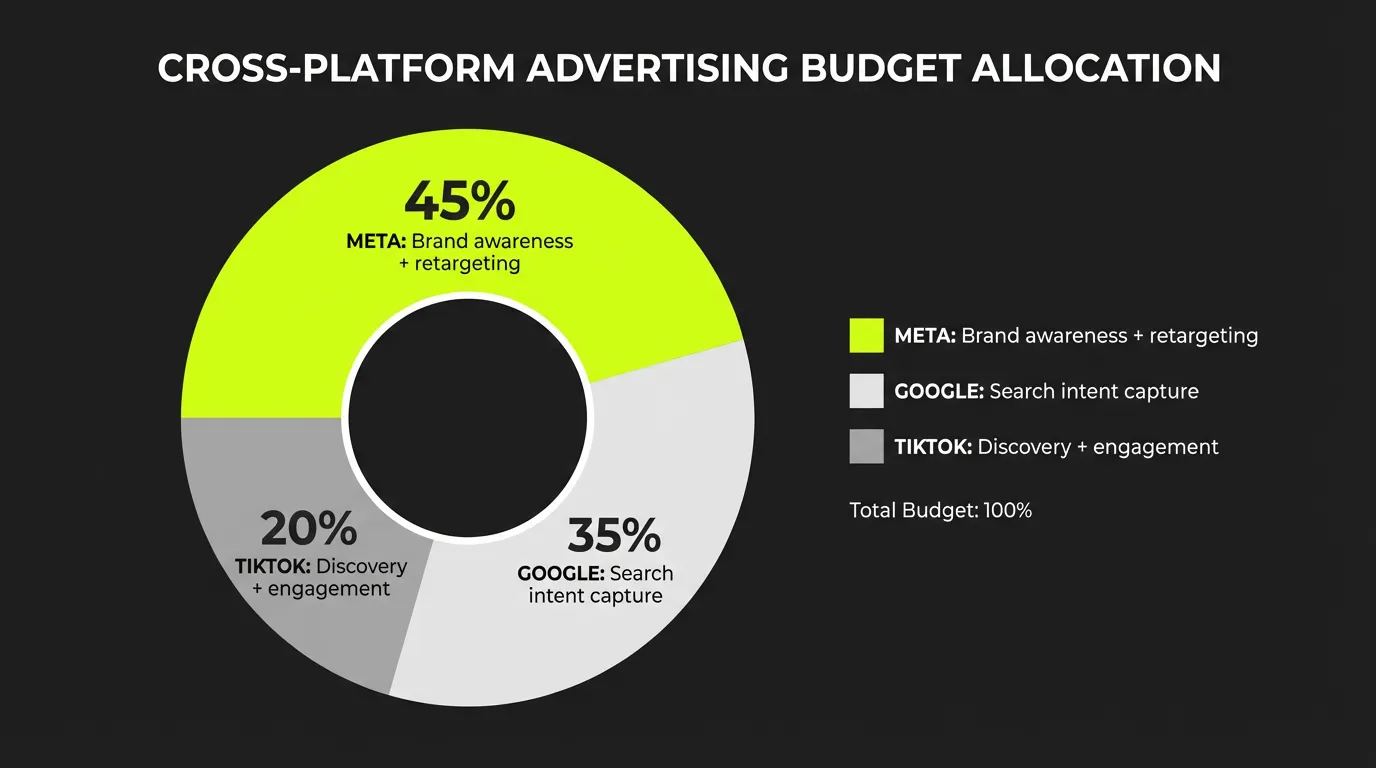
Initial Allocation
| Platform | Budget % | Purpose |
|---|---|---|
| Google Search | 30-40% | Intent capture, conversion |
| Meta | 30-40% | Awareness, retargeting |
| TikTok | 10-20% | Discovery, younger audiences |
| Other | 10-20% | Testing, diversification |
Allocation Optimization
- Start with hypothesis — Platform-stage mapping
- Run initial test — 2-4 weeks minimum
- Measure holistically — Blended ROAS, not platform ROAS
- Adjust based on data — Shift to performers
- Continuously test — Platforms change, so should allocation
When to Shift Budget
| Signal | Action |
|---|---|
| Diminishing returns | Reduce spend, test elsewhere |
| CPM spikes | Diversify to cheaper channels |
| Audience exhaustion | Expand platforms |
| New opportunity | Test emerging channels |
| Performance drop | Investigate before cutting |
Cross-Platform Audience Strategy
Audience Mapping
| Audience Type | Platform Application |
|---|---|
| First-party (CRM) | Meta Custom, Google Customer Match |
| Website visitors | Meta Pixel, Google Remarketing |
| Engagers | Platform-native engagement audiences |
| Lookalikes | Meta LAL, Google Similar Audiences |
| In-market | Google In-Market, Meta interests |
Cross-Platform Retargeting
User sees TikTok ad → Visits website → Retargeted on Meta → Searches on Google → Converts
Implementation:
- Consistent UTM tagging
- Cross-platform pixel/tag
- Unified audience lists where possible
- Sequential messaging by platform
2025-2026 Innovations
Platform Updates
Meta:
- AI-powered Image Expansion for cross-format adaptation
- Incremental Attribution
- Enhanced Advantage+ automation
Google:
- Centralized DSP upgrade in DV360
- GA4 cross-platform cost imports
- Enhanced AI-powered campaigns
TikTok:
- Smart+ AI-powered campaigns
- Full-funnel performance positioning
- Enhanced shopping integration
The AI-First Future
"The paid media landscape is set to become more dynamic, diversified, and AI-driven than ever before."
What This Means:
- More automation, less manual control
- Creative becomes the variable
- Measurement becomes critical
- Diversification becomes survival
Common Mistakes
1. Platform Silo Thinking
Optimizing each platform independently ignores the customer journey.
2. Inconsistent Tracking
Different UTMs, conversion events, and attribution settings make comparison impossible.
3. Over-Reliance on Platform Data
Each platform claims credit for everything. Use external measurement.
4. Copy-Paste Creative
What works on Meta likely fails on TikTok. Adapt.
5. Set-and-Forget Allocation
Optimal allocation changes constantly. Review monthly.
The Bottom Line
Cross-platform advertising in 2026 requires:
- Diversification — Don't depend on one platform
- Platform expertise — Understand each platform's strengths
- Unified measurement — Single source of truth where possible
- Creative adaptation — Platform-native content
- Flexible allocation — Shift budget based on performance
- AI adoption — Automation is the new normal
"The industry is rapidly coalescing around a new mobile advertising playbook built on four core pillars: AI, immersive media, contextual targeting, and privacy-centric measurement."
AdBid unifies your advertising across Meta, Google, TikTok, and more. See cross-platform performance in one dashboard. Unify your advertising.