
Part of our Meta Ads Platform guide series.
Key Takeaways
- Meta's default is 7-day click, 1-day view (restricted from pre-iOS 14 28-day windows)
- Google allows 1-90 day attribution windows with various models
- Meta is removing 7-day and 28-day view-through windows in January 2026 (Supermetrics)
- Incremental Attribution from Meta shows 20%+ boost in incremental conversions
- Window misalignment guarantees reporting disagreement between platforms
:::warning Major Change Coming Starting January 12, 2026, Meta will remove 7-day and 28-day view-through attribution windows. Plan your measurement strategy accordingly. :::
For teams that need cleaner measurement behind these decisions, AdBid's advertising attribution connects campaign performance, revenue, and channel data.
Understanding Attribution Windows
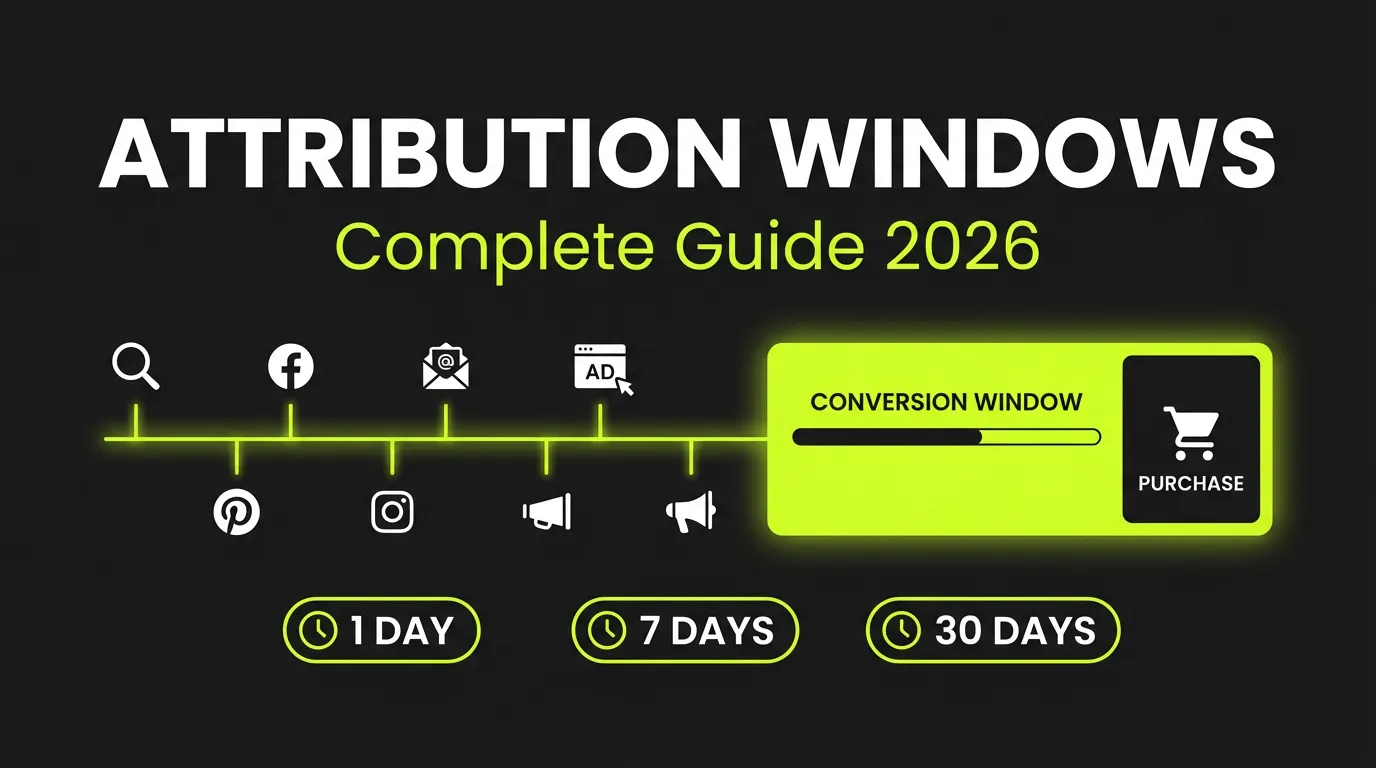
Attribution windows define how long after an ad interaction a conversion can be credited to that ad. Get this wrong, and you'll make decisions based on inaccurate data.
The Basic Concept
User sees ad → [Window opens] → User converts → [Credit assigned?]
      ↑                                              ↑
  Impression/Click                        Only if within window
Window Types
| Type | Definition | Best For |
|---|---|---|
| Click-through | Conversion after clicking | Direct response |
| View-through | Conversion after seeing (no click) | Awareness, brand |
| Engaged-view | Video watch of 10+ seconds | Video campaigns |
Meta Attribution Windows
Available Options (2026)
| Window | Description | Use Case |
|---|---|---|
| 1-day click | 24 hours after click | Impulse purchases |
| 7-day click | 7 days after click | Most e-commerce |
| 1-day view | 24 hours after impression | Brand influence |
| 7-day click + 1-day view | Default setting | Balanced approach |
The iOS 14 Impact
"Before Apple's iOS 14.5 update, Meta offered advertisers detailed attribution insights, with windows extending up to 28 days post-click and 7 days post-view."
What Changed:
- 28-day click window removed
- 7-day view window being removed (Jan 2026)
- More limited data granularity
- Modeled conversions for iOS users
Incremental Attribution (2025)
"In April 2025, Meta rolled out Incremental Attribution (Seer Interactive), an AI-powered technique that uses holdout testing to separate conversions driven by ads from those that occur naturally."
Benefits:
- 20%+ boost in incremental conversions identified
- True incrementality measurement
- AI-powered holdout testing
- Better budget allocation insights
Choosing Meta Windows
| Scenario | Recommended Window |
|---|---|
| Impulse products (<$50) | 1-day click |
| Standard e-commerce | 7-day click |
| High-consideration ($500+) | 7-day click |
| Brand awareness | 7-day click + 1-day view |
| Flash sales | 1-day click |
:::tip Default Setting The 7-day click + 1-day view default is appropriate for most advertisers. Change it only if you have a specific reason. :::
Google Ads Attribution
Window Options
| Platform | Min Window | Max Window | Default |
|---|---|---|---|
| Google Ads (Search) | 1 day | 90 days | 30 days |
| Google Ads (Display) | 1 day | 90 days | 30 days |
| Google Ads (Video) | 1 day | 90 days | 30 days |
| GA4 | 1 day | 90 days | 30 days |
Attribution Models in Google
| Model | Description | Best For |
|---|---|---|
| Data-Driven | ML-based credit distribution | Most advertisers |
| Last Click | 100% to final click | Direct response |
| First Click | 100% to first click | Awareness campaigns |
| Linear | Equal credit to all | Understanding full path |
| Time Decay | More credit to recent | Shorter cycles |
| Position-Based | 40/20/40 first/middle/last | Balanced view |
Google's Time Decay
"Google differs from Meta in that credit is distributed through a 7-day half life. An ad interaction 8 days before the conversion event gets half as much credit as an interaction 1 day before."
Platform Comparison
Key Differences
| Factor | Meta | |
|---|---|---|
| Max click window | 7 days | 90 days |
| View-through | 1 day (soon limited) | Varies by campaign |
| Default model | Last touch | Data-driven |
| Cross-device | Limited post-iOS 14 | Better with login data |
| Granularity | Restricted | More detailed |
Why Numbers Never Match
"Window misalignment guarantees numerical disagreement."
Causes of Discrepancy:
- Different attribution windows
- Different attribution models
- Different conversion definitions
- Cross-device tracking differences
- View-through methodology
- Time zone differences
- Conversion delay handling
Comparing Apples to Apples
To minimize discrepancy:
- Align windows where possible
- Use same conversion events
- Understand each platform's methodology
- Don't expect 100% match
- Use incrementality testing for truth
Setting Up Attribution
Meta Attribution Settings
Location: Ads Manager → Ad Set Level → Attribution Setting
| Setting | Options |
|---|---|
| Click window | 1-day or 7-day |
| View window | 1-day or none |
| Combination | Click-only or Click + View |
Google Ads Attribution Settings
Location: Tools & Settings → Measurement → Attribution
| Setting | Options |
|---|---|
| Model | Data-driven, Last click, etc. |
| Window | 1-90 days |
| Conversions | Include in conversions toggle |
GA4 Attribution Settings
Location: Admin → Attribution Settings
| Setting | Options |
|---|---|
| Reporting model | Data-driven or rules-based |
| Lookback window | Acquisition: 30 days default |
| Other: 90 days default |
Attribution Strategy by Business Type
E-commerce
| Factor | Recommended Approach |
|---|---|
| Meta | 7-day click for most products |
| 30-day click for standard, 7-14 for impulse | |
| High AOV | Longer windows (consider full journey) |
| Low AOV | Shorter windows (impulse behavior) |
Lead Generation
| Factor | Recommended Approach |
|---|---|
| Meta | 7-day click (form fills are quick decisions) |
| 30-60 day for B2B, 14-30 for B2C | |
| Long sales cycle | Supplement with offline conversion import |
| Short sales cycle | 7-14 day windows |
Subscription/SaaS
| Factor | Recommended Approach |
|---|---|
| Trial signups | 7-30 day click |
| Paid conversions | 30-60 day |
| Enterprise | 60-90 day, plus CRM integration |
| Consumer | 14-30 day |
View-Through Attribution
The Debate
View-through attribution credits conversions to users who saw but didn't click your ad. It's controversial:
Arguments For:
- Captures awareness influence
- Recognizes brand impact
- More complete picture
- Especially relevant for video/display
Arguments Against:
- Hard to prove causality
- Inflates reported performance
- Can overlap with other channels
- Open to manipulation
Best Practices
- Use conservatively — 1-day view maximum
- Compare with and without — Understand the delta
- Consider incrementality — View-through lift testing
- Don't double count — Deduplicate across channels
- Question high view-through — If most conversions are VT, investigate
:::warning View-Through Reality High view-through percentages often indicate you're getting credit for conversions that would have happened anyway. Use incrementality testing to verify. :::
Advanced Attribution Approaches
Incrementality Testing
The gold standard for true attribution:
- Holdout groups — Don't show ads to control
- Geo testing — Dark markets vs. exposed
- Conversion lift — Platform-native measurement
- Matched market analysis — Statistical comparison
Marketing Mix Modeling (MMM)
For macro-level attribution:
- All channels together
- Historical data analysis
- Accounts for external factors
- No individual tracking needed
- Privacy-compliant
Multi-Touch Attribution (MTA)
Distributes credit across touchpoints:
- Requires cross-channel data
- Various models available
- Better than last-touch alone
- Still limited by tracking gaps
Common Mistakes
1. Using Misaligned Windows
Comparing Meta 7-day to Google 30-day makes no sense. Align or understand the delta.
2. Ignoring Window in Optimization
Meta optimizes for your chosen window. Wrong window = wrong optimization.
3. Over-Relying on View-Through
High view-through conversion percentages should trigger skepticism, not celebration.
4. Forgetting Conversion Delay
Some conversions take days/weeks. Don't evaluate campaigns before window closes.
5. Not Testing Windows
Your optimal window may differ from defaults. Test different settings.
The Bottom Line
Attribution windows in 2026 require:
- Platform understanding — Meta and Google work differently
- Business alignment — Match windows to purchase cycle
- Consistency — Same settings across similar campaigns
- Skepticism — Question high view-through rates
- Supplemental testing — Incrementality for truth
- Adaptability — Privacy changes will continue
"The right approach is to use multiple measurement methods by combining attribution, MMM, and incrementality testing for a complete picture."
AdBid normalizes attribution across platforms, showing you comparable data regardless of window settings. Understand your true performance. See unified attribution.