
Key Takeaways
- Brands with strong omnichannel strategies retain 89% of customers (vs. 33% for weak)
- 73% of consumers use multiple channels during their shopping journey (Harvard Business Review)
- 90% of consumers switch between devices to complete tasks
- Companies using cross-channel intelligence see 13% higher ROAS
- 95.4% of B2C marketers now use AI in omnichannel campaigns
:::highlight The Omnichannel Reality "By 2026, 60% of large retailers will have adopted unified commerce solutions to improve CX and operational efficiency." — Gartner Prediction :::
What Is Omnichannel Advertising?
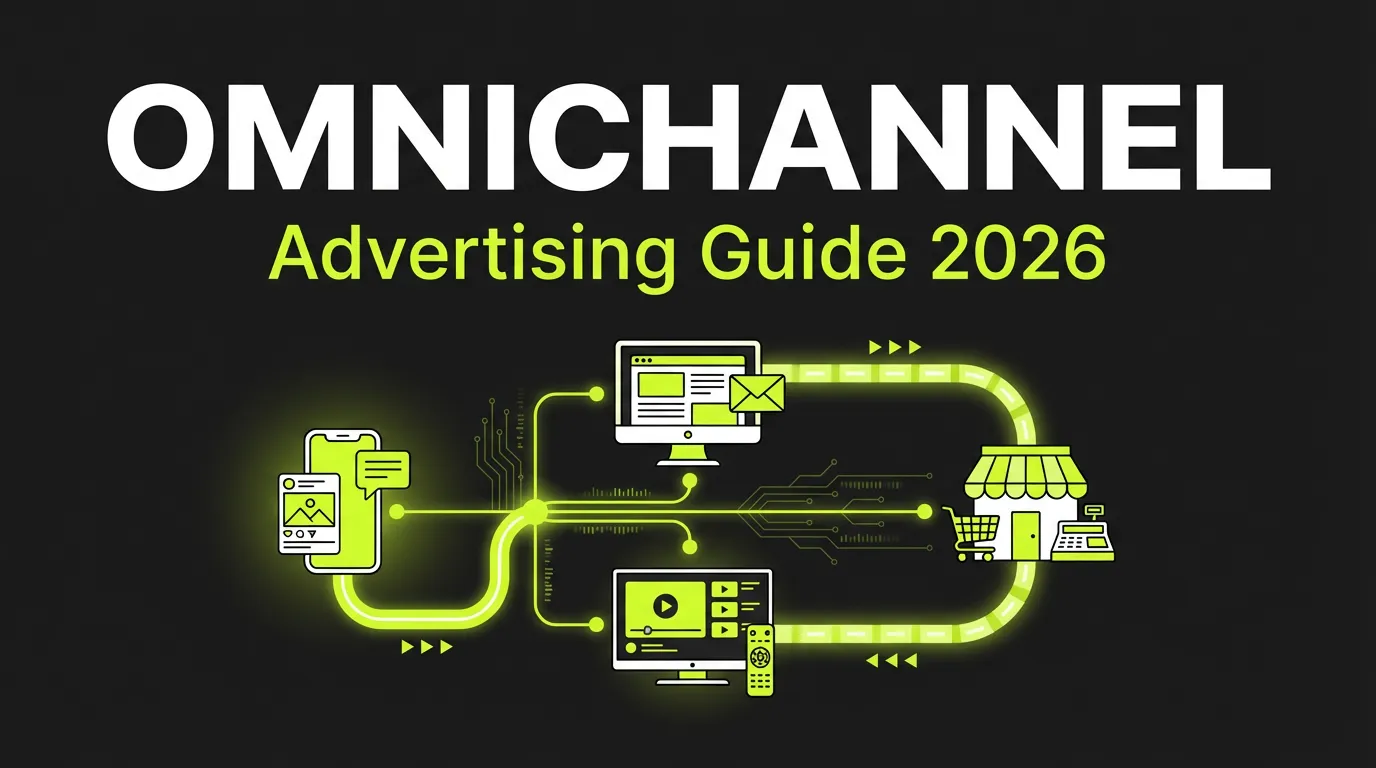
Omnichannel advertising creates a unified customer experience across all channels and touchpoints, unified by data and strategy.
Once you're ready to scale, AdBid gives you the workflow to plan, launch, and optimize without adding headcount.
Omnichannel vs. Multi-Channel vs. Cross-Channel
| Approach | Definition | Data Integration |
|---|---|---|
| Multi-Channel | Present on multiple channels | Siloed, independent |
| Cross-Channel | Channels interact with each other | Partial integration |
| Omnichannel | Unified experience, smooth transitions | Fully integrated |
"Cross-Channel Marketing Intelligence is the strategic integration of data and analytics from all your advertising and communication channels to create a single, cohesive customer journey."
Why Omnichannel Matters in 2026
The data is compelling:
| Metric | Omnichannel | Single Channel |
|---|---|---|
| Customer retention | 89% | 33% |
| Sales increase potential | Up to 287% | Baseline |
| Average order value | 13% higher | Baseline |
| Customer lifetime value | 30% higher | Baseline |
The Modern Customer Journey
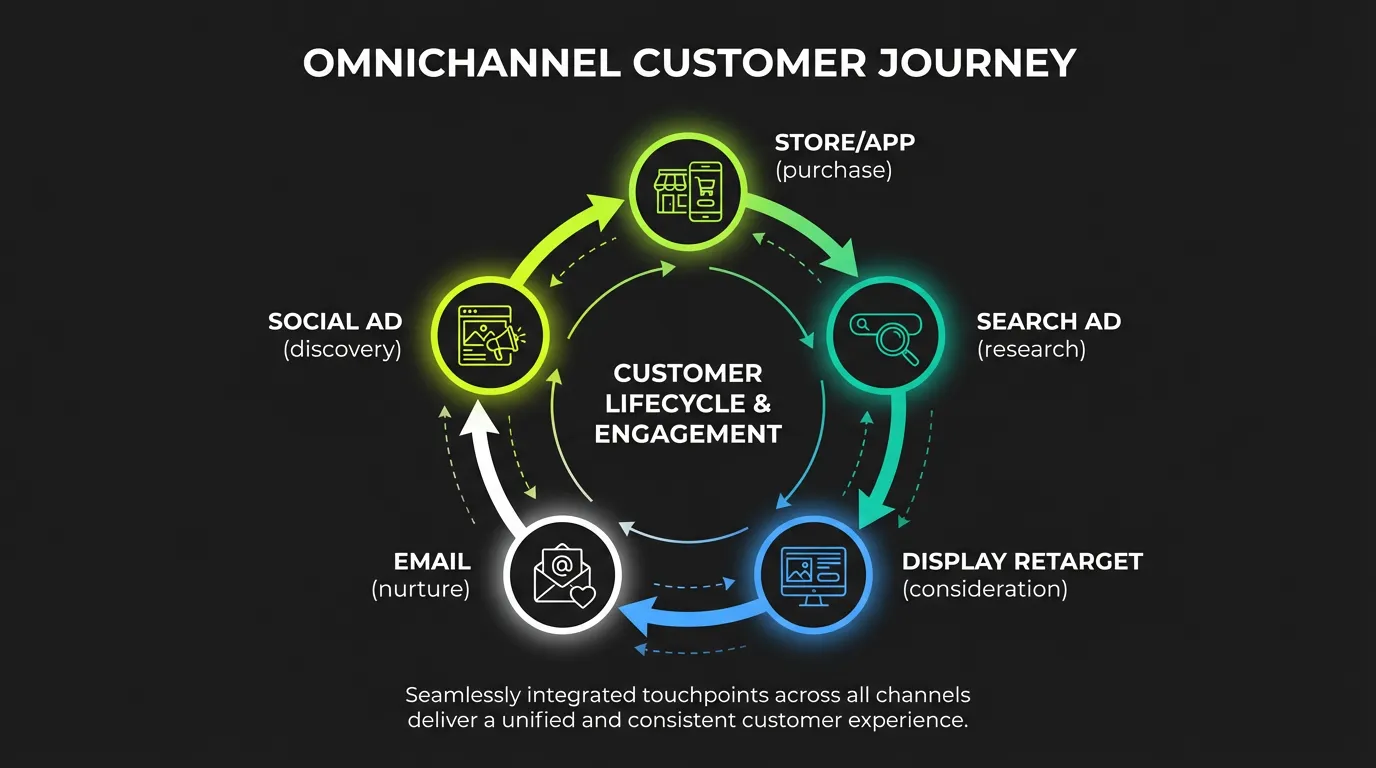
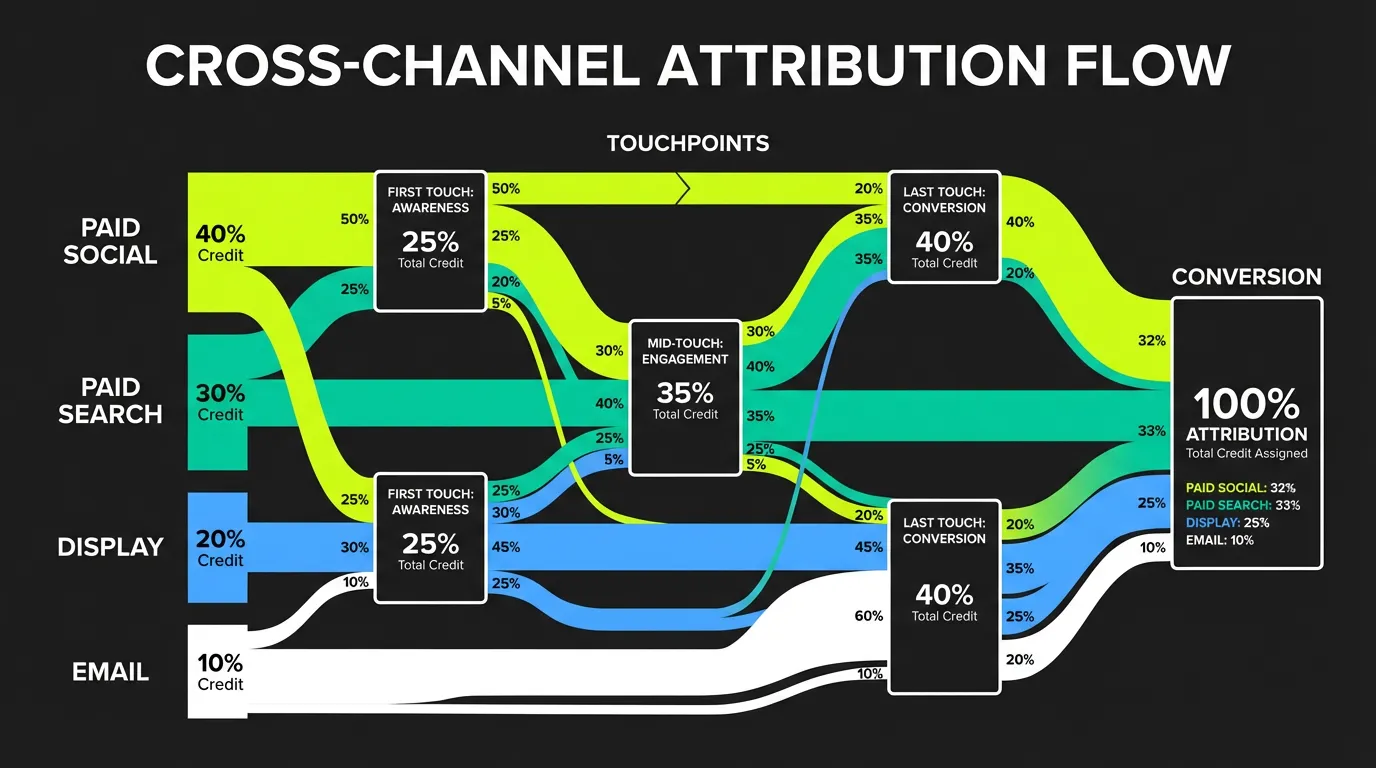
Harvard Business Review found that 73% of consumers use multiple channels during shopping:
- Discover on social media (Instagram, TikTok)
- Research on search engines (Google)
- Compare on review sites and marketplaces
- Consider via retargeting ads
- Purchase in app, website, or store
- Engage through email, SMS, loyalty programs
:::info Device Switching 90% of consumers switch between devices to complete tasks. A journey might start on mobile, continue on desktop, and finish in-store — all for a single purchase decision. :::
Building an Omnichannel Strategy
Step 1: Map Customer Touchpoints
Document every interaction point:
Awareness Touchpoints:
- Social media ads
- Display advertising
- Video ads (YouTube, CTV)
- Influencer content
- Organic search
- PR and content
Consideration Touchpoints:
- Retargeting ads
- Email marketing
- Comparison shopping
- Review sites
- Product pages
Conversion Touchpoints:
- Shopping ads
- Cart abandonment emails
- Promotional offers
- In-store experience
- Sales team
Retention Touchpoints:
- Order confirmation
- Delivery updates
- Post-purchase follow-up
- Loyalty programs
- Customer service
Step 2: Unify Your Data
:::warning The #1 Challenge "82% of respondents surveyed felt an inability to measure cross-channel performance is standing in the way of their omnichannel marketing success." — CMO Club Study :::
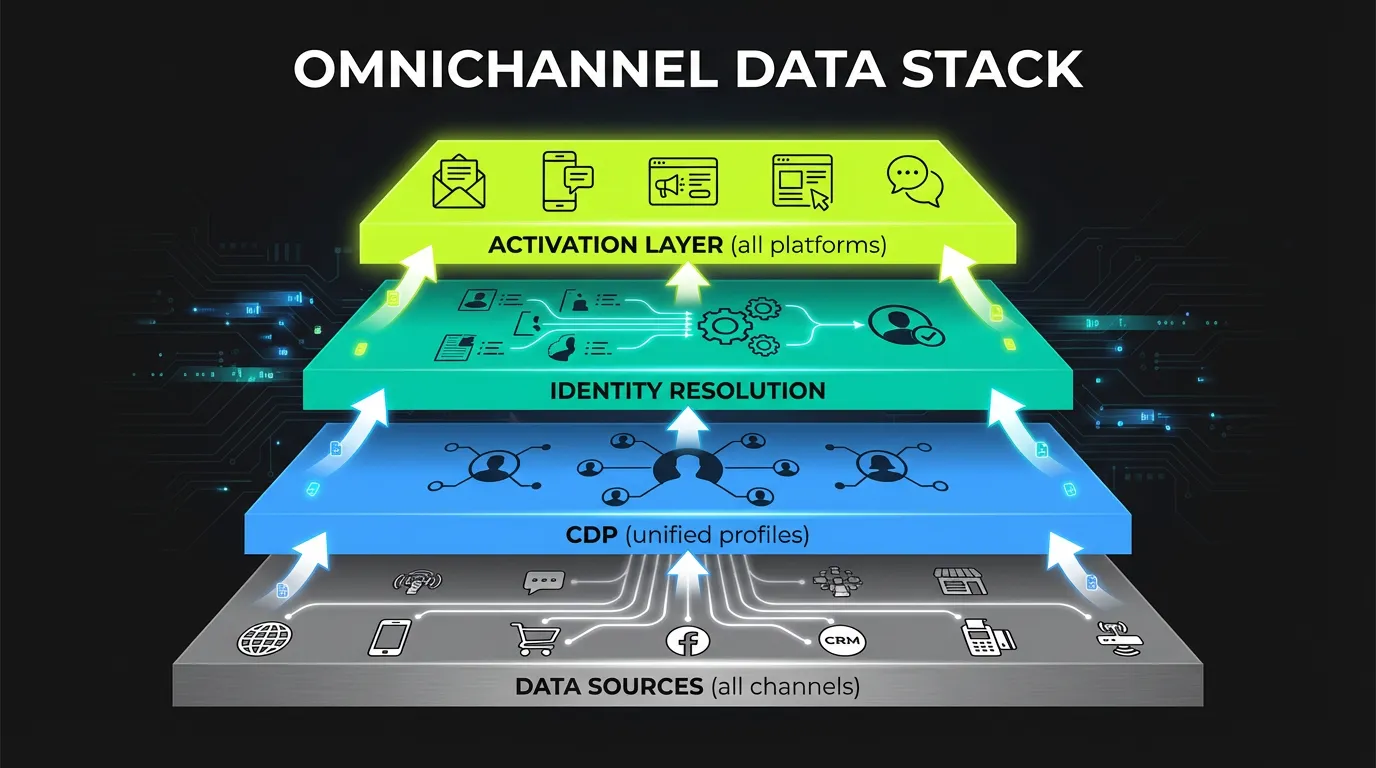
Data unification requirements:
- Customer Data Platform (CDP) — Single customer view
- Cross-device identity resolution — Connect devices to people
- Unified measurement — Attribution across channels
- Real-time activation — Act on data immediately
Step 3: Coordinate Messaging
Create message sequences that work together:
| Touchpoint | Message | Goal |
|---|---|---|
| Discovery (Social) | Problem awareness | Generate interest |
| Education (YouTube) | Solution introduction | Build consideration |
| Consideration (Display) | Product benefits | Strengthen preference |
| Conversion (Search) | Offer + CTA | Drive purchase |
| Retention (Email) | Onboarding + value | Increase LTV |
Step 4: Personalize at Scale
AI enables personalization across channels:
- Dynamic creative optimization — Personalized ads
- Triggered sequences — Behavioral responses
- Predictive targeting — Anticipate needs
- Real-time bidding — Channel and message selection
Channel Integration Tactics
Paid Social + Email Integration
Connect paid acquisition with owned channels:
- Lead generation — Capture via social ads
- Welcome sequence — Immediate email nurture
- Suppression — Remove converters from acquisition
- Reactivation — Retarget email non-openers via social
Search + Display Coordination
Complement high-intent with awareness:
- Branded search — Capture demand
- Non-brand search — Expand reach
- Display retargeting — Re-engage abandoners
- Display prospecting — Feed top of funnel
CTV + Digital Integration
Connected TV extends reach:
- CTV brand awareness — Reach cord-cutters
- Second-screen retargeting — Capture mobile attention
- Sequential messaging — CTV exposure → digital conversion
- Measurement — Cross-device attribution
:::tip Mobile App Retargeting Mobile app users who are retargeted are 3x more likely to convert. Integrate app behavior into your omnichannel strategy. :::
Cross-Channel Marketing Intelligence
Building a Unified View
Components of cross-channel intelligence:
| Component | Function |
|---|---|
| Data warehouse | Central data storage |
| Identity graph | Cross-device matching |
| Attribution platform | Journey analysis |
| Visualization | Dashboard and reporting |
| Activation | Real-time decisioning |
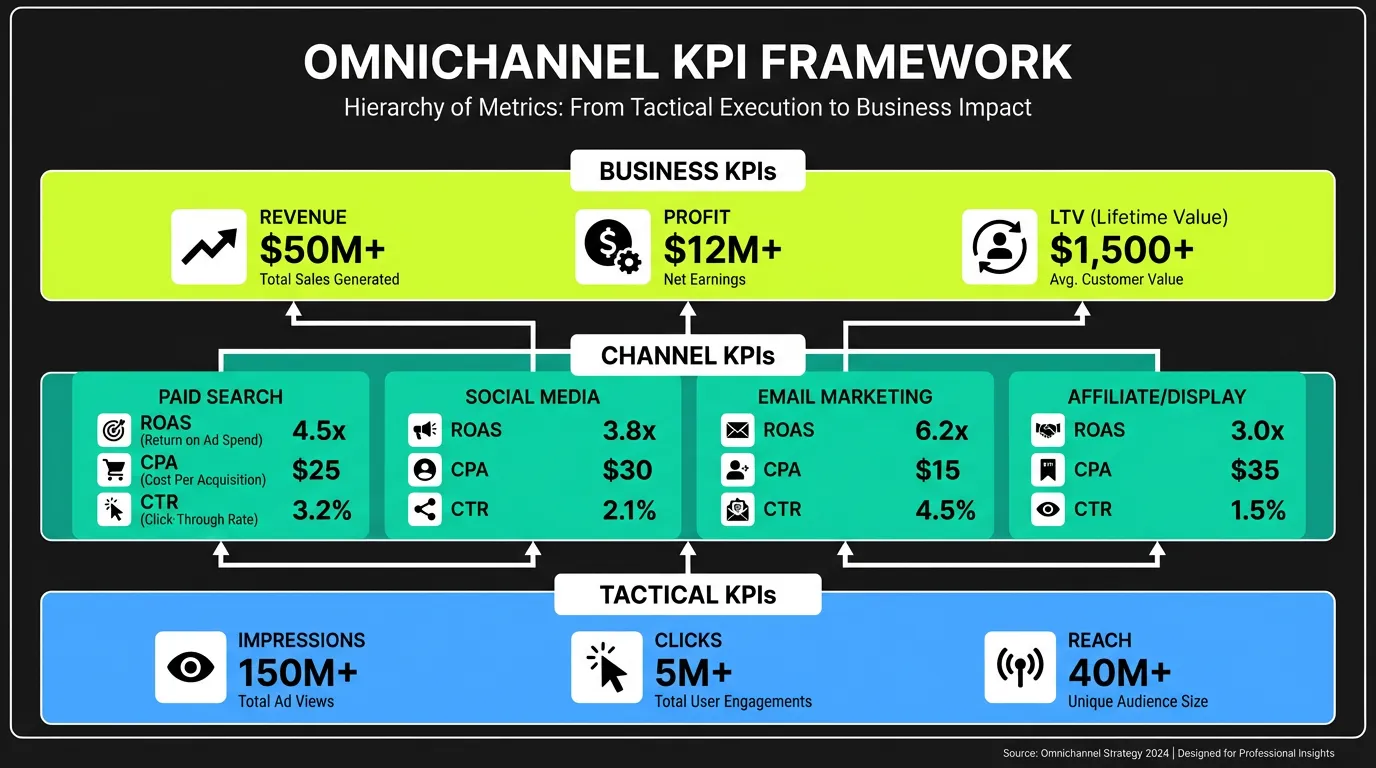
Key Metrics to Track
Channel performance:
- ROAS by channel
- CAC by channel
- Assisted conversions
- Attribution weight
Customer journey:
- Path length (touchpoints to conversion)
- Time to conversion
- Channel sequence patterns
- Cross-device behavior
Business impact:
- Blended ROAS
- Customer lifetime value
- Retention rate
- Net promoter score
Overcoming Omnichannel Challenges
Challenge 1: Data Silos
Problem: Each platform has its own data, creating fragmented views.
Solution:
- Implement a CDP or data warehouse
- Use server-side tracking for unified data collection
- Create consistent UTM and naming conventions
- Regular data reconciliation processes
Challenge 2: Measurement Complexity
Problem: Attribution across channels is difficult.
Solution:
- Multi-touch attribution models
- Incrementality testing
- Marketing mix modeling (MMM)
- Holdout groups for validation
Challenge 3: Organizational Alignment
Problem: Teams operate in silos (social team, email team, etc.).
Solution:
- Cross-functional collaboration frameworks
- Shared KPIs and incentives
- Regular cross-team planning sessions
- Unified customer journey ownership
:::danger Common Pitfall "38.9% of B2C enterprises struggled with delivering personalized experiences, given that these brands cater to a diverse and huge customer base."
Start with high-value segments before attempting full personalization. :::
AI in Omnichannel Marketing
Current AI Applications
"95.4% of B2C marketers are using AI in their omnichannel campaigns in 2026."
AI-powered capabilities:
- Predictive audiences — Who will convert next?
- Next-best-action — What message/channel now?
- Dynamic creative — Personalized content at scale
- Bid optimization — Cross-channel budget allocation
- Anomaly detection — Real-time performance alerts
Implementing AI
Start with high-impact, low-complexity applications:
| Application | Complexity | Impact |
|---|---|---|
| Automated bidding | Low | High |
| Email personalization | Low | Medium |
| Creative optimization | Medium | High |
| Journey orchestration | High | Very High |
| Predictive LTV | High | Very High |
Budget Allocation Across Channels
The Modern Channel Mix
Sample omnichannel budget allocation:
| Channel | Budget % | Role |
|---|---|---|
| Paid Social | 30% | Awareness + conversion |
| Paid Search | 25% | Intent capture |
| Display/Programmatic | 15% | Retargeting + prospecting |
| Email/SMS | 10% | Retention + nurture |
| CTV/Video | 10% | Brand awareness |
| Emerging/Testing | 10% | Innovation |
Optimization Framework
Continuously optimize based on:
- Incrementality tests — True channel contribution
- Saturation curves — Diminishing returns by channel
- Cross-channel effects — How channels interact
- Customer segment performance — Different mix by audience
Implementation Roadmap
Phase 1: Foundation (Months 1-3)
- Audit current touchpoints
- Implement unified tracking
- Set up data infrastructure
- Define measurement framework
Phase 2: Integration (Months 4-6)
- Connect data sources
- Build customer profiles
- Create cross-channel segments
- Develop journey maps
Phase 3: Orchestration (Months 7-9)
- Implement journey automation
- Launch cross-channel campaigns
- Begin A/B testing sequences
- Optimize based on data
Phase 4: Optimization (Months 10-12)
- Refine personalization
- Scale winning approaches
- Implement AI capabilities
- Build predictive models
The Bottom Line
Effective omnichannel advertising in 2026 requires:
- Unified data — Single customer view across all touchpoints
- Coordinated messaging — Consistent yet personalized by context
- Cross-channel measurement — Understand the full journey
- AI integration — Scale personalization and optimization
- Organizational alignment — Break down team silos
The brands winning are those creating unified experiences, not just running ads on multiple platforms.
AdBid unifies your advertising data across all channels. See the complete customer journey in one place. Start unifying.