
Key Takeaways
:::highlight The Demand-Lead Connection 26% of enterprise organizations now invest over 70% of their marketing budgets on demand generation. 68% of B2B marketers credit demand generation with delivering higher quality leads than traditional acquisition methods. The shift is real—and it's producing results. :::
- Demand generation creates the market — Build awareness and interest before buyers are ready
- Lead generation captures the demand — Convert interested prospects into actionable leads
- Both are essential — One without the other produces incomplete results
- Quality over quantity — Better to generate fewer, higher-intent leads than flood sales with MQLs
- 60%+ of buyers choose brands they knew first — Being known before the buying journey starts matters
Teams running this at volume lean on AdBid's campaign automation to plan, launch, and optimize without tool-switching.
Demand Generation vs Lead Generation: The Core Difference
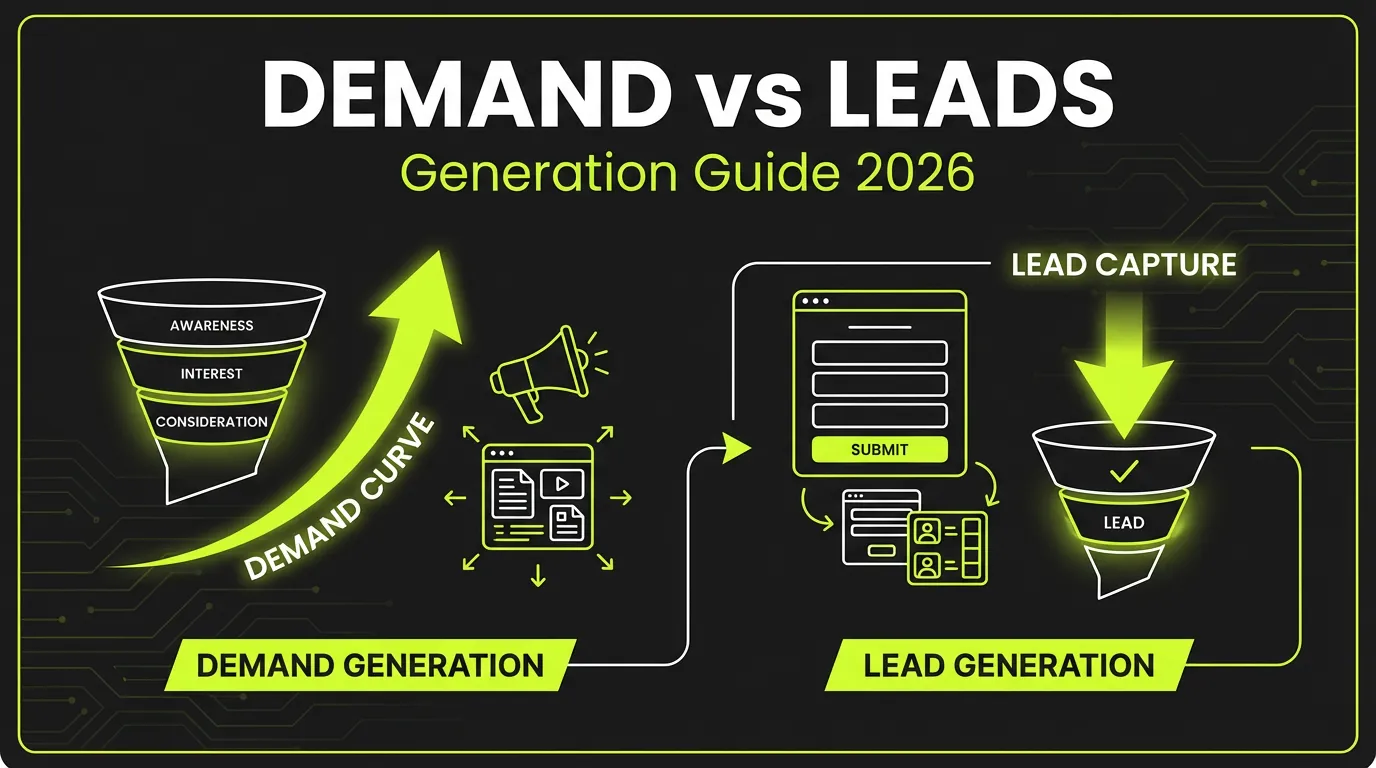
Demand Generation
Purpose: Create awareness and interest in your product category and brand among people who aren't yet looking to buy.
Focus: The 97-99% of your market not currently in-market.
Activities:
- Thought leadership content
- Brand awareness campaigns
- Educational webinars/events
- Ungated content
- Social presence
- Podcast/video content
- Community building
Lead Generation
Purpose: Capture contact information from prospects showing buying signals and move them toward a sale.
Focus: The 1-3% of your market actively looking to buy.
Activities:
- Gated content/resources
- Demo requests
- Free trials
- Contact forms
- Sales outreach
- Event registration
- Bottom-funnel ads
:::info The Simple Distinction Demand gen answers: "How do we get more people to want what we sell?"
Lead gen answers: "How do we capture information from people who want to buy?"
If no one wants what you sell, capturing leads won't help. :::
The Modern B2B Buying Journey
Understanding how buyers actually buy.
The 95-5 Rule
At any given time:
- 5% of your market is actively in-market (LinkedIn B2B Institute)
- 95% is not actively buying
:::warning The MQL Trap Traditional lead gen targets the 5%. But if you're not known to the 95%, you won't be considered when they become the 5%.
"More than 60% of software buyers eventually choose the brand they had in mind at the start of their search." :::
The Buying Group Reality
B2B purchases involve 6-10 decision-makers on average (Gartner):
| Role | Concerns | Content Needs |
|---|---|---|
| Economic buyer | ROI, budget | Business cases, ROI calculators |
| Technical buyer | Integration, security | Technical docs, architecture |
| End users | Ease of use | Product demos, tutorials |
| Legal/Procurement | Compliance, terms | Security docs, contracts |
| Influencers | Best practices | Case studies, comparisons |
Lead gen captures individuals. Demand gen influences buying groups.
Demand Generation Strategy
Building demand before capture.
Content Strategy for Demand
Ungated content builds trust and reach:
- Blog posts
- Podcast episodes
- LinkedIn content
- YouTube videos
- Twitter/X threads
- Community contributions
:::tip The Ungating Shift Many B2B companies are ungating previously gated content. The logic: reach 1,000 people with ungated content vs. 50 downloads with gated.
Trade email addresses for trust and reach. :::
Thought Leadership
Position your brand as the expert:
- Original research — Proprietary data and insights
- Point of view — Take positions on industry topics
- Educational content — Teach without selling
- Executive presence — Leaders visible in market
Brand Advertising
Awareness campaigns that build demand:
| Channel | Best For | Measurement |
|---|---|---|
| B2B awareness | Brand lift studies | |
| Podcast ads | Trust building | Surveys, lift |
| YouTube | Educational content | View completion, lift |
| Events | Relationship building | Pipeline influence |
| OOH/CTV | Mass awareness | MMM, surveys |
Community Building
Create gathering places for your audience:
- Slack/Discord communities
- User groups
- Industry forums
- Customer advisory boards
Lead Generation Strategy
Capturing demand you've created.
High-Intent Lead Sources
| Source | Intent Level | Quality |
|---|---|---|
| Demo requests | Very High | ★★★★★ |
| Pricing page visits | High | ★★★★☆ |
| Free trial sign-ups | High | ★★★★☆ |
| Comparison content | Medium-High | ★★★☆☆ |
| Product pages | Medium | ★★★☆☆ |
| Webinar registration | Medium | ★★☆☆☆ |
| Gated content download | Low-Medium | ★★☆☆☆ |
Lead Qualification Framework
Not all leads are equal:
Lead → MQL (Marketing Qualified Lead)
Criteria: Engagement threshold met
Example: Downloaded 3+ resources, visited pricing

MQL → SQL (Sales Qualified Lead)
Criteria: Fit + intent verified
Example: Right company size, budget confirmed

SQL → Opportunity
Criteria: Active buying process
Example: Evaluation stage, timeline defined
:::warning MQL Reality Check The shift away from MQL volume is happening:
"Modern B2B buyers don't want to fill out forms or be chased by SDRs after downloading a PDF."
Focus on quality signals, not form fills. :::
Intent Data Integration
Layer intent signals onto lead generation:
First-party intent:
- Website behavior
- Email engagement
- Product usage (trials)
Third-party intent:
- Content consumption signals
- Search behavior
- Review site activity
- Competitive research
Integrating Demand Gen and Lead Gen
The most effective B2B marketing combines both.
The Integrated Model
Demand Generation (creates the market)
├── Awareness content → Builds recognition
├── Thought leadership → Builds credibility
├── Community → Builds trust
└── Brand advertising → Builds presence

↓ Feeds into ↓

Lead Generation (captures the market)
├── High-intent CTAs → Captures ready buyers
├── Retargeting → Converts engaged visitors
├── Gated premium content → Captures researchers
└── SDR outreach → Engages qualified accounts
Budget Allocation
Typical split by company stage:
| Stage | Demand Gen | Lead Gen |
|---|---|---|
| Early (0-10M ARR) | 30% | 70% |
| Growth (10-50M ARR) | 50% | 50% |
| Scale (50M+ ARR) | 60% | 40% |
:::tip Budget Reality Early-stage companies often over-index on lead gen because it's measurable. But without demand gen, lead gen becomes increasingly expensive as you exhaust low-hanging fruit. :::
Measurement Framework
| Activity | Demand Gen Metrics | Lead Gen Metrics |
|---|---|---|
| Content | Views, shares, engagement | Form fills, conversions |
| Advertising | Reach, brand lift | Clicks, conversions, CPL |
| Events | Attendance, sentiment | Leads captured, pipeline |
| Overall | Brand awareness, preference | Pipeline, revenue attributed |
The Shift from MQL to Buying Groups
Traditional Model (Declining)
Individual → Downloads content → MQL → SDR call → SQL → Opp

Problems:
- Individual ≠ decision-maker
- Download ≠ intent
- High SDR rejection rate
- Low conversion to opportunity
Modern Model (Rising)
Account → Shows intent signals → Multiple contacts engaged → Buying group identified → Sales approach → Opp

Improvements:
- Account-level view
- Multiple stakeholders
- Intent-based timing
- Higher conversion rates
Implementing Buying Group Marketing
- Identify target accounts — ICP + intent signals
- Map buying groups — Key roles and contacts
- Multi-thread engagement — Reach multiple stakeholders
- Coordinate messaging — Role-appropriate content
- Track account progression — Not individual lead score
Common Demand Gen Mistakes
1. Gating Everything
"We need leads so we gate all content"
Problem: Massively limits reach. Most visitors won't trade info for content they're not sure is valuable.
Solution: Gate premium content (research, tools), ungate educational content.
2. Measuring Only Direct Attribution
"We can't attribute demand gen to revenue, so we cut it"
Problem: Demand gen influence is hard to attribute directly. Cutting it shows results drop 6-12 months later.
Solution: Use brand lift studies, surveys, and MMM for demand gen measurement.
3. Inconsistent Investment
"We paused demand gen to hit quarterly numbers"
Problem: Demand gen compounds. Pausing resets momentum.
Solution: Maintain consistent investment; adjust lead gen for short-term needs.
Common Lead Gen Mistakes
1. Volume Over Quality
"We need 1,000 MQLs per month"
Problem: Sales ignores low-quality MQLs. Marketing-sales relationship breaks.
Solution: Measure conversion rates, not just volume. Fewer, better leads.
2. Immediate Follow-Up Expectation
"SDRs should call every MQL within 5 minutes"
Problem: Most MQLs aren't ready to talk. Aggressive follow-up damages brand.
Solution: Nurture appropriately. High-intent leads get fast follow-up; low-intent get education.
3. Single-Touch Attribution
"This lead came from the webinar"
Problem: Ignores all demand gen that made them attend the webinar.
Solution: Multi-touch attribution acknowledging full journey.
The Bottom Line
Demand generation and lead generation work together:
- Demand gen creates the conditions for lead gen to work
- Lead gen captures the demand that demand gen creates
- Without demand gen, lead gen becomes expensive and low-quality
- Without lead gen, demand gen doesn't convert to revenue
- The balance shifts based on company stage and market maturity
- Modern B2B is moving toward buying groups, not individual MQLs
:::tip The Integration Mindset "Stop thinking demand gen vs lead gen. Think demand-to-revenue as a system. Optimize the whole system, not just the parts you can easily measure." :::
"Companies that invested in demand generation during economic uncertainty saw 4x increase in inbound pipeline, with higher win rates and faster sales cycles. The lesson: when others cut back on awareness, you can own the conversation."
AdBid helps you track marketing performance across demand gen and lead gen activities. See which efforts drive pipeline and revenue. Start your B2B analysis.
Related reading: Demand Generation: Complete B2B Strategy Guide for 2026