
Key Takeaways
:::highlight ABM Performance Impact Companies that align ABM with account-based advertising see 60% higher win rates (Demandbase). 87% of marketers report ABM delivers higher ROI than other marketing strategies (ITSMA). Ad-influenced accounts progress through the pipeline significantly faster than non-influenced accounts. :::
- Account-focused, not lead-focused — Target companies, not individuals
- Sales and marketing alignment — Shared account lists, goals, and metrics
- Personalization at scale — Relevant messaging for buying committees
- Multi-channel orchestration — Coordinated outreach across touchpoints
- Full buying group engagement — 6-10 decision-makers per enterprise deal
If you're scaling this across accounts, AdBid pulls planning, launch, and optimization into a single workflow.
What Is Account-Based Marketing?
ABM is a B2B strategy that focuses marketing and sales resources on a defined set of target accounts using personalized campaigns designed to resonate with each account.
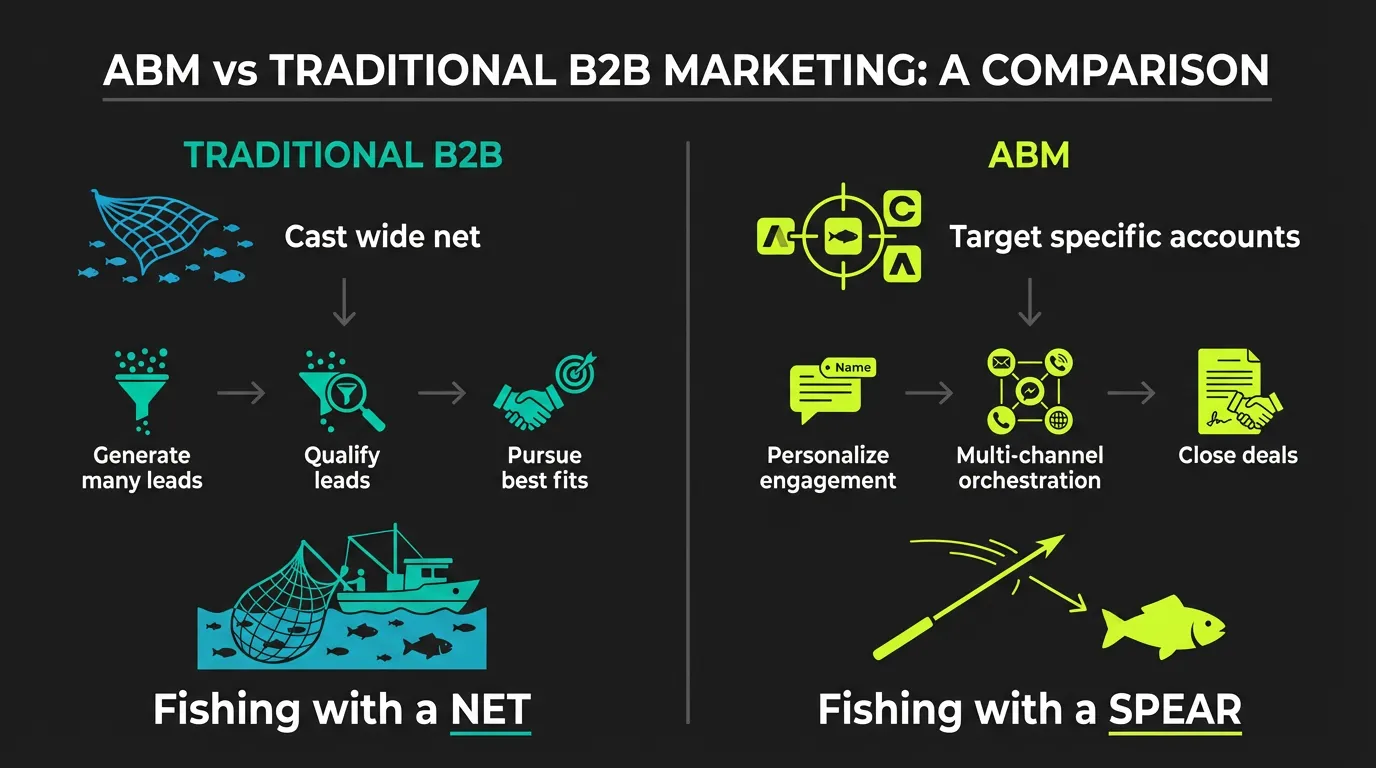
:::info ABM vs Traditional B2B Marketing Traditional B2B: Cast wide net → Generate leads → Qualify → Pursue
ABM: Define target accounts → Personalize engagement → Orchestrate multi-channel → Close
Traditional = fishing with a net. ABM = fishing with a spear. :::
The ABM Tiers
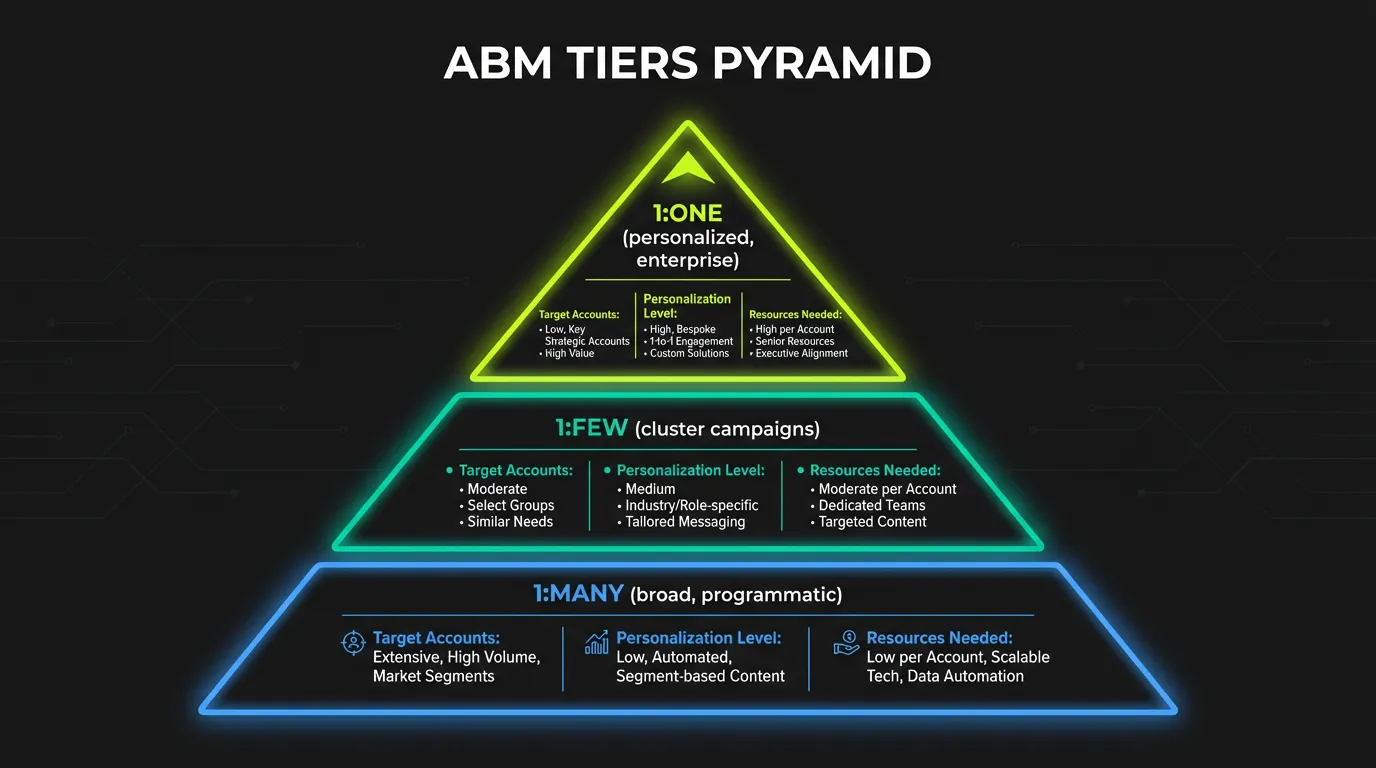
| Tier | Accounts | Personalization | Investment |
|---|---|---|---|
| Strategic (1:1) | 5-50 | Highly custom | High $/account |
| Scale (1:Few) | 50-500 | Segment personalized | Medium $/account |
| Programmatic (1:Many) | 500-5,000+ | Light personalization | Low $/account |
The 2026 ABM Landscape
ABM has evolved significantly.
Market Adoption
- 67% of brands now utilize ABM
- 70% of marketers have active ABM programs
- 49.7% plan to increase ABM budgets in 2026
- Market projected to reach $2 billion by 2032
Key Trends
1. AI Integration 30% of businesses report AI integration has increased ABM revenue. AI powers:
- Intent prediction
- Account prioritization
- Content personalization
- Optimal timing
2. Buying Group Focus
"ABM doesn't win deals at the account level—it wins them at the buying group level."
2026 strategies map full buying committees, not just primary contacts.
3. Media-First ABM ABM has expanded beyond sales-aligned, high-touch tactics to include programmatic display, connected TV, and even TikTok/Reddit for reaching B2B buyers.
:::tip Multi-Channel ABM Expanding account-based marketing beyond LinkedIn and Meta is no longer optional. B2B buying groups consume content across the open web, CTV, native, and emerging platforms. :::
Building an ABM Strategy
Step 1: Define Your Ideal Customer Profile (ICP)
Who are your best-fit accounts?
| Criteria | Example Attributes |
|---|---|
| Firmographics | Industry, size, revenue, location |
| Technographics | Tech stack, tools used |
| Behavioral | Website activity, content engagement |
| Intent | Active research signals |
| Fit | Historical win rate, deal size |
Step 2: Build Your Target Account List
Account selection process:
- Score existing customers — Who are your best customers?
- Identify look-alikes — Which accounts match that profile?
- Layer intent data — Who's actively researching?
- Prioritize — Rank by fit + intent + opportunity
- Validate with sales — Ensure list alignment
Step 3: Map Buying Groups
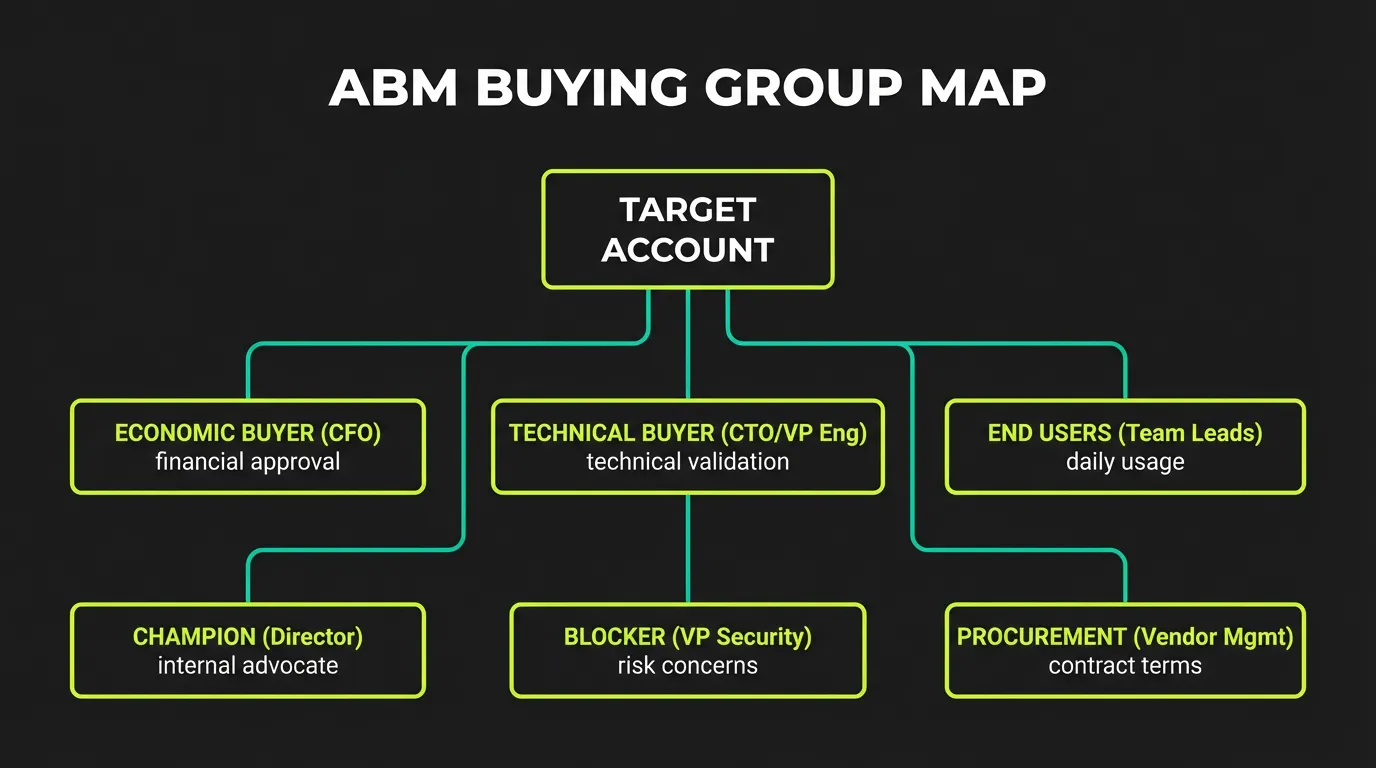
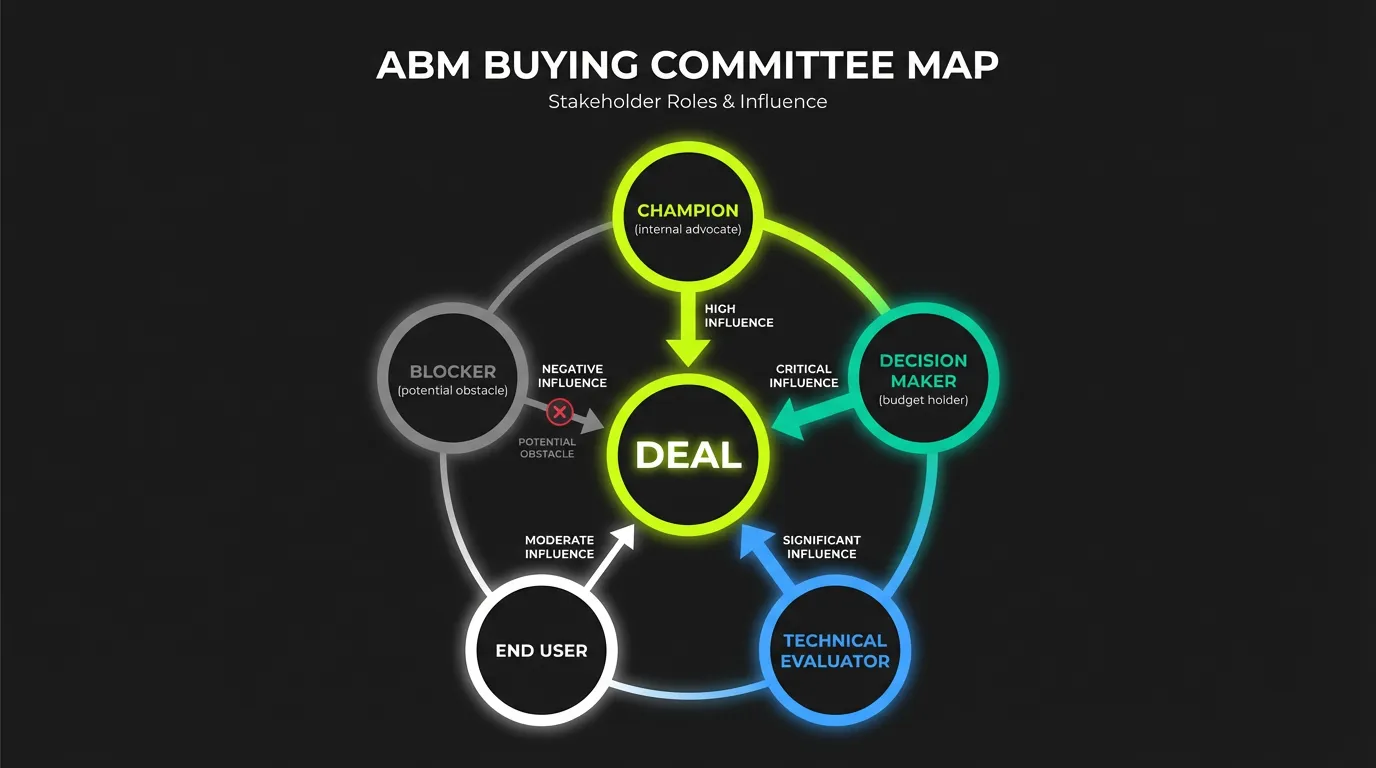
For each target account:
Account: Enterprise Corp
├── Economic Buyer: CFO
├── Technical Buyer: CTO, VP Engineering
├── End Users: Engineering team leads
├── Champion: Director of Operations
├── Blocker: VP Security
└── Procurement: Vendor Management

Goal: Engage multiple stakeholders with relevant content
Step 4: Develop Personalized Content
Content by buying group role:
| Role | Content Type | Topics |
|---|---|---|
| Economic Buyer | Business case, ROI | Financial impact, TCO |
| Technical Buyer | Documentation, architecture | Integration, security, scale |
| End Users | Product demos, tutorials | Features, ease of use |
| Champion | Case studies, competitive | Why you win |
| Procurement | Security docs, contracts | Compliance, terms |
ABM Advertising Tactics
LinkedIn Advertising
LinkedIn remains the primary B2B ABM channel:
Account targeting options:
- Company name targeting
- Company list upload
- Contact targeting
- Website retargeting
Ad formats for ABM:
- Sponsored Content (awareness)
- Message Ads (direct outreach)
- Conversation Ads (engagement)
- Lead Gen Forms (capture)
:::warning LinkedIn Saturation Decision-makers are inundated with LinkedIn ads. Standout creative and genuine value proposition are essential to cut through. :::
Programmatic ABM
Scale ABM across the open web:
Platforms:
- DV360, Trade Desk (general DSPs)
- Demandbase, 6sense, RollWorks (ABM-specific)
- Terminus, Madison Logic (B2B focused)
Capabilities:
- IP-based account targeting
- Cookie-based contact targeting
- Lookalike account modeling
- Cross-device recognition
Connected TV for B2B
CTV is emerging for ABM:
- Target business decision-makers at home
- High attention format
- Account-level targeting via IP matching
- Complement digital campaigns
Social Beyond LinkedIn
Reaching buyers where they are:
| Platform | B2B Use Case |
|---|---|
| Twitter/X | Tech decision-makers, thought leadership |
| IT, developers, niche communities | |
| YouTube | Educational content, product demos |
| TikTok | Reaching younger buyers, brand awareness |
Website Personalization
Account-Based Website Experience
Personalize web experience for target accounts:
Anonymous visitor: Generic messaging
Known target account:
├── Company name in headline
├── Industry-specific case studies
├── Relevant use cases featured
├── Personalized CTA
└── Rep contact displayed
Implementation Approaches
| Approach | Complexity | Impact |
|---|---|---|
| IP-based personalization | Low | Medium |
| Cookie-based personalization | Medium | High |
| Integration with CRM/MAP | High | Very High |
:::info Personalization ROI Personalized web experiences can double engagement from target accounts. The investment pays off quickly for enterprise targets. :::
Sales and Marketing Alignment
Shared Account Framework
ABM requires alignment:
| Element | Marketing | Sales | Shared |
|---|---|---|---|
| Account list | Contributes data | Validates | Owns together |
| Engagement | Air cover, nurture | Direct outreach | Coordinated |
| Content | Creates assets | Uses in outreach | Co-develops |
| Metrics | Account engagement | Pipeline, revenue | Revenue attribution |
Service Level Agreements (SLAs)
Define expectations:
Marketing commits:
- X impressions per target account/month
- Y website visits from target accounts
- Z engaged accounts handed to sales
Sales commits:
- Follow up on engaged accounts within X days
- Log account activity in CRM
- Provide feedback on account quality
Regular Alignment Cadence
| Meeting | Frequency | Focus |
|---|---|---|
| Account reviews | Weekly | Individual account status |
| Pipeline review | Weekly | Opportunity progress |
| List review | Monthly | Account selection, prioritization |
| Strategy review | Quarterly | Overall ABM effectiveness |
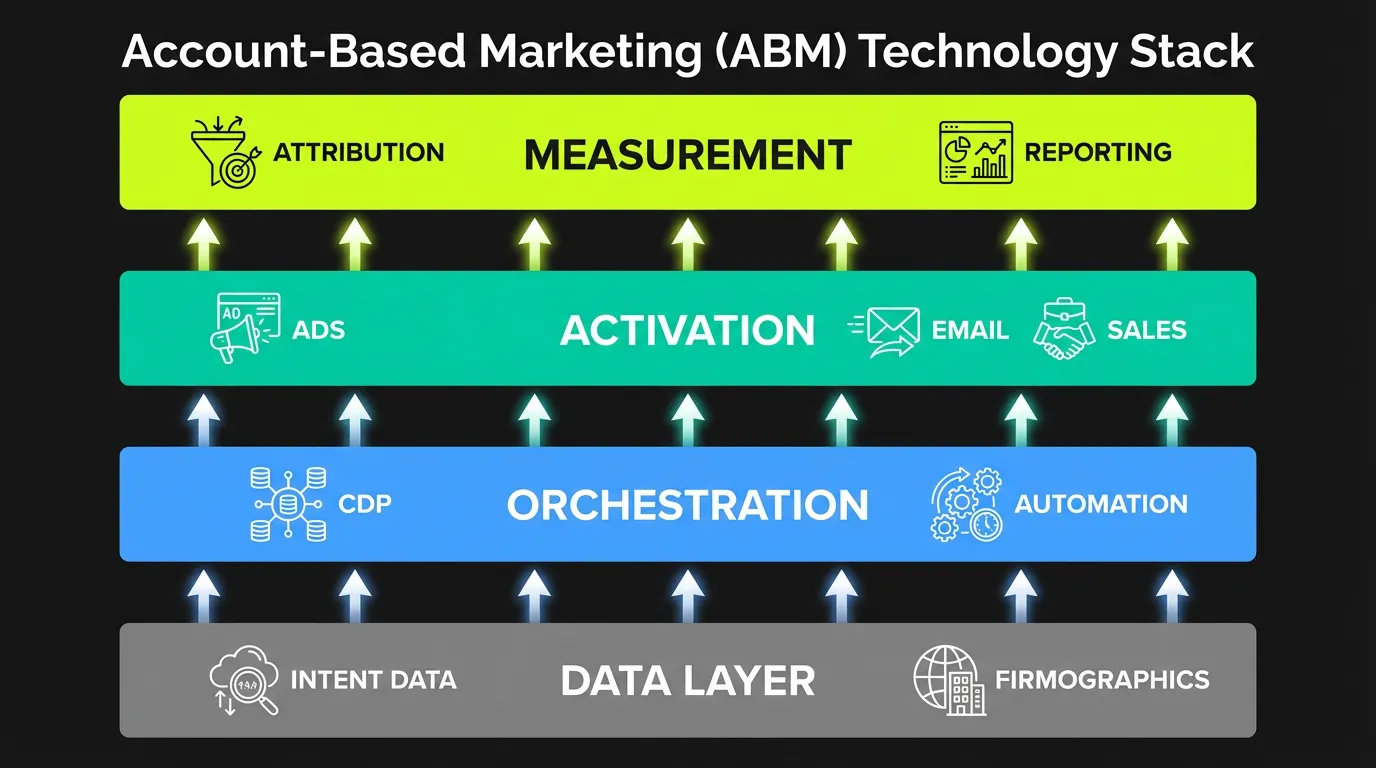
ABM Technology Stack
Core ABM Platforms
| Category | Leading Tools | Function |
|---|---|---|
| ABM Platforms | Demandbase, 6sense, Terminus | End-to-end ABM |
| Intent Data | Bombora, G2, TrustRadius | Buying signals |
| Advertising | LinkedIn, RollWorks, Madison Logic | Account-targeted ads |
| Personalization | Mutiny, Intellimize | Website personalization |
| Sales Engagement | Outreach, Salesloft | Coordinated outreach |
| CRM | Salesforce, HubSpot | Account records |
Data Infrastructure
Data Flow:
Target account list (ICP)
    ↓
Enrichment (firmographics, contacts)
    ↓
Intent signals (research activity)
    ↓
Engagement data (ad views, web visits)
    ↓
CRM/MAP (sales activity, pipeline)
    ↓
Attribution (revenue impact)
Measuring ABM Success
Account-Level Metrics
| Metric | Definition | Benchmark |
|---|---|---|
| Account reach | % of target accounts seeing ads | >70% |
| Account engagement | % showing meaningful engagement | >25% |
| Account pipeline | % with active opportunities | >15% |
| Win rate | % of engaged accounts won | Industry varies |
| Deal size | Average deal from ABM accounts | vs. non-ABM |
| Sales cycle | Time to close for ABM accounts | vs. non-ABM |
Engagement Scoring
Track account-level engagement:
Engagement Score Components:
├── Ad impressions: +1 point each
├── Website visit: +5 points
├── Content download: +10 points
├── Form submission: +20 points
├── Meeting scheduled: +50 points
└── Multiple contacts engaged: 2x multiplier

Thresholds:
< 50 points: Low engagement
50-150 points: Medium engagement
> 150 points: High engagement (sales handoff)
Attribution Models
ABM attribution approaches:
| Model | Approach | Best For |
|---|---|---|
| Account-based attribution | Credit to account, not individual | Complex B2B |
| Influenced pipeline | ABM touched accounts | Marketing credit |
| Multi-touch | Weight across touchpoints | Journey understanding |
| Self-reported | "How did you hear about us?" | Intent validation |
ABM Campaign Examples
Tier 1: Strategic ABM (1:1)
Target: Fortune 500 enterprise account
Campaign Elements:
├── Custom landing page with account name
├── Personalized video from exec
├── Account-specific case study
├── Direct mail to C-suite
├── LinkedIn + display ads to buying group
├── Executive event invitation
├── Dedicated sales + CSM team

Investment: $10,000+ per account
Tier 2: Scale ABM (1:Few)
Target: 100 accounts in financial services
Campaign Elements:
├── Industry-specific landing pages
├── Financial services case studies
├── Compliance-focused content
├── LinkedIn ads to CFO/CIO titles
├── Programmatic display to account list
├── Webinar invitation
├── SDR outreach sequence

Investment: $500-2,000 per account
Tier 3: Programmatic ABM (1:Many)
Target: 2,000 accounts matching ICP
Campaign Elements:
├── ICP-targeted ads (firmographic)
├── Intent-based prioritization
├── Automated email sequences
├── Standard website (no personalization)
├── Sales follows up on high-intent signals

Investment: $50-200 per account
Common ABM Mistakes
1. List Too Large
"We're targeting 10,000 accounts"
Problem: That's not ABM, that's segment marketing. Can't personalize at that scale.
Solution: Start smaller, personalize more, expand once you prove results.
2. No Sales Alignment
"Marketing does ABM, sales does their thing"
Problem: Uncoordinated outreach confuses buyers and wastes effort.
Solution: Shared lists, SLAs, regular alignment meetings.
3. Advertising Only
"ABM = running LinkedIn ads to target account list"
Problem: Ads alone don't close deals. ABM requires orchestrated multi-channel.
Solution: Integrate content, web personalization, sales outreach, events.
4. Individual Lead Focus
"We got 50 leads from target accounts"
Problem: Thinking in leads, not accounts or buying groups.
Solution: Track account engagement, not just individual conversion.
5. Expecting Quick Results
"We've been doing ABM for 6 weeks, where are the deals?"
Problem: Enterprise sales cycles are long. ABM compounds over time.
Solution: Set realistic timelines (6-18 months), track leading indicators.
The Bottom Line
Account-based marketing in 2026 requires:
- Clear ICP and target account list — Quality over quantity
- Buying group mapping — 6-10 decision-makers per account
- Sales and marketing alignment — Shared goals and coordination
- Multi-channel orchestration — Ads, content, web, sales outreach
- Account-level measurement — Think accounts, not leads
- Patience and investment — ABM compounds, but takes time
:::tip The ABM Mindset "ABM isn't a marketing tactic—it's a go-to-market strategy. When done right, it aligns your entire company around the accounts that matter most." :::
"Organizations with shared KPI contracts between Marketing and Sales achieve 27% faster conversion and 34% higher win rates. ABM works when everyone's rowing in the same direction."
AdBid helps ABM teams track engagement across target accounts. See which accounts are engaging and when they're ready for sales. Start your ABM analysis.