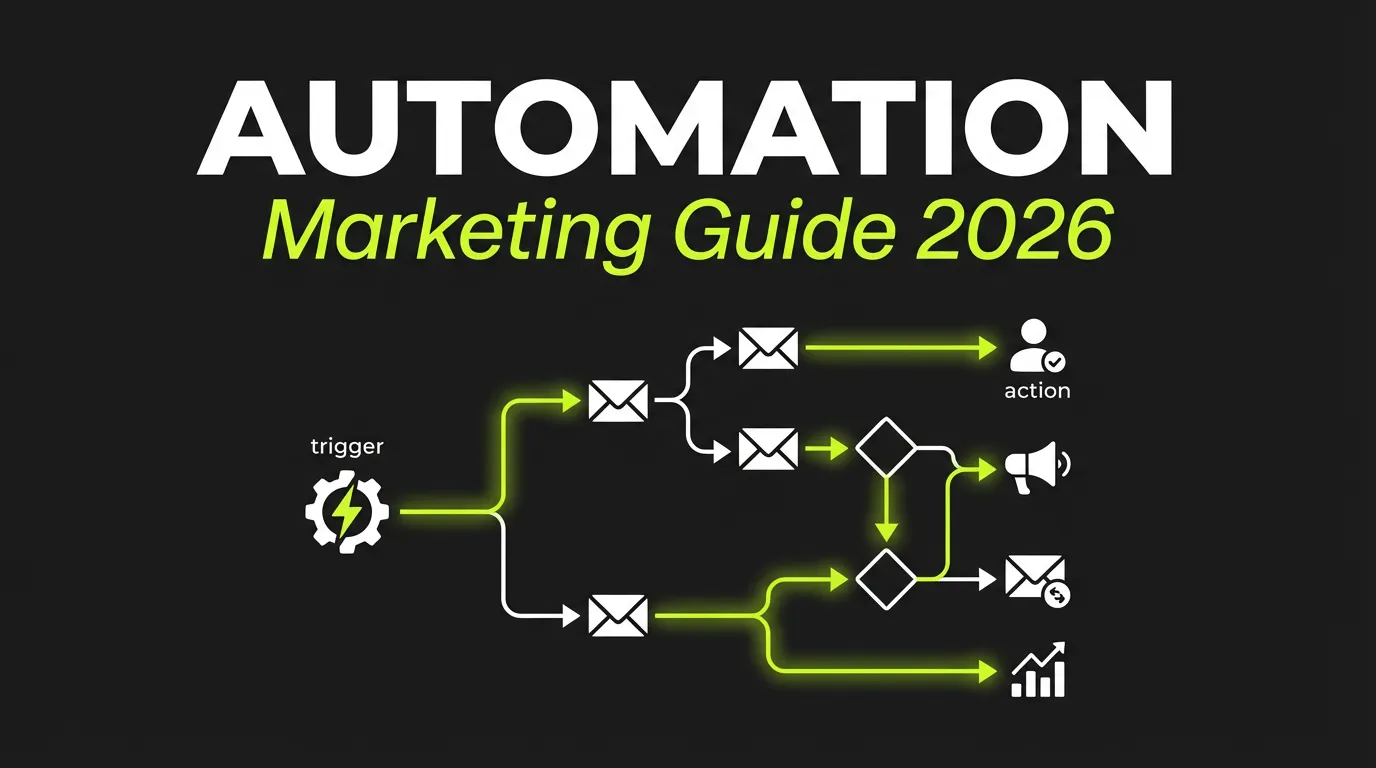

Marketing Automation Guide 2026: Build Systems That Scale
Marketing automation has shifted from a "nice to have" into the backbone of how modern teams operate. In 2026, the expectations are different. AI-powered personalization, omnichannel orchestration, and predictive analytics now define what a competent automation stack looks like. The companies pulling ahead aren't sending more messages. They're sending smarter ones, built on clean data and clear goals. This guide walks through the foundations, the core workflows, and where AI genuinely earns its place, so you can build systems that scale without becoming noise.
Key Takeaways
- Clean data comes first: automation amplifies whatever quality your data already has, good or bad.
- Email workflows like welcome, abandoned cart, and re-engagement remain the highest-leverage starting point.
- Lead scoring separates ready-to-buy prospects from casual browsers, sharpening sales focus.
- The global AI marketing market is expected to reach $107.5 billion by 2028 (Statista), reshaping how automation gets built.
What Does Marketing Automation Look Like in 2026?
The gap between companies with mature automation and those without has never been wider. Predictive models now flag which leads are warming up before a salesperson notices. Generative tools draft subject lines, segment audiences, and assemble personalized content on the fly. What used to take a team a week now happens in minutes.
But the core promise hasn't changed. Automation exists to deliver the right message, to the right person, at the right time. The tooling got smarter. The discipline behind it still decides whether you win.
For a deeper look at how AI specifically reshapes campaign building, see our AI marketing automation guide for 2026.
Why the Stakes Are Higher Now
Consumers expect personalization as a baseline, not a perk. A generic blast lands flat against competitors who already know what each subscriber wants. That rising bar is exactly why automation matters: doing it manually at scale is impossible, and doing it poorly is worse than not doing it at all.
How Do You Lay the Right Foundation?
Strong automation starts long before you build a single workflow. It starts with goals and data. Skip this step and you'll automate confusion at scale, sending the wrong messages faster than ever before.
Setting Clear Automation Goals
Before building anything, answer three questions:
- What business outcome are we targeting? More qualified leads, higher retention, faster sales cycles.
- What metric defines success? Pick one primary number, not five competing ones.
- What's the baseline and the target? You can't measure lift without a starting point.
A simple framework keeps teams honest: increase a chosen metric from its current baseline to a defined target within a set timeframe by automating one specific process. Vague goals produce vague results.
Data Hygiene: The Unglamorous Foundation
None of this works without clean data. Automation doesn't fix messy records; it broadcasts them.
| Issue | Impact | Solution |
|---|---|---|
| Duplicate records | Double messages, skewed analytics | Deduplication rules |
| Missing fields | Can't segment or personalize | Progressive profiling |
| Outdated info | Wrong messages, higher bounce rates | Regular verification |
| Inconsistent formats | Integration failures | Standardization rules |
Clean your data before you implement automation, not after. The teams that treat data hygiene as ongoing maintenance, not a one-time cleanup, are the ones whose campaigns keep performing.
If your goals lean toward measurable outcomes, our data-driven marketing guide for 2026 covers how to turn raw data into decisions.
Which Email Workflows Should You Automate First?
Email remains the workhorse of marketing automation. It's direct, measurable, and owned by you rather than rented from a platform. A handful of sequences cover most of the value for most businesses, so start there before chasing complexity.
The Essential Sequences
Every business benefits from these automated flows:
- Welcome series: 5 to 7 emails over roughly two to three weeks, introducing your brand and setting expectations.
- Abandoned cart: Triggered reminders at one hour, 24 hours, and 72 hours after a cart is left behind.
- Post-purchase: An immediate confirmation, a follow-up around day 7, and a check-in near day 30.
- Re-engagement: Win-back attempts at 30, 60, and 90-day intervals of inactivity.
- Lead nurturing: Content paced to each contact's engagement level rather than a fixed calendar.
Dynamic Content That Matches the Reader
Static emails treat everyone the same. Dynamic content blocks adapt the message to who's reading it.
| Segment | Content Block |
|---|---|
| First-time buyer | Welcome discount, how-to guides |
| Repeat buyer | Loyalty rewards, exclusive access |
| High-value customer | Premium service, personal contact |
| At-risk customer | Win-back offer, feedback request |
The principle is simple. One email, many versions, each one relevant. For ecommerce-specific tactics, our email marketing guide for ecommerce in 2026 goes deeper on revenue-driving flows.
How Does Lead Scoring Sharpen Your Pipeline?
Lead scoring stops your team from treating every contact identically. Instead of chasing cold names alongside hot ones, scoring ranks prospects by readiness, so sales spends time where it counts. A mature scoring model turns a flat list into a prioritized queue.
Building a Scoring System
Scores combine who a lead is with what they do. Demographic and firmographic traits describe fit. Behavioral and engagement signals reveal intent.
| Category | Attributes | Weight |
|---|---|---|
| Demographic | Title, company size, industry | 0-25 points |
| Firmographic | Revenue, location, tech stack | 0-25 points |
| Behavioral | Page visits, downloads, email engagement | 0-50 points |
| Engagement | Event attendance, sales conversations | 0-50 points |
Notice that behavior and engagement carry the most weight. A vice president who never opens an email is a weaker signal than a manager who reads everything and books a demo. Intent beats title.
Keeping Scores Honest
A scoring model isn't set-and-forget. Review which scores actually predicted closed deals, then adjust the weights. If high-scoring leads keep stalling, your model is rewarding the wrong signals. Treat it as a living system that learns from outcomes.
Where Does AI Add Real Value in Automation?
AI in marketing automation is most useful where pattern recognition and scale exceed human capacity. The global AI marketing market is expected to reach $107.5 billion by 2028 (Statista), and much of that investment flows into prediction and personalization rather than novelty features.
Prediction and Optimization
The strongest AI use cases tend to cluster in two areas:
Predictive analytics answers questions that used to rely on guesswork. Which leads are most likely to convert? When is the best moment to reach out? What content will resonate with a given segment? Models trained on your historical data surface answers faster than manual analysis ever could.
Content optimization handles the volume humans can't. Subject line testing across dozens of variants, dynamic content selection per recipient, and personalized product recommendations all run continuously in the background.
Knowing AI's Limits
AI augments judgment; it doesn't replace it. A model can predict the best send time, but it can't decide whether a campaign aligns with your brand voice or strategy. The teams that win treat AI as a powerful assistant working under clear human direction, not as an autopilot. Garbage inputs still produce garbage predictions, which loops back to data hygiene.
Frequently Asked Questions
How long before marketing automation shows results?
It depends on the workflow. Triggered sequences like abandoned cart and welcome series can show measurable lift within weeks because they fire on existing traffic. Longer plays like lead nurturing and re-engagement need a full cycle to evaluate fairly. Set a baseline first so you can measure honestly.
Do I need clean data before starting automation?
Yes, and it's the single most overlooked step. Automation amplifies whatever quality your data already has. Duplicates create double messages, missing fields break personalization, and outdated records inflate bounce rates. Clean and standardize your records before launching workflows, then keep that hygiene ongoing rather than treating it as a one-time fix.
What's the difference between automation and AI in marketing?
Automation executes predefined rules: if a cart is abandoned, send a reminder. AI adds prediction and adaptation on top, deciding which leads to prioritize or which content fits each person. Most modern stacks blend both, using rules for reliable triggers and AI for optimization and forecasting.
How does automation support customer retention?
Automation keeps existing customers engaged through post-purchase flows, loyalty messaging, and timely re-engagement before they churn. Consistent, relevant touchpoints cost far less than acquiring new buyers. For a full breakdown of tactics, see our customer retention marketing guide for 2026.
The Bottom Line
Marketing automation in 2026 rewards discipline over volume. Start with clean data, because everything downstream depends on it. Set clear goals tied to a single primary metric. Build customer-centric workflows that deliver value rather than noise, coordinate across channels for a unified experience, and layer in AI where prediction and scale genuinely help. Then keep optimizing, because nothing here is set-and-forget.
The goal was never to send more messages. It's to send the right message, to the right person, at the right time. Get the foundation right and the technology does the rest.
Ready to put this into practice? See how the AI Agents Ads Manager unifies your advertising and automation in one place.