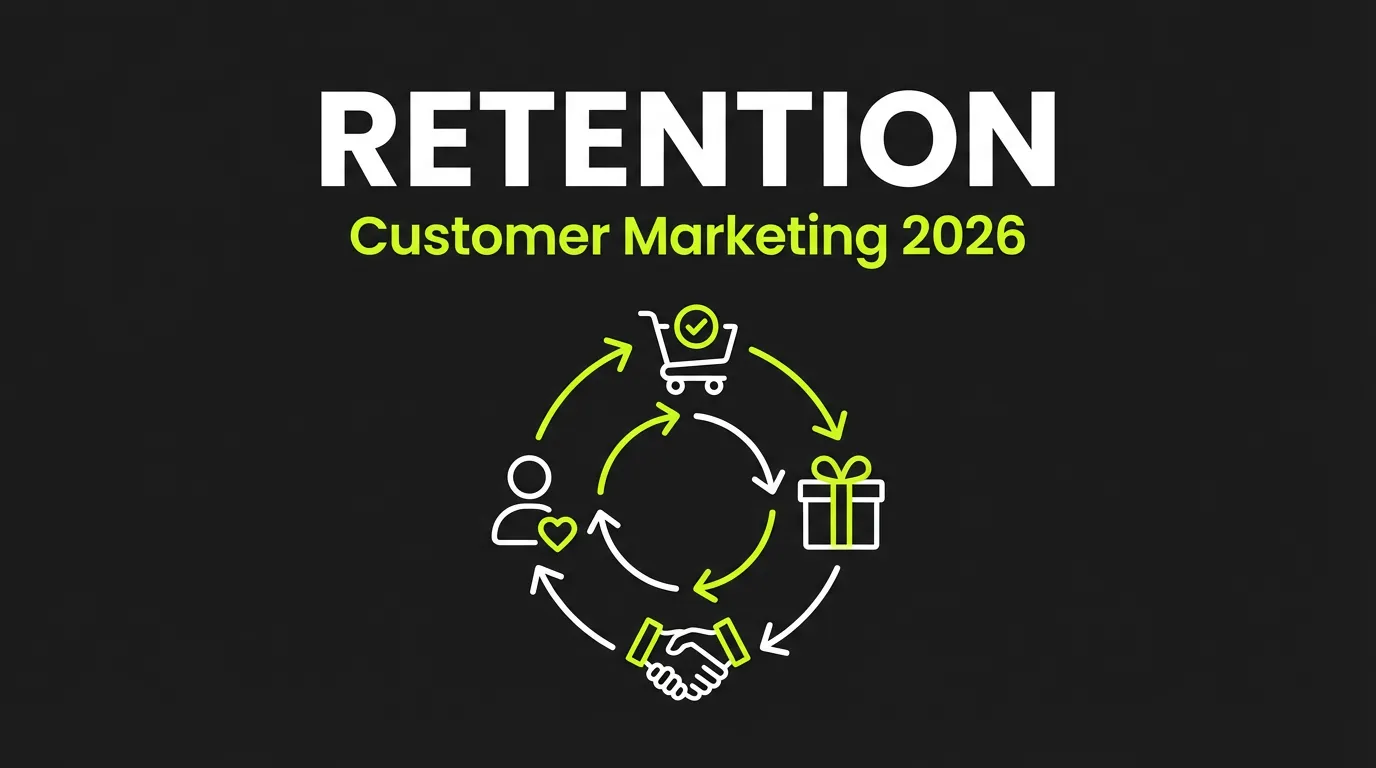

Customer Retention Marketing Guide 2026
Acquisition gets the glory. Retention pays the bills. As advertising costs climb and privacy rules tighten in 2026, the brands winning long-term are the ones keeping the customers they already paid to win. According to Nielsen, 92% of people trust recommendations from friends and family above any form of advertising (Nielsen, 2012), and those recommendations come from satisfied, retained customers. This guide breaks down what actually works now: onboarding, modern loyalty, referrals, and the metrics that tell you whether any of it is paying off.
Key Takeaways
- Retention is consistently cheaper than acquisition, which is why mature brands shift budget toward keeping existing buyers.
- Word of mouth drives growth: 92% of people trust friend and family recommendations over advertising (Nielsen, 2012).
- The first 30 days of a customer relationship set the tone for whether someone buys again.
- Loyalty, referrals, and clear retention metrics work together, not in isolation.
Why Does Retention Beat Acquisition in 2026?
Retention beats acquisition because you are selling to people who already trust you, so the cost and friction drop sharply. Acquiring a new customer typically costs far more than keeping an existing one, and existing buyers convert faster on repeat offers. Nielsen found that 92% of people trust recommendations from friends and family over any advertising (Nielsen, 2012), and loyal customers are the ones who make those referrals.
The math is simple. When you raise spend to win new buyers without keeping them, you refill a leaking bucket. Every churned customer means you pay the acquisition cost again just to stand still. Retention compounds in the opposite direction: returning buyers cost less to reach, respond to fewer messages, and often spend more over time.
There is also a privacy angle. Third-party tracking keeps shrinking, so relationships you own, email lists, accounts, loyalty members, matter more than ever. If you want the full picture on what acquisition really costs you, our customer acquisition cost guide walks through the calculation step by step.
What Do Customers Expect From Loyalty Now?
Customers now expect relevance, not just rewards. The old playbook of punch cards, generic newsletters, and occasional discounts no longer holds attention. Buyers want brands that remember their behavior, anticipate problems, and reflect values they care about. Recommendations still rule purchase decisions, with 92% of people trusting friends and family over advertising (Nielsen, 2012), so a generic experience quietly costs you advocates.
The shift is from transactional to relational. People judge brands on the whole experience, not a single sale.
Old Expectations vs New Expectations
| Old Expectation | New Expectation |
|---|---|
| Points for purchases | Meaningful rewards they actually want |
| Generic email blasts | Personalized content based on behavior |
| Reactive support | Proactive problem prevention |
| Transactional relationship | Brand alignment with their values |
The takeaway? Meeting the minimum is now invisible. Customers notice when you understand them, and they notice even faster when you do not.
How Should You Onboard New Customers?
Onboarding should turn a first purchase into a habit, and the first 30 days carry most of that weight. This is the window where someone decides whether you were a one-time convenience or a brand they return to. A structured welcome sequence sets expectations, removes friction, and prompts the early actions that predict repeat buying. Get this right and you reduce churn before it starts.
Think of onboarding as a relationship, not a receipt. Each message should help the customer succeed with what they bought, not just upsell them.
A Simple Onboarding Email Sequence
| Day | Goal | |
|---|---|---|
| 0 | Welcome and what happens next | Set expectations |
| 2 | Product tips or quick start | Enable early success |
| 7 | Check-in and feedback request | Show you care |
| 14 | Advanced features or cross-sell | Deepen engagement |
| 30 | Review request or referral ask | Generate advocacy |
Notice the rhythm. You earn the right to ask for a review or referral by helping first. If you want to push these flows further, our email marketing guide for ecommerce covers segmentation, automation, and timing in depth.
Which Loyalty Program Type Fits Your Brand?
The right loyalty program depends on how often people buy and what motivates them. There is no single best structure. A points program rewards frequency, a tiered program rewards aspiration, cashback rewards price sensitivity, and subscriptions reward commitment. The goal is recognition that feels personal, because trust drives advocacy, and 92% of people trust friend and family recommendations over advertising (Nielsen, 2012).
Comparing Loyalty Models
| Type | How It Works | Best For |
|---|---|---|
| Points-based | Earn points, redeem rewards | High-frequency purchases |
| Tiered | Status levels with rising benefits | Aspirational customers |
| Cashback | Direct money back on purchases | Price-sensitive customers |
| Subscription | Paid membership with exclusive perks | High-engagement brands |
Whichever model you choose, tie it to lifetime value, not just the next transaction. A reward that feels generous but trains customers to buy only on discount can quietly shrink margins. Our customer lifetime value guide explains how to model the payoff before you commit budget to a program.
How Do Referral Programs Drive Retention?
Referral programs work because they convert your happiest customers into a sales channel you do not pay upfront. Referred customers arrive with built-in trust, since they came on a friend's recommendation, and that trust is powerful: 92% of people trust recommendations from family and friends over any advertising (Nielsen, 2012). A good referral also deepens loyalty for the person doing the referring.
The structure should be obvious and two-sided, rewarding both the advocate and the new customer.
Referral Structures That Fit Different Models
- Ecommerce: "Give $20, Get $20" credit on both sides
- SaaS: "Give one month, get one month" of service
- Subscription: "Share the box" with a free or discounted shipment
Keep the offer simple enough to explain in a sentence. The harder it is to understand, the fewer people share. Referrals also lean on relationships you own rather than rented ad audiences, which matters as tracking erodes. For more on building those owned channels, see our first-party data strategy guide.
How Do You Measure Retention Success?
You measure retention with a small set of metrics that show whether customers stay, return, and recommend. Retention rate and churn rate track survival, repeat purchase rate tracks behavior, and Net Promoter Score tracks sentiment. Together they tell you if your programs are working or just generating activity. Advocacy ties back to the relationship, and 92% of people trust friend and family recommendations over advertising (Nielsen, 2012).
Core Retention Metrics
| Metric | What It Measures |
|---|---|
| Retention rate | Share of customers who stay over a period |
| Churn rate | Share of customers lost over a period |
| Repeat purchase rate | Share of customers who buy again |
| Net Promoter Score | Willingness to recommend your brand |
Track these on a regular cadence, not once a year. A rising churn rate is an early warning that onboarding or product fit is slipping, long before it shows up in revenue.
Ready to turn retention insight into action? Explore the AI ads manager to plan, launch, and optimize campaigns around the customers worth keeping.
Frequently Asked Questions
Is retention really cheaper than acquisition?
Yes, in most businesses retention costs less because you are selling to people who already trust you and need fewer touches to convert. Acquisition requires paid reach, creative, and convincing strangers. Word of mouth amplifies the gap, since 92% of people trust friend and family recommendations over advertising (Nielsen, 2012).
What is the most important retention metric to start with?
Start with churn rate, because it is the clearest early warning that something is wrong. A rising churn rate signals problems in onboarding, product fit, or service before revenue declines. Pair it with repeat purchase rate to confirm whether customers are actually returning, then layer in NPS for sentiment over time.
Which loyalty program should a small brand choose?
Small brands usually do best with a simple points or cashback program, since both are easy to explain and run. Tiered and subscription models reward depth but demand more management. Match the model to how often customers buy, and confirm the reward economics fit your margins using a lifetime value calculation before launching.
How long does it take to see retention results?
Onboarding improvements can show up within the first 30 days, while loyalty and referral programs usually take a few buying cycles to mature. Retention compounds slowly but steadily. Track churn and repeat purchase rate monthly so you can spot direction early, then give programs enough time to prove out before judging them.
The Bottom Line
Retention in 2026 is not a single tactic, it is a connected system. Strong onboarding sets the relationship up to last. A loyalty model matched to your customers turns repeat buyers into regulars. Referral programs convert satisfied customers into a trusted channel, which matters when 92% of people trust friends and family over advertising (Nielsen, 2012). And clear metrics, churn, repeat purchase rate, and NPS, tell you what to fix next. Treat every interaction as a chance to strengthen the relationship, measure honestly, and reinvest in the customers most worth keeping. That is how retention quietly outperforms the chase for new logos.