
Key Takeaways
:::highlight MMM's Resurgence 46.9% of US marketers will invest more in MMM (EMARKETER / TransUnion) over the next year. 27.6% of marketers rate MMM as the most reliable (EMARKETER / TransUnion) measurement methodology. It's privacy-safe and doesn't depend on user-level tracking. :::
- MMM has been a measurement cornerstone for 40+ years
- 36.2% of marketers increasing incrementality investment (EMARKETER / TransUnion)
- 52% already using incrementality testing (EMARKETER / TransUnion)
- Triangulated measurement (MMM + MTA + Incrementality) is the gold standard
- Causal MMM combines experiments with modeling for precision
For teams that need cleaner measurement behind these decisions, AdBid's advertising attribution connects campaign performance, revenue, and channel data.
What Is Marketing Mix Modeling?
Marketing Mix Modeling (MMM) is a statistical technique that measures the impact of all major business drivers on outcomes like revenue, customer acquisition, and market share.
:::info The Classic 4 Ps MMM quantifies the effect of: Product, Price, Place (distribution), and Promotion (advertising). It answers: "What's driving our business results?" :::
Why MMM Is Back
For years, digital attribution seemed like the answer. Clicks, conversions, last-touch—we had data on everything.
Then came:
- iOS 14.5 (ATT)
- Cookie deprecation
- GDPR/CCPA
- Walled gardens
"Because MMM doesn't depend on user-level tracking, it remains compliant with privacy regulations. MMM offers a durable, privacy-safe measurement framework."
MMM vs. Other Methods
| Method | View | Timeframe | Data Needs | Privacy |
|---|---|---|---|---|
| MMM | Top-down, aggregate | Long-term | Aggregate | Compliant |
| MTA (Multi-Touch Attribution) | Bottom-up, user | Real-time | User-level | Challenged |
| Incrementality Testing | Experimental | Short-term | Test/Control | Compliant |
| Last-Click | Bottom-up | Real-time | User-level | Challenged |
How MMM Works
The Basic Model
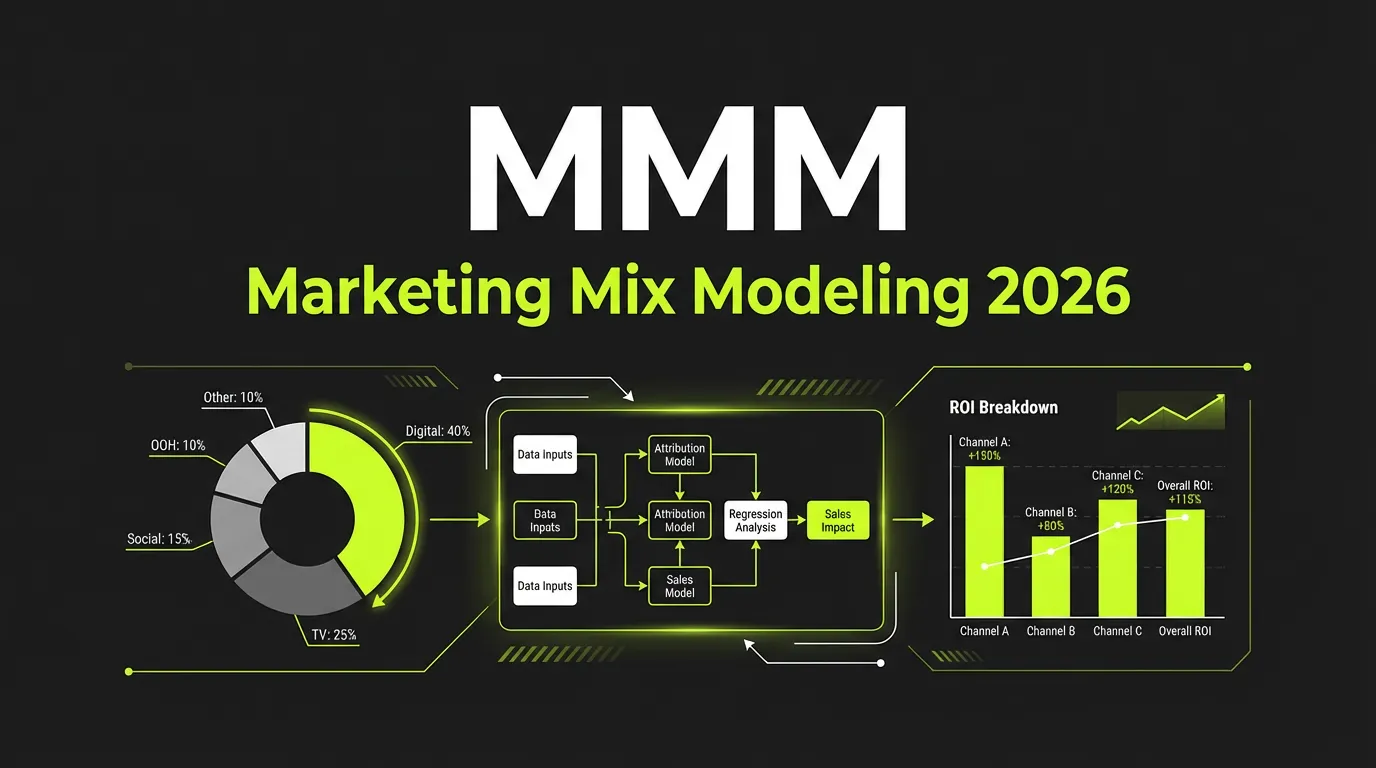
MMM uses regression analysis to identify relationships between marketing inputs and business outcomes.
Simplified formula: Sales = Base + (TV effect) + (Digital effect) + (Promotions) + (Seasonality) + (External factors)
What MMM Measures
Marketing inputs:
- TV advertising spend/GRPs
- Digital advertising (by channel)
- Print, radio, OOH
- Promotions and discounts
- Email and CRM activity
External factors:
- Seasonality
- Economic conditions
- Competitive activity
- Weather
- COVID-type disruptions
Business outcomes:
- Revenue/sales
- New customer acquisition
- Market share
- Brand metrics
The Output
MMM produces:
- Contribution by channel — How much did each channel drive?
- ROI by channel — Return on investment for each
- Saturation curves — Diminishing returns by spend level
- Optimal allocation — Where should budget go?
:::highlight Example Output "TV drove $5M in incremental revenue on $1M spend (5x ROI). Facebook drove $3M on $500K spend (6x ROI). TV is hitting saturation at current levels—shift 20% to Facebook for optimal mix." :::
MMM vs. Incrementality Testing
These approaches complement each other:
MMM Strengths
- Long-term, strategic view
- All channels included
- Always-on measurement
- Budget optimization
MMM Weaknesses
- Requires 2-3 years of data
- Slower to react to changes
- Can be noisy without experiments
- Observational (correlation ≠ causation)
Incrementality Strengths
- Proves causation
- Fast results (weeks vs. months)
- Specific tactical answers
- Validates MMM assumptions
Incrementality Weaknesses
- One channel/tactic at a time
- Requires holdout groups
- Can't run continuously everywhere
- Revenue impact during tests
:::tip The Combination "MMM provides a top-down, long-term perspective. Incrementality tests validate specific short-term causal effects. Together, they form a holistic ecosystem." :::
The Triangulated Approach
The best measurement programs combine three methods:
1. MMM (Strategic Layer)
- Answers: "How should we allocate budget?"
- Timeframe: Quarterly/annually
- Updates: Monthly or quarterly
2. Incrementality Testing (Validation Layer)
- Answers: "Does this channel actually work?"
- Timeframe: 4-12 weeks per test
- Updates: Ongoing test program
3. Attribution/Platform Data (Tactical Layer)
- Answers: "What's working today?"
- Timeframe: Real-time
- Updates: Daily
"By triangulating MMM with incrementality tests for causality and platform attribution for granularity, marketers have a more advanced way of capturing the full impact of their media mix."
Building an MMM Program
Step 1: Data Collection
Required data (minimum 2 years):
- Weekly/daily marketing spend by channel
- Sales or revenue by week/day
- Pricing and promotion calendar
- Distribution changes
- Major competitive events
Nice to have:
- Brand tracking data
- Weather data
- Economic indicators
- Share of voice data
:::warning Data Quality Matters Garbage in, garbage out. Spend time validating and cleaning data before building models. :::
Step 2: Model Development
Approaches:
- In-house build — Full control, requires expertise
- Vendor/agency — Faster, less control
- Hybrid — Vendor builds, you own
Key modeling decisions:
- Time granularity (daily vs. weekly)
- Geographic level (national vs. regional)
- Transformation functions (adstock, saturation)
- Control variables included
Step 3: Validation
Validate your model:
- Out-of-sample testing (holdout period)
- Cross-validation
- Incrementality test comparison
- Business sense check
:::tip Sanity Check If your model says TV has 10x ROI while your incrementality tests show 2x, something's wrong. Investigate. :::
Step 4: Activation
Turn insights into action:
- Budget reallocation recommendations
- Scenario planning tools
- Regular reporting cadence
- Integration with planning process
Causal MMM: The Evolution
Traditional MMM relies on observational data, which can be noisy and uncertain.
What Is Causal MMM?
"With Causal MMM, experiments are used to calibrate models and improve precision using causal factors."
How it works:
- Run incrementality experiments
- Use results to "ground-truth" the model
- Model calibrates to experimental data
- Ongoing experiments update calibration
Why It Matters
Traditional MMM might say Facebook ROI is 3-7x (wide range). Causal MMM, calibrated with experiments, might say 4.2-4.8x (tight range).
:::highlight Precision Improvement Causal MMM reduces uncertainty by 50-70% compared to traditional approaches. :::
Incrementality Testing Deep Dive
Test Types
1. Geo Experiments
- Turn off advertising in test markets
- Compare to control markets
- Gold standard for TV, OOH
2. Matched Market Tests
- Pair similar markets
- One gets treatment, one doesn't
- Controls for external factors
3. Ghost Bidding / PSA Tests
- Digital-specific
- Bid but show PSA instead of ad
- Cleanest digital incrementality
4. Conversion Lift Studies
- Platform-provided (Meta, Google)
- Uses platform's test/control
- Limited to specific platforms
Testing Best Practices
| Factor | Recommendation |
|---|---|
| Test duration | 4-8 weeks minimum |
| Holdout size | 10-20% of budget/geo |
| Statistical power | 80%+ pre-calculate |
| Test frequency | 2-4 major tests per year |
| Documentation | Log everything |
:::warning Common Mistakes
- Tests too short to detect effect
- Holdout too small for significance
- Not accounting for spillover
- Testing during abnormal periods :::
Practical Applications
Budget Optimization
MMM tells you where to shift budget:
| Channel | Current Spend | Optimal Spend | Change |
|---|---|---|---|
| TV | $5M | $4M | -20% |
| $2M | $2.8M | +40% | |
| $1.5M | $1.7M | +13% | |
| TikTok | $500K | $800K | +60% |
Scenario Planning
"What if we cut TV by 50%?" "What would happen if we doubled digital?" "How much do we need to spend to hit $50M target?"
Media Planning
- Set channel-level targets
- Determine flighting patterns
- Plan for seasonality
- Allocate to campaigns
MMM Vendors & Tools
Enterprise Solutions
| Vendor | Strengths |
|---|---|
| Analytic Partners | Established, full-service |
| Nielsen Attribution | Legacy TV expertise |
| Ipsos MMA | Global coverage |
| Neustar/TransUnion | Identity graph integration |
Modern/Tech-Forward
| Vendor | Strengths |
|---|---|
| Measured | Incrementality-first |
| Rockerbox | Digital-native |
| Recast | Modern, transparent |
| Northbeam | E-commerce focused |
| Triple Whale | Shopify ecosystem |
Open Source
- Meta's Robyn — Free, flexible, well-documented
- Google's Meridian — Coming soon
- PyMC Marketing — Bayesian approach
:::tip Vendor Selection Choose based on: data integration capabilities, transparency of methodology, ability to incorporate experiments, and alignment with your tech stack. :::
Common MMM Challenges
1. Data Availability
Many brands don't have clean, consistent historical data. Start collecting now.
2. Slow to Update
Traditional MMM updates quarterly. Modern approaches (Bayesian, real-time) can update faster.
3. Digital Granularity
MMM works at channel level, not campaign level. Combine with attribution for tactical optimization.
4. New Channels
Hard to measure emerging channels with limited history. Use incrementality testing for new channels.
5. Organizational Buy-In
MMM requires trust in the methodology. Educate stakeholders.
Getting Started
If You're Starting from Scratch
- Audit your data — What do you have? What's missing?
- Clean and organize — Standardize naming, fill gaps
- Start simple — Basic regression before complex models
- Run experiments — Build incrementality testing muscle
- Iterate — Models improve with time and data
If You Have an Existing Program
- Validate with experiments — Are model outputs accurate?
- Increase frequency — Move from quarterly to monthly
- Add granularity — Regional, brand, category
- Integrate — Connect to planning and buying systems
- Evolve to Causal MMM — Calibrate with experiments
The Bottom Line
Marketing Mix Modeling in 2026 is:
- Essential — Privacy changes make it necessary
- Evolving — Causal MMM improves precision
- Complementary — Best combined with incrementality
- Strategic — Answers the big budget questions
- Accessible — Modern tools democratize MMM
:::tip The Investment Start with experiments if you have limited resources. Build toward full MMM as you scale. The triangulated approach is the goal. :::
"Almost half (46.9%) of US marketers will invest more in MMM over the next year. It's the most reliable measurement methodology available."
AdBid provides the data foundation for your measurement program. Track all your advertising performance in one place. Start measuring.