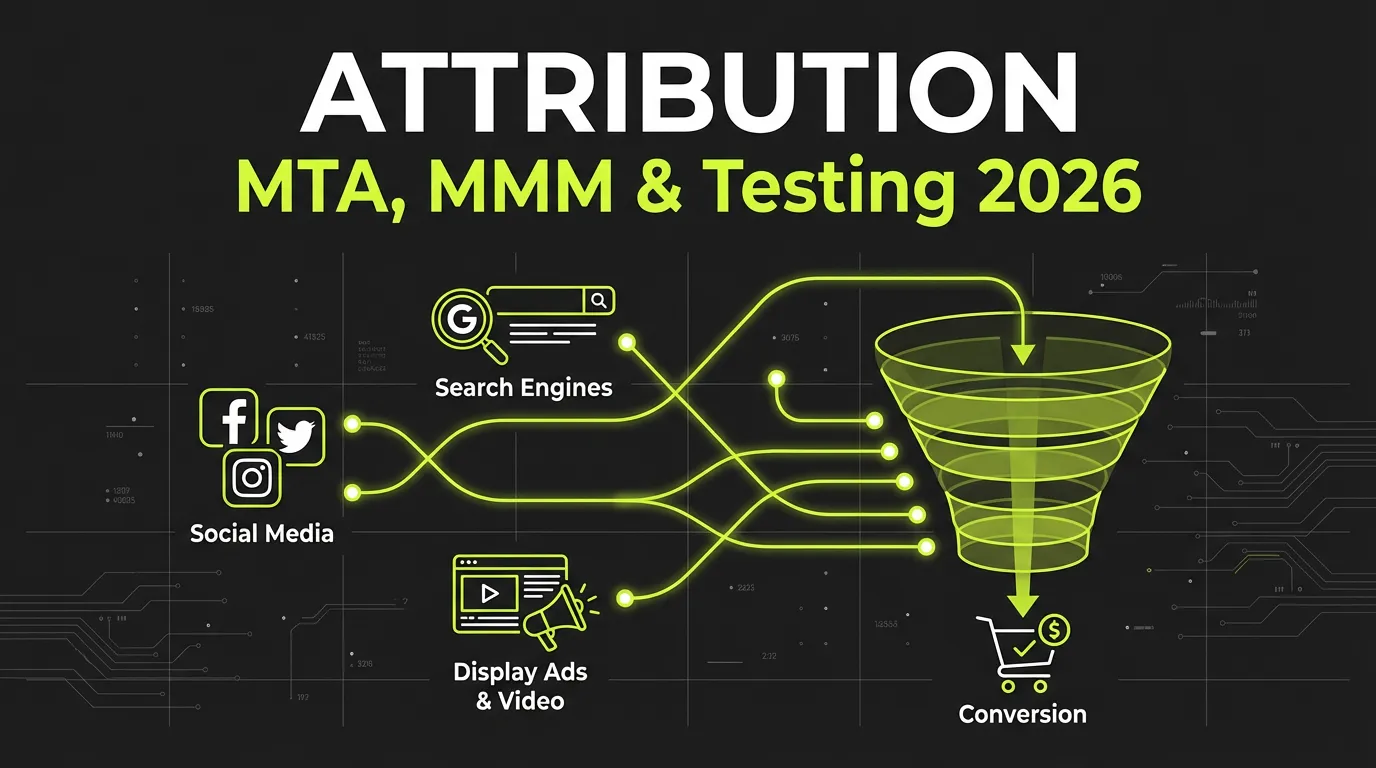

Key Takeaways
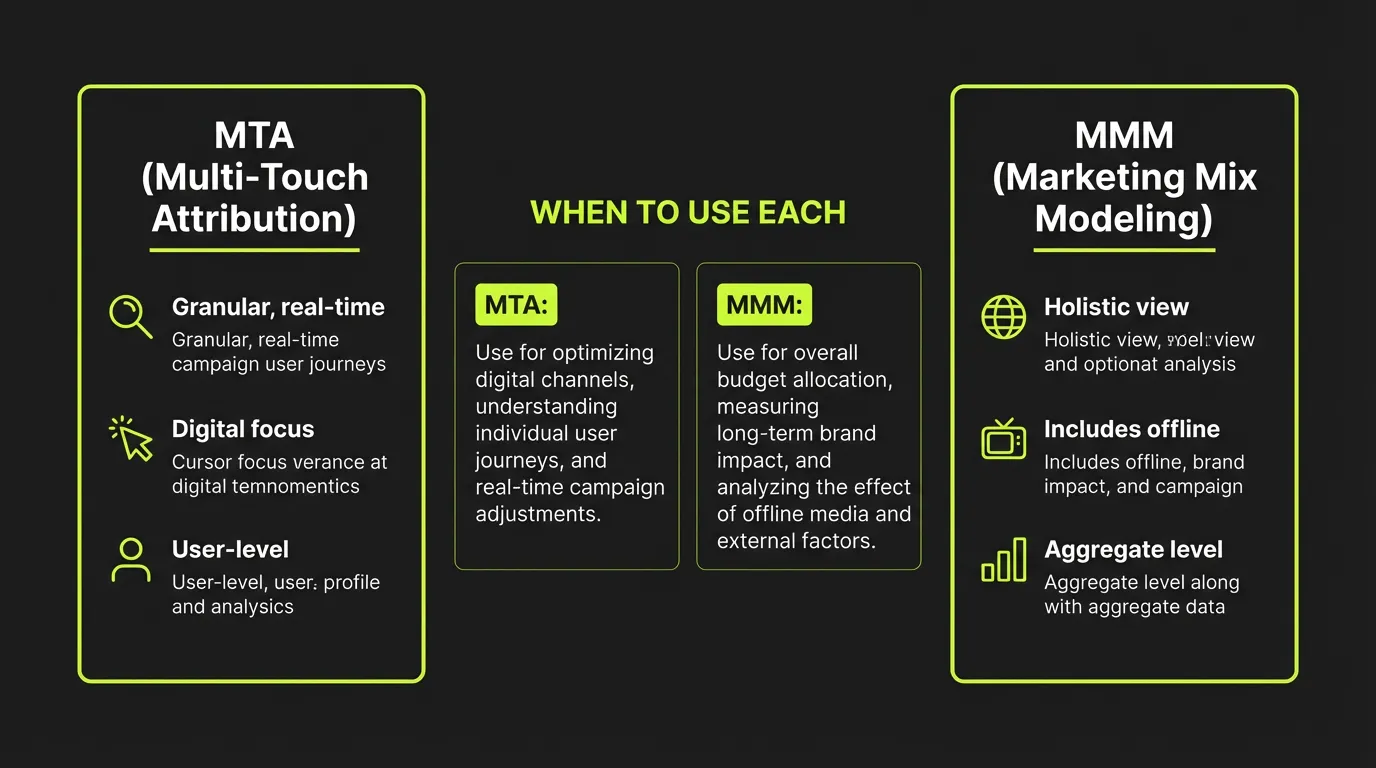
- MTA provides granular, real-time digital channel insights
- MMM offers holistic view including offline and external factors
- Incrementality testing validates true causal impact
- Best approach: Combine all three for complete picture
- Privacy changes are pushing the industry toward MMM
The Attribution Challenge
Customers don't convert in a straight line. They see Instagram ads, search Google, read emails, and visit directly — all before buying.
For teams that need cleaner measurement behind these decisions, AdBid's advertising attribution connects campaign performance, revenue, and channel data.
:::highlight The Question How do you assign credit to each touchpoint? The answer determines where you invest your budget. :::
Three main approaches exist:
- Multi-Touch Attribution (MTA) — Digital touchpoint tracking
- Marketing Mix Modeling (MMM) — Aggregate statistical analysis
- Incrementality Testing — Causal impact measurement
Multi-Touch Attribution (MTA)
What It Is
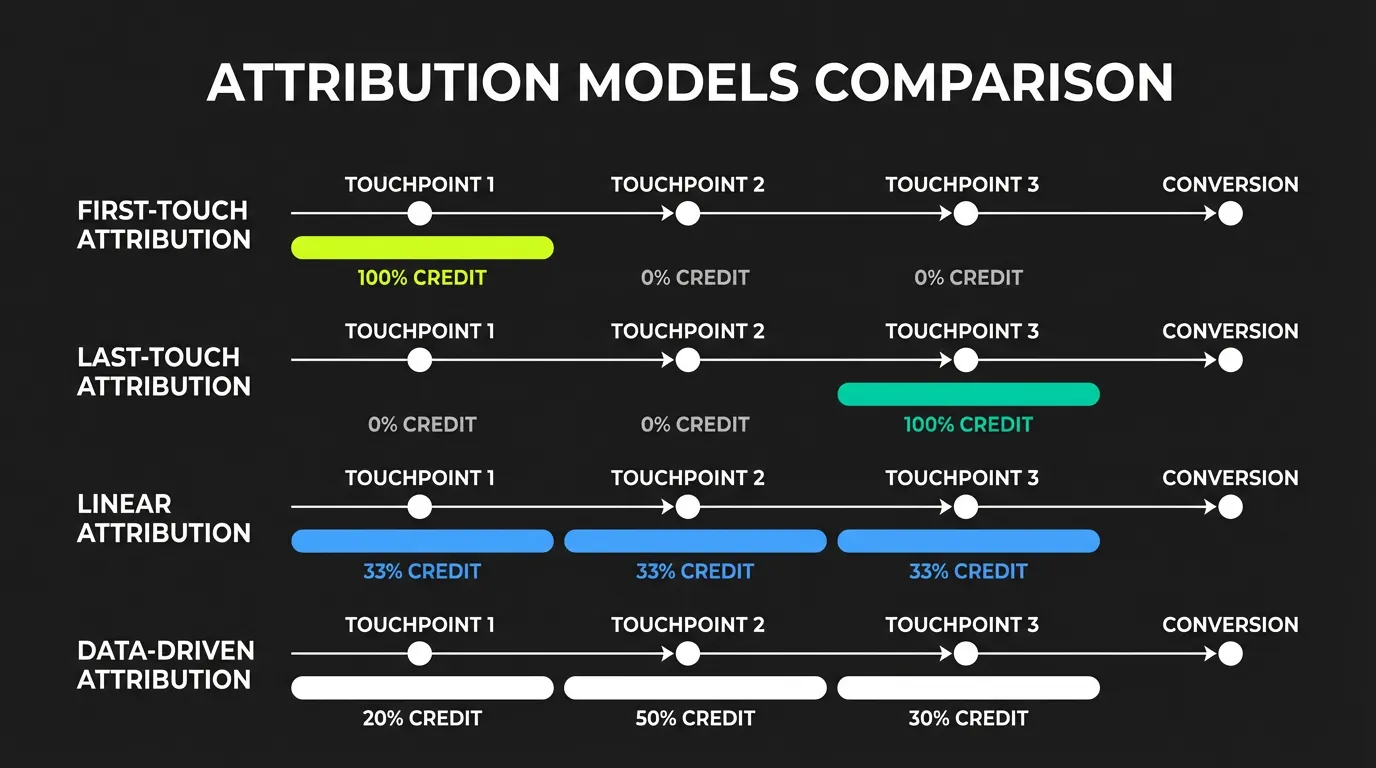
MTA assigns credit to multiple touchpoints a customer interacts with before converting. Instead of all credit to first or last touch, MTA distributes across the journey.
MTA Models
| Model | Logic | Best For |
|---|---|---|
| Linear | Equal credit to all | Balanced view |
| Time Decay | More credit to recent | Short sales cycles |
| Position-Based | 40% first/last, 20% middle | Full-funnel |
| Data-Driven | ML determines credit | High volume, sophisticated |
Data-Driven MTA
:::info Best Practice "Data-driven MTA is the most reliable method. It uses machine learning to assign credit based on actual performance patterns rather than fixed rules." :::
Requires:
- Sufficient conversion volume
- Clean tracking implementation
- Cross-device identity
MTA Strengths
- Granular, touchpoint-level insights
- Real-time optimization capability
- Easy to understand and act on
- Works well for digital channels
MTA Limitations
- Doesn't account for offline channels
- Ignores external factors (seasonality, economy)
- Privacy regulations limit tracking
- Cookie deprecation reduces accuracy
- Doesn't prove causation
Marketing Mix Modeling (MMM)
What It Is
MMM uses statistical analysis of aggregate data to quantify each channel's contribution to business outcomes. Originally developed in the 1960s, modern MMM uses machine learning on 2-3 years of historical data.
How MMM Works
Inputs:
- Marketing spend by channel
- Sales/revenue data
- External factors (weather, economy, competitors)
- Pricing and promotions
- Product changes
Output:
- Contribution of each variable to sales
- ROI by channel
- Optimal budget allocation
MMM Strengths
- Includes all channels (online + offline)
- Privacy-compliant (aggregated data)
- Accounts for external factors
- Long-term strategic insights
- No cookie dependency
MMM Limitations
- Requires 2-3 years of data
- Slow feedback (monthly/quarterly)
- Can't optimize real-time
- Doesn't capture individual journeys
- Expensive to implement
Incrementality Testing
What It Is
Incrementality testing measures the true causal impact of marketing by comparing exposed vs. unexposed groups.
Types of Incrementality Tests
Geo Lift Tests:
- Split regions into test and control
- Run marketing in test, not control
- Measure sales difference
Holdout Tests:
- Randomly exclude audience segment
- Compare conversion rates
- Calculate incremental lift
Ghost Ads:
- Record when ad would have shown
- Don't actually show it
- Compare behavior to exposed users
Why Incrementality Matters
:::warning The Truth Test "MTA and MMM can both be validated or contradicted by incrementality testing. It proves whether marketing actually causes sales, not just correlates with them." :::
Incrementality Strengths
- Proves causation, not just correlation
- Validates other attribution methods
- Identifies channel-specific lift
- Guides budget allocation
Incrementality Limitations
- Requires sufficient scale
- Can be expensive to run
- May miss long-term effects
- Disrupts normal marketing
Comparing the Approaches
| Factor | MTA | MMM | Incrementality |
|---|---|---|---|
| Granularity | High (user-level) | Low (aggregate) | Medium (test/control) |
| Speed | Real-time | Monthly/quarterly | Test duration |
| Channel Coverage | Digital only | All channels | Per-test basis |
| Privacy Impact | High | Low | Medium |
| Proves Causation | No | Partial | Yes |
| Cost | Low-medium | High | Medium |
The Hybrid Approach
:::highlight Best Practice "Rather than choosing one, combining MTA and MMM gives you the best of both worlds. MTA answers what's working now, while MMM shows what works over time." :::
How to Combine
MMM for Strategy:
- Long-term budget allocation
- Channel-level ROI
- Including offline impact
- Annual/quarterly planning
MTA for Tactics:
- Daily campaign optimization
- Real-time bid adjustments
- Creative testing decisions
- Digital channel allocation
Incrementality for Validation:
- Validate MMM findings
- Confirm MTA conclusions
- Quarterly calibration tests
- High-stakes decisions
Implementation Framework
Step 1: Assess Your Needs
| If You Have... | Start With... |
|---|---|
| Mostly digital, real-time needs | MTA |
| Offline channels, strategic focus | MMM |
| Specific channel questions | Incrementality |
| Mature program, big budget | All three |
Step 2: Build the Foundation
For MTA:
- Implement cross-device tracking
- Set up conversion events
- Choose attribution window
- Select model type
For MMM:
- Gather 2+ years of data
- Identify external variables
- Choose modeling approach
- Select vendor or build in-house
Step 3: Validate and Iterate
Run incrementality tests to validate findings. Adjust models based on results.
Privacy Considerations
The Changing Landscape
- Third-party cookies deprecated
- GDPR, CCPA, and new regulations
- ATT (App Tracking Transparency)
- Consent requirements growing
Impact by Method
MTA: Most affected. User-level tracking increasingly difficult.
MMM: Least affected. Uses aggregate data, no individual tracking.
Incrementality: Moderately affected. Geo-based tests still viable.
Future-Proofing
:::tip Privacy-First Strategy Invest in first-party data, contextual signals, and privacy-compliant measurement (MMM, aggregated incrementality) to prepare for continued tracking limitations. :::
Common Mistakes
Mistake 1: Choosing Only One Method
Each method has blind spots.
Fix: Use multiple methods for complete picture.
Mistake 2: Ignoring Incrementality
MTA and MMM correlation isn't causation.
Fix: Run incrementality tests to validate findings.
Mistake 3: Over-Attributing to Lower Funnel
Last-touch bias overvalues retargeting and brand search.
Fix: Use position-based or data-driven models.
Mistake 4: Set-and-Forget Models
Markets and customer behavior change.
Fix: Recalibrate MMM quarterly, validate with incrementality.
The Bottom Line
Attribution in 2026 requires multiple lenses:
- MTA for day-to-day digital optimization
- MMM for strategic planning and offline inclusion
- Incrementality for validating true impact
The brands getting attribution right combine all three, using each for its strengths while acknowledging its limitations.
:::tip Start Here Begin with your most pressing question. If it's "which Facebook campaigns should I scale today?" — use MTA. If it's "how should I allocate my annual budget?" — invest in MMM. If it's "does TV actually drive sales?" — run an incrementality test. :::
AdBid provides cross-platform attribution to help you understand the customer journey across Meta, Google, TikTok, and more. Make better budget decisions. See how it works.
What Does Attribution Actually Measure?
Attribution measures how conversion credit is distributed across the touchpoints in a customer journey. It answers a deceptively hard question: of all the ads, emails, and visits that preceded a sale, which ones mattered, and how much? Because customers interact with many channels, the answer is never obvious, and different models produce very different conclusions from the same raw data.
Think of attribution as an accounting system for influence. A buyer might discover you through a paid social ad, return via organic search a week later, click a retargeting banner, then convert after an email. Five touchpoints, one sale. Attribution rules decide whether that conversion belongs to the email, the social ad, or gets split. The maths is simple. The judgment is not.
This is why two analysts looking at identical numbers can disagree sharply about channel value. They are using different models. Before arguing about which channel "wins," teams should first agree on how credit gets assigned. For a deeper structural breakdown of how these systems are built and maintained, our attribution modeling guide covers the engineering side in detail.
How Is Data-Driven Attribution Different?
Data-driven attribution replaces fixed rules with machine learning that assigns credit based on each touchpoint's measured contribution to conversions. Instead of assuming the last click matters most, it studies your actual conversion paths and learns which sequences and channels move outcomes. Google and other major analytics platforms have made data-driven attribution their recommended default, reflecting a broad industry shift away from static rules.
The mechanics matter. A data-driven model compares paths that converted against paths that did not, isolating the touchpoints that consistently appear when conversions happen. It updates as buying behavior shifts, so the model you trained last quarter adapts to this quarter's patterns. That responsiveness is its biggest advantage over rule-based logic, which stays frozen until someone manually changes it.
There are real prerequisites, though. Data-driven attribution needs sufficient conversion volume to find reliable patterns, and low-traffic accounts may not qualify. It also depends on clean, well-connected tracking. If touchpoints are missing because of cookie loss or fragmented measurement, even the smartest model learns from a distorted picture. Strengthening collection often matters more than picking the model, which is why many teams pair it with server-side tracking to recover signal that browser-side tracking loses.