
Part of our Meta Ads Platform guide series.
Key Takeaways
- Lookalike audiences find new customers who share traits with your existing customers
- 1% lookalikes are highly targeted; 3-5% lookalikes offer better scale
- Broad targeting shows 113% ROAS vs. 76% for lookalikes in some tests
- Advantage+ AI targeting is challenging traditional lookalikes
- Combine lookalikes with interest targeting for precision + scale
:::highlight The Lookalike Debate "While some advertisers have started shifting toward the Advantage+ Audience feature in recent years, lookalike audiences still deliver excellent results for many accounts." :::
What Are Lookalike Audiences?
A lookalike audience helps you find new customers who are likely to be interested in your business because they share similar traits with your existing customers.
Pricing scales with spend, not seats — see how AdBid works for teams running paid acquisition seriously.
How They Work
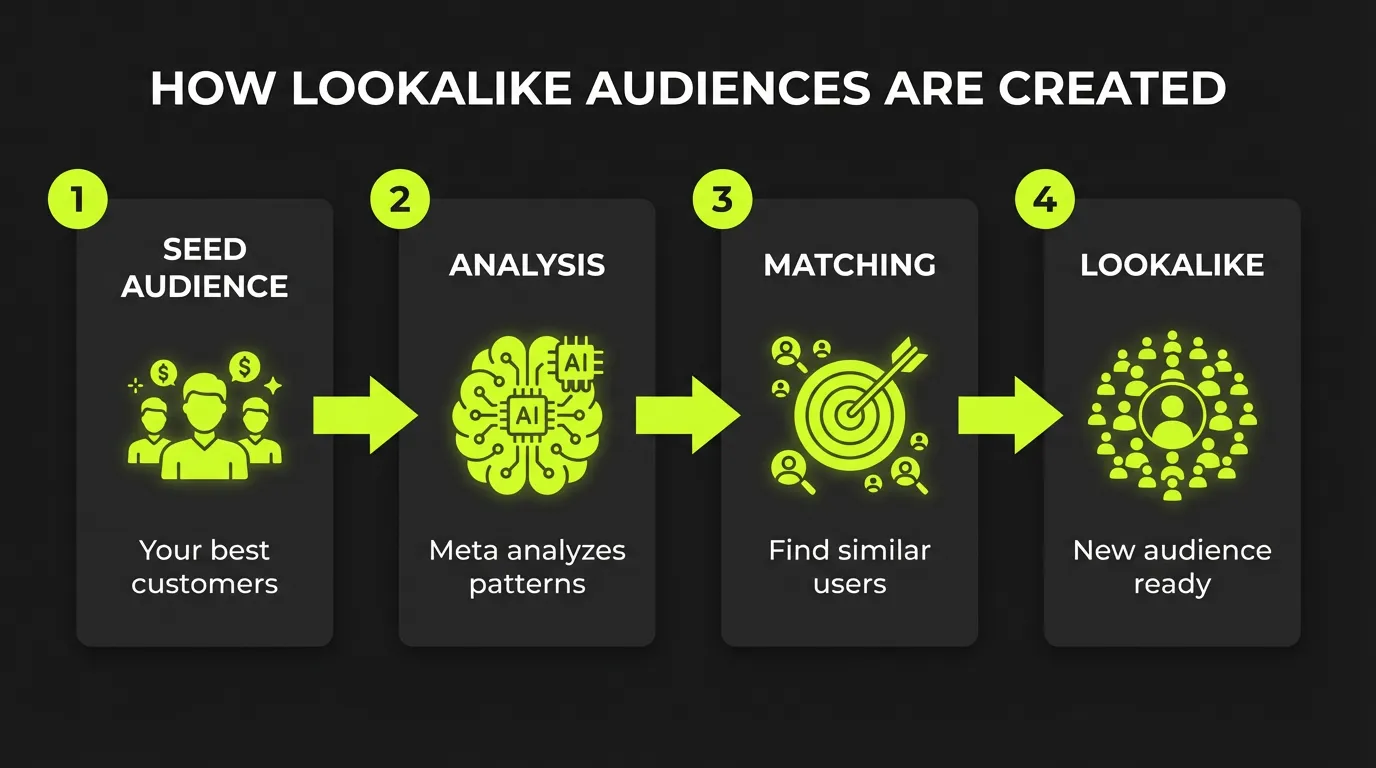
- You provide a seed audience — Customer list, website visitors, purchasers
- Platform analyzes traits — Demographics, behaviors, interests
- AI finds similar users — People with matching characteristics
- You choose audience size — From 1% (most similar) to 10% (broader reach)
Seed Audience Options
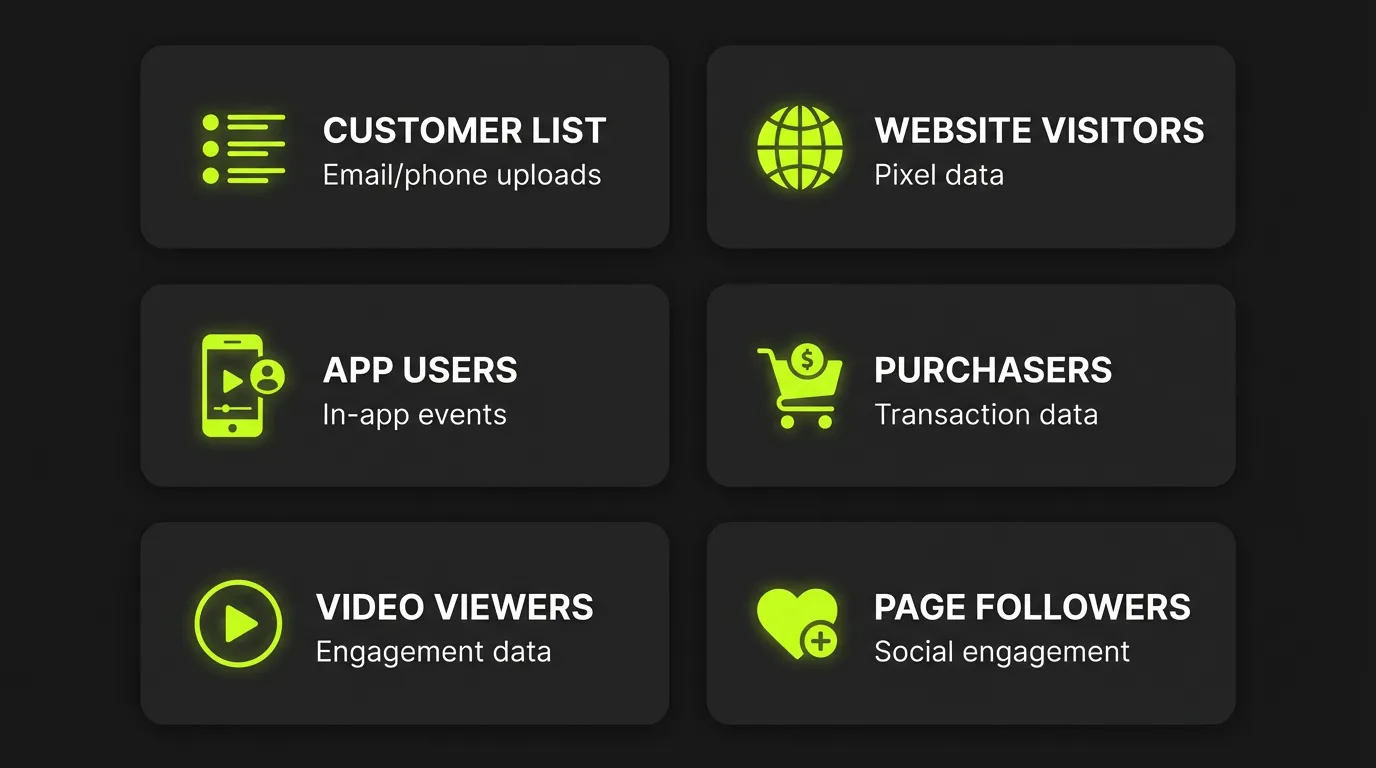
| Seed Type | Quality | Use When |
|---|---|---|
| Purchasers | Highest | Finding more buyers |
| High-value customers | Highest | Targeting premium segments |
| Email subscribers | High | Building awareness |
| Website visitors | Medium | Top-of-funnel expansion |
| App users | High | App promotion |
| Video viewers | Medium | Engagement campaigns |
:::tip Best Seed Audiences Start with purchasers or high-LTV customers as your seed. The higher the quality of your seed, the better your lookalike will perform. Minimum seed size: 1,000-5,000 people for best results. :::
Lookalike Size Strategy
The 1-10% Spectrum
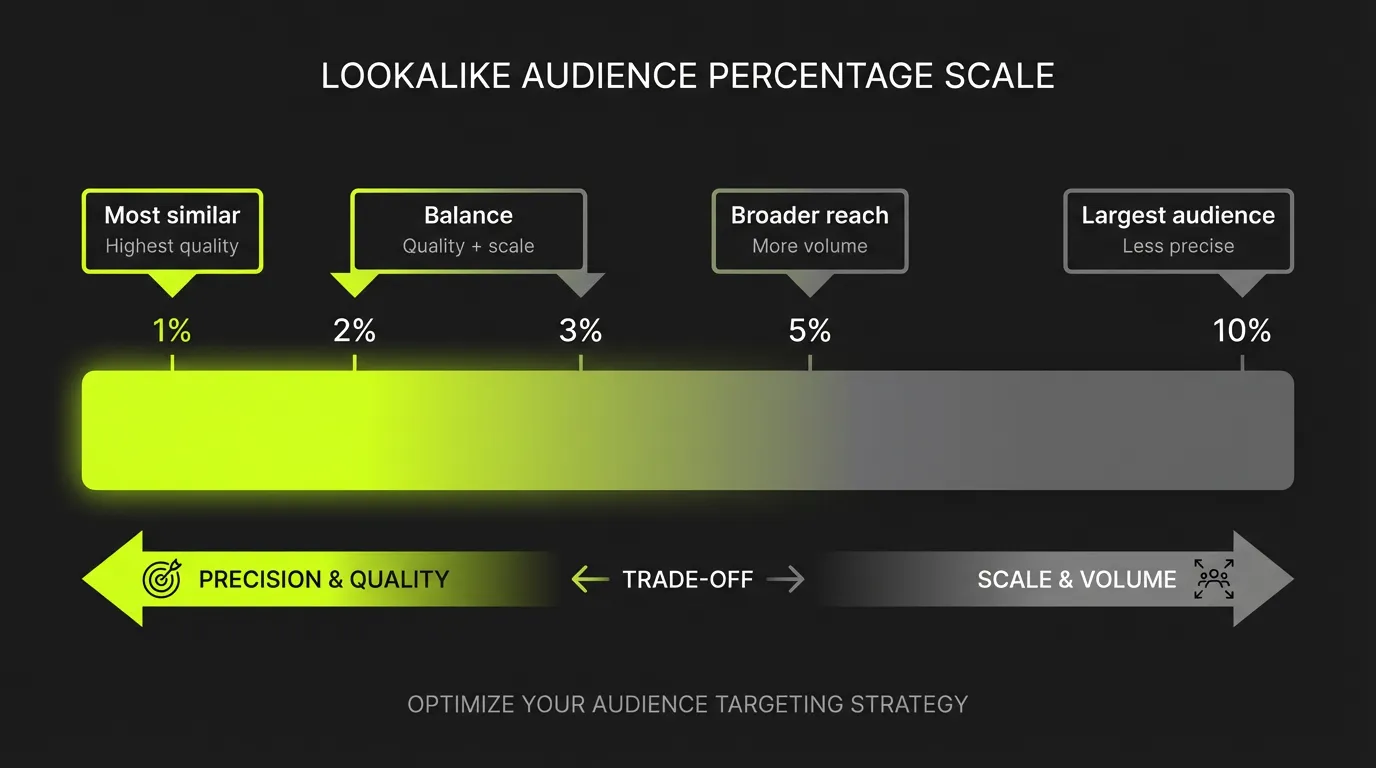
| Size | Similarity | Reach | Best For |
|---|---|---|---|
| 1% | Highest | Smallest | High-ticket products, precision targeting |
| 2-3% | High | Medium | Balanced approach, most campaigns |
| 4-5% | Medium | Large | Scale with quality |
| 6-10% | Lower | Largest | Maximum reach, brand awareness |
Scaling Strategy
Start narrow, expand based on performance:
- Test 1% — Establish baseline performance
- Scale to 3% — If 1% performs well
- Test 5% — For more volume
- Compare to broad — See if broad targeting beats lookalikes
"Typically, advertisers start with targeting a 1% lookalike audience. To enhance your campaign's reach without saturating your audience, consider increasing this to between 3% and 5%."
Lookalikes vs. Broad Targeting in 2026
Here's the honest debate happening in 2026:
The Broad Targeting Case
| Metric | Broad Targeting | Lookalike Targeting |
|---|---|---|
| Average ROAS | 113% | 76% |
| Average CTR | ~1% | ~1% |
| Average CPM | Lower | 45% higher |
:::warning The Data "Analysis shows that on average, Broad targeting has a higher ROAS (113%) (Lebesgue) than Lookalike targeting (76%), with comparable CTR. Lookalikes have a higher average CPM (45% higher) which negatively impacts overall ROAS." :::
When Lookalikes Still Win
- Limited budget — Need to focus spend on precise audience
- High-ticket products — Quality over quantity
- Niche markets — Specific customer profiles
- Cold start — Before platforms learn your audience
- B2B campaigns — Professional targeting precision
When Broad Wins
- Large budgets — Let AI find the best audiences
- E-commerce — High volume, lower prices
- Established pixel data — Platform knows your buyers
- Advantage+ campaigns — AI handles optimization
Meta Advantage+ vs. Lookalikes
How Advantage+ Changes Things
"Meta's Advantage+ targeting is an advanced AI-driven solution that automatically adjusts your audience targeting to maximize results. Unlike manual targeting, Advantage+ dynamically refines who sees your ads based on real-time engagement and conversion data."
When to Use Each
| Use Advantage+ | Use Lookalikes |
|---|---|
| Established pixel with 50+ conversions/week | New campaigns, limited data |
| High budget ($5K+/month) | Budget-conscious targeting |
| E-commerce with broad appeal | Niche products, specific audiences |
| Shopping campaigns | Lead generation |
Hybrid Approach
Best practice in 2026:
- Start with lookalikes for new campaigns
- Use Advantage+ "suggestions" feature
- Combine lookalike seed with Advantage+ expansion
- Let AI expand beyond initial audience if results improve
Creating High-Quality Lookalikes
Step 1: Build Strong Seed Audiences
Best seed sources:
- Customer email lists (hash before upload)
- Purchase custom audiences (last 180 days)
- Website conversion events via pixel
- High-value customer segments from CRM
Step 2: Segment Your Seeds
Don't just use "all customers." Create specific seeds:
- High-LTV customers — Top 20% by revenue
- Repeat purchasers — 2+ orders
- Recent converters — Last 30-60 days
- Specific product buyers — For product-specific campaigns
Step 3: Technical Setup
:::info Pixel Requirements "Facebook Pixel must be set up when creating Lookalike Audiences. Use Conversion API (CAPI) to bypass iOS 14+ restrictions. CAPI helps send events to Facebook via a server rather than a browser pixel and offers more accurate conversion tracking." :::
Step 4: Layer with Interests
For even better precision:
- Create 1-3% lookalike
- Add relevant interest targeting
- Exclude existing customers
- Exclude recent website visitors (avoid overlap with retargeting)
Funnel Placement for Lookalikes
Top of Funnel (Awareness)
- Audience: 5-10% lookalikes
- Objective: Reach, video views
- Creative: Brand intro, problem awareness
- Budget: 20-30% of total spend
Middle of Funnel (Consideration)
- Audience: 1-3% lookalikes
- Objective: Traffic, engagement
- Creative: Product benefits, social proof
- Budget: 30-40% of total spend
Bottom of Funnel (Conversion)
- Audience: Custom audiences, not lookalikes
- Objective: Conversions
- Creative: Offers, urgency
- Budget: 30-40% of total spend
:::tip Lookalike Placement "Lookalikes are best used in top- and mid-funnel campaigns but can also work for higher-ticket offers when layered with custom events." :::
Platform-Specific Lookalikes
Meta (Facebook/Instagram)
Setup:
- Go to Audiences in Ads Manager
- Create Audience → Lookalike Audience
- Select seed source
- Choose location and audience size
- Create and use in campaigns
Unique features:
- Value-based lookalikes (prioritize high-LTV)
- Multi-country lookalikes
- Audience overlap checker
Google Ads
Similar Audiences (legacy):
- Based on remarketing lists
- Auto-created from customer match
Customer Match:
- Upload customer lists
- Google finds similar users
- Works across Search, Shopping, YouTube
Lookalike Audiences:
- Based on Matched Audiences
- Company or contact list seeds
- Best for B2B targeting
Common Mistakes to Avoid
Mistake 1: Using Too Small a Seed
Problem: Seed audience < 1,000 people Fix: Build larger seed before creating lookalike
Mistake 2: Never Refreshing Seeds
Problem: Using same seed for 6+ months Fix: Update seed quarterly with fresh customers
Mistake 3: Not Excluding Existing Customers
Problem: Paying to reach current customers Fix: Always exclude purchasers and email list
Mistake 4: Only Testing One Size
Problem: Assuming 1% is always best Fix: Test 1%, 3%, and 5% simultaneously
Mistake 5: Ignoring Audience Overlap
Problem: Multiple lookalikes compete against each other Fix: Check overlap, consolidate similar audiences
Measuring Lookalike Performance
Key Metrics
| Metric | What to Watch | Action Threshold |
|---|---|---|
| CPM | Rising CPMs signal saturation | >50% increase |
| CTR | Declining CTR shows fatigue | <0.8% |
| CVR | Conversion rate stability | <1% for e-commerce |
| Frequency | Audience exhaustion | >3 per week |
| ROAS | Bottom line efficiency | Below target |
Testing Framework
Run controlled tests:
- Split test lookalike vs. broad
- Test different seed audiences
- Test different sizes (1% vs. 3% vs. 5%)
- Measure at 7-day and 28-day windows
The Bottom Line
Effective lookalike strategy in 2026 requires:
- Quality seeds — Start with your best customers
- Right sizing — Match size to campaign goals
- Test vs. broad — Don't assume lookalikes always win
- Hybrid approach — Combine with Advantage+ when appropriate
- Regular refresh — Update seeds quarterly
"Facebook's Lookalike Audiences remain a valuable tool for advertisers aiming to expand their reach. However, it is advisable to use other targeting methods to ensure your campaigns remain effective."
AdBid helps you analyze audience performance across platforms. See which targeting strategies drive the best results. Start analyzing.