
Part of our Meta Ads Platform guide series.
Key Takeaways
- Advantage+ Audience is Meta's default AI targeting — it treats your inputs as suggestions, not rules
- Performance data shows 13% lower cost per catalog sale (Jon Loomer Digital), 7% lower cost per conversion
- Only location and minimum age are hard constraints — everything else is a suggestion
- In Q2 2025, 35% of US retail ad spend went to Advantage+ campaigns (EMARKETER)
- Trade-off: better performance but less visibility and control
What Is Advantage+ Audience?
:::highlight The Fundamental Shift Advantage+ Audience treats your inputs as suggestions rather than hard rules. It will only follow your hard rules for location and minimum age. Everything else? The algorithm decides. :::
Instead of forcing your ads to show only to people you specify, Advantage+ uses your data to find the best customers across the entire platform.
To run this repeatably, AdBid's automated rules let you set conditions once and let campaigns self-optimize.
This is a fundamental change in how Meta advertising works. Understanding it is essential for success in 2026.

How Advantage+ Audience Works
The Algorithm Behind It
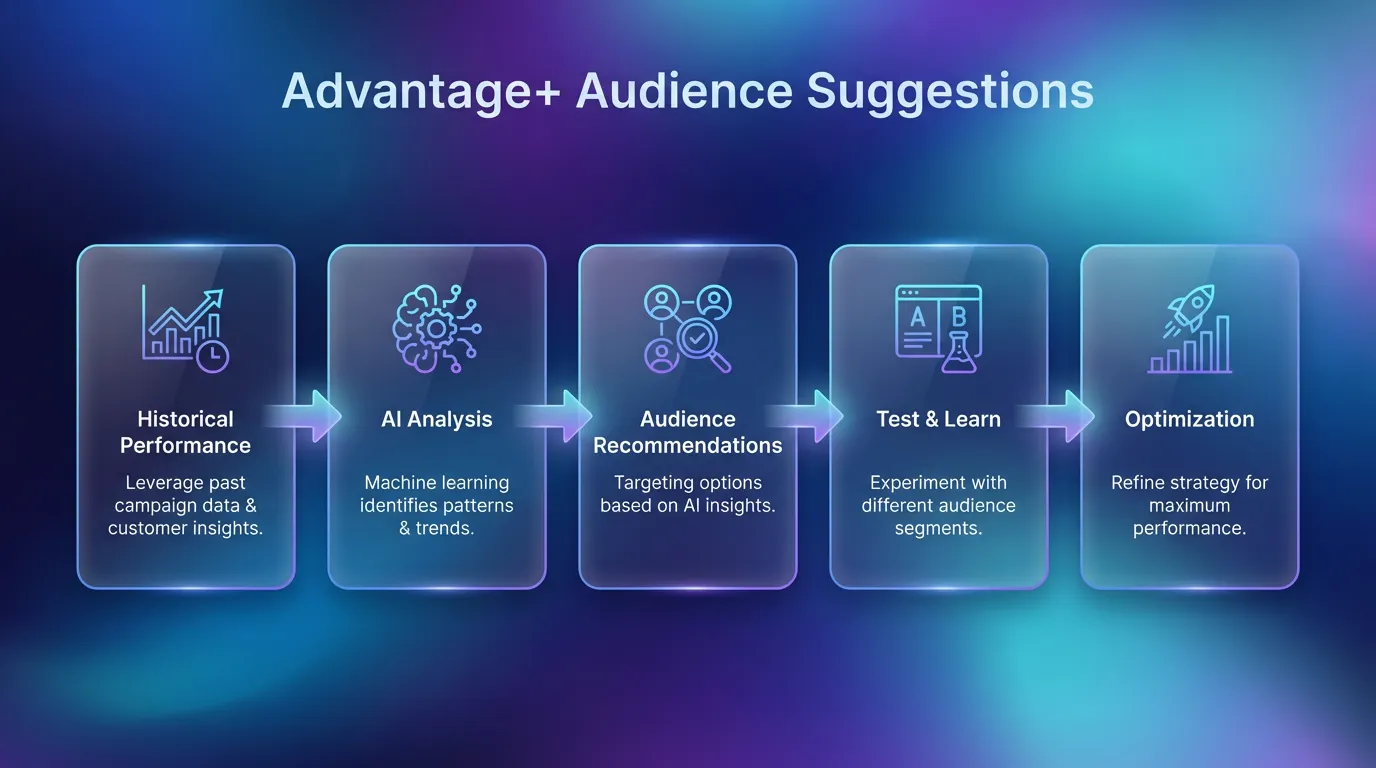
Meta's targeting engine is powered by Andromeda, a deep learning architecture introduced in late 2024. Here's what happens:
Signal Collection: Meta processes user behavior across Facebook, Instagram, Messenger, and external websites (via pixel)
Real-Time Prediction: For every impression opportunity, the system predicts conversion likelihood
Auction Optimization: Your ad competes against others, with the algorithm bidding based on predicted value
Learning: Every conversion (or non-conversion) feeds back into the model
Audience Controls vs. Suggestions
:::warning Critical Distinction This is where most advertisers get confused. :::
Audience Controls (Hard Rules):
- Location (country, region, city)
- Minimum age
- Language
These are actual constraints. Your ads will not show to people outside these parameters.
Audience Suggestions (Soft Signals):
- Custom audiences
- Lookalike audiences
- Age range (beyond minimum)
- Gender
- Detailed targeting (interests, behaviors)
The algorithm will prioritize these initially but can (and will) go outside them if it finds better prospects.
"You can provide custom audiences, lookalike audiences, an age range, gender, and detailed targeting as suggestions. Just keep in mind that these are not tight constraints."
Performance Benefits
The Data
Jon Loomer's analysis shows Advantage+ Audience delivers:
| Metric | Improvement |
|---|---|
| Cost per Catalog Sale | 13% lower |
| Cost per Website Conversion | 7% lower |
| Cost per Click/Lead/Landing Page View | 28% lower |
:::tip Why It Works Instead of running multiple split tests manually, Advantage+ continuously tests different audience segments and optimizes in real time. The algorithm has more data than you do. :::
When It's Automatically Enabled
Advantage+ Audience is automatically active for:
- Leads campaigns
- App Promotions campaigns
- Sales campaigns
For Awareness, Engagement, and Traffic campaigns, it's optional.
When to Use Advantage+ Audience
Ideal Scenarios
1. Conversion Campaigns with Good Data
- Strong pixel history (1,000+ monthly conversions)
- Well-configured Conversions API
- Clear conversion event
2. Scaling Phase
- You've validated your creative
- Ready to expand reach
- Budget can support broader testing
3. Large Addressable Market
- Product/service appeals broadly
- Not hyper-niche targeting required
- Geographic flexibility
When to Be Cautious
1. Very Specific Targeting Needed
- B2B with strict firmographics
- Highly regulated industries
- Niche products with small TAM
2. New Accounts
- Limited pixel data
- Algorithm has little to learn from
- Better to start with defined audiences
3. Brand Safety Concerns
- Can't risk appearing in certain contexts
- Strict placement requirements
- Highly controlled brand guidelines
The Trade-Offs
What You Gain
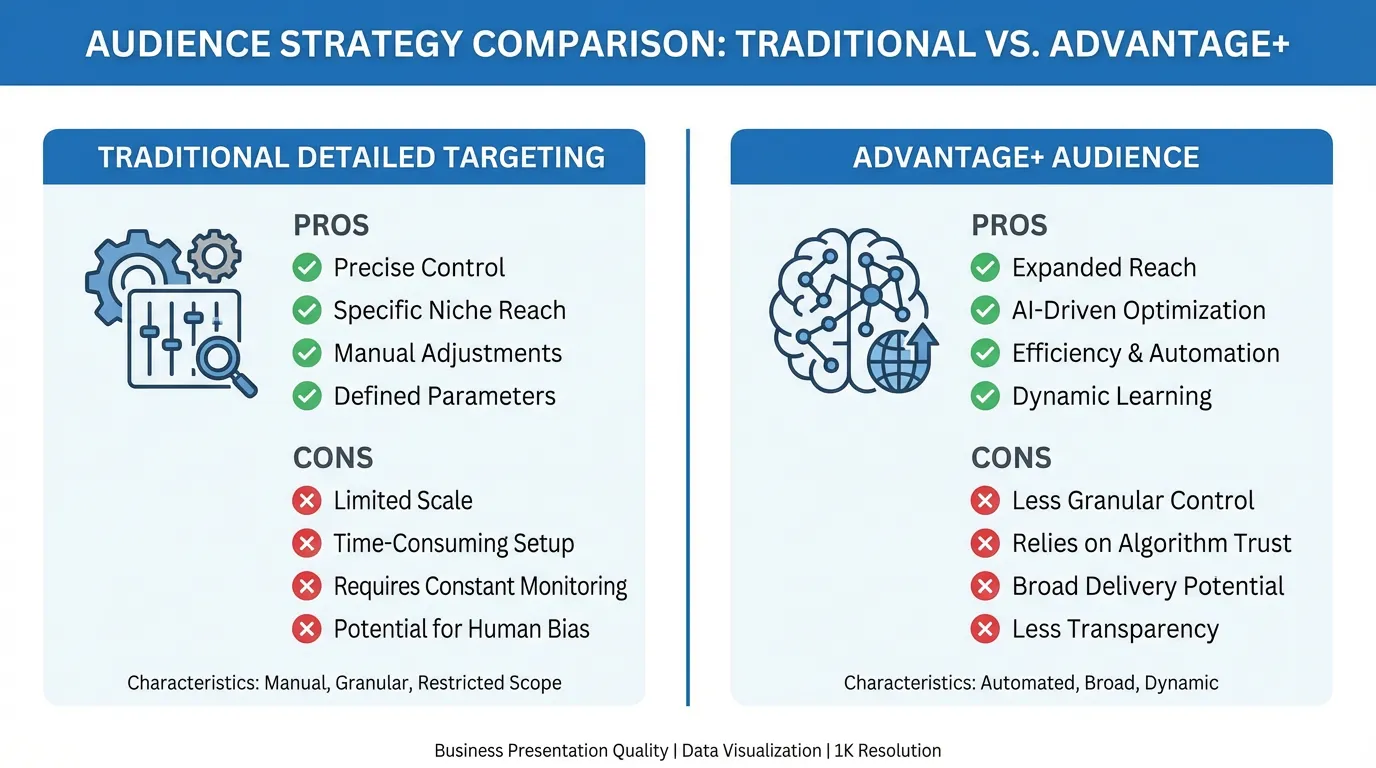
- Broader reach
- Automated optimization
- Access to Meta's signal library
- Generally better performance
What You Lose
:::danger The Visibility Problem You won't know how far Meta expanded your audience, how much of your budget went to that expansion, or how it performed separately. :::
- Transparency: No breakdown of algorithm vs. your targeting
- Control: Can't force specific audience focus
- Learning: Harder to extract insights for other channels
- Pacing: Less control over budget distribution
Managing the Trade-Off
If you need more control:
- Use Original Audiences for Testing: Run manual campaigns to test specific hypotheses
- Segment by Creative: Different creatives for different audience intents
- Monitor Frequency: High frequency might indicate narrow actual reach
- Run A/B Tests: Advantage+ vs. manual to measure actual impact
Optimizing Advantage+ Campaigns
Signal Quality Matters Most
:::tip The New Targeting Meta targeting in 2026 is less about who you think your audience is, and more about supplying the system with the right signals so it can find them for you. :::
Improve Your Signals:
1. Conversions API Implementation
- Server-side event tracking
- Higher match rates
- More data for algorithm
2. Customer Value Data
- Pass purchase values
- Implement value-based optimization
- Feed LTV data back to Meta
3. Enhanced Match Parameters
- Email, phone, name
- External IDs
- Geographic data
Suggestion Strategies
Even though they're suggestions, your inputs still matter:
Custom Audiences as Seeds:
- Use your best customers
- Refresh monthly
- Multiple seed audiences for different products
Lookalike Suggestions:
- Start with 1-3% for focus
- Use value-based lookalikes
- Layer multiple lookalikes
Interest Suggestions:
- Pick 10-15 highly relevant interests
- Let algorithm find patterns
- Don't over-constrain
2026 Changes and Trends
The Advantage+ Evolution
:::info Recent Update Meta has officially removed the "Audience Types" selection from Advantage+ catalog ads using the sales objective. This marks a clear shift toward AI-driven audience targeting. :::
The trend is clear: Meta wants you to trust the algorithm. Future updates will likely continue this direction:
- More campaign types defaulting to Advantage+
- Fewer manual override options
- Greater emphasis on signal quality over targeting
Adoption Trends
In Q2 2025, 35% of US retail ad spend went to Advantage+, reflecting growing confidence in Meta's native AI. This percentage is increasing quarter over quarter.
Testing Advantage+ Effectively
A/B Test Structure
Campaign A: Advantage+ Audience
- Objective: Conversions
- Audience: Suggestions only
- Creative: Your top performers
- Budget: 50% of test budget
Campaign B: Manual Targeting
- Same objective
- Defined audiences (lookalikes, interests)
- Same creative
- Budget: 50% of test budget
Run for: 2-4 weeks minimum
Measure:
- CPA comparison
- ROAS comparison
- Conversion volume
- Quality metrics (if available)
What to Do With Results
If Advantage+ Wins:
- Shift budget toward Advantage+
- Focus on signal quality improvements
- Use manual for specific tests only
If Manual Wins:
- Investigate why (audience too niche? poor signals?)
- Improve pixel/CAPI implementation
- Test again in 3 months with better data
If Results Are Close:
- Consider Advantage+ for convenience
- Or maintain manual for control/insights
Common Mistakes
Mistake 1: Treating Suggestions as Rules
Advertisers set detailed targeting and assume those are their audiences. They're not — the algorithm can (and will) expand.
Fix: Accept suggestions are hints. If you need true constraints, Advantage+ might not be right for your campaign.
Mistake 2: Starving the Algorithm
Using Advantage+ with minimal conversion data gives the algorithm nothing to learn from.
Fix: Need at least 50 conversions/week for stable performance. Lower volume? Use manual targeting.
Mistake 3: Ignoring Signal Quality
Weak pixel implementation + Advantage+ = garbage in, garbage out.
Fix: Audit your tracking. Implement CAPI. Pass enhanced match parameters.
Mistake 4: No Control Group
Running Advantage+ without comparison makes it impossible to know if it's actually better.
Fix: Always maintain some manual campaigns for comparison.
The Bottom Line
Advantage+ Audience represents Meta's vision for the future of targeting: algorithm-first, signal-driven, and broadly reaching.
For most advertisers, it works. The data shows consistent performance improvements across key metrics.
But it requires:
- Strong conversion tracking
- Good data signals
- Comfort with less visibility
- Willingness to trust the algorithm
:::tip Start Here Run a 4-week A/B test: Advantage+ vs. your current manual targeting. Same creative, same budget. Let the data tell you what works for your account. :::
The advertisers winning in 2026 aren't fighting the algorithm — they're feeding it better data.
Want to compare Advantage+ performance across all your campaigns? AdBid provides cross-campaign analytics and A/B test management. Start your free trial.
Related reading: Understanding Meta Advantage+ Sales Campaigns: 2026 Guide