
Part of our CTV Advertising guide series.
Programmatic Advertising in 2026: A Practical Strategy Guide
Programmatic buying now handles more than 90% of all U.S. digital display ad spending, according to (eMarketer, 2024). That share keeps climbing because automation buys, places, and prices ads faster than any human team could. This guide is about execution: how to run programmatic campaigns well in 2026, not just which platforms exist. We focus on channel strategy, targeting in a cookieless world, and the optimization habits that separate wasted budgets from profitable ones. If you already know what a DSP is, this is the next step.
Key Takeaways
- Programmatic accounts for over 90% of U.S. digital display spend (eMarketer, 2024), so the skill gap is now execution, not access.
- Real-time bidding resolves an auction in under 100 milliseconds, which forces pre-set rules over manual control.
- Connected TV is the fastest-growing channel, with U.S. CTV ad spend projected to top $33 billion in 2025.
- First-party and contextual targeting are replacing third-party cookies as the privacy-safe default.
- Cross-channel sequencing, not siloed buys, drives the strongest measurable lift.
How does programmatic advertising actually work in 2026?
Programmatic advertising uses software to buy and place ads automatically, and real-time bidding settles each auction in under 100 milliseconds, faster than a page finishes loading. That speed, noted across industry coverage like (IAB, 2024), means you no longer control individual buys. You set rules, budgets, and audiences, then algorithms execute thousands of decisions per second on your behalf.
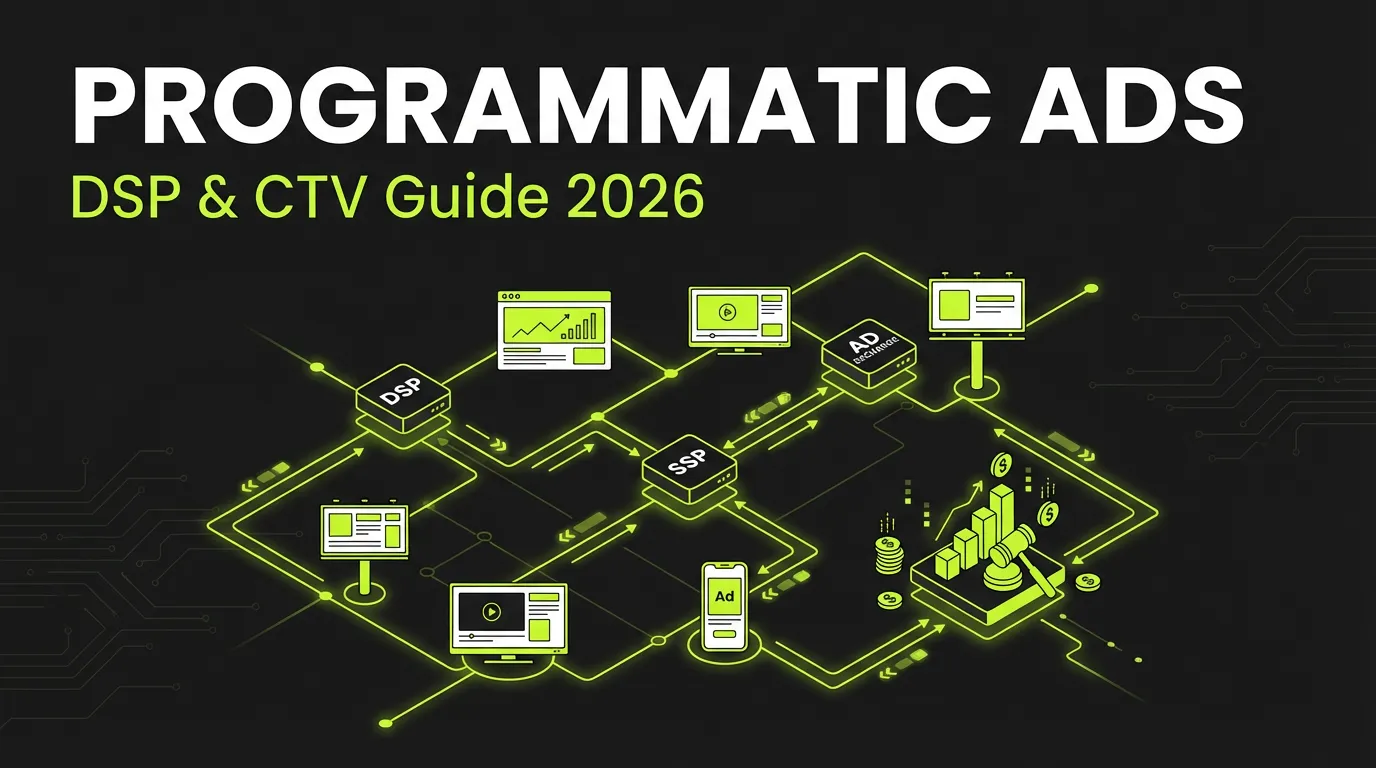
Here's the core loop. A user opens a webpage or app. The publisher's supply-side platform sends the impression to an exchange. Demand-side platforms evaluate the user, the context, and your campaign goals, then bid. The highest bid wins, and the ad renders. All of it happens before the content settles on screen.
So what changed by 2026? The mechanics are stable, but the inputs shifted. Cookie deprecation, signal loss, and AI-driven bidding mean your setup matters more than your manual intervention. Good campaigns now win on data quality and rule design, not on someone watching a dashboard all day. We've found that teams who treat programmatic as "set the strategy, then audit" outperform those who tinker hourly.
If you want a deeper platform-by-platform breakdown, see our programmatic advertising platforms guide for DSP comparisons.
The roles in the ecosystem
Three pieces carry most of the weight. Demand-side platforms (DSPs) buy inventory for advertisers across many exchanges from one interface. Supply-side platforms (SSPs) help publishers sell that inventory at the best price. Data platforms organize audience signals so both sides can target accurately. You mostly live inside the DSP, but understanding the supply side explains why some inventory costs more and why transparency matters.
Which programmatic channels matter most this year?
Display remains the largest programmatic channel by volume, but Connected TV is growing fastest, with U.S. CTV ad spend projected to exceed $33 billion in 2025 per widely cited industry forecasts. The practical takeaway: a 2026 plan that ignores CTV leaves reach and attention on the table, while one that ignores display loses cheap, scalable retargeting.
Display advertising
Display covers banners, native units, and rich media across websites and apps. It is the workhorse for retargeting and the cheapest way to maintain presence after a user shows intent. Standard sizes (300x250, 728x90, 160x600) still dominate, but native formats blend into feeds and tend to earn higher engagement. For format-level tactics, our display advertising guide goes deeper than we can here.
Video and Connected TV
Video splits into in-stream (pre-roll, mid-roll) and CTV, which serves full-screen, often non-skippable ads on smart TVs. CTV combines television's premium environment with digital targeting and measurement. The trade-offs are real: inventory is fragmented across apps and devices, measurement is harder, and CPMs run higher than display. You pay more for attention, so reserve CTV for awareness and high-value prospecting rather than direct-response scale.
Native and Digital Out-of-Home
Native ads match the look of their surroundings, which reduces banner blindness; our native advertising guide covers the formats in detail. Digital out-of-home (DOOH) brings programmatic logic to billboards, transit screens, and retail displays, with location, dayparting, and weather triggers. DOOH won't carry your funnel alone, but it amplifies awareness campaigns in specific geographies.
How should you target audiences without third-party cookies?
Third-party cookies are declining, so first-party and contextual targeting now form the privacy-safe core of most 2026 strategies. Industry guidance from (IAB, 2024) consistently points marketers toward owned data and content-based signals. The shift isn't a downgrade. First-party data is often more accurate than purchased segments, and contextual targeting needs no user identity at all.
Start with what you own. Website visitors captured by a pixel, CRM records, app users, and loyalty members are your most valuable and most durable audiences. Build these segments before chasing reach, because they also seed lookalike models that find similar prospects.
Contextual targeting fills the gap third-party data leaves. Instead of tracking a person, you place ads against relevant content: a running-shoe brand next to marathon-training articles. It is brand-safe, cookie-free, and increasingly powered by AI that reads page meaning rather than crude keywords. Is it as precise as old behavioral targeting? Not always, but it survives privacy regulation, and it doesn't break when a browser kills cookies overnight.
A reasonable 2026 stack looks like this: first-party data for retargeting and lookalikes, contextual for prospecting, and privacy-compliant identity solutions to bridge the two where consent allows.
What optimization habits separate winning campaigns?
Winning programmatic campaigns win on frequency control, creative testing, and measurement discipline, not on bid micromanagement. Because real-time bidding runs in under 100 milliseconds, your leverage lives in the rules you set beforehand. The advertisers who treat optimization as a weekly routine, not a daily scramble, tend to protect margin and avoid the classic budget leaks below.
Set frequency caps before you launch
Without frequency limits, the same user sees your ad over and over, which breeds fatigue and burns spend on people already saturated. A common starting range is three to five impressions per user per week, lower for premium CTV placements and higher for short flighted campaigns. Cap first, then loosen if reach stalls. It is far easier to spend more than to win back a fatigued audience.
Use dynamic creative and clean measurement
Dynamic creative optimization (DCO) tests combinations of headlines, images, and offers automatically, then serves the best match per audience or context. It scales testing beyond what manual variants allow. Pair that with honest measurement: programmatic often influences buyers without a direct click, so use sensible attribution windows and run incrementality tests. Counting only last-click conversions undervalues display and CTV, and that mistake quietly kills useful channels.
Sequence channels instead of siloing them
Running CTV, video, and display as separate campaigns misses the synergy between them. A stronger pattern uses CTV to build awareness, display to retarget those viewers, and mobile to close. Keeping that sequence inside one DSP makes cross-device retargeting and measurement far cleaner. Managing it across many platforms is possible, but you lose frequency control and attribution clarity at the seams.
How do you keep programmatic campaigns brand-safe and compliant?
Brand safety and privacy compliance are non-negotiable in 2026, and both require setup before launch rather than cleanup after. Pre-bid filtering, third-party verification, and consent management protect spend and reputation at the same time. Regulators including GDPR in Europe and CCPA/CPRA in California require explicit consent for tracking, so compliant data handling is now a buying prerequisite, not an afterthought.
On the brand-safety side, use blocklists to exclude unwanted domains, contextual avoidance to skip sensitive topics, and third-party verification tools to confirm viewability and fraud rates. Private marketplace (PMP) deals give you vetted, premium inventory when open exchanges feel too risky. None of this guarantees perfection, but layered defenses catch most problems before they spend your money.
On privacy, treat consent as the foundation. Limit data sharing to what users approved, document your basis for processing, and lean on first-party data you collected with permission. The cookieless transition and regulation point the same direction: own your data, respect consent, and you sidestep most compliance risk while keeping targeting effective.
More from our Programmatic Advertising Platforms guide
The sections below were consolidated from our earlier article on the same topic.
Understanding the Programmatic Ecosystem
How Programmatic Advertising Works
User visits website
    ↓
Ad request sent to SSP
    ↓
SSP sends to Ad Exchange
    ↓
DSPs bid in real-time (<100ms)
    ↓
Highest bidder wins
    ↓
Ad served to user
This entire process happens in milliseconds before the page loads.
Key Components
| Component | Role | Examples |
|---|---|---|
| DSP | Demand-Side Platform (buy ads) | The Trade Desk, DV360 |
| SSP | Supply-Side Platform (sell inventory) | Google Ad Manager, Magnite |
| Ad Exchange | Marketplace connecting DSPs & SSPs | Google AdX, OpenX |
| DMP | Data Management Platform | Oracle, Lotame |
| CDP | Customer Data Platform | Segment, mParticle |
Demand-Side Platforms (DSPs)
DSPs allow advertisers to buy programmatic inventory across multiple ad exchanges.
Top DSPs for 2025
1. The Trade Desk
Best For: Large brands and agencies
Key Features:
- Unified ID 2.0 for cookieless targeting
- Access to 90%+ of programmatic inventory
- Advanced AI optimization (Koa)
- CTV, audio, DOOH capabilities
Pricing: Self-serve minimum ~$100k/month
Pros:
- Industry-leading targeting
- Excellent CTV access
- Strong data partnerships
Cons:
- High minimums
- Steep learning curve
2. Google Display & Video 360 (DV360)
Best For: Brands in Google ecosystem
Key Features:
- YouTube and Google inventory access
- Integration with Google Analytics
- Campaign Manager 360 integration
- Audience insights from Google
Pricing: Variable based on spend
Pros:
- Best for YouTube/Google inventory
- Familiar interface
- Strong measurement
Cons:
- Limited transparency
- Walled garden limitations
3. Amazon DSP
Best For: E-commerce and retail brands
Key Features:
- Amazon shopping data targeting
- Amazon-owned inventory (Fire TV, IMDb)
- Purchase intent signals
- Retail media integration
Pricing: $35,000 minimum for self-serve
Pros:
- Unmatched commerce data
- Fire TV CTV access
- Cross-device Amazon ID
Cons:
- High minimums
- Limited off-Amazon insights
4. MediaMath
Best For: Mid-market advertisers
Key Features:
- Modular platform design
- Strong identity solution
- Brain (AI optimization)
- Full-funnel activation
Pricing: Flexible, lower minimums
Pros:
- More accessible pricing
- Good transparency
- Customizable
Cons:
- Smaller scale than leaders
- Fewer integrations
5. Basis Technologies (Centro)
Best For: Agencies and multi-channel buyers
Key Features:
- Omnichannel buying
- Workflow automation
- Financial reconciliation
- Direct and programmatic combined
Pricing: Agency-friendly pricing
Pros:
- Excellent for agencies
- Unified billing
- Direct + programmatic
Cons:
- Less advanced optimization
- Smaller data partnerships
DSP Comparison Table
| DSP | Min Spend | Best Channel | Ease of Use | Data Strength |
|---|---|---|---|---|
| The Trade Desk | High | CTV | Medium | Excellent |
| DV360 | Medium | YouTube | Medium | Very Good |
| Amazon DSP | High | Fire TV | Medium | Excellent (commerce) |
| MediaMath | Medium | Display | High | Good |
| Basis | Low | Multi | High | Good |
Supply-Side Platforms (SSPs)
SSPs help publishers monetize their ad inventory through programmatic selling.
Leading SSPs
1. Google Ad Manager
Market Share: ~50%
Key Features:
- Unified auction
- YouTube integration
- Direct deals support
- Advanced forecasting
2. Magnite (Formerly Rubicon + Telaria)
Specialty: CTV and video
Key Features:
- Largest independent SSP
- CTV-first approach
- SpringServe ad server
- Demand manager
3. PubMatic
Specialty: Mobile and video
Key Features:
- Strong mobile inventory
- Identity Hub
- Audience Encore
- Real-time analytics
4. Index Exchange
Specialty: Premium publishers
Key Features:
- Header bidding expertise
- Transparent marketplace
- Quality inventory
- Direct relationships
Ad Exchanges
Ad exchanges are marketplaces where DSPs and SSPs meet to trade inventory.
How Ad Exchanges Work
Publisher (SSP) -> Lists inventory with floor price
                      ↓
               Ad Exchange
                      ↓
Advertiser (DSP) -> Bids on inventory
                      ↓
         Highest bid wins auction
                      ↓
            Ad served to user
Types of Ad Exchanges
1. Open Exchange
- Any buyer can participate
- Maximum reach
- Lower prices
- Less control over placements
2. Private Marketplace (PMP)
- Invitation-only buyers
- Premium inventory
- Negotiated pricing
- Brand safety
3. Programmatic Guaranteed
- Fixed price, guaranteed inventory
- Direct relationship benefits
- Automated execution
- Best for large campaigns
Data Platforms in Programmatic
Data Management Platforms (DMPs)
DMPs organize audience data for targeting.
Leading DMPs:
- Oracle (BlueKai)
- Salesforce DMP
- Lotame
Use Cases:
- Audience segmentation
- Look-alike modeling
- Cross-device tracking
Customer Data Platforms (CDPs)
CDPs unify first-party customer data.
Leading CDPs:
- Segment
- mParticle
- Tealium
Use Cases:
- First-party data activation
- Customer journey tracking
- Real-time personalization
Choosing the Right Platform
Questions to Ask
1. What's your primary channel?
- Display/Banner: Most DSPs work
- CTV: The Trade Desk, Amazon
- Video: DV360, Magnite
- Audio: Spotify Ad Studio, The Trade Desk
2. What's your budget?
| Budget | Recommended |
|---|---|
| <$10k/mo | Self-serve platforms |
| $10-50k/mo | Mid-tier DSPs, managed |
| $50k+/mo | Enterprise DSPs |
3. What data do you need?
- Commerce data: Amazon DSP
- Google data: DV360
- Third-party: The Trade Desk
- First-party: Any with CDP integration
4. What's your team's expertise?
- Beginner: Managed service or simple DSP
- Intermediate: Self-serve with support
- Advanced: Full-feature enterprise DSP
Platform Selection Framework
Step 1: Define primary channels
        ↓
Step 2: Determine budget range
        ↓
Step 3: List must-have features
        ↓
Step 4: Evaluate data needs
        ↓
Step 5: Test 2-3 platforms
        ↓
Step 6: Choose based on results
Programmatic Buying Strategies
1. Open Market Buying
Best For: Reach and scale
Strategy:
- Broad targeting parameters
- Multiple ad exchanges
- Aggressive frequency capping
- Brand safety tools enabled
2. Private Marketplace Deals
Best For: Premium inventory, brand safety
Strategy:
- Negotiate with premium publishers
- Set floor prices
- Curated inventory lists
- Higher CPMs, better performance
3. Programmatic Guaranteed
Best For: Guaranteed reach, specific publishers
Strategy:
- Reserve inventory in advance
- Fixed pricing agreements
- Specific placement guarantees
- Long-term publisher relationships
Measurement & Attribution
Key Metrics
| Metric | Description | Benchmark |
|---|---|---|
| Viewability | % of ad that was viewable | 70%+ |
| VCR | Video completion rate | 75%+ |
| CTR | Click-through rate | 0.1-0.3% |
| VTR | View-through rate | 0.05-0.15% |
Attribution Models
Last Click: Credit to final touchpoint Linear: Equal credit to all touchpoints Time Decay: More credit to recent touchpoints Data-Driven: AI-determined credit distribution
Future of Programmatic
Cookieless Future
Preparing for 2025+:
- Build first-party data strategies
- Test identity solutions (UID 2.0, ID5)
- Invest in contextual targeting
- Explore cohort-based targeting
Emerging Trends
1. Supply Path Optimization (SPO)
- Reduce intermediary fees
- Direct publisher relationships
- Transparent supply chains
2. Attention Metrics
- Move beyond viewability
- Time-in-view measurement
- Attention prediction models
3. AI/ML Optimization
- Automated bidding
- Predictive targeting
- Real-time creative optimization
4. Retail Media Integration
- Commerce data activation
- Purchase attribution
- Closed-loop measurement
Frequently Asked Questions
What is the difference between programmatic and a DSP?
Programmatic is the broad practice of automated, real-time ad buying across channels. A DSP, or demand-side platform, is the specific software advertisers use to do it, settling auctions in under 100 milliseconds. Think of programmatic as the method and the DSP as the cockpit. You buy programmatically by operating a DSP that connects to exchanges and supply-side platforms.
Is programmatic advertising worth it for small budgets?
Yes, with the right starting point. Programmatic handles over 90% of U.S. digital display spend (eMarketer, 2024) precisely because automation scales down as well as up. Small advertisers usually start with display retargeting, which is cheap and data-rich, then expand into prospecting and CTV once they have learnings. Begin narrow, prove return, and grow from there.
Will the end of third-party cookies break programmatic targeting?
No, but it changes the inputs. Targeting shifts toward first-party data you own and contextual signals based on page content, both of which survive cookie deprecation. Many advertisers find first-party segments more accurate than purchased ones. For platform-level details on how DSPs adapt, our programmatic advertising platforms guide covers the mechanics.
How much should I cap ad frequency?
A practical starting range is three to five impressions per user per week. Lower it for premium, high-cost CTV placements where each view carries more attention, and raise it for short campaigns that need rapid reach. Set the cap before launch, then adjust based on reach and fatigue signals rather than guessing after the budget is gone.
The Bottom Line
Programmatic advertising in 2026 rewards preparation over reaction. With automation handling more than 90% of U.S. digital display spend and CTV climbing past $33 billion, the advantage no longer comes from access to the tools. It comes from how you set them up. Build first-party data, lean on contextual targeting, cap frequency before launch, and sequence CTV, display, and mobile inside one workspace instead of siloed buys. Measure with incrementality, not just last clicks, and treat brand safety and consent as launch requirements. Get the foundation right, and the algorithms do the heavy lifting profitably.
Ready to plan and run cross-channel programmatic in one place? Explore the AI Agents Ads Manager to automate campaign setup, optimization, and reporting.