
Part of our CTV Advertising guide series.
Key Takeaways
:::highlight CTV Is Now a Must-Buy CTV advertising spending reached $30.1 billion in 2024 (EMARKETER), growing toward $40+ billion by 2026. 68% of US advertisers call CTV a "must-buy" in their media plans. Over 50% of marketers are increasing CTV budgets this year. :::
- 88% of US households have at least one connected TV
- Streaming accounts for 43.8% of all TV viewing (Nielsen The Gauge) (up 10 points in 2 years)
- 72% of streaming time is with ad-supported content
- CTV ad completion rates reach 95.92% for 30-second ads
- CTV-exposed households convert 45% higher than unexposed
Want to see it in practice? Explore the AdBid platform — campaign planning, automation, and analytics live in one workspace.
Why CTV Advertising Dominates in 2026
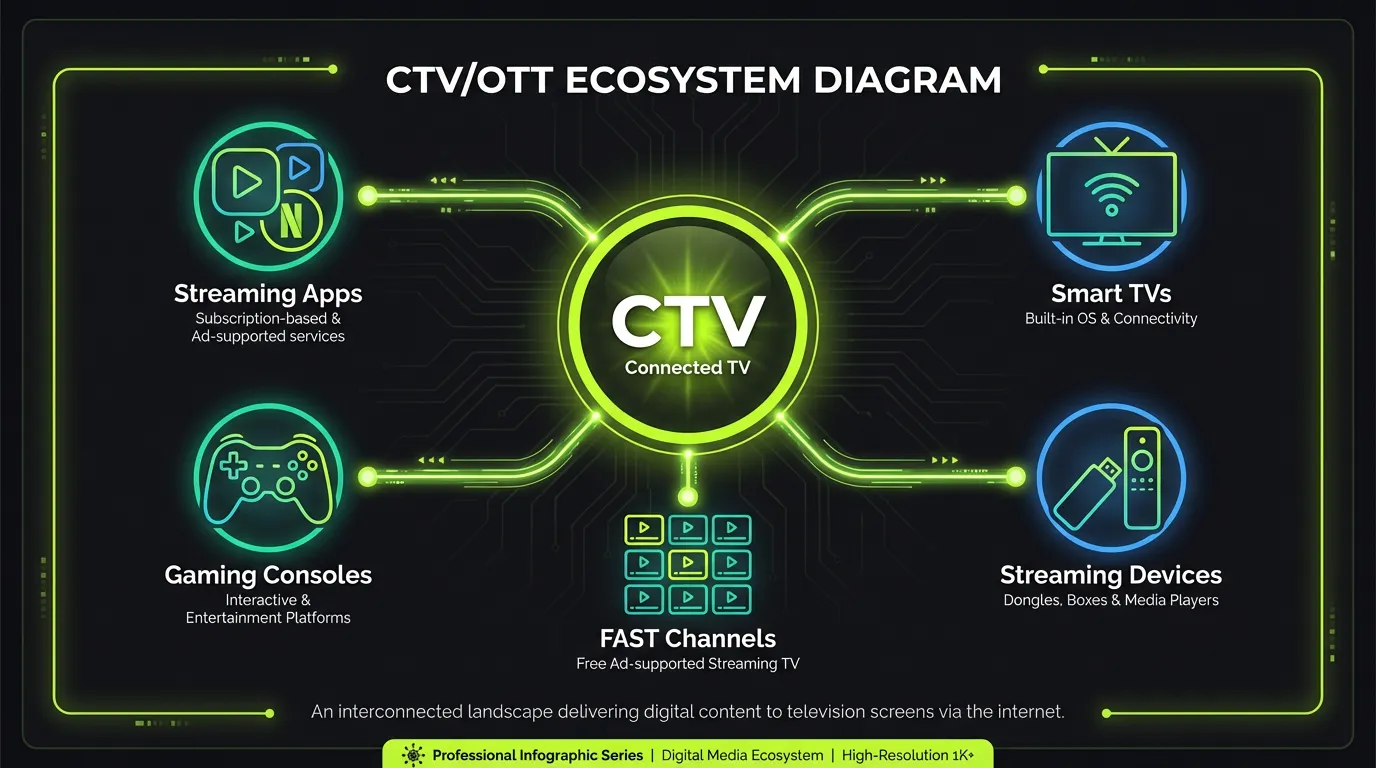
The shift is complete. Streaming won.
:::info The New Reality More than half of TV time is now streaming. And the majority of that streaming is ad-supported. Linear TV isn't dead, but CTV is where growth happens. :::
The CTV Advantage
| Benefit | Description |
|---|---|
| Massive reach | 88% of US households |
| Engaged audiences | Large screen, focused viewing |
| Precision targeting | Digital-level targeting on TV |
| Real-time measurement | Track performance as it happens |
| High completion | 95%+ for 30-sec ads |
| Premium environment | Brand-safe content |
CTV vs. Linear TV Performance
| Metric | CTV | Linear TV |
|---|---|---|
| Targeting precision | Household + individual | Broad demo |
| Measurement | Real-time | Post-campaign (delayed) |
| Completion rate | 95%+ | 70-80% (estimated) |
| Cost efficiency | CPM $20-40 | CPM $15-30 |
| Attribution | Trackable to conversion | Modeled |
CTV Targeting Capabilities
Audience Definition
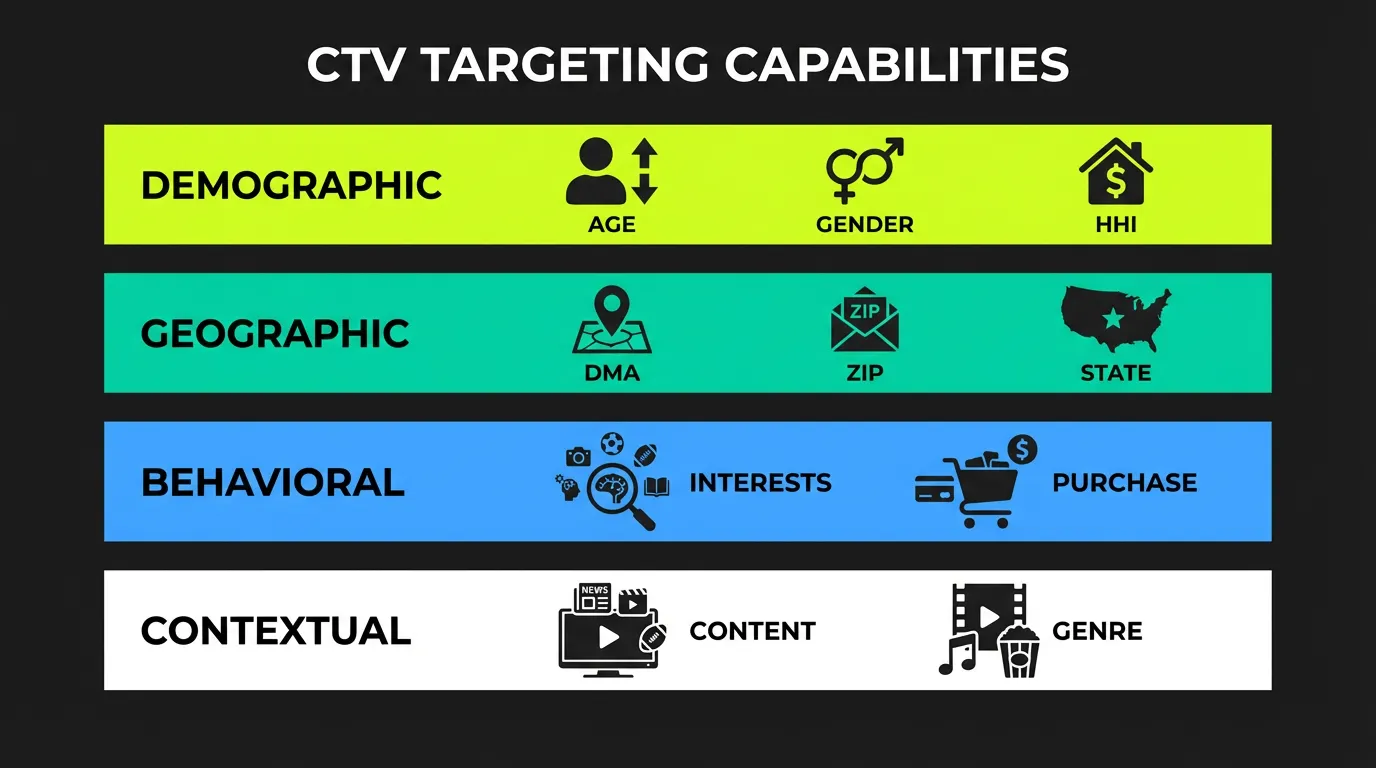
CTV targeting works through audience definition—advertisers define target audiences using multiple data signals that translate into technical identifiers like IP addresses and device IDs.
:::tip Targeting Layers Combine multiple targeting methods for precision without sacrificing scale. Start broad, then refine based on performance data. :::
Targeting Types
1. Demographic & Geographic
- Age and gender
- Income level
- Life stage (young professionals, families, empty nesters)
- Geographic: DMA, local, ZIP code
2. Behavioral Targeting
- Content viewing history
- App usage patterns
- Purchase behavior
- Interest categories
3. Contextual Targeting
- Content genre
- Show/movie specific
- Daypart
- Device type
4. First-Party Data Targeting
- CRM matching
- Website visitors
- Customer lists
- App users
5. Retail Media Data
- Purchase history (Amazon, Walmart)
- Shopping behavior
- Brand affinity
- Category interest
Data Types: Deterministic vs. Probabilistic
:::info Data Quality Matters Deterministic data is directly provided by users (registration, authentication). Probabilistic data is inferred from patterns. The best campaigns combine both—deterministic for core audiences, probabilistic for scale. :::
| Data Type | Example | Accuracy | Scale |
|---|---|---|---|
| Deterministic | Streaming service login | 95%+ | Lower |
| Probabilistic | "Likely pet owners" inference | 70-85% | Higher |
CTV Ad Formats
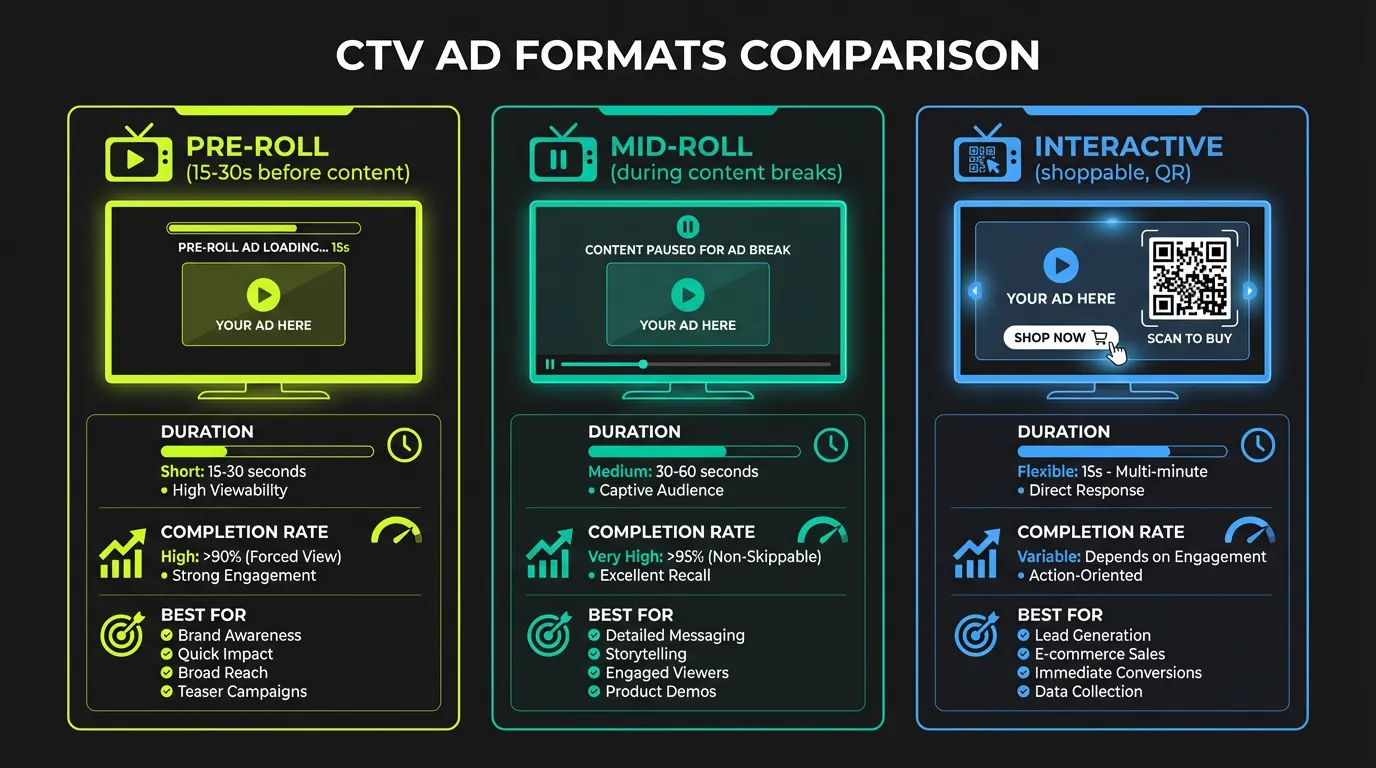
Standard Video Ads
Pre-roll
- Before content
- Highest attention
- Best for awareness
Mid-roll
- During natural breaks
- Good engagement
- Risk of skip if too long
Post-roll
- After content
- Lower attention
- Lower cost
Advanced Formats
1. Interactive Ads
- Clickable overlays
- Product carousels
- Lead capture forms
- Engagement rates: 3-8%
2. Shoppable Ads
- QR codes for mobile purchase
- Voice-activated ("Alexa, add to cart")
- Remote commerce (click-to-buy)
3. Pause Ads
- Displayed when content is paused
- Non-interruptive
- Growing format
4. Dynamic Creative
- Personalized based on viewer data
- Location-specific offers
- Weather-triggered creative
- Time-of-day optimization
:::highlight Interactive Format Performance Interactive CTV ads can drive 2-5x lift in brand consideration and purchase intent compared to standard benchmarks. :::
Building Your CTV Strategy
Step 1: Define Clear Objectives
"CTV lets you target viewers directly and track results. Before creating your ad, get clear on your goal."
| Objective | KPI | Creative Focus |
|---|---|---|
| Brand awareness | Reach, frequency | Storytelling |
| Consideration | Engagement, website visits | Product features |
| Performance | Conversions, ROAS | Direct response |
Step 2: Audience Strategy
Start broad, then refine:
- Cast a wide net initially
- Collect performance data
- Identify high-performing segments
- Shift budget to winners
- Test new segments continuously
:::warning Avoid Over-Targeting "Leverage CTV's precision, but don't slice the pie so thin that your campaign can't scale or becomes cost-inefficient." :::
Step 3: Platform Selection
Major CTV Platforms:
| Platform | Strengths | Best For |
|---|---|---|
| Roku | Largest reach, shoppable | Mass reach, retail |
| Amazon Fire TV | Amazon ecosystem, voice | E-commerce, retail |
| Samsung TV+ | AVOD content, broad demo | Awareness |
| Hulu | Premium content, targeting | Brand safety |
| YouTube CTV | Scale, Google integration | Performance |
| Peacock | NBC content, sports | Premium audiences |
| Paramount+ | CBS/Paramount content | Entertainment seekers |
Step 4: Creative Requirements
Technical specifications:
- Resolution: 1920x1080 minimum (4K preferred)
- Aspect ratio: 16:9
- Length: 15, 30, or 60 seconds
- File format: MP4, MOV
- Max file size: Varies by platform
Creative best practices:
:::tip CTV Creative Rules
- Hook in first 3 seconds (non-skippable doesn't mean attention-grabbing)
- Design for 10-foot viewing distance
- Use clear, large text
- Include audio (unlike social video)
- End with clear CTA
- Optimize for 30-second format :::
Programmatic CTV Buying
How Programmatic CTV Works
"75% of all connected TV advertising transactions occur programmatically in 2025 (AdExchanger), democratizing television advertising while improving results for advertisers of all sizes."
The process:
- Advertiser defines audience in DSP
- DSP bids on matching inventory in real-time
- Winning ad served to viewer
- Performance data returned to DSP
- AI optimizes future bids
Buying Models
| Model | Description | Control | Scale |
|---|---|---|---|
| Programmatic guaranteed | Pre-negotiated CPM, guaranteed inventory | High | Medium |
| Private marketplace (PMP) | Curated inventory, auction-based | Medium-High | Medium |
| Open exchange | All available inventory | Lower | Highest |
| Direct/IO | Traditional direct buy | Highest | Variable |
DSP Options
Major DSPs for CTV:
- The Trade Desk
- DV360 (Google)
- Amazon DSP
- Xandr (Microsoft)
- Roku OneView
- Samsung Ads
:::info DSP Selection Choose based on: inventory access, audience data, measurement capabilities, and your existing tech stack. Many advertisers use 2-3 DSPs for best coverage. :::
Measurement & Attribution
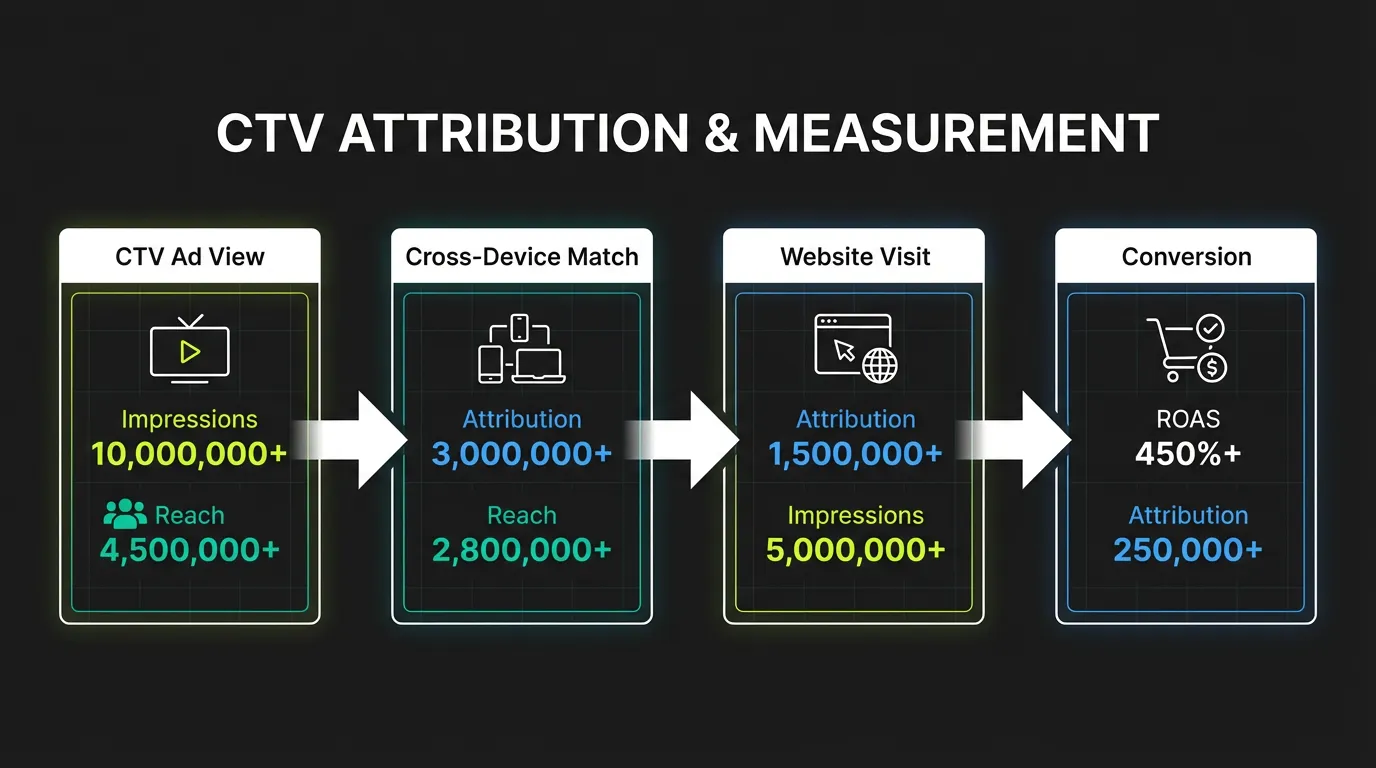
CTV Measurement Challenges
CTV measurement is complex due to:
- Cross-device behavior
- Household vs. individual viewing
- Walled garden data
- Online-to-offline attribution
Key Metrics
Delivery metrics:
- Impressions
- Reach (unique households/viewers)
- Frequency
- Completion rate
Engagement metrics:
- Interactive engagement
- QR code scans
- Website visits
- Search lift
Business outcomes:
- Conversions
- ROAS
- Brand lift
- Sales lift
Attribution Methods
1. Deterministic Attribution
- Device graph matching
- IP address matching
- Login-based tracking
- Most accurate, limited scale
2. Probabilistic Attribution
- Statistical modeling
- Pattern matching
- Better scale, less precision
3. Incrementality Testing
- Geo holdouts
- Matched market tests
- Gold standard for true lift
:::tip Measurement Best Practice "Prioritize robust measurement solutions that provide a holistic view across both linear and CTV. Emphasize accuracy, efficiency, and interoperability." :::
CTV Optimization Tactics
1. Frequency Management
Optimal frequency depends on objective:
| Objective | Recommended Frequency |
|---|---|
| Brand awareness | 3-5x/week |
| Consideration | 5-8x/week |
| Performance | 8-12x/week |
:::warning Frequency Caps Over-frequency annoys viewers and wastes budget. Set caps at household and individual level where possible. :::
2. Daypart Optimization
| Daypart | Viewer Behavior | Strategy |
|---|---|---|
| Morning (6-9am) | News, quick sessions | Awareness |
| Daytime (9am-5pm) | Background viewing | Lower priority |
| Primetime (7-11pm) | Focused viewing | Premium, performance |
| Late night (11pm+) | Individual viewing | Retargeting |
3. Content Alignment
Match your brand to appropriate content:
- Genre targeting (sports, comedy, news)
- Content rating targeting
- Custom content inclusion/exclusion lists
4. AI-Powered Optimization
"AI-powered optimization and targeting is shaping the future of CTV marketing. AI automatically optimizes bids, pacing, and creative delivery in real time."
Let AI optimize:
- Bid prices
- Budget pacing
- Creative rotation
- Audience weighting
5. Cross-Screen Coordination
CTV works best in combination:
- CTV for reach and brand building
- Mobile for retargeting and conversion
- Display for frequency and reinforcement
CTV Performance Benchmarks
Average Performance
| Metric | Benchmark |
|---|---|
| Completion rate (30s) | 95%+ |
| Click-through rate | 0.5-1.5% |
| Conversion rate (exposed) | 45% lift |
| CPM | $20-40 |
| Brand lift | 10-30% |
By Industry
| Industry | Typical CPM | Performance |
|---|---|---|
| Auto | $30-50 | High consideration |
| CPG | $20-35 | Broad reach |
| Retail | $25-40 | Performance focus |
| Financial | $35-55 | Qualified reach |
| Travel | $25-45 | Seasonal |
Common CTV Mistakes
1. Treating CTV Like Linear TV
CTV requires digital optimization mindset—test, measure, iterate.
2. Ignoring Creative
The targeting is only as good as the creative. Invest in quality production.
3. Measurement Paralysis
Perfect attribution doesn't exist. Use directional data and incrementality tests.
4. Over-Relying on One Platform
Diversify across DSPs and publishers for best reach and negotiating leverage.
5. Neglecting Frequency Caps
Without caps, you'll waste budget showing ads to the same households repeatedly.
2026 CTV Trends
1. FAST Channel Growth
Free ad-supported streaming TV (FAST) channels are exploding—lower CPMs, growing audiences.
2. Shoppable CTV Mainstream
Commerce directly on the TV screen becomes standard.
3. Improved Measurement
Cross-screen identity and incrementality measurement mature.
4. AI Creative Optimization
Dynamic creative optimization powered by AI becomes standard.
5. First-Party Data Integration
Advertisers increasingly bring their own data to CTV targeting.
The Bottom Line
CTV advertising in 2026 offers:
- Mass reach — 88% of US households
- Premium engagement — Lean-back, focused viewing
- Digital targeting — Precision on the big screen
- Measurable results — Track to business outcomes
- Growing inventory — More content, more opportunities
:::tip Get Started Start with programmatic via a DSP. Test 30-second creative. Target broadly at first. Measure incrementality. Scale what works. :::
"Over half of marketers worldwide say they'll increase CTV or OTT budgets this year, and 68% of US advertisers now call CTV a 'must-buy.'"
AdBid helps you measure CTV alongside your social and search advertising. See the full picture of your marketing performance. Start measuring.
CTV Ad Creative Best Practices
Video Specifications
Resolution: 1920x1080 (minimum)
Aspect Ratio: 16:9
Frame Rate: 29.97 fps
File Format: MP4, MOV
Audio: Stereo, -24 LUFS
Creative Guidelines
Hook Early:
- Grab attention in first 3 seconds
- Lead with brand or product
Design for the Big Screen:
- Use large, readable text
- High-quality visuals
- Avoid small details
Include Strong CTA:
- Clear next step
- QR codes for mobile action
- Website or phone number
Consider Sound-On:
- CTV is sound-on environment
- Use voiceover effectively
- Music enhances emotion
Ad Length Recommendations
| Length | Use Case | CPM Impact |
|---|---|---|
| :06 | Bumper/reminder | Lower CPM |
| :15 | Quick message | Standard CPM |
| :30 | Full story | Standard CPM |
| :60 | Demo/tutorial | Higher CPM |
CTV Campaign Measurement
Primary Metrics
Video Completion Rate (VCR):
VCR = Completed Views / Impressions x 100
Benchmark: 95%+ for CTV
Cost Per Completed View (CPCV):
CPCV = Total Spend / Completed Views
Reach and Frequency:
- Unique households reached
- Average ad exposures per household
Attribution Methods
1. Website Visit Lift
- Measure website visits after ad exposure
- Compare exposed vs. control groups
2. Conversion Lift
- Track conversions (purchases, sign-ups)
- Match CTV viewers to converters
3. Brand Lift Studies
- Survey-based awareness measurement
- Message recall testing
4. Foot Traffic Attribution
- Match CTV exposure to store visits
- Location-based measurement
Cross-Device Measurement
CTV viewers often take action on other devices:
See CTV Ad -> Search on Mobile -> Purchase on Desktop
Use identity solutions to track:
- IP-based household matching
- Device graphs
- Login-based identification
Why Does Supply Path Decide Your Real CPM?
About 75% of all CTV transactions now happen programmatically (AdExchanger), which means most of your money flows through a chain of intermediaries. Each hop in that chain takes a cut and adds a place for the same impression to be resold. Your headline CPM and your effective CPM can differ sharply.
The Hidden Cost Between You and the Screen
When you buy through an open exchange, an impression can pass through multiple resellers before it reaches the viewer. You pay for that complexity twice: once in fees, once in duplicated bids on the same inventory. The fix is supply-path optimization, choosing the shortest, cleanest route to each publisher.
Practical Supply-Path Choices
| Path | When it fits | Trade-off |
|---|---|---|
| Direct / IO | Tentpole moments, brand-safe must-haves | Manual, less flexible |
| Programmatic guaranteed | Locked CPM on known inventory | Lower agility |
| Curated PMP | Vetted publishers, mid-scale audiences | Smaller pool |
| Open exchange | Maximum scale and discovery | Most fee leakage |
Favor curated deals and programmatic guaranteed for the bulk of premium spend, then use the open exchange for incremental scale. The two earlier playbooks in our connected TV advertising guide cover DSP selection in more depth if you are still choosing platforms.
How Do You Control Frequency Across Fragmented Apps?
The single biggest source of wasted CTV budget is uncontrolled frequency. A household streaming across Roku, Tubi, and a smart-TV app can see your spot far more often than intended, because each platform counts impressions on its own. Without household-level capping, you pay to annoy the same living room.
Cap at the Household, Not the App
Set frequency caps that span platforms, not just within one DSP or publisher. Identity solutions and household graphs let you treat one home as one audience. The goal is steady, useful exposure: enough to register, not so much that viewers tune out and your effective cost per outcome climbs.
Match Frequency to the Objective
Frequency is not one number. Tie it to what you want the campaign to do:
- Awareness: lighter, broad exposure to maximize unique households.
- Consideration: moderate, repeated exposure to build familiarity.
- Performance: tighter, concentrated exposure on in-market audiences.
When the same household appears across many apps, deduplicate before you cap. Otherwise your reported reach inflates and your real frequency hides. This is exactly where a consolidated view across channels earns its keep, which our 2025 CTV advertising guide discusses alongside creative fundamentals.
How Do You Prove CTV Actually Worked?
Streaming captures 43.8% of TV viewing (Nielsen The Gauge), yet measurement remains the hardest part of the channel. TV is a household, lean-back medium, so last-click logic falls apart. Prove value through incrementality and lift, not through clicks alone.
Start With a Holdout, Not a Dashboard
The strongest evidence is a controlled test. Hold back a comparable group of households or geographies, then compare outcomes against exposed groups. If exposed households convert, visit, or search at a higher rate, you have real lift. Dashboards full of completion rates feel reassuring, but completion is table stakes, not proof.
A Practical Measurement Stack
Layer three views rather than betting on one:
- Delivery quality: unique reach, deduplicated frequency, completion.
- Mid-funnel signal: site visits, search lift, QR scans tied to flights.
- Outcome lift: incrementality via holdouts or matched markets.
Give the campaign time. A meaningful read usually needs several weeks of flight before the lift signal stabilizes. Pulling budget after one week tells you almost nothing.
What Should a 2026 CTV Launch Checklist Include?
CTV is a "must-buy" for 68% of US advertisers (EMARKETER), so the bar for execution keeps rising. A repeatable pre-launch checklist prevents the avoidable mistakes that quietly drain budget. Run through these before any flight goes live.
Before You Launch
- Objective and KPI locked. One primary metric, agreed in advance.
- Reach and frequency math done. Budget floor justified by the numbers.
- Supply path chosen. Curated and guaranteed for premium, open for scale.
- Household frequency caps set. Cross-platform, deduplicated.
- Creative built for the big screen. Audio on, hook early, clear end card.
- Measurement plan in place. Holdout or matched market defined now, not later.
After You Launch
- Watch deduplicated frequency weekly, not just impressions served.
- Rebalance the three budget buckets toward what drives lift.
- Protect the holdout. Do not contaminate the control group mid-flight.
Shoppable formats add another execution layer worth planning early, which our shoppable video and CTV commerce guide walks through in detail.