
Video Marketing Strategy Guide 2026
Video has quietly become the backbone of how brands earn attention. In 2026, 93% of marketers say video gives them good ROI (Wyzowl, 2025), the highest level the survey has ever recorded. That single number explains why so many teams are restructuring their content calendars around moving images instead of static posts. But a strong return doesn't happen by accident. It comes from a clear strategy: knowing what to film, where to publish, and how to measure whether any of it actually moved the needle.
Key Takeaways
- 93% of marketers report video delivers good ROI, an all-time high (Wyzowl, 2025).
- 89% of businesses now use video as a marketing tool, making it the default format rather than the exception.
- Match video length to its job: short-form for awareness, mid-form for education, shoppable clips for conversion.
- Measure each video against a stage-specific goal, not vanity views.
Why Does Video Marketing Matter So Much in 2026?
Video marketing matters because audiences expect it and buyers act on it. According to Wyzowl, 89% of businesses use video as a marketing tool and 87% of people say a video has convinced them to buy a product or service (Wyzowl, 2025). That combination, near-universal adoption plus real purchase influence, is rare for any channel.
The deeper shift is behavioral. People scroll, skim, and decide in seconds. A paragraph asks for patience that most feeds no longer grant. A short clip, by contrast, can deliver a hook, a benefit, and a reason to act before someone's thumb keeps moving. So video isn't competing with your blog or your email list. It's the format that earns the first moment of attention everything else depends on.
There's a strategic distinction worth drawing here. Video advertising focuses on paid placements and ad formats, and we cover that separately in our video advertising strategy guide. Video marketing is broader: it's the organic and owned content, the storytelling, and the channel mix that build an audience over time. This guide stays on that marketing side.
What Types of Video Should You Actually Make?
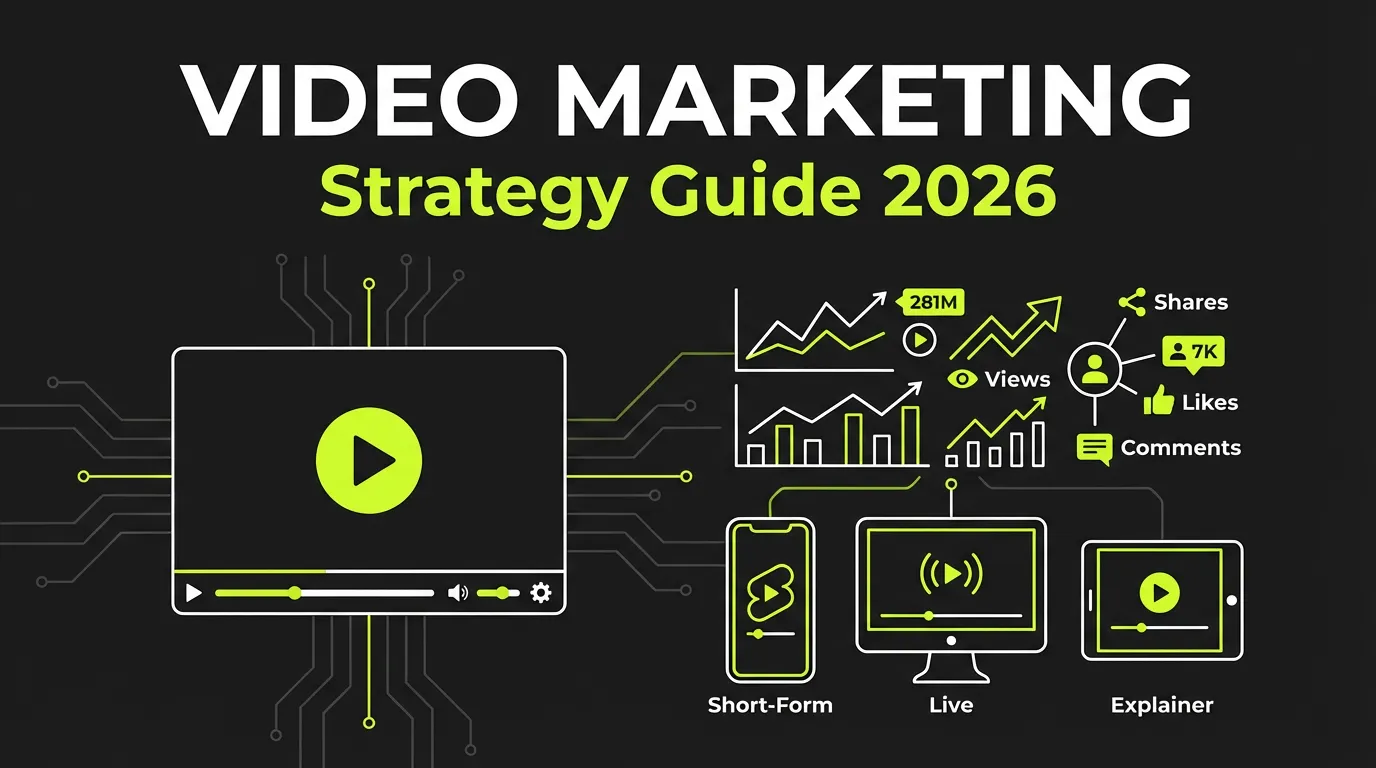
The right video type depends entirely on the job you need it to do. Short-form clips of 15 to 60 seconds drive awareness on TikTok, Reels, and Shorts. Mid-form videos suit education and consideration. Long-form lives on YouTube and webinars. And shoppable video exists for one thing: turning a view into a purchase.
A common mistake is producing a ten-minute explainer when a thirty-second demo would have done the job better. Length should follow purpose, not the other way around.
| Type | Length | Best for | Where it lives |
|---|---|---|---|
| Short-form | 15-60 seconds | Awareness, engagement | TikTok, Reels, Shorts |
| Mid-form | 1-10 minutes | Education, consideration | YouTube, LinkedIn |
| Long-form | 10+ minutes | Deep education | YouTube, webinars |
| Shoppable | 15-60 seconds | Direct conversion | TikTok, Instagram |
Building a Balanced Content Mix
Don't pour every resource into one format. A healthy mix usually means a steady stream of short clips for reach, a smaller cadence of mid-form pieces that answer real buyer questions, and the occasional long-form anchor that establishes authority. Short-form earns the discovery. Mid-form and long-form earn the trust. Together they carry someone from first glimpse to confident decision.
How Do You Win at Short-Form Video?
Short-form wins on hooks and consistency, not production budget. The first three seconds decide whether anyone keeps watching, so the opening has to earn the next nine. Treat each platform as its own room with its own etiquette rather than copying one clip everywhere. A polished Reel and a raw, creator-style TikTok rarely succeed in the same form.
Effective hooks tend to fall into a few reliable patterns. A bold claim stops the scroll. A sharp question creates a small itch the viewer wants scratched. A visual surprise interrupts the pattern. And direct address, speaking to a specific person, makes a stranger feel seen.
Optimize for Each Platform
| Platform | Optimal length | What works |
|---|---|---|
| TikTok | 9-15 seconds | Native feel, creator style |
| Instagram Reels | 15-30 seconds | Polished yet authentic |
| YouTube Shorts | 30-60 seconds | Clear value, fast hook |
| 30-60 seconds | Insight-driven, subtitled |
YouTube deserves special attention because it spans both organic Shorts and a mature ecosystem of placements. If your audience lives there, our YouTube ads strategy guide digs into how organic and paid reinforce each other on the platform.
Lean on Creators and Real Voices
Authenticity outperforms polish on most short-form feeds. People scroll past anything that smells like an ad and stop for content that feels like a recommendation from a friend. That's why user-generated and creator-style content has become a core part of so many video strategies. We break down how to source and brief that content in our UGC advertising guide.
How Does Shoppable Video Shorten the Path to Purchase?
Shoppable video removes the gap between wanting something and buying it. Instead of watching a clip, opening a browser, and hunting for the product, viewers tap a tag and check out inside the experience. With 87% of people saying video has convinced them to buy (Wyzowl, 2025), collapsing that intent into a single tap is a natural next step.
The mechanics differ by platform, but the principle holds everywhere: less friction means more conversions.
| Platform | Feature | What it enables |
|---|---|---|
| TikTok Shop | In-video product tags | Native checkout |
| Shopping tags | Linked product pages | |
| YouTube | Product tags | External checkout |
The creative still has to do its work first. A shoppable tag won't rescue a clip that fails to make someone want the product. So treat the shop integration as the final step of a video that already sells, not as a substitute for a compelling story.
How Should You Measure Video Marketing ROI?
Measure each video against the goal it was built to serve, not a single universal metric. A brand-awareness clip and a conversion clip succeed in completely different ways, and judging both by views alone hides what's really happening. Map your metrics to the buyer's stage so the numbers tell an honest story.
| Stage | Primary metrics | Secondary metrics |
|---|---|---|
| Awareness | Views, reach | Brand lift |
| Engagement | Watch time, completion rate | Likes, shares |
| Consideration | Clicks, site visits | Time on site |
| Conversion | Purchases, signups | Attributed revenue |
Watch time and completion rate deserve more weight than most teams give them. A video that holds attention to the end tells the algorithm it's worth distributing and tells you the message landed. Pair those engagement signals with downstream conversion data and you can see which creative ideas actually drive revenue, not just applause.
This is also where a consistent creative framework pays off. When every video is tied to a clear hypothesis, measurement becomes a feedback loop rather than a report card. Our creative strategy framework walks through how to structure those tests so each round of video teaches you something.
Frequently Asked Questions
How is video marketing different from video advertising?
Video marketing covers the whole organic and owned strategy: the content you publish, the audience you build, and the stories you tell over time. Video advertising is the paid subset, focused on ad formats and placements. With 89% of businesses using video as a marketing tool (Wyzowl, 2025), most brands need both working together.
Do I need expensive equipment to start with video?
No. Short-form especially rewards authenticity over production value, and audiences often respond better to a clip shot on a phone than a glossy studio piece. Strong hooks, clear value, and consistent posting matter far more than gear. Start with what you have, study what performs, and reinvest in production only where the data justifies it.
How long should my marketing videos be?
Length should follow purpose. Use 15 to 60 seconds for awareness on TikTok, Reels, and Shorts, one to ten minutes for education on YouTube or LinkedIn, and longer formats only for deep tutorials or webinars. A thirty-second demo often beats a ten-minute explainer when the goal is simply to spark interest and earn the next click.
Which metrics prove video is working?
It depends on the goal. For awareness, track views, reach, and brand lift. For engagement, watch time and completion rate reveal whether the message held attention. For conversion, follow purchases, signups, and attributed revenue. Judging an awareness clip by sales, or a conversion clip by views, leads teams to the wrong conclusions.
The Bottom Line
Winning with video in 2026 comes down to a handful of disciplines. Prioritize short-form for reach, but build a mix that also educates and converts. Make content native to each platform instead of resizing one clip everywhere. Obsess over the first three seconds, because the hook decides everything that follows. And measure each video against the job it was hired to do, so your strategy improves with every upload.
The brands that treat video as an ongoing conversation rather than a one-off production are the ones compounding results month over month. If you want help turning briefs into campaign-ready video concepts and tracking what performs, explore AdBid's AI agents ads manager and put a faster creative loop to work.