
Key Takeaways
- 88% of app marketers now use AI daily — it's not optional anymore
- Channel diversification is critical as Meta and Google become saturated
- iOS dominates revenue (89.6%) while Android leads install volume
- Privacy-first strategies (first-party data, SKAN) are competitive advantages
- Web funnels bypass app store fees and provide better attribution
The State of Mobile App Marketing in 2026
:::highlight Industry Outlook 80% of app marketers are optimistic about 2026. If 2024 was the year of experimentation, 2025 was scaling, and 2026 is about sustainable, profitable growth. :::
Mobile ad spend in the U.S. is projected to reach $228 billion in 2026, making up over 66% of total digital ad spending. The market is massive — and massively competitive.
For teams optimizing spend around payback quality, AdBid's predictive LTV helps connect acquisition decisions to customer value.
I've seen the landscape shift dramatically. The old playbook of "throw money at Facebook and hope for installs" doesn't work anymore. Here's what does.
The New User Acquisition Landscape
Platform Saturation Reality
Traditional platforms are crowded and expensive:
- Meta CPIs have increased 35% YoY for most categories
- Google UAC faces similar inflation
- Competition for top placements is fierce
:::info The Diversification Imperative The brands winning in 2026 aren't relying on one or two channels. They're running profitable campaigns across 5-7 platforms simultaneously. :::
Channel Diversification Strategy
Tier 1: Core Channels (60% of budget)
- Meta (Facebook, Instagram)
- Google (UAC, YouTube)
- Apple Search Ads
Tier 2: Growth Channels (25% of budget)
- TikTok
- Programmatic (AppLovin, Unity, ironSource)
- CTV (Connected TV)
Tier 3: Experimental (15% of budget)
- Influencer marketing
- Reddit, Twitter/X
- Emerging platforms
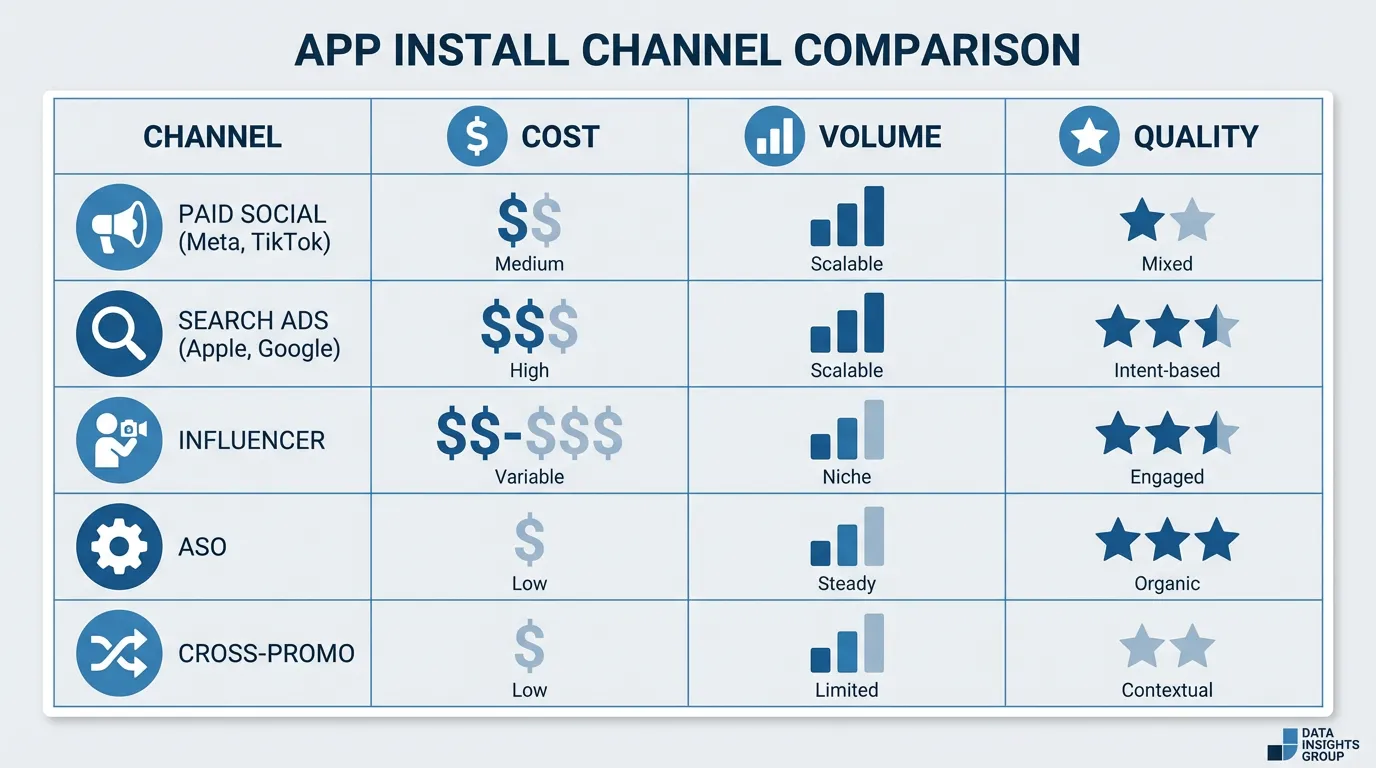
"Traditional platforms like Meta and Google are becoming more saturated and expensive, pushing businesses to explore alternatives."
Platform-Specific Performance
Android vs. iOS Economics:
| Metric | Android | iOS |
|---|---|---|
| Install Volume | Higher (60%+) | Lower (40%-) |
| Revenue Share | 10.4% | 89.6% |
| Attribution Accuracy | Good | Limited (SKAN) |
| User Quality | Variable | Generally higher |
This split means different strategies for each platform:
- Android: Volume-focused, optimize for install cost
- iOS: Value-focused, optimize for ROAS and retention
AI and Automation in App Marketing
How AI Changed Everything
:::warning The New Baseline 88% of app marketers now use AI daily, with 69% integrating it into core operations. If you're not using AI, you're operating with a handicap. :::
AI Applications in App UA:
1. Creative Optimization
- Automated creative testing at scale
- Predictive performance scoring
- Dynamic creative assembly
2. Bid Management
- Real-time bid adjustments
- Cross-platform budget allocation
- Predictive LTV bidding
3. Audience Finding
- Lookalike expansion
- Behavioral prediction
- Intent modeling
4. Campaign Automation
- Rule-based optimization
- Anomaly detection
- Performance alerting
The Human-AI Balance
AI handles:
- Pattern recognition across millions of data points
- Real-time bid adjustments
- Creative variation testing
- Performance monitoring 24/7
Humans handle:
- Strategy and positioning
- Creative concept development
- Brand safety decisions
- Market context interpretation
Privacy-First Strategies
The Post-ATT Reality
Apple's App Tracking Transparency has fundamentally changed iOS marketing:
- Opt-in rates hover around 25-35%
- User-level attribution is limited
- SKAN provides aggregated data only
:::tip Thriving in Privacy-First World The preparation many companies undertook has turned into a competitive advantage. Organizations that invested in first-party data are winning. :::
Building First-Party Data Assets
Collection Points:
- In-app registration
- Email capture
- Loyalty programs
- Direct customer relationships
Activation:
- Custom audiences on ad platforms
- Lookalike modeling
- Personalization
- Re-engagement campaigns
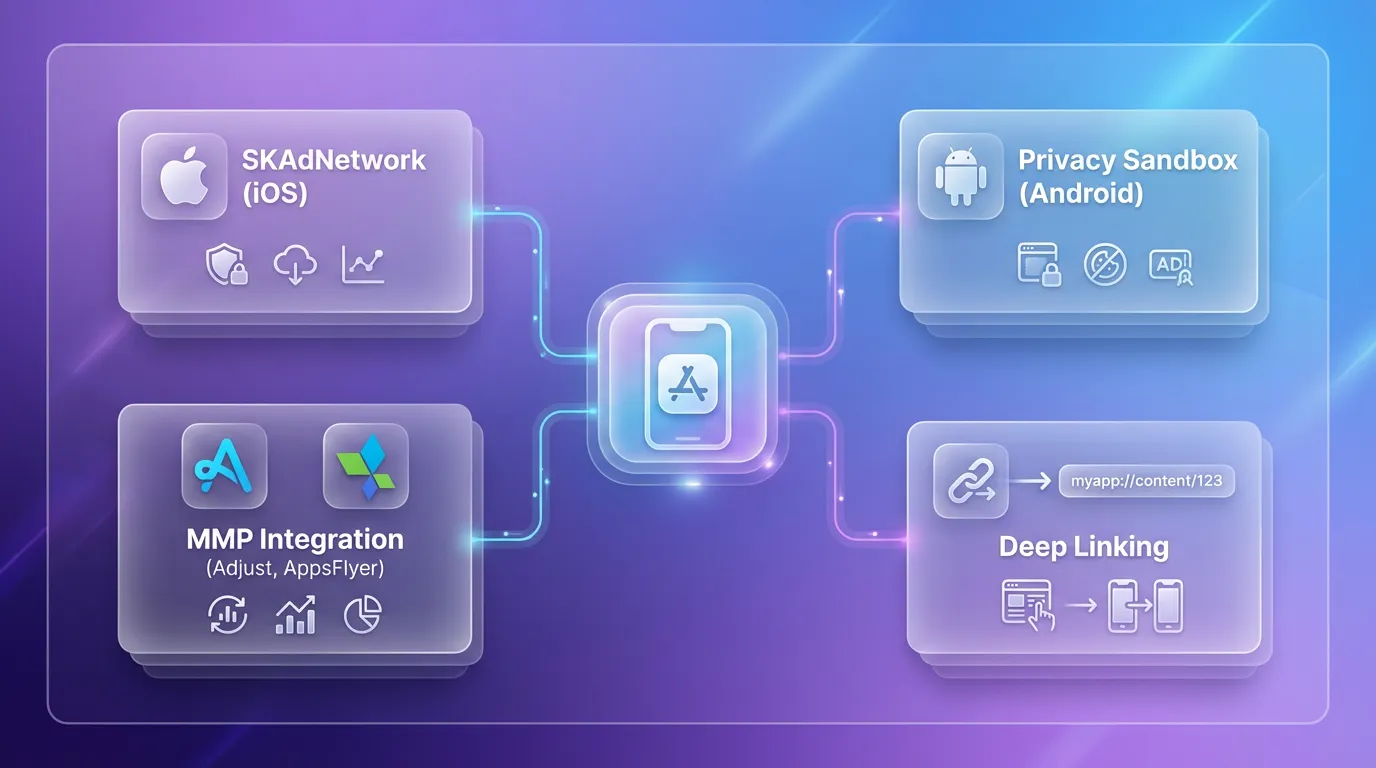
SKAN Optimization
For iOS campaigns, SKAN mastery is essential:
- Optimize conversion value schemas
- Build predictive models from limited data
- Use incrementality testing for validation
- Combine with MMM (Media Mix Modeling)
Web Funnels: The Cost-Efficient Alternative
Why Web Funnels Work
:::highlight Web Funnel Advantage Web funnels are gaining traction as cost-efficient options, offering enhanced user-level attribution and bypassing app store fees. :::
Benefits:
- Avoid 15-30% app store commission
- Better attribution (no ATT restrictions)
- Faster iteration (no app review)
- Multiple payment options
Structure:
- Ad clicks to landing page (web)
- Registration/payment on web
- Deep link to app for usage
- Subscription managed on web
Implementation Considerations
- Ensure seamless web-to-app transition
- Build compelling web experience (not just a redirect)
- Test different funnel lengths
- Optimize for web conversion, not just app install
Creative Strategy for 2026
The Creative-First Mindset
:::warning Platform Reality Today it's less about hyper-targeting and more about nailing creative and product-market fit. Creative is the new targeting. :::
What Works:
- Authentic, native-looking content
- Short-form video (under 30 seconds)
- User-generated style
- Clear value proposition in first 3 seconds
What Doesn't:
- Overly polished ads
- Generic stock content
- Long-form videos without early hooks
- Feature lists without benefits
Creative Testing Framework
Weekly Cadence:
- Monday: Review last week's performance
- Tuesday: Brief new concepts
- Wednesday: Creative production
- Thursday: Launch new tests
- Friday: Early performance analysis
Testing Variables:
- Hooks (first 3 seconds)
- Value propositions
- Visual styles
- CTAs
- Length variations
Platform-Specific Creative
Meta: Works across formats, 15-30 second videos perform best
TikTok: Native, authentic, trend-aware, under 15 seconds ideal
Google UAC: Let machine learning test, provide diverse assets
CTV: Longer format OK, focus on storytelling
Measurement in 2026
Moving Beyond Last-Click
Last-click attribution is increasingly unreliable. Modern measurement combines:
1. Platform Attribution (Directional)
- Good for optimization within platform
- Limited cross-platform view
- Affected by privacy changes
2. Mobile Measurement Partners (MMP)
- AppsFlyer, Adjust, Branch, Singular
- Cross-platform view
- SKAN support
- Fraud protection
3. Incrementality Testing
- Gold standard for true impact
- Requires holdout groups
- More resource-intensive
- Validates other methods
4. Media Mix Modeling (MMM)
- Macro-level effectiveness
- Privacy-safe
- Requires significant data
- Best for budget allocation
Key Metrics to Track
Acquisition Metrics:
- CPI (Cost per Install) — by platform, by campaign
- CPR (Cost per Registration) — more meaningful than install
- CAC (Customer Acquisition Cost) — including all costs
Quality Metrics:
- Day 1, 7, 30 retention
- ROAS at Day 7, 30, 90
- Payback period
Efficiency Metrics:
- LTV:CAC ratio (target 3:1+)
- Cohort profitability
- Channel contribution margin
App Store Optimization (ASO)
ASO in 2026
:::info ASO Evolution Personalized search results are redefining ASO. Search customization leverages user preferences, location, and past behaviors. Hyper-targeted keyword strategies are essential. :::
Core ASO Elements:
- App name and subtitle
- Keyword field (iOS)
- Description optimization
- Screenshot and video preview
- Ratings and reviews management
- Update frequency
The Paid + Organic Loop:
- Paid drives initial visibility
- App usage improves organic ranking
- Better organic reduces paid dependency
- Cycle repeats at larger scale
The Monetization Side
Beyond User Acquisition
UA success means nothing without monetization:
Subscription Optimization:
- Trial length testing
- Pricing experiments
- Winback campaigns
- Churn prediction
In-App Purchase Strategy:
- First-purchase optimization
- Bundle testing
- Seasonal offers
- Whale identification
Micro-Subscriptions:
:::tip Emerging Trend Micro-subscriptions are growing — offering short-term, flexible access at lower price points. This responds to subscription fatigue and demand for affordability. :::
Building Your 2026 Strategy
Audit Your Current State
- Channel concentration risk?
- iOS vs. Android performance gap?
- First-party data assets?
- Creative testing velocity?
- Attribution confidence?
Prioritize Improvements
High Impact, Lower Effort:
- Increase creative testing volume
- Implement basic automation rules
- Start first-party data collection
High Impact, Higher Effort:
- Channel diversification
- Web funnel implementation
- Incrementality testing program
Maintain:
- Core channel optimization
- ASO maintenance
- Basic measurement
The Bottom Line
Mobile app marketing in 2026 rewards advertisers who:
- Diversify beyond Meta and Google
- Use AI for optimization, humans for strategy
- Build first-party data moats
- Test creative continuously
- Measure incrementality, not just attribution
The days of easy growth are over. But for marketers who adapt, the opportunity is enormous.
:::tip Start Here Audit your channel concentration. If more than 70% of your budget is on one platform, start testing alternatives this week. Begin with TikTok or Apple Search Ads — both have strong app install performance. :::
Need help scaling your app across multiple channels? AdBid provides unified campaign management and analytics across Meta, Google, TikTok, and more. Start your free trial.