
Growth Marketing: The Complete Operating Guide for 2026
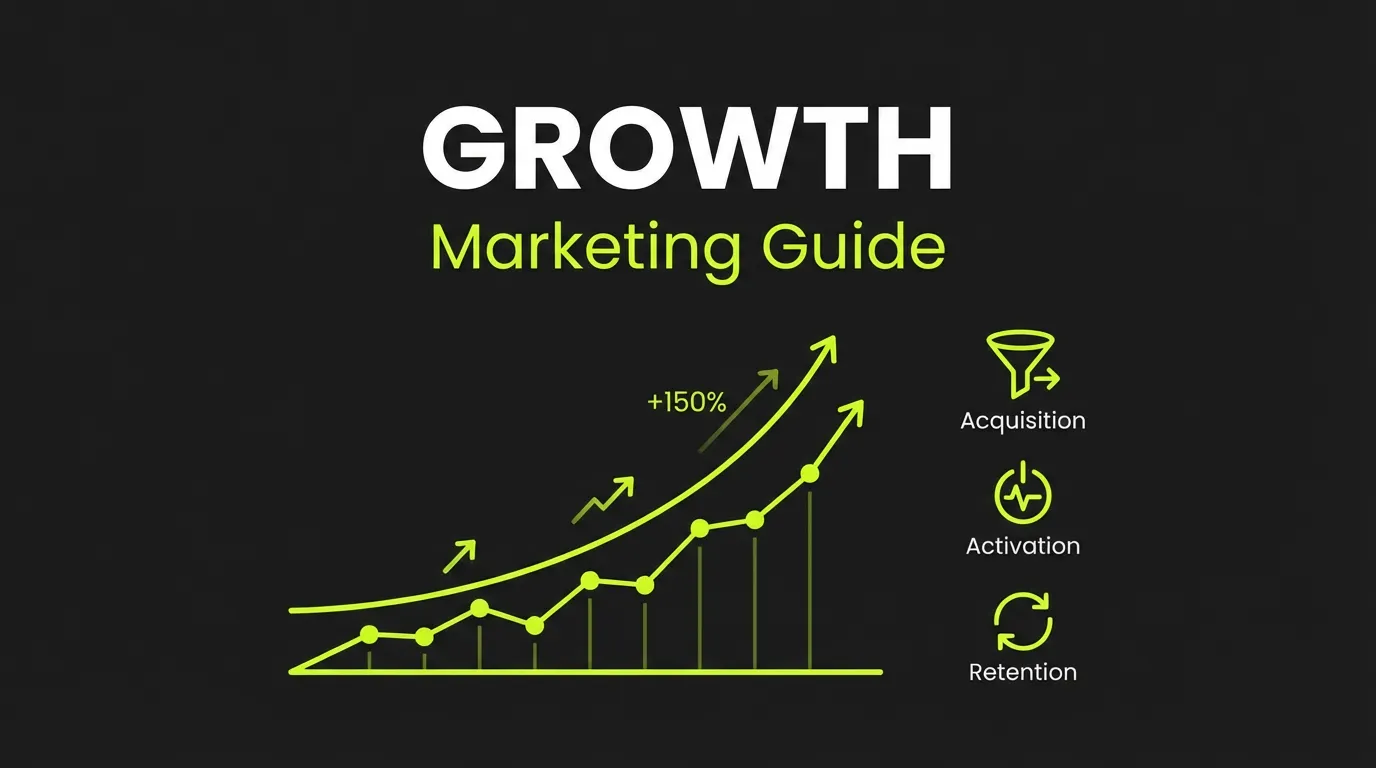
Growth marketing is the discipline of running structured experiments across the full customer lifecycle to find repeatable, compounding ways to grow revenue. This complete guide focuses on the operating system behind growth: how to build a metric model, run an experiment engine, and structure a team that ships learnings every week.
Most teams already know the buzzwords. What separates a growth function that compounds from one that stalls is operational discipline: a shared metric model, a prioritized backlog, and a cadence that turns tests into decisions. That is the gap this guide closes.
Key Takeaways
- Growth marketing is a system, not a tactic: it links a North Star metric to inputs you can actually move.
- A growth model turns vague goals into math, so every team knows which lever matters most this quarter.
- Test velocity beats clever ideas. More structured experiments mean more compounding wins over time.
- Dropbox's two-sided referral program drove roughly 4,000% growth in 15 months (Referral Rock).
- Cross-functional ownership across marketing, product, and data is what makes growth durable.
For teams that want to apply these ideas to paid channels first, AdBid's AI ads manager plans, launches, and optimizes campaigns from a single dashboard.
What Makes Growth Marketing Different?
Growth marketing differs from traditional marketing by owning outcomes across the entire funnel, not just the top. Where a classic campaign optimizes for impressions or leads, a growth team optimizes for activated, retained, and paying customers. The mindset shift is simple: measure the dollar that comes back, not the click that goes out.
This guide treats growth as an operating system rather than a list of channels. The earlier AARRR-focused approach in our growth marketing guide for 2026 maps the funnel stages well. Here, the focus is mechanics: how you wire metrics, experiments, and teams together so the funnel actually moves.
| Dimension | Campaign marketing | Growth marketing |
|---|---|---|
| Unit of work | A campaign | An experiment |
| Time horizon | Quarterly | Weekly sprints |
| Owns | Acquisition | The full lifecycle |
| Wins on | Reach | Revenue and retention |
How Do You Build a Growth Model?
A growth model is a quantitative map of how your business actually grows, breaking output revenue into the inputs you can influence. It converts a fuzzy target like "grow faster" into an equation, which makes prioritization objective. Without a model, teams argue about opinions. With one, they argue about numbers.
Start with your North Star metric, the single number that best captures delivered value. Then decompose it.
Decompose The Equation
Write growth as a chain of multiplied rates. For a subscription product, that might look like:
Visitors × Signup rate × Activation rate × Conversion rate × Retention = Active revenue
Each multiplier is a lever. Improving any single rate lifts the whole equation, and the model shows you which rate has the most headroom right now.
Find The Constraint
Not every lever deserves attention this quarter. Look for the stage with the steepest drop-off, because fixing the weakest link returns more than polishing a strong one. Pouring traffic into a product that fails to activate users just fills a leaky bucket faster. For a deeper channel-economics view, see our performance marketing guide for 2026.
How Do You Run A Growth Experiment Engine?
A growth experiment engine is a repeatable weekly cycle that moves ideas from hypothesis to validated learning. The output is not just wins; it is a documented library of what works and what does not. Teams that test more, learn more, and the learnings compound across quarters.
The engine has four moving parts: a backlog, a prioritization rule, a launch cadence, and a documentation habit. Skip any one and velocity collapses.
Prioritize With ICE
Score every idea on three axes from one to ten:
- Impact: how much it could move the target metric.
- Confidence: how sure you are it will work.
- Ease: how quickly you can ship it.
The ICE score keeps loud opinions from jumping the queue. Quick copy, targeting, and design tests usually score high on ease, so they fill gaps between bigger engineering bets.
Run A Weekly Cadence
| Day | Activity |
|---|---|
| Monday | Review last week's results, update the model |
| Tuesday | Generate and score new hypotheses |
| Wednesday | Design the week's experiments |
| Thursday | Launch tests across channels |
| Friday | Read early signals, document learnings |
Consistency matters more than perfection here. A team running three honest tests a week will out-learn one chasing a single "perfect" experiment a month.
Document Every Result
Record the hypothesis, the design, the result, and the takeaway, even for losers. Losing tests are not wasted; they narrow the search space. A documented archive becomes one of the most valuable assets a growth team owns, because it stops you re-running questions you already answered.
Which Channels Should Growth Teams Prioritize?
Growth teams should diversify channels so no single source dominates acquisition, reducing risk if one platform shifts. A healthy mix usually keeps each major channel below roughly 40% of total growth, so an algorithm change or rising cost does not threaten the whole business. Channel concentration is one of the quietest risks in marketing.
Group channels by how you earn them, then match each to the funnel stage it serves best.
Paid Channels
Paid search and paid social give you speed and control, ideal for high-intent acquisition and retargeting. The discipline here is unit economics: prove that one channel returns more than it costs before scaling spend. To turn demand into qualified pipeline, pair these with the tactics in our demand generation and lead generation guide for 2026.
Owned And Earned Channels
Owned channels like email, your product, and your website compound over time and cost little per use. Earned channels, SEO and word of mouth, build the slowest but defend hardest against rising ad costs. A balanced portfolio uses paid to buy speed and owned plus earned to buy durability.
Watch Marginal Returns
Every channel hits diminishing returns. Track the return on the next dollar spent, not the average across all dollars. The first block of budget in a channel may return strongly while the next block returns far less, which signals when to layer in a new channel rather than push harder on a saturated one.
How Should A Growth Team Be Structured?
A growth team should be cross-functional, combining marketing, product, engineering, and data under shared metric ownership. The structure matters because growth lives in the gaps between departments, and a siloed marketing team cannot fix an activation problem buried in the product. Shared metrics keep everyone pulling the same direction.
Structure scales with company stage rather than following a fixed template.
Scale With Stage
- Early stage: a founder and one generalist marketer own everything.
- Growth stage: a growth lead directs specialists in performance, content, and product marketing.
- Scale stage: dedicated pods own acquisition, activation, retention, and analytics.
The constant across all stages is a clear North Star and a weekly operating rhythm. Headcount changes; the cadence does not. For broader strategic context across stages, our growth marketing strategy guide for 2025 lays out the planning foundations this operating model sits on.
How Do You Measure Growth Marketing ROI?
You measure growth marketing ROI by tracking value across the lifecycle, not just cost per acquisition. The clearest summary metric is the ratio of customer lifetime value to acquisition cost, because it tells you whether each new customer eventually pays for itself and then some. Acquisition cost alone hides whether growth is profitable.
Layer in retention-based metrics to see whether growth is compounding or leaking.
Track Retention And Expansion
Net revenue retention shows whether existing customers grow in value over time. When expansion revenue outpaces churn, the business grows even without new acquisition, which is the strongest signal of a healthy growth engine. Cohort analysis reveals whether each new group of users retains better than the last, proving your improvements actually work.
Connect Tests To The Model
Every experiment should map back to a lever in your growth model. If a winning test does not move a modeled input, you cannot trust that it moved the business. Tying results to the model is what separates measurable growth from a pile of disconnected tactics.
Frequently Asked Questions
What is the difference between growth marketing and growth hacking?
Growth hacking emphasizes quick, often one-off tricks to spark short-term spikes. Growth marketing is the broader, durable discipline: a metric model, a structured experiment engine, and cross-functional ownership across the full lifecycle. Hacks can feed the experiment backlog, but systems are what compound returns over quarters and years.
What is a North Star metric and why does it matter?
A North Star metric is the single number that best captures the core value your product delivers, such as nights booked or weekly active users. It matters because it aligns every team on one outcome and anchors your growth model. Without it, departments optimize conflicting local metrics and the funnel pulls apart.
How many experiments should a growth team run?
There is no universal number, but velocity beats volume of ideas. Slower teams might run a couple of tests monthly, while high-velocity teams ship several each week using quick copy, design, and targeting tests. More structured tests mean more validated learnings, and learnings are what compound into durable growth.
Does growth marketing replace paid advertising?
No. Paid advertising is one channel inside a growth system, valued for speed and control over acquisition. Growth marketing adds the surrounding discipline: modeling which lever to pull, testing systematically, and measuring lifetime value against cost. The best teams use paid channels to buy speed and owned plus earned channels to buy durability.
Conclusion
Growth marketing in 2026 rewards operators, not just idea generators. The teams that win build a growth model that turns goals into math, run a weekly experiment engine that documents every result, and organize cross-functional ownership around a single North Star. Channels and tactics will keep shifting, but that operating system endures.
Start small. Build your model, find the constraint slowing your funnel, and ship three honest tests next week. Over a few quarters, those compounding wins become a growth engine competitors struggle to copy.
Ready to apply this system to your paid channels? Track and optimize your full-funnel performance in AdBid →