
Part of our Meta Ads Platform guide series.
Key Takeaways
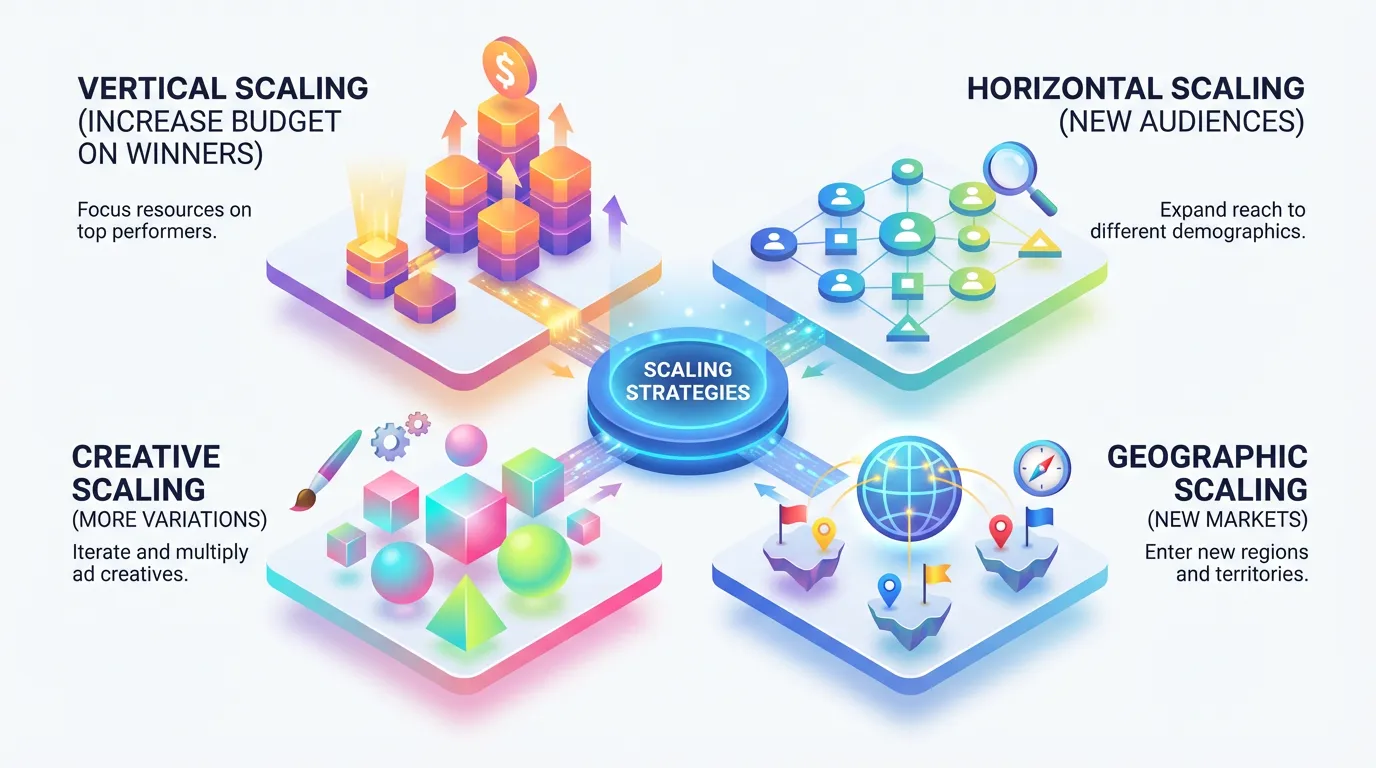
- Vertical scaling = increasing budget on winning ad sets (slow and steady)
- Horizontal scaling = expanding to new audiences and duplicating ad sets (fast but risky)
- Never mix both approaches simultaneously — you won't know what's working
- Wait for 50+ conversions and exit learning phase before scaling
- Increase budgets by 10-20% every 24-48 hours to preserve performance
The Scaling Dilemma
You've found a winning campaign. ROAS is healthy, conversions are consistent, your boss is finally happy. Now what?
AdBid was built for exactly this workflow: take a look inside to plan, launch, and measure campaigns end to end.
:::warning The #1 Scaling Mistake Doubling your budget overnight because things are working. This almost always tanks performance by 30-50% as the algorithm scrambles to recalibrate. :::
Scaling Facebook ads isn't about throwing more money at what works. It's about expanding reach while preserving the efficiency that made the campaign successful in the first place.
"Scaling requires patience. The same qualities that made you successful — testing, iterating, analyzing — are the qualities that will help you scale."
Vertical vs Horizontal Scaling
Understanding these two approaches is fundamental. They serve different purposes and work best in different scenarios.
Vertical Scaling: The Slow Burn
Vertical scaling means increasing budget on your existing winning ad sets. You're not touching targeting, creative, or structure — just giving Meta more money to work with.
Best for:
- Proven winners with consistent 7+ day performance
- Risk-averse advertisers who value stability
- Accounts with clear, profitable audiences
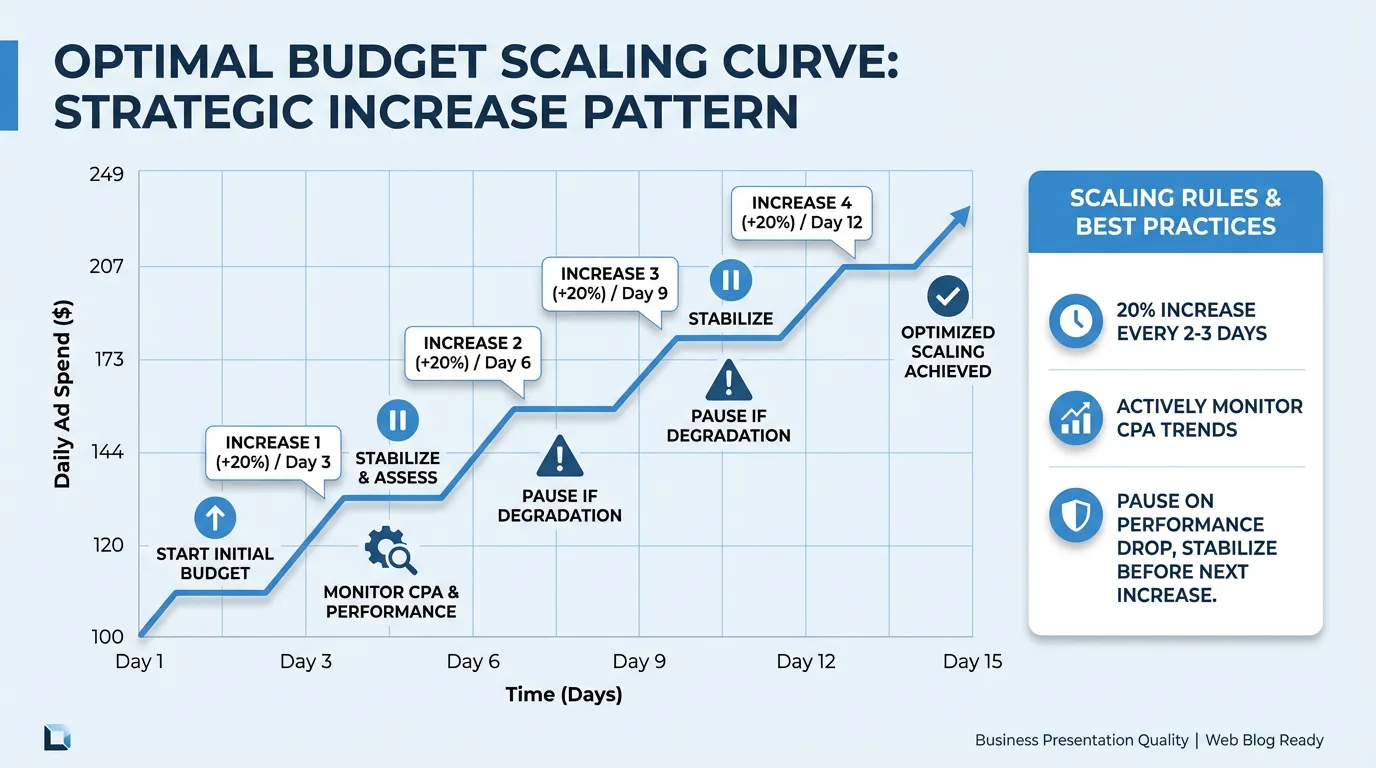
:::tip The 20% Rule Raise your budget by 10-20% every 24-48 hours. This gradual increase lets Meta's algorithm adjust without resetting the learning phase. Going above 20% triggers a partial re-learning period. :::
Vertical Scaling Protocol:
- Confirm ad set has 50+ conversions and exited learning
- Verify 7+ days of consistent performance
- Increase budget by 15-20%
- Wait 48-72 hours before next increase
- Monitor CPA/ROAS daily — pause increases if efficiency drops 20%+
Horizontal Scaling: The Fast Expansion
Horizontal scaling means expanding reach by duplicating ad sets, testing new audiences, and creating campaign variations. It's faster but requires more management.
Best for:
- Aggressive growth goals
- Audiences that are saturating quickly
- Testing multiple hypotheses simultaneously
:::danger Audience Overlap Warning When you duplicate ad sets, audience overlap creates internal competition. Your ads bid against themselves, driving up costs. Always exclude audiences from each other or use different targeting angles. :::
Horizontal Scaling Protocol:
- Duplicate winning ad set
- Change ONE variable: audience, placement, or objective
- Start with original budget (don't scale duplicate immediately)
- Let run 7 days before comparing performance
- Kill losers fast, scale winners gradually
The 4 Proven Scaling Methods
Method 1: Lookalike Ladder
Start with 1% lookalike of purchasers. Once saturated, expand to 3%, then 5%, then 10%.
| Lookalike % | Audience Size | Expected CPA | Best For |
|---|---|---|---|
| 1% | Small, precise | Lowest | Initial scaling |
| 3% | Medium reach | +15-25% | Growth phase |
| 5% | Broad reach | +30-40% | Volume focus |
| 10% | Mass reach | +50%+ | Awareness/retargeting |
Each step trades precision for volume. Monitor closely as you expand.
Method 2: Interest Stacking
Instead of one broad interest, combine related interests to create more qualified audiences.
Before: "Fitness" (50M people) After: "Fitness" + "Gym Membership" + "Protein Supplements" (8M people, much more qualified)
Method 3: Geo Expansion
Your US campaign working? Test Canada, UK, Australia. Similar markets, fresh audiences, often lower CPMs.
:::info International Scaling English-speaking markets (US, UK, CA, AU, NZ) usually share creative and messaging. When expanding to non-English markets, localization becomes critical — translated ads outperform English ads by 40-60% in local markets. :::
Method 4: Campaign Budget Optimization (CBO)
Let Meta distribute budget across ad sets automatically. This works best when:
- All ad sets target similar-sized audiences
- You have 5+ ad sets in the campaign
- You're comfortable with Meta's allocation decisions
When NOT to Scale
Scaling at the wrong time destroys campaigns. Don't scale when:
- Ad set is still in learning phase (< 50 conversions)
- Performance has been inconsistent for 7+ days
- Creative fatigue is showing (declining CTR, increasing frequency)
- You haven't identified WHY the campaign is working
"Before scaling, ask: Do I understand what's driving this success? If you can't articulate why it's working, you can't protect it when you scale."
The 5-7 Day Rule
:::highlight Critical Rule Wait at least 5-7 days to gather sufficient performance data before making scaling decisions. Quick decisions based on 24-48 hour data lead to false positives. :::
Weekend performance differs from weekdays. Beginning of month differs from end of month. You need a full week minimum to understand true performance.
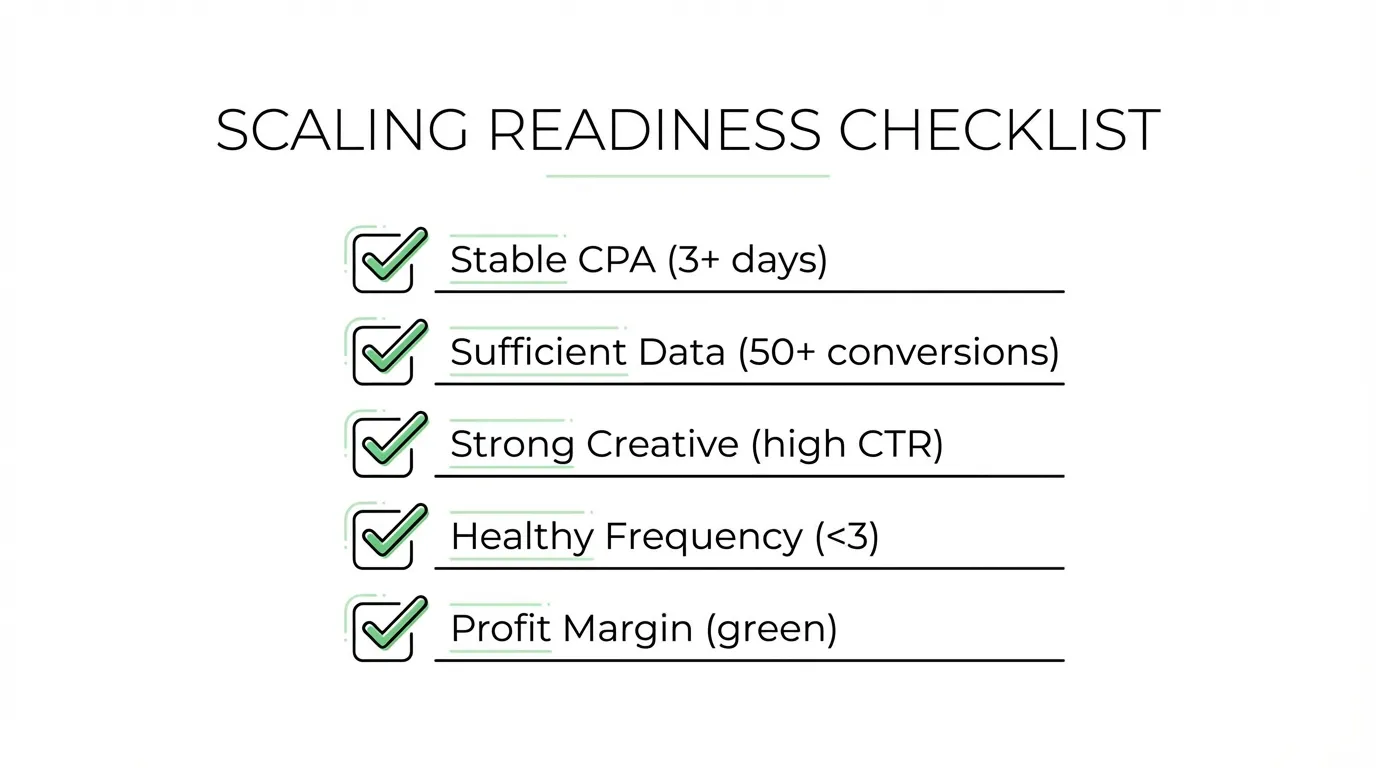
Scaling Checklist
Before you increase any budget, confirm:
- 50+ conversions per ad set
- Exited learning phase
- 7+ days of consistent performance
- ROAS above profitability threshold
- CTR hasn't declined more than 15% in past week
- Frequency below 3 (ideally below 2)
- No major creative or audience changes planned
Troubleshooting Scaled Campaigns
Problem: CPA Spiked After Budget Increase
Cause: Budget increase too aggressive, triggered learning reset Fix: Roll back to previous budget, wait 5 days, try smaller increase
Problem: Performance Declining at Scale
Cause: Audience saturation or creative fatigue Fix: Horizontal scale to new audiences, refresh creative
Problem: Inconsistent Day-to-Day Results
Cause: Insufficient conversion volume for stable optimization Fix: Increase budget more gradually, or consolidate ad sets to increase conversion density
The Math of Scaling
Let's say your winning ad set:
- $100/day budget
- $25 CPA
- 4 conversions/day
To scale to $500/day while maintaining $25 CPA:
:::tip Scaling Timeline
- Week 1: $100 → $120 → $145
- Week 2: $145 → $175 → $210
- Week 3: $210 → $250 → $300
- Week 4: $300 → $360 → $430 → $500
Total time: ~4 weeks. Rushing this to 2 weeks typically results in $40+ CPA instead of $25. :::
Advanced: Combining Both Methods
Once you've mastered each approach individually, you can combine them:
- Vertically scale your best performer
- Horizontally scale by testing new audiences with duplicate
- Vertically scale the best horizontal duplicate
- Repeat
Critical: Never do both simultaneously on the same ad set. You won't know what's working.
The Bottom Line
Scaling isn't a hack. It's patient, methodical expansion that preserves what made your campaign successful.
The advertisers who scale successfully in 2026 are the ones who:
- Wait for statistical significance before scaling
- Increase budgets gradually, not dramatically
- Expand audiences systematically, not randomly
- Kill underperformers fast, scale winners slow
- Monitor daily but decide weekly
:::info Start With This Take your best-performing ad set. If it's been stable for 7+ days, increase budget by 15%. Wait 3 days. If performance holds, increase another 15%. This simple protocol will scale more sustainably than any "scaling hack." :::
Want to track scaling performance across all your campaigns? AdBid's analytics dashboard shows you exactly when campaigns are ready to scale and when they're starting to fatigue. Try it free.