
Key Takeaways
:::highlight The Contextual Renaissance The contextual advertising market reached $233.89 billion in 2025, growing 13.8% annually. In a privacy-first world, context is the new cookie. Ads placed in relevant content see 50% higher click rates than non-contextual placements. :::
- No user data required — Target based on page content, not user profiles
- Privacy-compliant by design — Works without cookies, consent, or tracking
- Brand safety built-in — Control exactly where your ads appear
- Performance matches behavioral — Modern contextual rivals cookie-based targeting
- Future-proof strategy — Works regardless of privacy regulation changes
Bringing this in-house? AdBid's ads manager consolidates planning, launch, and optimization into a single flow.
What Is Contextual Advertising?
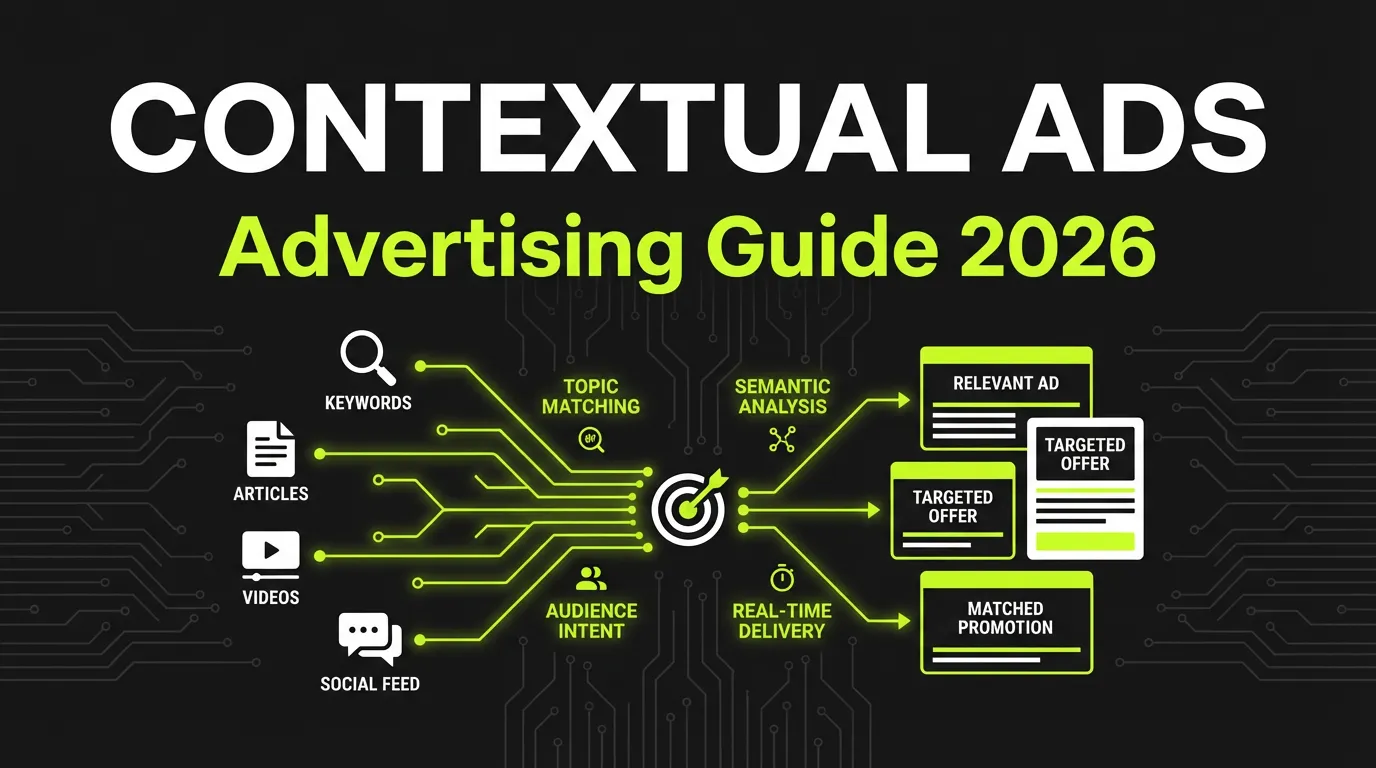
Contextual advertising matches ads to the content of the page where they appear, rather than the user viewing the page.
:::info How It Works Traditional (Behavioral): Track user → Build profile → Show ads based on profile
Contextual: Analyze page content → Match relevant ads → Show ads based on context
No user data collected, stored, or required. :::
Contextual vs Behavioral Targeting
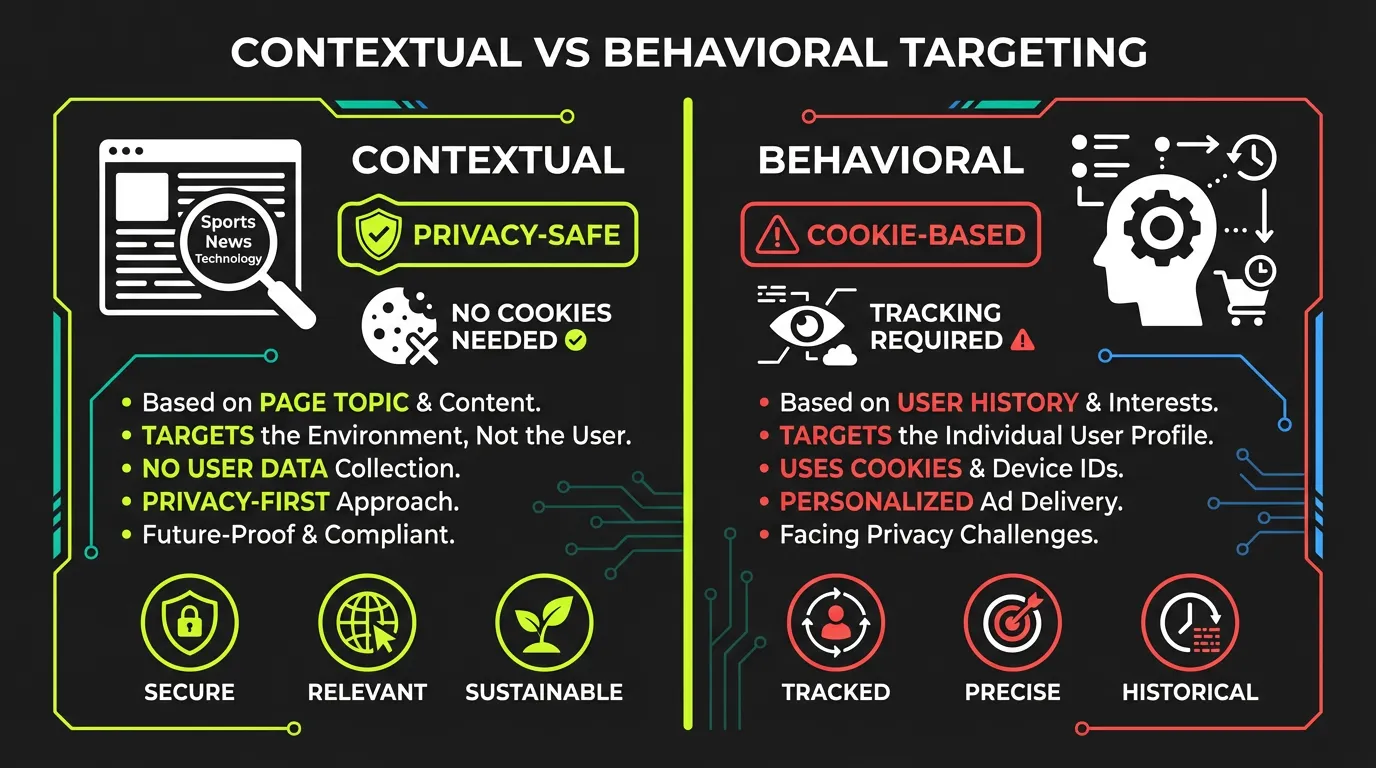
| Aspect | Contextual | Behavioral |
|---|---|---|
| Data source | Page content | User history |
| Privacy | No consent needed | Requires consent |
| Cookie dependency | None | High |
| Brand safety | High control | Variable |
| Reach | Unlimited inventory | Limited to tracked users |
| Performance | Competitive | Historically higher |
Why Contextual Is Having a Moment
Several forces are driving the contextual renaissance.
The Privacy Catalyst
Regulatory pressure:
- GDPR enforcement increasing
- CCPA/CPRA in California
- State privacy laws expanding
- Global privacy frameworks emerging
Platform changes:
- Chrome cookie deprecation (finally happening)
- Safari/Firefox already cookieless
- Apple ATT limiting mobile tracking
- Android Privacy Sandbox evolving
:::warning The Cookie Reality 40% of desktop traffic and 70% of mobile traffic (GumGum) is already untrackable via cookies. Contextual isn't a "nice to have"—it's necessary for reaching the majority of users. :::
Performance Improvements
Modern contextual advertising has evolved:
| Era | Approach | Accuracy |
|---|---|---|
| 2010 | Keyword matching | Low |
| 2015 | Category targeting | Medium |
| 2020 | Semantic analysis | High |
| 2026 | AI/ML understanding | Very High |
"Today's contextual targeting understands the meaning and sentiment of content, not just keywords. An article about 'running' is distinguished between marathon training and a company 'running' out of money."
Types of Contextual Targeting
1. Keyword Contextual
Target pages containing specific words:
Target: "running shoes"
Matches: Articles mentioning running, shoes, marathon
Doesn't match: Articles about "running a business"
Pros: Simple, precise Cons: Limited scale, misses synonyms
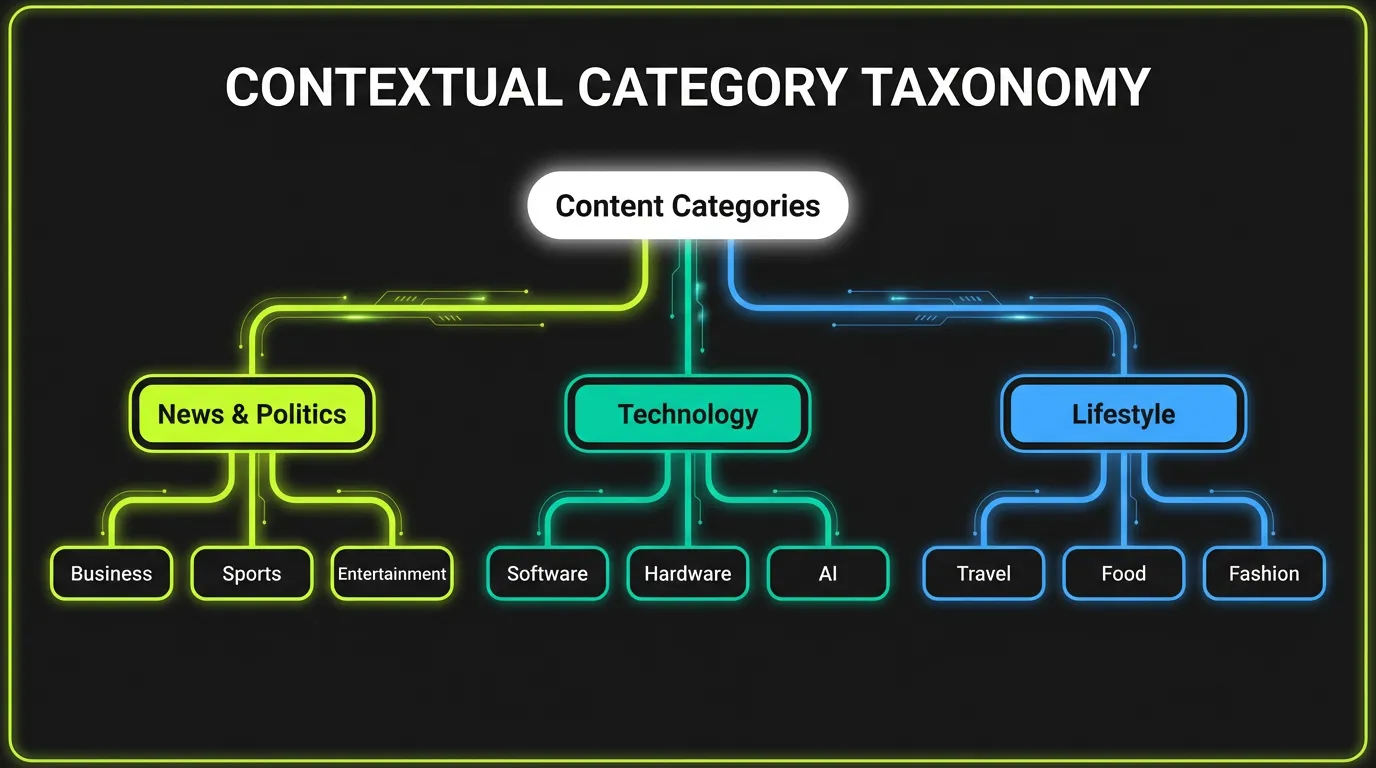
2. Category Contextual
Target content categories:
| Category | Sub-Categories |
|---|---|
| Sports | Running, Basketball, Football, Tennis |
| Technology | Gadgets, Software, AI, Mobile |
| Finance | Investing, Banking, Crypto, Insurance |
| Travel | Destinations, Hotels, Airlines, Road Trips |
Pros: Scalable, comprehensive Cons: Broad, less precise
3. Semantic Contextual
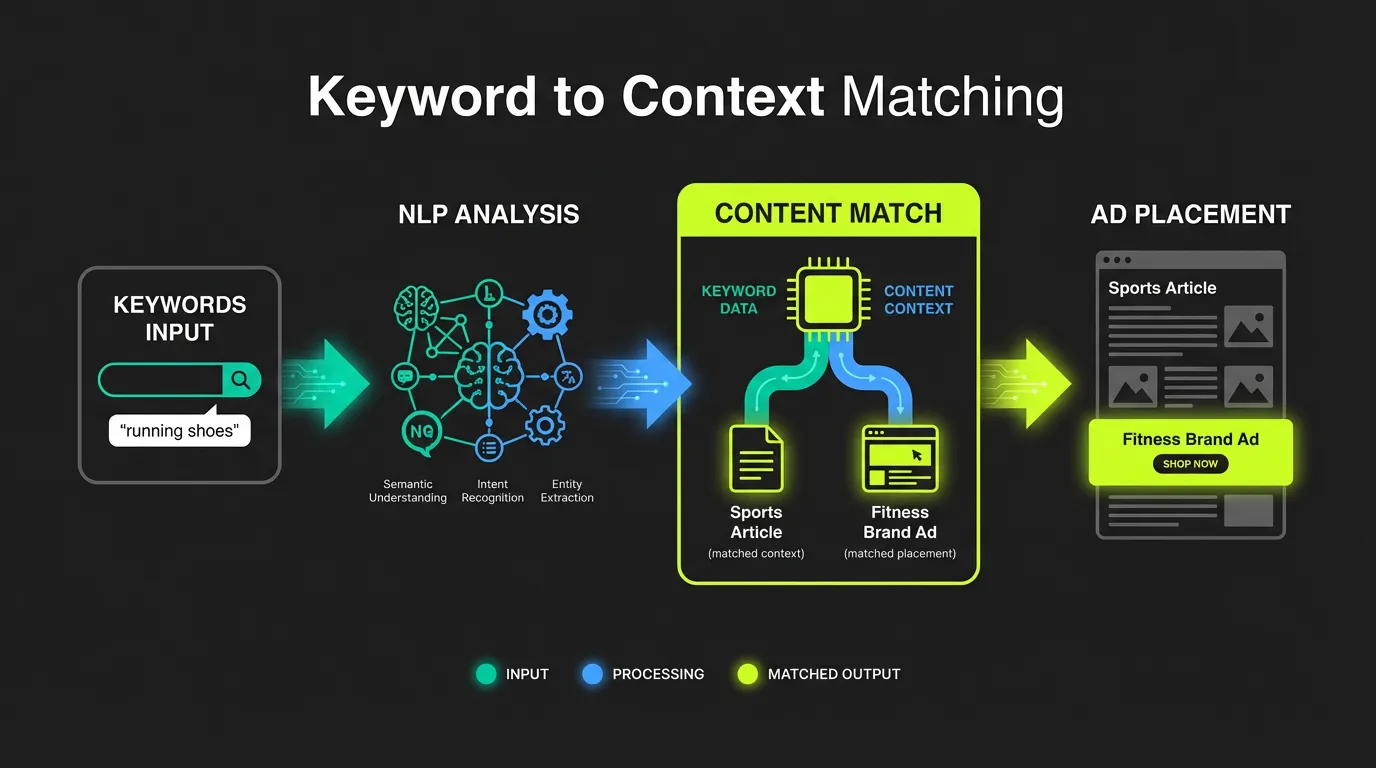
AI analyzes content meaning:
:::tip Semantic Example Page discusses "best ways to reduce monthly expenses"
Semantic targeting understands:
- Topic: Personal finance
- Intent: Cost reduction
- Sentiment: Practical/solution-seeking
- Audience: Budget-conscious consumers
Matches: Banking apps, budgeting tools, discount services :::
4. Sentiment Contextual
Target based on emotional tone:
| Sentiment | Ad Type |
|---|---|
| Positive/Uplifting | Celebration products, experiences |
| Informational/Neutral | Education, comparison |
| Concern/Worry | Solutions, protection |
| Excitement/Anticipation | New releases, events |
5. Visual/Video Contextual
Analyze images and video content:
- Scene recognition
- Object detection
- Text in images
- Audio transcription
- Logo identification
Implementing Contextual Targeting
Google Ads Contextual Options
Topics Targeting:
- Campaign → Content → Topics
- Select relevant categories
- Options: Target (only) or Observe (track performance)
Keywords (Display):
- Campaign → Content → Keywords
- Enter contextual keywords
- Set to "Audience" or "Content" targeting
:::info Placement Targeting For maximum control, combine contextual with placement targeting. Pre-approve specific sites where your ads can appear. :::
Meta Contextual Options
Meta's approach is different—primarily behavioral with contextual elements:
Inventory filters:
- Full inventory (all content)
- Standard (excluding sensitive)
- Limited (highest brand safety)
Topic exclusions:
- News and Politics
- Social Issues
- Gambling
- Dating
Programmatic Contextual
DSPs offer advanced contextual:
Setup process:
- Choose contextual vendor (Oracle, DoubleVerify, IAS, GumGum)
- Create contextual segments
- Apply to programmatic campaigns
- Layer with other targeting (optional)
Advanced options:
- Custom category creation
- Sentiment analysis
- Predictive contextual
- Cross-channel consistency
Contextual + Brand Safety
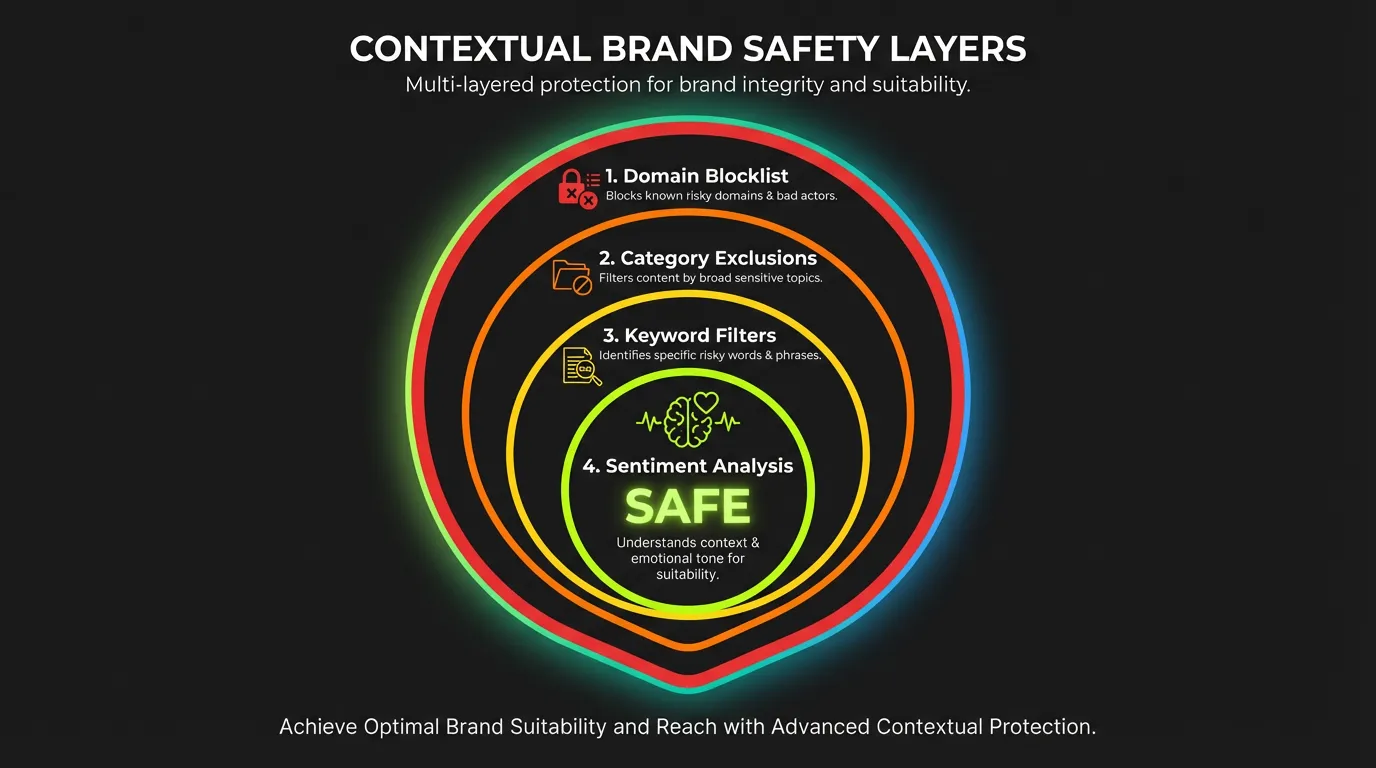
Contextual targeting doubles as brand safety.
The Brand Safety Benefit
Without contextual:
Ad could appear next to:
- Controversial news
- Negative brand mentions
- Inappropriate content
- Competitor content

With contextual:
Ad appears next to:
- Relevant, curated content
- Brand-aligned topics
- Positive/neutral sentiment
- Pre-approved categories
Exclusion Categories
Standard exclusions to consider:
| Category | Risk Level |
|---|---|
| Adult content | High |
| Violence/Crime | High |
| Hate speech | High |
| Drugs/Alcohol | Medium-High |
| Political news | Medium |
| Controversial topics | Medium |
| User-generated content | Variable |
:::warning Over-Exclusion Excluding too many categories limits reach and increases costs. News exclusion alone can reduce available inventory by 30%+. :::
Adjacency Management
Beyond category exclusion:
- Pre-bid filtering — Block before auction
- Page-level analysis — Each URL evaluated
- Real-time sentiment — Block negative contexts
- Keyword blocklists — Specific term exclusion
Advanced Contextual Strategies
Contextual Conquesting
Target content about competitors:
- Competitor mentions — Articles reviewing/discussing competitors
- Comparison content — "Best X alternatives" articles
- Category buying guides — Purchase research content
:::tip Conquest Example A project management software company targets:
- "Asana vs Monday comparison"
- "Best Trello alternatives"
- "Project management software reviews"
Reaches users actively researching the category. :::
Moment-Based Contextual
Align ads with current events and moments:
| Moment | Contextual Target |
|---|---|
| Morning news | Coffee, commute apps |
| Sports scores | Team merchandise, sports betting |
| Recipe pages | Kitchen appliances, ingredients |
| Wedding planning | Registry, honeymoon, venues |
| Tax season | Financial services, accounting |
Sequential Contextual
Tell a story across contexts:
Touch 1 (Awareness):
Context: Industry news
Message: "Did you know...?"

Touch 2 (Consideration):
Context: How-to content
Message: "Here's how to solve..."

Touch 3 (Decision):
Context: Review/comparison
Message: "See why customers choose..."
Predictive Contextual
Use ML to predict which contexts convert:
- Analyze historical conversion data
- Identify content patterns of converters
- Build predictive context models
- Target content similar to converting contexts
Measuring Contextual Performance
Key Metrics
| Metric | What It Tells You |
|---|---|
| CTR by context | Which topics drive engagement |
| Conversion rate by category | Which contexts convert |
| Brand lift by placement | Which content builds brand |
| Cost per context | Efficiency by targeting type |
A/B Testing Contexts
Test contextual vs behavioral:
Test Structure:
├── Control: Behavioral targeting
├── Test A: Category contextual
├── Test B: Semantic contextual
└── Test C: Hybrid (contextual + behavioral)

Measure: CTR, CVR, CPA, Brand Lift
:::info Test Results Benchmark In controlled tests, semantic contextual typically performs within 5-15% of behavioral targeting—sometimes matching or exceeding it—while reaching broader audiences. :::
Incrementality Testing
Measure true contextual impact:
- Holdout test — Geographic regions with/without contextual
- Conversion lift — Platform-measured lift studies
- Media mix modeling — Channel contribution analysis
Common Contextual Mistakes
1. Keyword-Only Approach
"We target 'running' to reach runners"
Problem: Matches irrelevant content ("running late," "running a business")
Solution: Use semantic contextual that understands meaning, not just words.
2. Over-Broad Categories
"We target 'Business' category"
Problem: Too broad, includes irrelevant content
Solution: Layer multiple specific categories or use semantic segments.
3. Excessive Exclusions
"We exclude news, politics, UGC, and all controversial topics"
Problem: Eliminates 50%+ of available inventory
Solution: Use page-level analysis instead of category exclusions. Not all news/UGC is risky.
4. Ignoring Creative Alignment
"Same creative regardless of context"
Problem: Missed opportunity for relevance
Solution: Create context-specific creative variations.
:::tip Creative Alignment An outdoor gear brand running contextual against hiking content should show hiking-specific creative, not generic brand ads. :::
5. Set-and-Forget
"We set up contextual targeting last quarter"
Problem: Content evolves, relevance changes
Solution: Regularly review context performance and refine targeting.
The Future of Contextual
AI-Powered Understanding
- Large language models analyzing content at scale
- Multi-modal analysis combining text, image, audio
- Real-time context signals adapting to live content
- Personalized context matching context to user preference
Privacy-First Identity Solutions
- Publisher first-party data enriching contextual
- Clean room matching connecting context to outcomes
- Cohort-based approaches grouping by interest, not identity
Contextual Commerce
- Shoppable content embedded in relevant articles
- Dynamic product feeds matching page context
- Affiliate integration contextual native placements
The Bottom Line
Contextual advertising in 2026 is essential, not optional:
- Start with semantic — Modern contextual understands meaning, not just keywords
- Balance safety and scale — Don't over-exclude into irrelevance
- Test against behavioral — Measure actual performance difference
- Align creative to context — Generic ads waste contextual advantage
- Layer intelligently — Combine contextual with other signals when available
- Future-proof strategy — Contextual works regardless of privacy changes
:::tip The Contextual Mindset "Contextual isn't a fallback when cookies disappear. It's a primary strategy for relevant, respectful advertising that works in any privacy environment." :::
"The best ads don't follow people around the internet. They appear in the right place, at the right moment, in the right context. That's the contextual promise."
AdBid helps you optimize contextual targeting across platforms. See which contexts drive results for your campaigns. Start your contextual strategy.