
Key Takeaways
:::highlight Creative Is the New Targeting With privacy limiting audience targeting precision, creative has become the primary performance lever. Top creative performers see 3-5x better results than average—same audience, same bid, different outcomes. :::
- Test systematically, not randomly — Random creative testing produces random insights
- Isolate variables — Change one thing at a time to know what actually worked
- Statistical significance matters — Stop tests when you have enough data, not when you see a trend
- Creative fatigue is real — Today's winner is tomorrow's underperformer
- AI accelerates, not replaces — Use AI for generation and analysis, humans for strategy
For teams that need more campaign-ready variations, AdBid's AI creative factory helps turn briefs into hooks, copy, and ad assets faster.
Why Creative Testing Matters in 2026
The advertising landscape has shifted creative from nice-to-have to must-have.
The Privacy-Creative Connection
| What Changed | Creative Impact |
|---|---|
| Cookie deprecation | Can't rely on behavioral targeting precision |
| Signal loss (ATT/etc.) | Algorithms need better creative signals |
| Audience saturation | Reaching same people, need different message |
| Rising CPMs | Creative efficiency is only cost lever |
:::warning The New Reality In 2020, great targeting could save mediocre creative. In 2026, great creative is required to make any targeting work. The algorithm can find your audience; creative determines if they convert. :::
Creative Performance Distribution
Performance vs Average (same audience, bid, budget)

Top 10% creative:    ████████████████░░░░ 3.2x
Top 25% creative:    ████████████░░░░░░░░ 1.8x
Average creative:    ██████░░░░░░░░░░░░░░ 1.0x
Bottom 25% creative: ███░░░░░░░░░░░░░░░░░ 0.5x
Bottom 10% creative: █░░░░░░░░░░░░░░░░░░░ 0.2x

3-5x performance gap between best and worst
The Creative Testing Framework
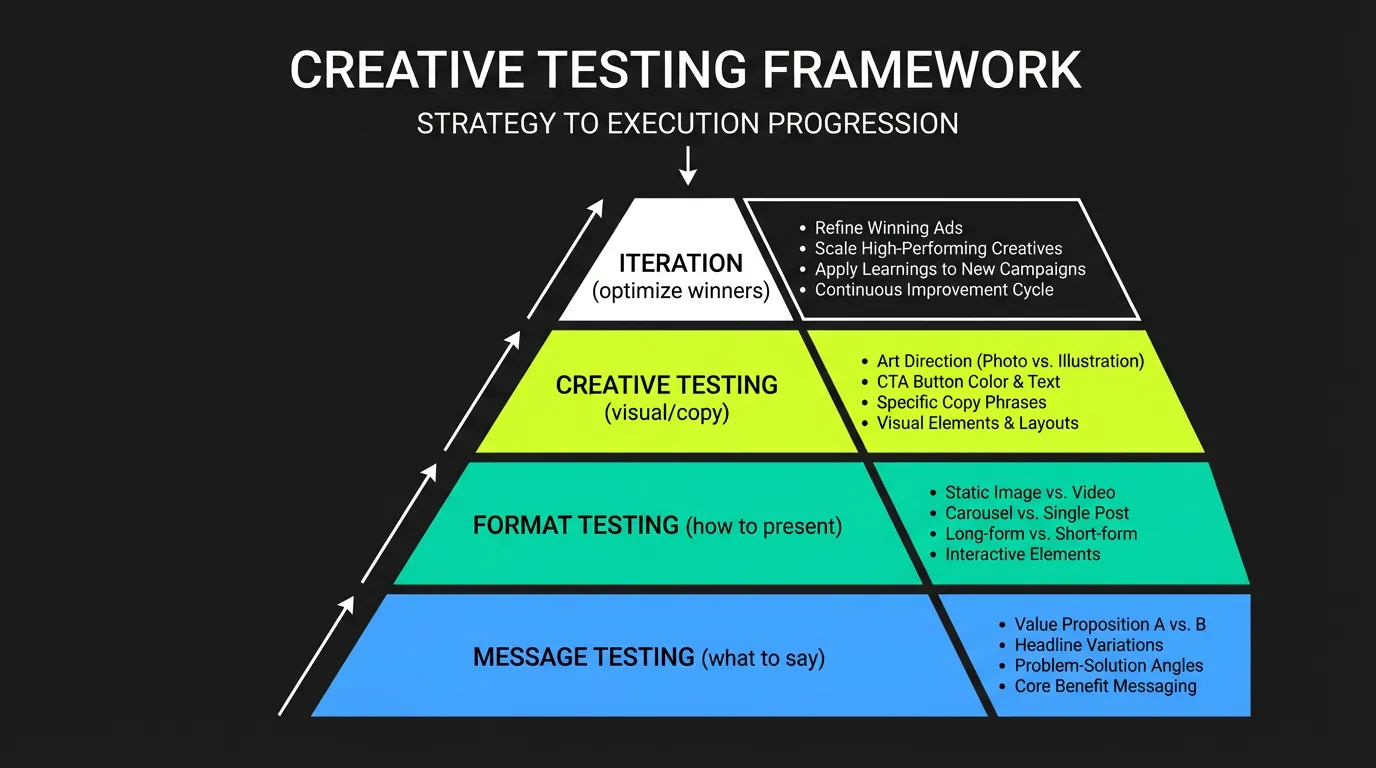
Systematic testing produces actionable insights.
Step 1: Define Testing Priorities
Not all creative elements have equal impact:
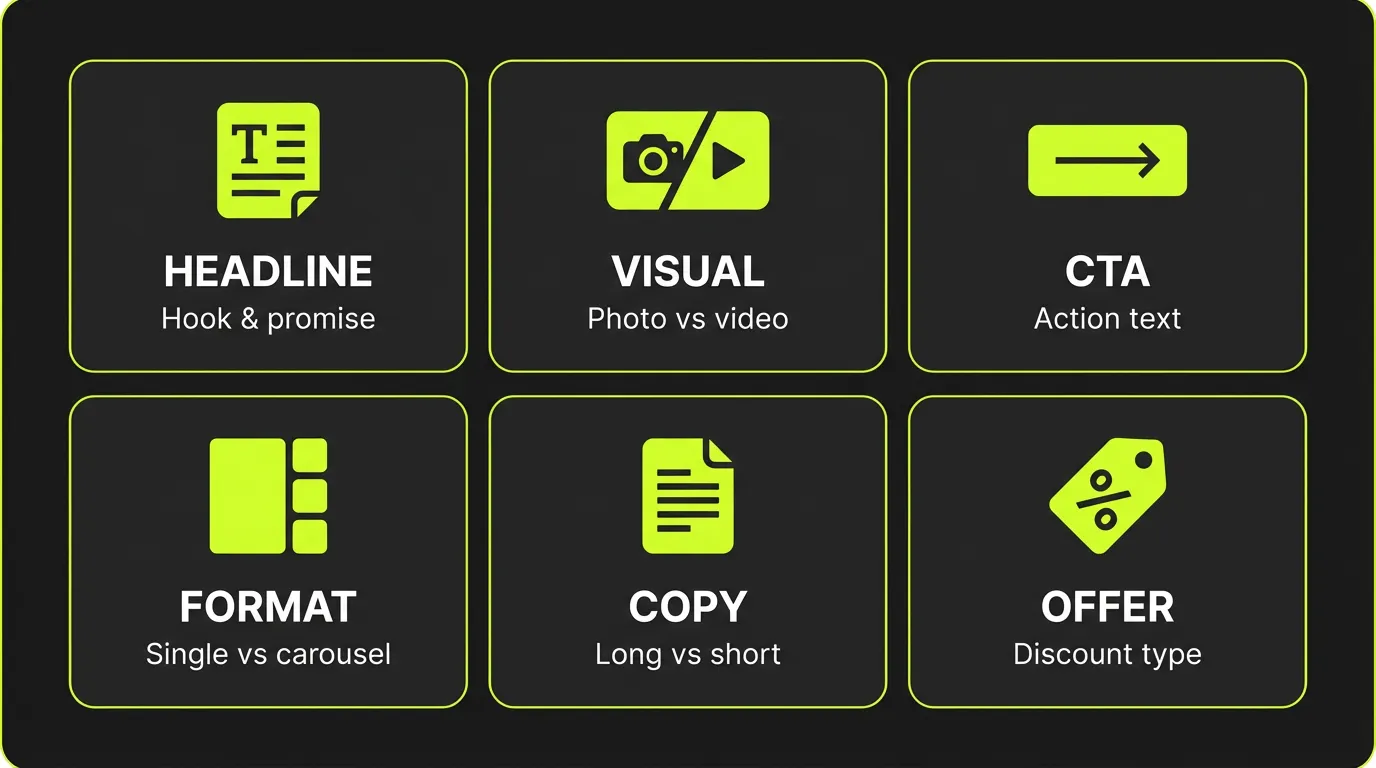
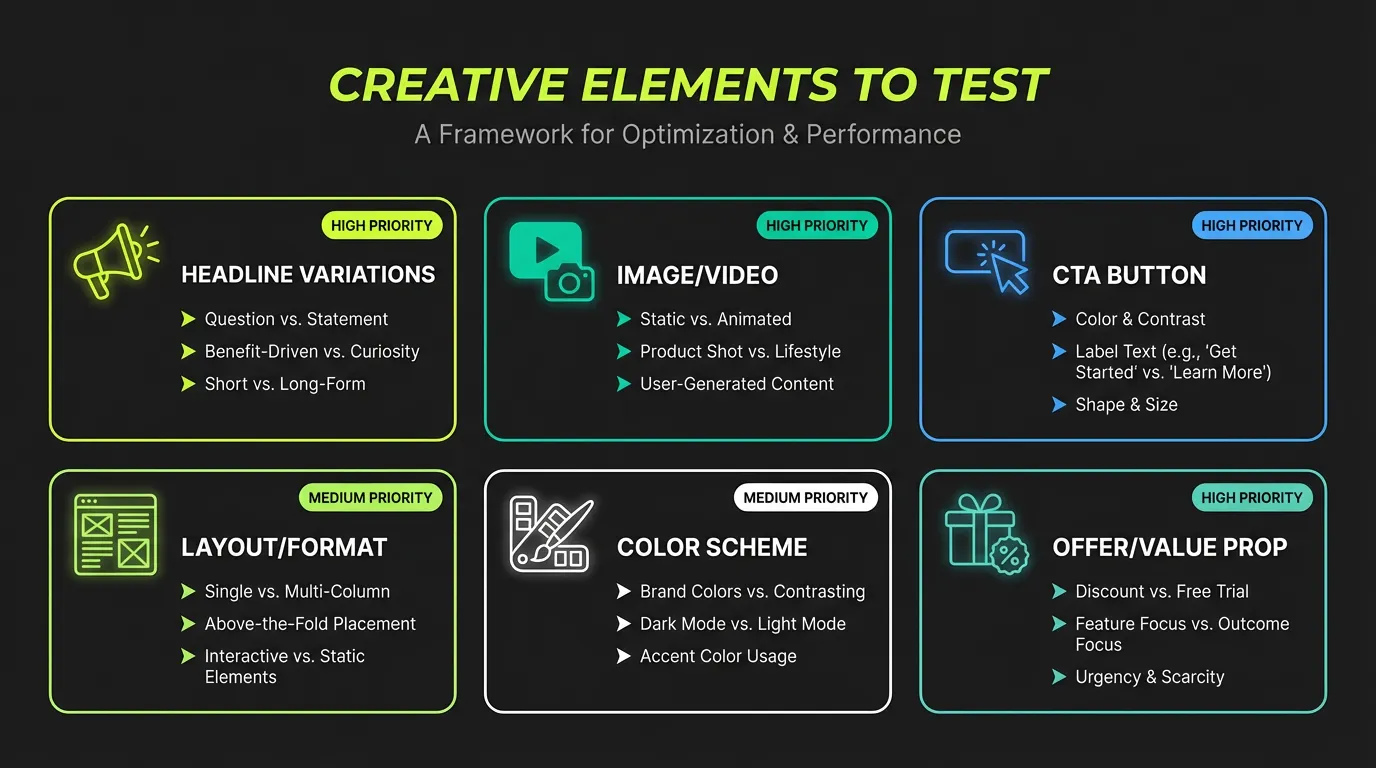
| Element | Typical Impact | Test Priority |
|---|---|---|
| Hook (first 3 seconds) | Very High | 1st |
| Main message/offer | Very High | 1st |
| Visual style | High | 2nd |
| Call-to-action | High | 2nd |
| Copy length | Medium | 3rd |
| Color scheme | Medium | 3rd |
| Text placement | Low | 4th |
| Minor design tweaks | Low | 4th |
:::tip Start Big Test high-impact elements first. A new hook will move performance more than a color change. Save micro-optimizations for after you've found a winning concept. :::
Step 2: Isolate Variables
Wrong approach: Test multiple changes at once
Version A: Blue background, "Save 20%", testimonial, Shop Now CTA
Version B: Red background, "Free shipping", product demo, Buy Now CTA

Result: B wins
Learning: ??? (don't know what caused the win)
Right approach: Test one variable at a time
Test 1: Background color
├── A: Blue background + standard elements
└── B: Red background + standard elements
Result: Blue wins

Test 2: Offer messaging (on winning background)
├── A: Blue + "Save 20%" + standard elements
└── B: Blue + "Free shipping" + standard elements
Result: "Free shipping" wins

Learning: Clear insights for each element
Step 3: Determine Sample Size
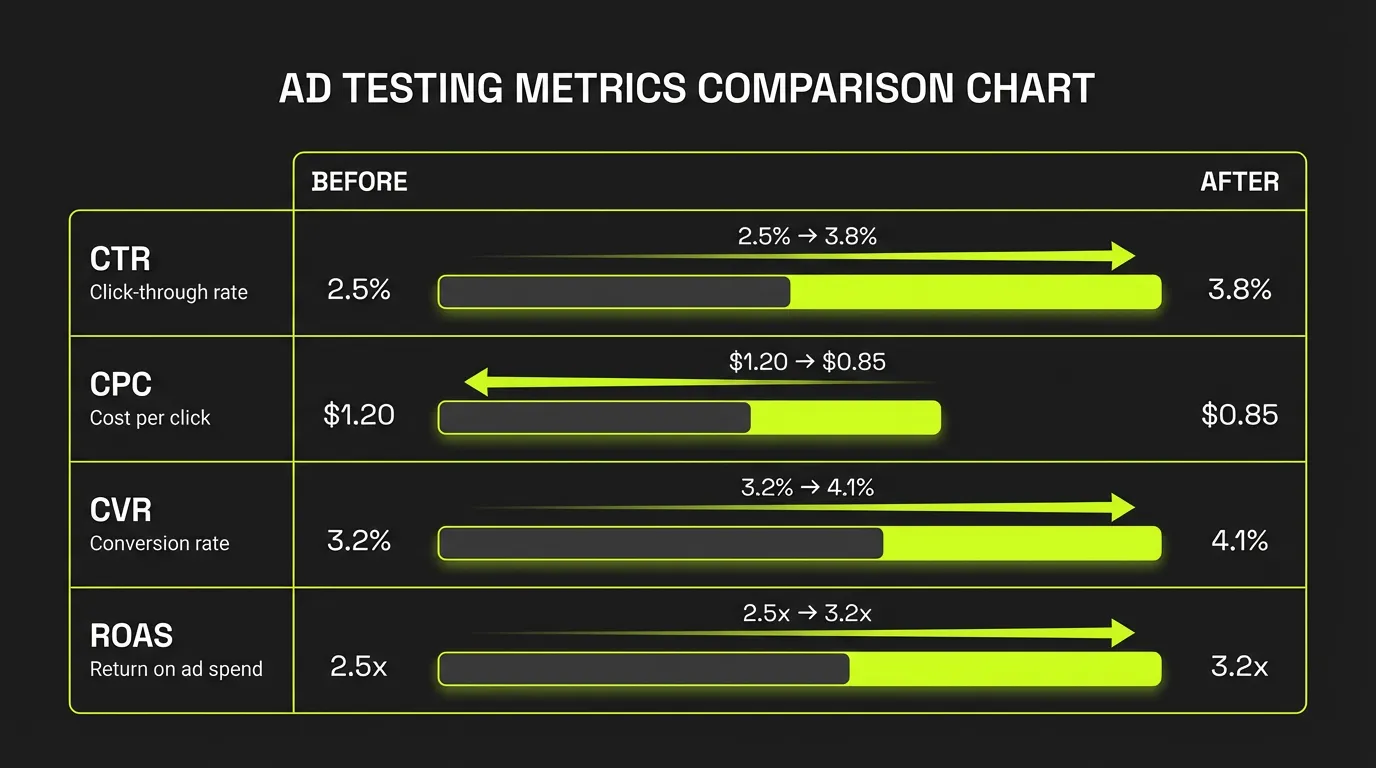
Statistical significance requires sufficient data:
| Metric | Minimum Events for Significance |
|---|---|
| Impressions | 10,000+ per variant |
| Clicks | 100+ per variant |
| Conversions | 30+ per variant |
| Value | Depends on variance |
:::info Statistical Significance Use a significance calculator. Most tests need 95% confidence level. Running tests until you "see a winner" introduces survivorship bias. :::
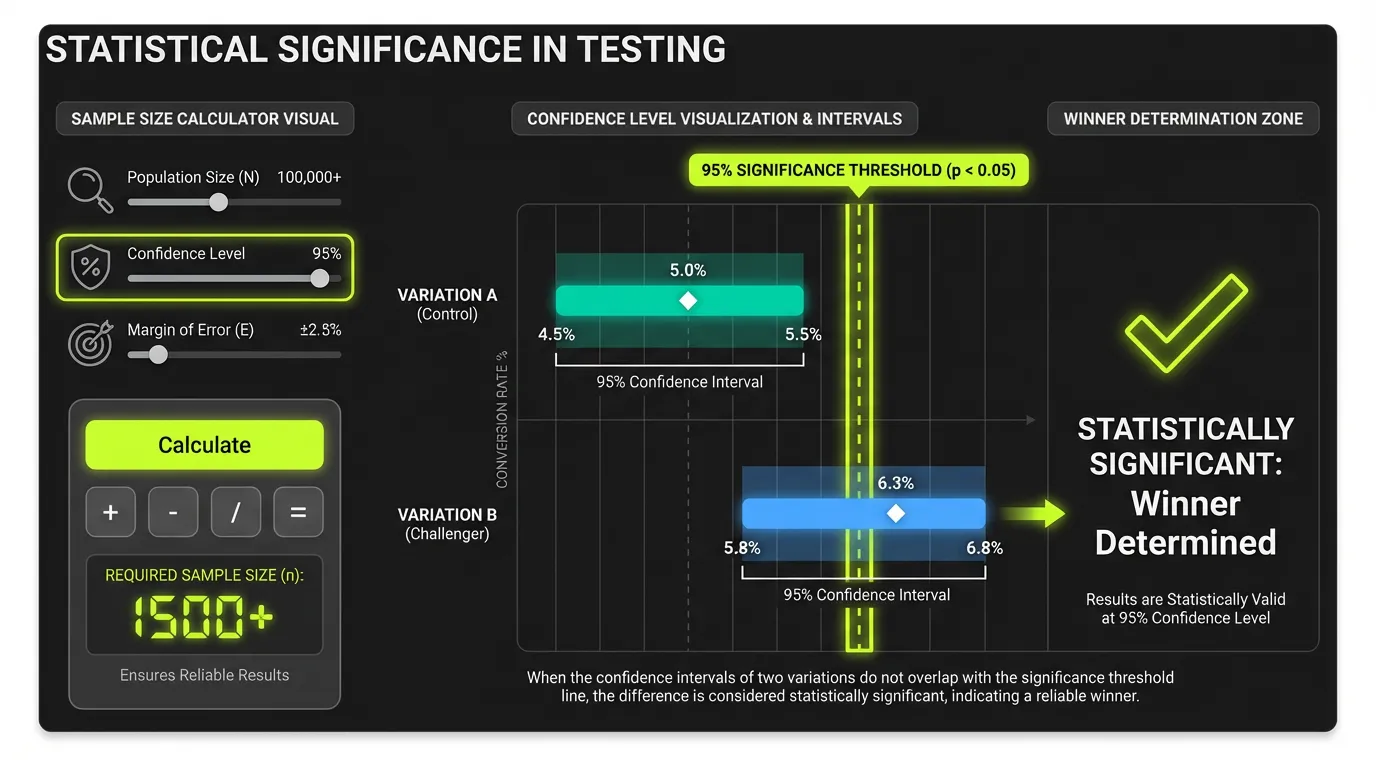
Step 4: Set Test Duration
Balance speed with validity:
Minimum: 7 days (capture day-of-week variation) Typical: 14-21 days Complex tests: 30+ days
Factors affecting duration:
- Traffic volume
- Conversion rate
- Number of variants
- Confidence level needed
Types of Creative Tests
A/B Testing
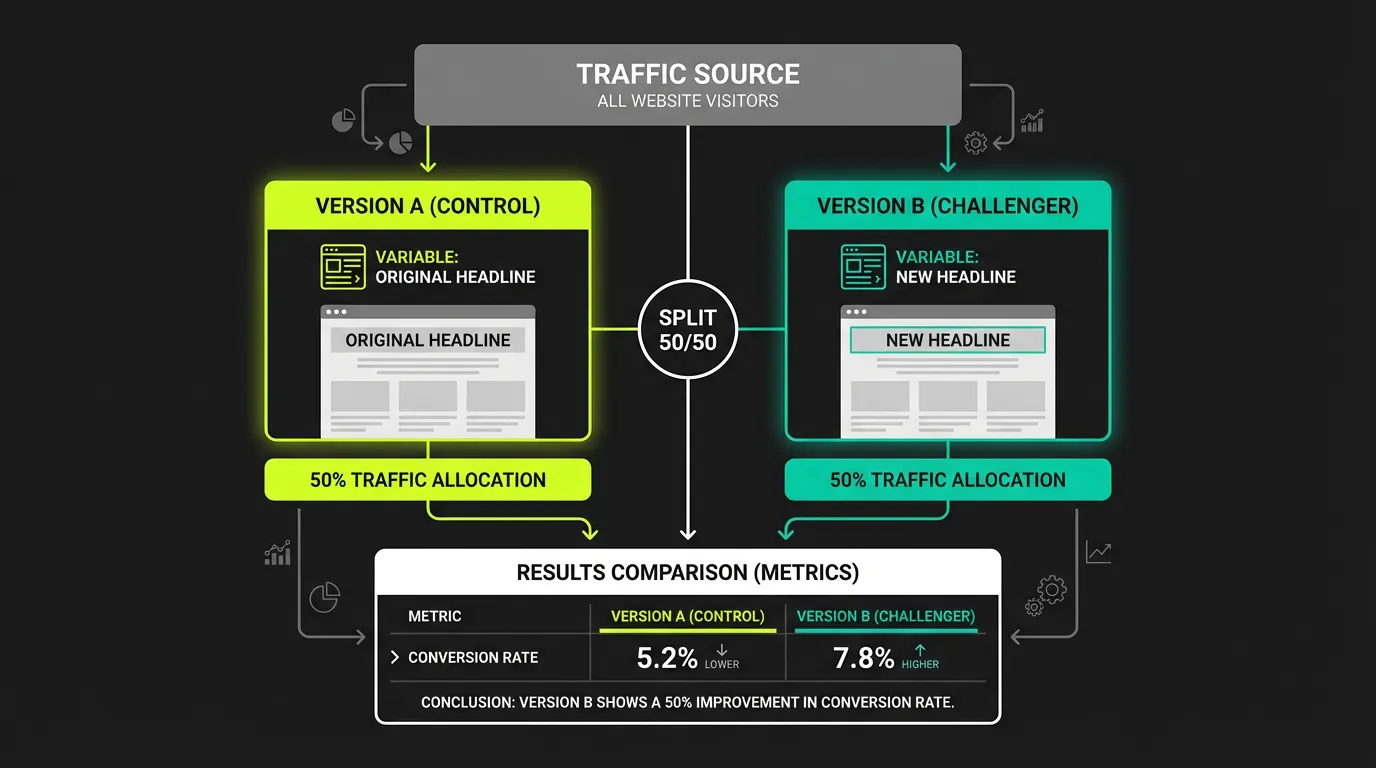
Two variants, one variable difference.
Best for:
- Headline testing
- CTA testing
- Offer comparison
- Single element optimization
Test Setup:
├── Control (A): Current best performer
├── Challenger (B): One variable changed
├── Split: 50/50 traffic
└── Duration: Until significance

Analysis:
- Winner: Statistically better performer
- Learnings: Why it won (hypothesis validation)
Multivariate Testing (MVT)
Test multiple elements simultaneously.
Best for:
- Finding optimal combinations
- Understanding element interactions
- Mature testing programs
:::warning MVT Complexity Testing 3 headlines × 3 images × 3 CTAs = 27 combinations. Each needs significant traffic. MVT requires high volume or long duration. :::
Sequential Testing
Test in stages, building on winners.
Stage 1: Test 3 concepts
Winner: Concept B

Stage 2: Test 3 hooks (using Concept B)
Winner: Hook 2

Stage 3: Test 3 CTAs (using Concept B + Hook 2)
Winner: CTA 3

Final: Optimized creative combining all winners
Holdout Testing
Measure incremental lift of new creative.
Test Group: See new creative
Control Group: Don't see ads (or see old creative)
Measure: Conversion difference between groups
Result: True incremental impact of creative change
Platform-Specific Testing
Meta Ads Testing
Dynamic Creative:
- Upload multiple headlines, images, descriptions
- Algorithm tests combinations
- Reports winning elements
A/B Test Feature:
- Ads Manager → A/B Test
- Select variable to test
- Set budget and duration
- Platform handles split and analysis
:::tip Meta Creative Testing Use Dynamic Creative for initial exploration, then A/B testing for specific hypothesis validation. Dynamic Creative shows what works; A/B testing shows why. :::
Creative Reporting:
- Breakdown by creative element
- Asset-level performance
- Creative fatigue indicators
Google Ads Testing
Responsive Search Ads:
- 15 headlines, 4 descriptions
- Automatic combination testing
- Asset performance labels (Best, Good, Low)
Responsive Display Ads:
- Multiple images, headlines, descriptions
- Auto-generated combinations
- Performance by asset
Video Testing:
- Video experiments in YouTube
- A/B test different videos
- Brand lift measurement
TikTok Testing
Split Test:
- Campaign level split testing
- Test creative, targeting, or bidding
- Traffic distributed evenly
- Statistical significance reporting
Smart Creative:
- Upload multiple videos
- AI generates variations
- Automatic optimization
Creative Testing Metrics
Primary Metrics
| Metric | What It Tells You | Watch For |
|---|---|---|
| CTR | Ad attractiveness | > 1% for display, > 3% for social |
| VTR | Video engagement | > 25% for short-form |
| Hook rate | First 3 sec hold | > 50% for video |
| CPC | Click efficiency | Lower is better |
| CVR | Conversion effectiveness | Compare vs benchmark |
| CPA/ROAS | Business outcome | Ultimate measure |
Creative Health Metrics
| Metric | Fatigue Signal |
|---|---|
| CTR trend | Declining week over week |
| Frequency vs CTR | CTR drops as frequency rises |
| Comment sentiment | More negative reactions |
| Share rate | Declining over time |
:::info Leading vs Lagging CTR is a leading indicator (shows early performance). CPA/ROAS are lagging (need conversion data). Use CTR for quick reads, CPA/ROAS for final decisions. :::
AI-Powered Creative Testing
AI Creative Generation
Use AI tools to create test variants:
Image generation:
- Midjourney, DALL-E for concept imagery
- Canva AI, Adobe Firefly for design variations
- Product photography generation
Copy generation:
- GPT-4 for headline variants
- Claude for long-form copy
- Platform AI writers (Meta, Google)
Video generation:
- Runway, Pika for video creation
- Synthesia for spokesperson videos
- Auto-caption and editing tools
:::tip AI Testing Strategy AI enables testing at unprecedented scale. Generate 20 headline variants instead of 3. Test 10 image styles instead of 2. Volume increases chance of finding winners. :::
AI Performance Prediction
Some tools predict creative performance before launch:
How it works:
- Analyze thousands of historical ads
- Identify patterns in winning creative
- Score new creative on likelihood of success
- Recommend improvements
Limitations:
- Predictions aren't perfect
- Novel concepts may score low but perform well
- Still need actual testing for validation
AI-Driven Optimization
Platform AI handles micro-optimization:
Human Role:
├── Define strategy and brand guidelines
├── Create diverse creative concepts
├── Set business goals and constraints
└── Analyze learnings and iterate

AI Role:
├── Test combinations at scale
├── Optimize delivery by audience/placement
├── Identify winning elements
└── Predict fatigue and recommend refresh
Creative Testing Best Practices
1. Test Concepts, Not Executions
Wrong: Testing small variations of same idea
Test A: "Save 20% today"
Test B: "20% off today"
Test C: "Today: 20% savings"
Right: Testing different strategic approaches
Test A: Price-focused ("Save 20% today")
Test B: Benefit-focused ("Sleep better tonight")
Test C: Social proof ("Join 10,000 happy customers")
2. Maintain Creative Volume
Ideal creative volume by spend:
| Monthly Spend | Active Creatives |
|---|---|
| < $10K | 5-10 |
| $10K-50K | 10-20 |
| $50K-200K | 20-40 |
| $200K+ | 40+ |
:::warning Creative Volume Many advertisers under-invest in creative quantity. More creative = more testing = faster learning = better performance. :::
3. Document Everything
Create a testing log:
| Test | Hypothesis | Winner | Lift | Learning |
|---|---|---|---|---|
| Hook test | Fast hook > slow | Fast | +34% CTR | First 2 seconds critical |
| Offer test | Free shipping > discount | Free ship | +22% CVR | Our audience values convenience |
| Format test | Carousel > static | Static | +18% CTR | Simple beats complex here |
4. Refresh on Schedule
Don't wait for fatigue—plan creative refresh:
| Creative Type | Refresh Cycle |
|---|---|
| Static image | Every 2-4 weeks |
| Carousel | Every 4-6 weeks |
| Video (short) | Every 4-6 weeks |
| Video (long) | Every 6-8 weeks |
| UGC | Every 2-3 weeks |
Advanced Testing Strategies
Cross-Platform Testing
Same creative performs differently across platforms:
Creative A Performance:
├── Meta: CTR 1.8%, CVR 3.2%
├── Google Display: CTR 0.6%, CVR 1.1%
├── TikTok: CTR 2.4%, CVR 2.8%
└── YouTube: VTR 42%, CVR 1.9%

Learning: Need platform-specific optimization
Audience × Creative Testing
Test creative by audience segment:
| Creative | New Visitors | Retargeting | Lookalikes |
|---|---|---|---|
| Educational | ★★★ | ★ | ★★ |
| Social proof | ★★ | ★★★ | ★★★ |
| Offer-focused | ★ | ★★★ | ★★ |
| Brand | ★★★ | ★ | ★★★ |
Different audiences respond to different messages.
Funnel Stage Testing
Creative needs change by funnel position:
| Stage | Creative Focus | Test Elements |
|---|---|---|
| Awareness | Hook, brand | Attention-grabbers |
| Consideration | Benefits, features | Educational content |
| Decision | Offers, urgency | CTAs, pricing |
| Loyalty | Value, appreciation | Exclusive offers |
Common Testing Mistakes
1. Declaring Winners Too Early
"We ran the test for 3 days and B is winning by 20%!"
Reality: Early results are noisy. Wait for statistical significance or you'll "learn" random variance.
2. Testing Too Many Variables
"We tested new image, new copy, new CTA, and new targeting"
Reality: Can't attribute results to any specific change. Insights are useless for future creative.
3. Ignoring Losing Tests
"Test B lost, let's move on"
Reality: Losses contain learning. WHY did it lose? What does that tell you about your audience?
4. Creative Tunnel Vision
"Our best performer is a product image, so we only test product images"
Reality: Best current approach isn't necessarily best possible. Test different concepts occasionally.
5. No Control Group
"All our creatives are 'new' so we can't have a control"
Reality: Always keep a proven control to benchmark against. Otherwise, you don't know if new creative is actually better.
The Bottom Line
Creative testing in 2026 is systematic science, not random guessing:
- Prioritize high-impact elements — Hooks and main messages before minor details
- Isolate variables — One change at a time for clear learnings
- Wait for significance — Don't declare winners based on early trends
- Document learnings — Build institutional knowledge from every test
- Maintain creative volume — More creative = more testing = faster learning
- Refresh proactively — Don't wait for fatigue to replace creative
:::tip The Testing Mindset "Every ad is a hypothesis. Testing is how you prove or disprove that hypothesis. The winner is the company that runs the most experiments and learns the fastest." :::
"In the privacy-first era, you can't out-target competitors. But you can out-creative them. Systematic testing is the path to creative advantage."
AdBid helps you track creative performance across platforms. See which creative drives results and when it's time to refresh. Start your creative analysis.
How Do You Measure Creative Performance?
Creative performance is best read through a sequence of metrics that reveal where an ad succeeds or fails. The earliest signals appear at the top of the engagement funnel and predict outcomes long before cost metrics stabilize. Reading them in order tells you not just whether a creative works, but why it works or breaks.
Start with the hook rate, the share of viewers who stay past the first few seconds. A weak hook rate means the opening fails, and nothing downstream can fix that. Next comes the hold rate, which measures how many viewers watch through to completion. Together these two tell you whether your creative earns and keeps attention.
After attention comes action. Click-through rate shows whether interest converts to intent, and cost per acquisition reflects whether that intent becomes profitable outcomes. The sequence matters: a high CTR with a poor hook rate suggests your audience is small but highly qualified, while a strong hook and weak CTR points to a mismatch between promise and payoff.
Citation capsule: Platform reporting and creative analytics tools surface early-funnel signals such as three-second view rates and completion rates because they predict downstream performance before cost metrics stabilize. Reading hook rate, then hold rate, then click-through, then cost per acquisition gives teams an actionable diagnosis of where a creative wins or breaks.
For teams running structured experiments, pairing these creative metrics with sound experimental design is what produces trustworthy reads. Our A/B testing guide for advertising covers how to set up clean comparisons that isolate the creative variable.
How Do You Scale a Testing Framework Without Burning Out?
Scaling a testing framework usually fails not because of strategy but because of production capacity. The bottleneck is making enough quality variations to keep every stage fed. Teams that win the volume game either build large creative pipelines or use AI tooling to multiply output, so the framework never runs dry between cycles.
The math is unforgiving. A four-stage framework needs concepts to test, then elements to refine, then iterations to extend, then fresh challengers for when winners fatigue. That demand never stops. Manual production rarely keeps pace, which is why so many promising programs stall after a few cycles.
The real constraint in modern creative testing isn't analysis, it's supply. Most teams can interpret results just fine. What they lack is the steady stream of new variations needed to keep the framework moving. Solving the production bottleneck often does more for results than refining the measurement.
This is exactly where AI-assisted creative production changes the equation. Turning a single brief into many hooks, copy variants, and ad assets keeps every testing stage supplied without exhausting your team. You can explore that approach with AdBid's Creative Factory and pair it with structured experimentation principles from our complete ad creative testing guide.