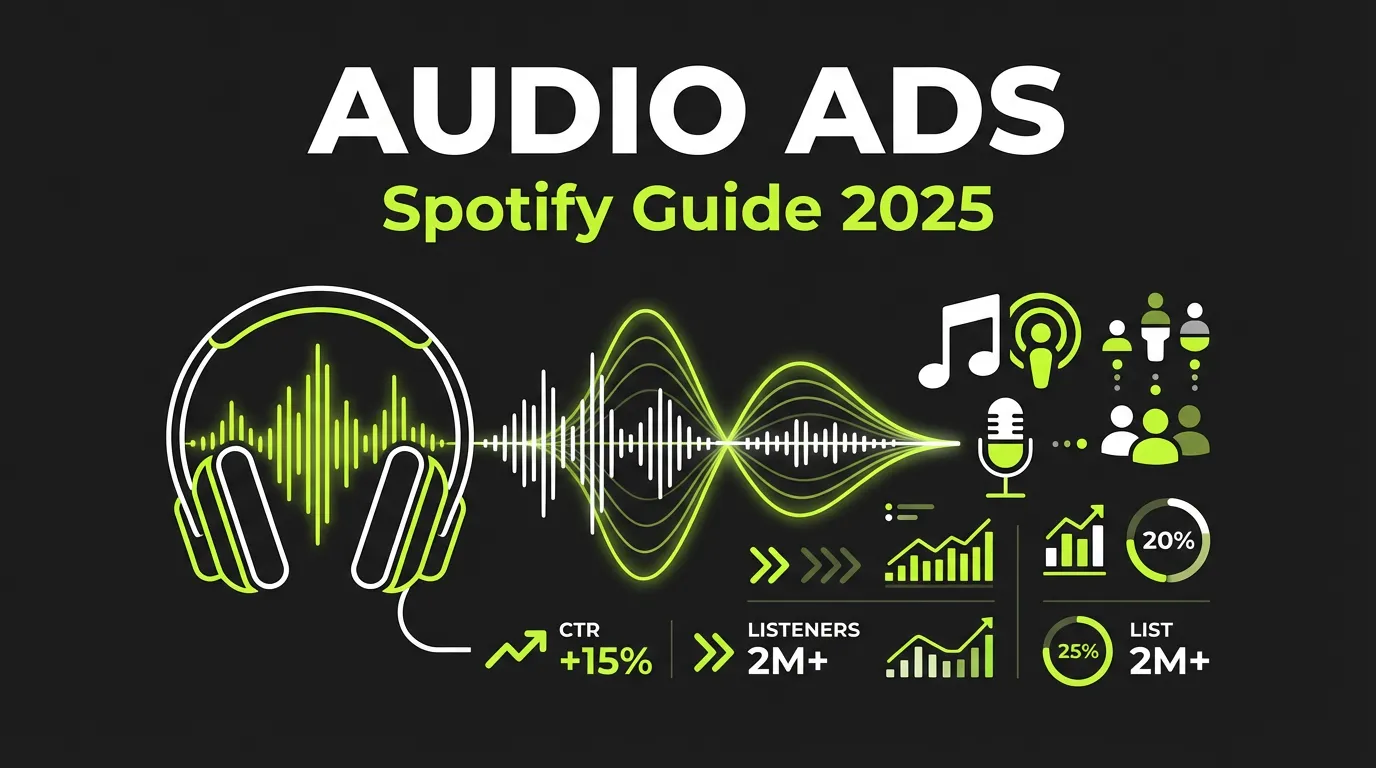

Spotify Ads in 2026: The Complete Guide to Audio Advertising
Spotify reaches more than 600M monthly active users worldwide, and over 250M of them listen on the free, ad-supported tier (Spotify SEC Form 6-K). That scale, paired with a self-serve platform starting at just $250, makes audio one of the most accessible channels for marketers in 2026. This guide walks through ad formats, targeting, costs, and the practical steps to launch a campaign that actually performs.
Key Takeaways
- Spotify has 600M+ monthly active users, with 250M+ on the free ad-supported tier (Spotify SEC Form 6-K).
- Minimum ad spend starts at just $250 through Spotify Ad Studio, one of the lowest entry points in audio.
- Audio ads deliver 24% higher recall than display ads (Nielsen for Spotify).
- CPMs typically range from $15-30 depending on format and targeting precision.
Why Does Spotify Advertising Matter in 2026?
Spotify advertising matters because it reaches listeners in moments no screen-based ad can. Audio ads deliver 24% higher recall than display ads (Nielsen for Spotify). With 250M+ people on the free tier (Spotify SEC Form 6-K), the reachable audience is enormous.
Think about when people actually use Spotify. They are commuting, working out, cooking, or focusing at their desk. In those moments, the screen is often locked or ignored. Your audio message lands with zero visual competition, which is rare in modern digital media.
This intimacy is the core of audio's value. A voice in someone's headphones feels personal in a way a banner never does. For brands building recognition over time, that effect compounds, much like the slow-build approach used in brand awareness advertising.
Spotify by the Numbers (2026)
| Metric | Value |
|---|---|
| Monthly Active Users | 600M+ |
| Ad-Supported Users | 250M+ |
| Premium Subscribers | 350M+ |
| Markets | 180+ countries |
| Podcast Listeners | 100M+ |
How Do You Get Started With Spotify Ad Studio?
You get started through Spotify Ad Studio, the self-serve platform with a minimum campaign spend of just $250 (Spotify Advertising). That low floor lets small businesses test audio without a media agency. The setup takes minutes, and you can produce a basic audio ad inside the tool itself.
Setting Up Your Account
- Visit ads.spotify.com and click "Get Started."
- Create your account using email or existing Spotify credentials.
- Set up billing with a credit card or PayPal.
- Build your first campaign, choosing objective, audience, and creative.
Ad Studio is built for beginners. If you do not have a recorded spot, Spotify can generate a free voiceover from your script, which removes a common barrier for first-time audio advertisers.
What Spotify Ad Formats Are Available?
Spotify offers four main ad formats: audio, video, podcast, and display. Audio ads are the most common, playing between songs on the free tier where 250M+ listeners sit (Spotify SEC Form 6-K). Each format serves a different goal, from broad awareness to direct response.
Audio Ads (15-30 Seconds)
These are the backbone of Spotify advertising. They play between songs on the free tier and reach listeners whether or not the screen is active.
- Length: 15 or 30 seconds
- Format: MP3, WAV, or OGG
- File size: 1MB max
- Companion image: 640x640 pixels
Start strong and capture attention in the first three seconds. Include one clear call to action, and match the tone to the moment: upbeat for workout playlists, calmer for focus sessions.
Video Ads
Video ads appear during active sessions when users are looking at the screen. Two main types exist. Video Takeover runs full-screen when the app is in focus. Sponsored Sessions reward viewers with 30 minutes of ad-free listening in exchange for watching.
Podcast Ads
Podcast ads reach listeners through host-read or pre-produced spots placed pre-roll, mid-roll, or post-roll. Spotify counts 100M+ podcast listeners, a fast-growing pool. For a deeper look at this channel, see our podcast advertising guide and the companion podcast advertising complete guide.
Display Ads
Display ads appear in the Spotify interface and include Homepage Takeover, Leaderboard, Overlay, and Sponsored Playlist placements. They add a visual layer that pairs well with audio for reinforcement.
What Targeting Options Does Spotify Offer?
Spotify offers demographic, behavioral, and contextual targeting, which lets you reach listeners by who they are and what they are doing. This depth matters: precise context targeting is part of why audio ads reach 24% higher recall than display (Nielsen for Spotify). You can layer these dimensions for sharper audiences.
Demographic Targeting
Reach listeners by age, gender, location down to the city, and language. These are the foundation of most campaigns and the easiest place to start.
Behavioral Targeting
Target by music genre, playlist type, listening times, and device. A fitness brand can reach people who stream workout playlists at 6 a.m., something almost no other channel can match.
Contextual Targeting
Reach people by real-time context: commuting, working out, studying, or winding down. This mood-based approach feels less like advertising and more like a relevant suggestion, which echoes the editorial fit of strong native advertising.
How Much Do Spotify Ads Cost?
Spotify ads cost roughly $15-30 CPM for most formats, with a $250 minimum campaign spend (Spotify Advertising). Audio sits at the lower end while video and premium podcast placements run higher. Your final rate depends on targeting, season, and competition for the audience.
| Ad Format | CPM Range |
|---|---|
| Audio Ads | $15-25 |
| Video Takeover | $20-30 |
| Podcast Ads | $18-50 |
| Display Ads | $8-15 |
Several factors push costs up or down. Narrow targeting raises the price because you are bidding for a smaller pool. Q4 rates climb as holiday demand peaks. Popular demographics cost more, and video plus podcast formats carry a premium over standard audio.
How Do You Create an Effective Spotify Ad?
An effective Spotify ad opens with a three-second hook, states one clear message, and closes with a single call to action. This discipline matters because audio is fleeting, and the 24% recall advantage of audio (Nielsen for Spotify) only holds when the message is clean. One idea beats three every time.
The Audio Ad Formula
- Hook (0-3 sec): a sound effect or a bold statement that stops the scroll in the ear.
- Problem and solution (3-15 sec): name the pain, then show your fix.
- Brand and CTA (15-30 sec): say who you are and exactly what to do next.
Production Tips
Use professional voice talent and keep background music subtle so it never competes with the words. Add a short sonic logo for recognition, and test energetic versus conversational reads. Avoid cramming in too much: clarity wins.
How Do You Measure Spotify Ad Performance?
You measure performance through reach, frequency, completion rate, and conversions tracked by Spotify's pixel. Frequency matters most for recall, and 3-5 exposures is the practical sweet spot for memory without fatigue. Spotify also supports brand lift studies and third-party measurement integrations for deeper validation.
| Metric | What It Measures |
|---|---|
| Impressions | Times the ad was served |
| Reach | Unique listeners who heard it |
| Frequency | Average plays per listener |
| Completion Rate | Share who heard the full ad |
| CTR | Clicks on the companion display |
Attribution options include pixel tracking for website conversions, brand lift studies, streaming conversion tracking, and integrations with outside measurement vendors. Use these to connect audio spend to real outcomes.
What Advanced Strategies Lift Spotify Results?
The strongest results come from sequencing, playlist targeting, and combining audio with podcasts. Layering these against Spotify's 600M+ users (Spotify SEC Form 6-K) lets you scale reach without losing relevance. Treat each tactic as a building block rather than a one-off test.
Sequential Messaging
Tell a story across exposures. Ad one builds awareness, ad two explains features, and ad three drives the action. This mirrors how people actually move from curiosity to purchase.
Playlist Targeting
Match the offer to the mood. Energy drinks fit workout playlists, productivity tools fit focus playlists, event brands fit party playlists, and wellness apps fit sleep playlists.
Campaign Structure
Separate campaigns by objective, test multiple creatives, layer demographics with behaviors, and hold frequency at 3-5 exposures. Start with $500-1,000 for testing, then shift roughly 70% of budget to your top performers.
Frequently Asked Questions
How much does it cost to advertise on Spotify?
Spotify Ad Studio has a minimum campaign spend of just $250 (Spotify Advertising), one of the lowest entry points in audio advertising. Most formats run a CPM of $15-30, with audio at the lower end and video or premium podcast placements at the higher end.
How many people can I reach on Spotify?
Spotify has more than 600M monthly active users, including over 250M on the free ad-supported tier (Spotify SEC Form 6-K). It also counts 100M+ podcast listeners across 180+ countries, giving advertisers broad global scale.
Are Spotify audio ads effective?
Yes. Audio ads deliver 24% higher recall than display ads (Nielsen for Spotify). Listeners hear them in focused, screen-free moments, so the message lands with little competition for attention.
What is the best ad length for Spotify?
Spotify supports 15- and 30-second audio ads. A 15-second spot works well for a single, sharp message, while 30 seconds gives room for a hook, a problem-solution story, and a clear call to action. For tips that also apply to podcasts, see our podcast advertising guide.
Conclusion
Spotify advertising reaches audiences in intimate, high-attention moments that screen ads cannot match. With a $250 entry point, an audience of 600M+ users, and audio's 24% recall advantage, it is a practical channel for brands of any size in 2026. Start small, test your creative, hold frequency at 3-5 exposures, and shift budget toward what works. Audio rewards patience and a clear message.
Ready to run audio alongside your other channels? AdBid's AI ads manager plans, launches, and optimizes campaigns from one dashboard, or you can get started free.