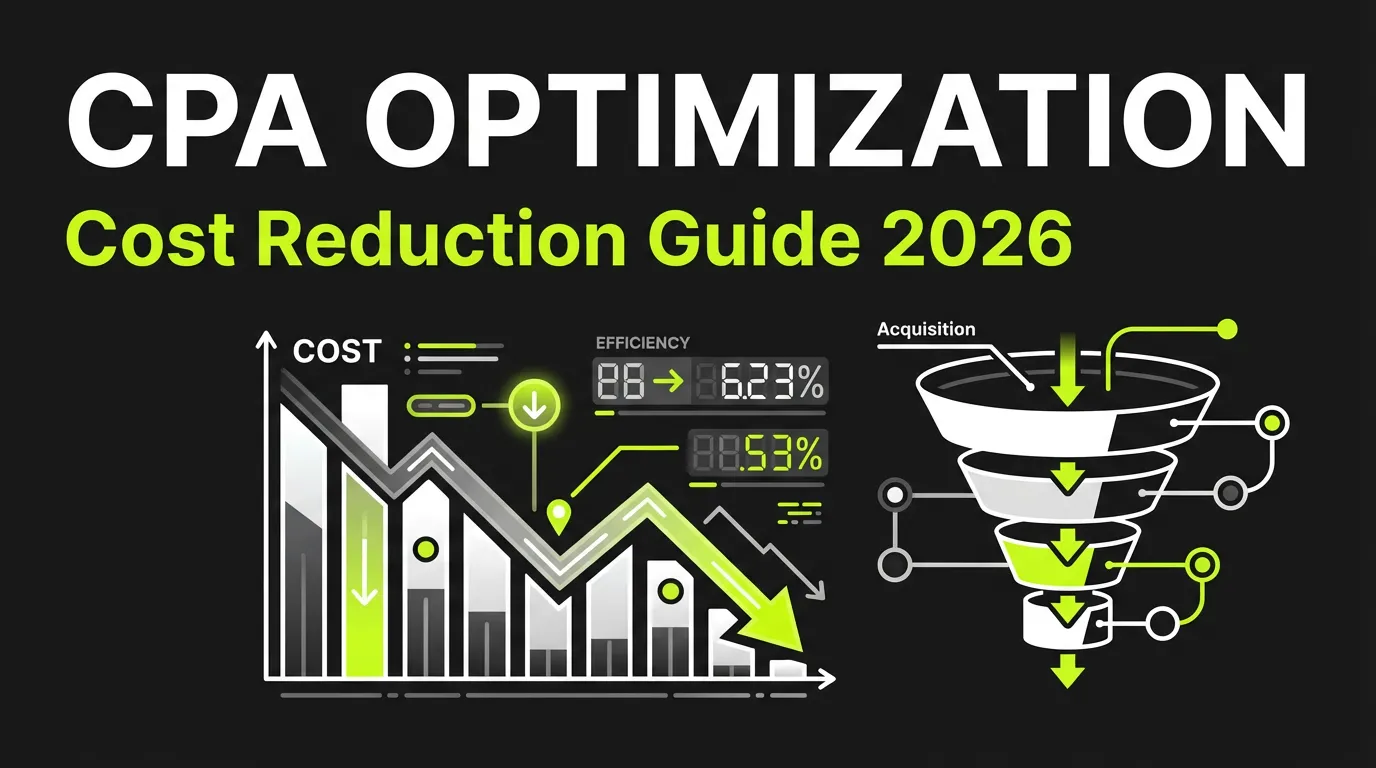

CPA Optimization Guide 2026
Cost per acquisition decides whether paid advertising builds a business or quietly drains it. As ad auctions get more crowded and privacy changes shrink targeting signals, the gap between efficient and wasteful spend keeps widening. This guide breaks down how CPA actually works in 2026, the three levers that move it most, and the channel tactics that hold up under real budgets. We've found that teams who treat CPA as a system, not a single dial, recover margin faster than those chasing the cheapest click. The goal here is simple: lower the cost of acquiring customers who stay profitable. Let's get practical.
Key Takeaways
- CPA equals total ad spend divided by acquisitions, so traffic quality, conversion rate, and bidding all move the number.
- The cheapest acquisition is rarely the most valuable one. Tie CPA targets to lifetime value and margin.
- Smart bidding needs data. Google recommends roughly 30 conversions per month before Target CPA stabilizes.
- Page speed matters: Google research shows bounce probability rises sharply as load time grows past three seconds.
- Continuous testing across audiences, creative, and landing pages compounds into durable CPA gains.
What Is CPA and Why Does It Matter in 2026?
Cost per acquisition measures what you pay to win one customer or conversion, calculated as total ad spend divided by the number of acquisitions. It matters because it links spend directly to results, unlike vanity metrics such as impressions or clicks. According to WordStream, average conversion rates and costs vary widely by industry, which means your CPA only makes sense against your own economics.
A single number hides a lot. CPA blends traffic quality, conversion rate, and how much you bid, so improving any one of them moves the result. That's why two advertisers in the same niche can post wildly different CPAs.
Here's the part teams miss: a low CPA can still lose money. If you acquire customers cheaply but they churn fast or buy little, you've optimized the wrong thing. CPA only earns its place when you read it next to lifetime value and gross margin.
For context on how acquisition cost fits the broader picture, see our customer acquisition cost guide.
How CPA Connects to Profit
A target CPA should never be a guess. Start from contribution margin per customer, subtract the buffer you need for profit, and the remainder is your acceptable acquisition cost. A $200 CPA looks alarming until you learn the customer generates $2,000 over their lifetime.
How Do You Build a CPA Optimization Framework?
A reliable framework rests on three pillars: traffic quality, conversion rate, and bidding efficiency. Each attacks the CPA equation from a different angle, and ignoring any one caps your results. Industry analysis from Invesp reports that typical site conversion rates sit in the low single digits, which shows how much headroom most accounts still hold.
| Pillar | Focus | Effect on CPA |
|---|---|---|
| Traffic quality | Bring better prospects to the click | Fewer wasted impressions |
| Conversion rate | Convert more of the visitors you get | More acquisitions per dollar |
| Bidding efficiency | Pay the right price per outcome | Higher value per spend |
Treat these as connected, not separate. Better traffic raises conversion rate. A faster page makes bidding algorithms learn quicker. When the pillars reinforce each other, CPA drops without you slashing budget.
Ask yourself a blunt question before optimizing anything: which pillar is actually broken? Spending weeks on creative when your landing page loads in eight seconds wastes effort. Diagnose first, then fix.
How Can You Improve Traffic Quality?
Traffic quality optimization means sending fewer, better prospects to your offer instead of buying every available click. In most accounts, a small slice of audiences drives the bulk of efficient conversions, so the work is finding that slice and feeding it. Meta advises advertisers to give broad audiences room and let delivery systems find responsive users rather than over-segmenting from the start.
Run a structured audience audit before expanding spend. The steps are straightforward, and they pay off quickly.
- Segment performance by audience type, not just by campaign.
- Rank segments by CPA, not by raw conversion volume.
- Expand the winners with lookalike or similar audiences.
- Exclude the persistent losers with negative targeting.
Using Negative Targeting
Negative targeting protects budget by blocking people who will never convert profitably. Common exclusions include recent purchasers, job seekers when you sell to businesses, and regions where lifetime value runs too low to justify the spend. Each exclusion sharpens delivery and quietly improves CPA without touching your bids.
In our experience, advertisers underuse exclusions. They obsess over who to target and forget who to avoid. Both halves matter.
How Do You Raise Conversion Rate to Lower CPA?
Conversion rate optimization lowers CPA by turning more of your existing traffic into customers, which means you pay the same for clicks but acquire more buyers. Page experience drives much of this. Google research on web performance found that as page load time stretches from one to several seconds, the probability of a bounce climbs steeply, draining conversions before visitors ever see your offer.
Landing page details compound. A headline that matches your ad keeps the promise visitors clicked on. A short form removes friction. Trust signals reassure first-time buyers. None of these are dramatic alone, yet together they reshape your CPA.
| Element | Best practice | Why it matters |
|---|---|---|
| Headline | Match the ad promise exactly | Cuts bounce from mismatched intent |
| Call to action | Clear and action-oriented | Removes hesitation |
| Speed | Aim under three seconds | Slow pages bleed conversions |
| Social proof | Reviews and testimonials | Builds trust with new visitors |
| Form length | Keep only essential fields | Every extra field costs conversions |
| Mobile layout | Design mobile-first | Mobile carries most paid traffic |
Test One Variable at a Time
Disciplined testing beats guesswork. Change the headline, measure, then change the form. When you alter five things at once, you learn nothing about which one worked. For a deeper playbook, read our conversion rate optimization complete guide.
Which Bidding Strategy Lowers CPA Best?
The right bidding strategy depends on how much conversion data your campaign has collected, not on which option sounds most automated. Google Ads guidance suggests automated strategies like Target CPA perform best once a campaign has accumulated meaningful recent conversions, often cited as around 30 per month. Below that threshold, the algorithm lacks signal and overspends.
Match the strategy to your stage. New campaigns benefit from manual control while you learn. Mature campaigns with steady volume reward automation.
| Strategy | Best for | When to use |
|---|---|---|
| Manual CPC | Control and learning | New or low-volume campaigns |
| Enhanced CPC | Control plus light automation | Moderate volume |
| Target CPA | Cost-efficiency at scale | 30+ conversions monthly |
| Target ROAS | Revenue and margin focus | E-commerce with value data |
Resist switching strategies every week. Each change resets the learning phase and clouds your read on what actually drives results.
What Channel-Specific CPA Tactics Work?
Each platform rewards different habits, so the best CPA tactics shift with the channel even when the principles stay constant. Meta and Google dominate most paid budgets, and both publish optimization guidance worth following. Meta emphasizes feeding its systems more conversion signal, while Google ties cost efficiency closely to ad relevance and Quality Score.
Meta Tactics
On Meta, lean toward broader targeting and let delivery optimize. Strengthen signal with the Conversions API so the system sees more of what happens after the click. Video and motion creative tend to earn cheaper engagement, which feeds back into lower acquisition costs over time.
Google Ads Tactics
On Google, Quality Score is your lever: more relevant ads and pages earn lower costs per click. Prune search terms regularly with negative keywords so you stop paying for irrelevant queries. Keep at least three ad variants running, and move to smart bidding once you have enough conversion history. To connect these moves to revenue outcomes, see our proven ways to increase ROAS and the broader performance marketing guide.
Frequently Asked Questions
What is a good CPA in 2026?
A good CPA is any acquisition cost that leaves healthy profit after you account for lifetime value and margin. Benchmarks differ sharply by industry. WordStream shows wide cost variation across sectors, so judge your CPA against your own unit economics, not a generic average.
How is CPA different from CPC?
CPC measures the cost of a single click, while CPA measures the cost of a completed acquisition such as a sale or qualified lead. You can hold a low CPC yet suffer a high CPA if the page rarely converts. CPA reflects business results; CPC reflects only traffic cost.
How many conversions do I need before using Target CPA?
Google Ads guidance indicates automated bidding strategies stabilize best with steady recent conversion volume, commonly cited as roughly 30 conversions per month. With less data, the algorithm has weak signal and tends to overspend, so manual or enhanced bidding usually performs better early on.
Does lowering CPA always increase profit?
No. A lower CPA only helps if the customers you acquire stay valuable. Cutting cost by chasing the cheapest clicks often brings low-intent buyers who churn or spend little. Pair CPA targets with lifetime value, as covered in our customer acquisition cost guide, to protect real profit.
The Bottom Line
CPA optimization in 2026 rewards systems thinking over single-metric chasing. Improve traffic quality so the right prospects click. Sharpen landing pages so more of them convert. Match bidding to your data so you pay fair prices. Then test continuously, because auctions and audiences keep shifting under you. Above all, anchor every target to lifetime value and margin, since the cheapest customer who never sticks around costs you the most. The lowest profitable CPA, not the lowest CPA, is the real goal.
Ready to put this into practice across every channel at once? Explore the AI Agents Ads Manager to track and optimize CPA in real time.