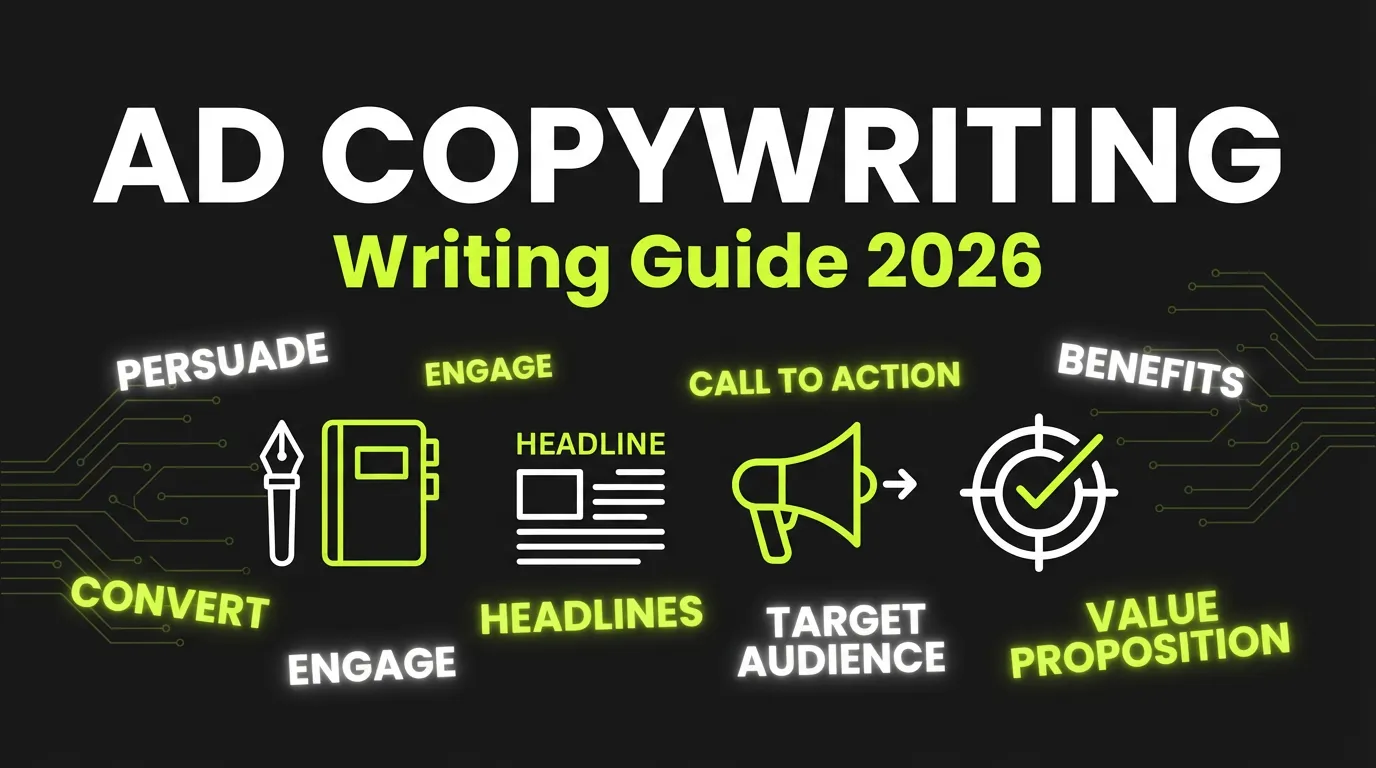

Key Takeaways
- Effective ad copy can boost conversion rates by up to 200%
- The right copy can slash cost-per-lead from $1600 to $60
- In 2026, attention spans are shorter than ever — you have under 3 seconds
- Clarity beats cleverness every time
- Test multiple variations — even great copywriters can't always predict what works
The Power of Words
:::highlight The Impact WordStream reports that effective ad copy can boost conversion rates by up to 200%. In some cases, the right copy can slash cost-per-lead from $1600 to $60 and deliver ROI increases of 1866%. :::
I've written ad copy for campaigns spending $1M+ monthly. The difference between copy that converts and copy that wastes budget isn't talent — it's understanding what makes people act.
For teams that need more campaign-ready variations, AdBid's AI creative factory helps turn briefs into hooks, copy, and ad assets faster.
The Five Principles of High-Converting Copy
1. Clarity Over Cleverness
:::warning The Clarity Rule The best ad copy is clear, not cute. Your reader should instantly understand what you're offering and why it matters. Customers shouldn't feel like they're solving a riddle. :::
Instead of: "Revolutionize your workflow with next-gen AI solutions"
Write: "Save 10 hours a week with automated reporting"
2. Benefits Over Features
Users don't care about features. They care about outcomes.
Feature: "AI-powered dashboards"
Benefit: "See exactly where you're wasting ad spend"
The Translation Formula: Feature → "which means" → Benefit → "so you can" → Outcome
3. Specific Over Vague
Specificity builds credibility.
Vague: "Improve your results"
Specific: "Increase ROAS by 43% in 30 days"
4. You Over We
Focus on the reader, not yourself.
We-focused: "We've helped thousands of marketers..."
You-focused: "You'll finally understand which ads are wasting money..."
5. One Message Per Ad
:::tip Focus Trying to communicate everything says nothing. Each ad should convey one clear idea, one compelling benefit, one action to take. :::
The Hook: Your First Three Seconds
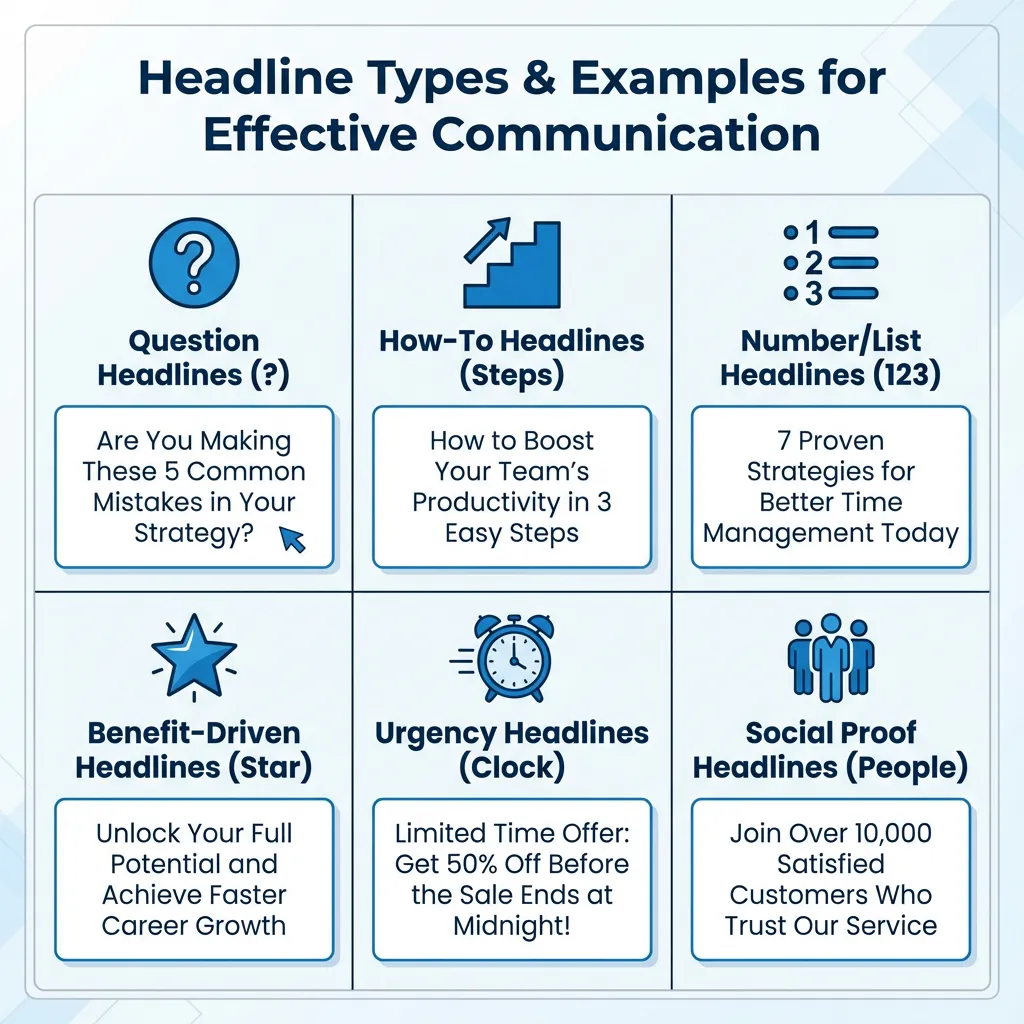
Why Hooks Matter
In 2026, attention spans are shorter than ever. Your headline or first sentence must stop the scroll or stand out in search results.
Hook Formulas That Convert
The Question Hook: "Tired of wasting money on Facebook ads?"
The Bold Statement: "Your landing page is killing conversions."
The Number Hook: "3 reasons your ROAS dropped this month"
The "If/Then" Hook: "If you're running Meta ads, you need to see this"
The Curiosity Gap: "This targeting mistake costs advertisers $millions"
The Social Proof Hook: "12,847 marketers are using this strategy"
Hook Testing
Always test 3-5 hook variations. The best hook can:
- 2-3x your click-through rate
- Cut CPC by 50%
- Transform campaign performance
Emotional Triggers
The Psychology of Action
:::info Emotional Impact Advertisements that trigger emotions such as joy, sadness, anger, or fear have a strong impact on customers. Emotion drives action. :::
Key Triggers to Use
Fear of Missing Out (FOMO):
- "Limited spots available"
- "Offer ends tonight"
- "Only 3 left at this price"
Pain/Problem Agitation:
- Address the struggle directly
- Make them feel understood
- Then offer the solution
Social Proof:
- "Join 10,000+ marketers"
- "Trusted by leading brands"
- "★★★★★ rated"
Curiosity:
- "The strategy nobody talks about"
- "What most advertisers get wrong"
- "The hidden feature in your account"
Authority:
- Expert credentials
- Industry recognition
- Results achieved
Call-to-Action Mastery
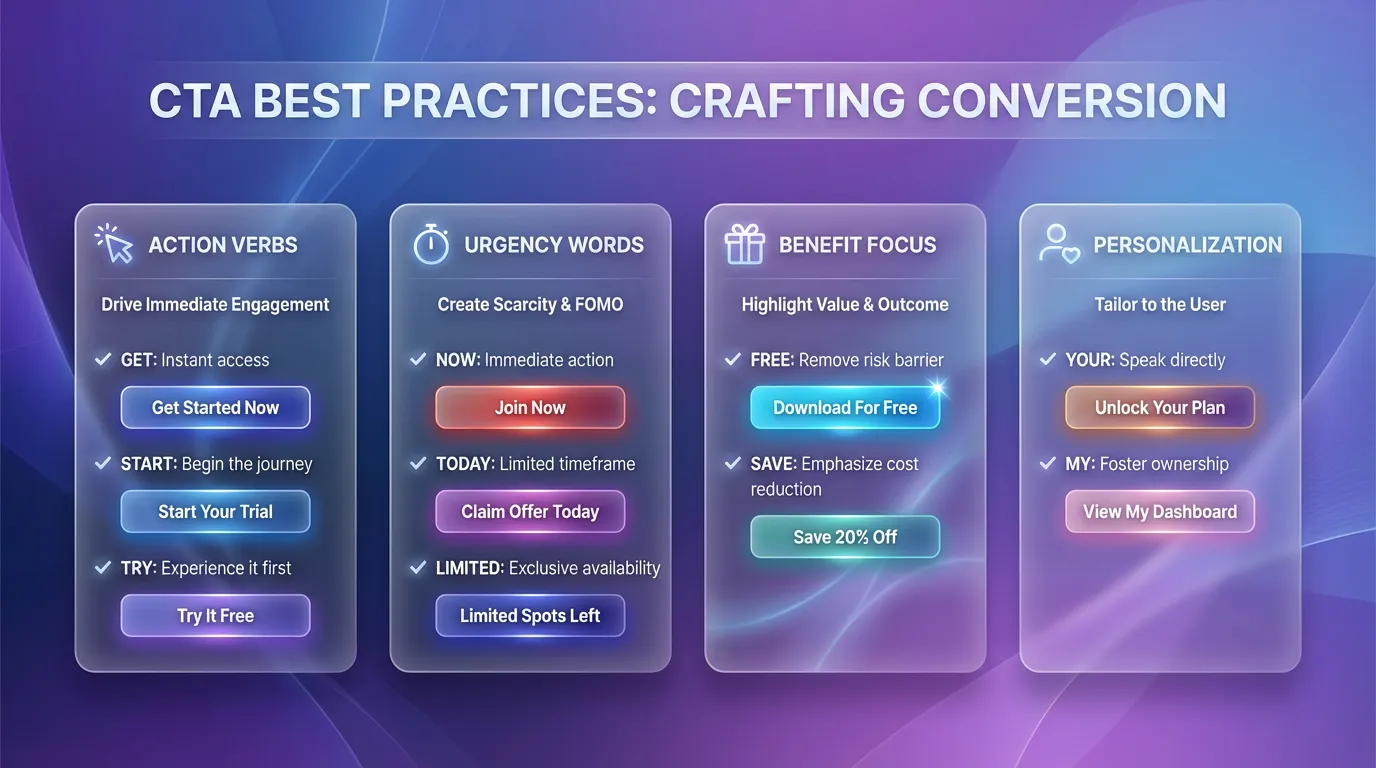
CTA Principles
Be Specific: Instead of "Learn More" → "Get Your Free Audit"
Add Urgency: Instead of "Sign Up" → "Start Your Free Trial Today"
Reduce Risk: Instead of "Buy Now" → "Try Free for 14 Days"
Promise Value: Instead of "Submit" → "Get My Results"
High-Converting CTAs by Goal
| Goal | CTA Examples |
|---|---|
| Lead Gen | "Get Your Free Guide" / "Download Now" |
| Free Trial | "Start Free Trial" / "Try It Free" |
| Demo | "Book Your Demo" / "See It In Action" |
| E-commerce | "Shop Now" / "Get 20% Off" |
| Content | "Read the Full Story" / "Watch Video" |
Platform-Specific Copy
Meta (Facebook/Instagram)
Character Limits:
- Primary text: 125 characters (before "see more")
- Headline: 40 characters
- Description: 30 characters
What Works:
- Conversational tone
- Emoji usage (sparingly)
- Question hooks
- Short paragraphs
Google Ads
Character Limits:
- Headlines: 30 characters each (15 available)
- Descriptions: 90 characters each (4 available)
What Works:
- Keyword inclusion
- Benefits in headlines
- Numbers and specifics
- Strong CTAs
Character Limits:
- Intro text: 150 characters visible
- Headlines: 70 characters
What Works:
- Professional tone
- Industry insights
- Thought leadership angles
- Value-first approach
TikTok
What Works:
- Native, authentic voice
- Conversational, not corporate
- Trend awareness
- Hook in first words
The Copy Testing Framework
What to Test
:::tip Testing Priority Even the best copywriters can't always predict what works. Run multiple variations and use A/B testing. :::
High Impact Tests:
- Hook/Opening line
- Primary benefit angle
- CTA text
- Urgency elements
- Social proof inclusion
Test Structure
Minimum Viable Test:
- 2 variations
- Same audience
- Same budget split
- Statistical significance before declaring winner
Advanced Testing:
- 3-5 variations per element
- Segment performance analysis
- Creative fatigue monitoring
Common Copy Mistakes
Mistake 1: Feature Dumping
Listing features without benefits.
Fix: Translate every feature into a customer outcome.
Mistake 2: Generic Claims
"Best," "leading," "innovative" — words that mean nothing.
Fix: Be specific. Use numbers, results, testimonials.
Mistake 3: Too Long
Burying the message in walls of text.
Fix: Cut ruthlessly. Every word must earn its place.
Mistake 4: Weak CTAs
Generic "Learn More" that doesn't inspire action.
Fix: Specific, value-focused CTAs that promise clear outcomes.
Mistake 5: Ignoring the Audience
Writing to everyone means connecting with no one.
Fix: Write to a specific person with a specific problem.
Mistake 6: No Urgency
No reason to act now vs. later (or never).
Fix: Add time limits, scarcity, or consequence of inaction.
Copy Frameworks
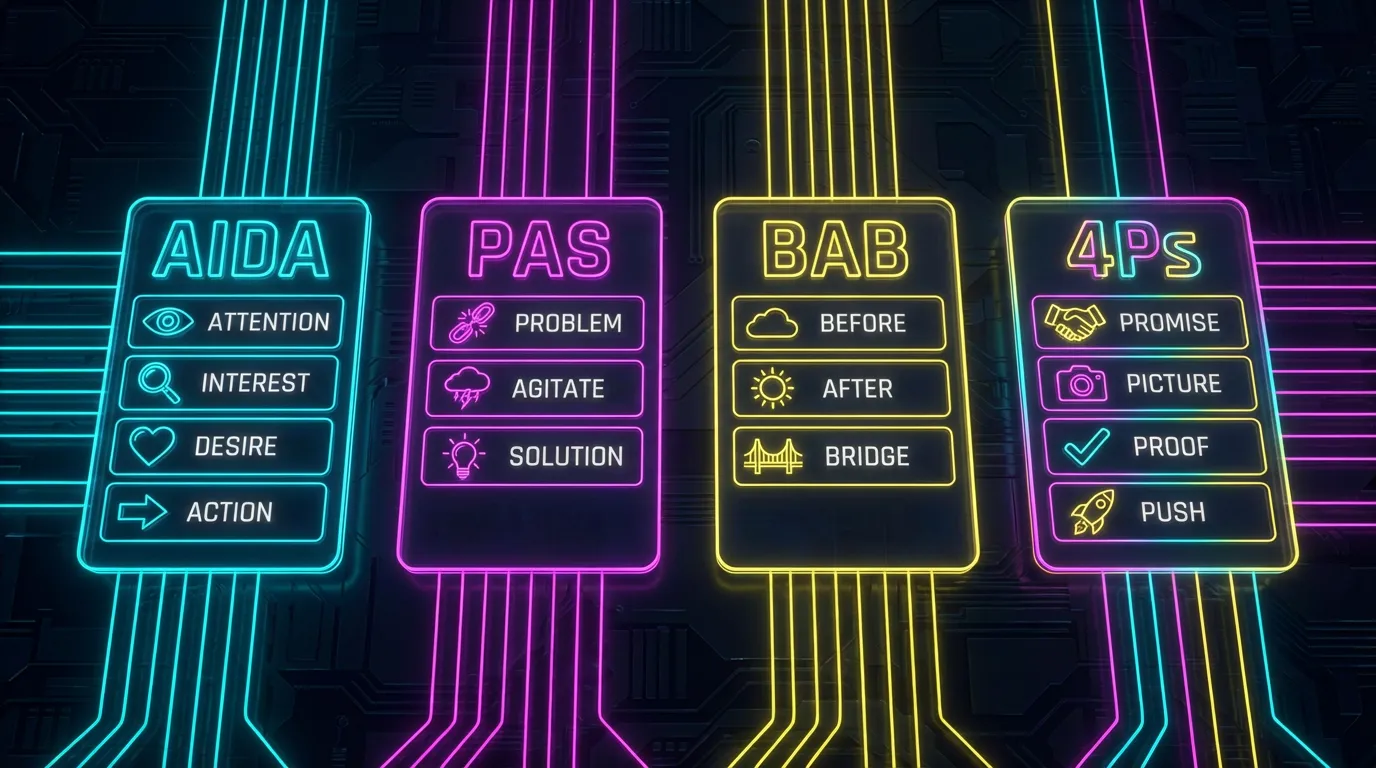
PAS (Problem-Agitate-Solve)
- Problem: Identify the pain
- Agitate: Twist the knife
- Solve: Offer relief
Example: "Tired of wasting money on ads that don't convert? (Problem) Every day, that budget goes to waste while competitors steal your customers. (Agitate) Our targeting audit shows you exactly where you're bleeding money — free. (Solve)"
AIDA (Attention-Interest-Desire-Action)
- Attention: Hook them
- Interest: Build curiosity
- Desire: Create want
- Action: Tell them what to do
4Ps (Promise-Picture-Proof-Push)
- Promise: Make a bold claim
- Picture: Paint the outcome
- Proof: Back it up
- Push: Drive action
Brand Consistency
Why It Matters
:::highlight Trust Building Maintaining the same tone of voice and ensuring your brand's messaging remains aligned across all ad platforms helps build trust. Customers who repeatedly see consistent branding are more likely to remember you. :::
Voice Guidelines
Create a simple voice document:
- 3-5 adjectives describing your brand voice
- Words you use vs. words you avoid
- Examples of on-brand and off-brand copy
The Bottom Line
Great ad copy doesn't require genius. It requires:
- Understanding your audience's pain
- Communicating clear value
- Testing relentlessly
- Optimizing based on data
The brands winning in 2026 aren't the ones with the biggest budgets. They're the ones who've mastered the words that make people act.
:::tip Start Here Take your worst-performing ad. Rewrite the headline using the "specific benefit + timeframe" formula. Test it against the original. This single change often improves CTR 30-50%. :::
Want to test ad copy variations at scale? AdBid helps you track creative performance across platforms and identify winning copy patterns. Start your free trial.