Key Takeaways
Замена лиц в GIF (face swapping in GIFs) is the workflow of replacing one person’s face with another across a short animated loop—while keeping motion, timing, and expression believable. In 2026, it matters because GIFs still dominate lightweight reactions in chats, community posts, and product marketing, and teams want faster iteration without reshooting. If you’re comparing tools, the practical question is not “can it swap a face once?” but “can it stay consistent across frames, handle occlusions, and survive compression?” This guide focuses on real production steps, quality checks, and safe usage—plus how to use AI Video & Image Generator by Cleep as part of a preparation loop (e.g., generating clean face assets and variations) without assuming native GIF import/export support. Learn more about the platform at Cleep via the official site AI Video & Image Generator.
Замена лиц в GIF is a frame-consistency problem. The best results come from stable identity, matched lighting, and careful handling of motion blur and occlusions.
- Plan a “source-first” workflow. Start with a high-quality clip or image sequence, do the face swap, then convert to GIF at the end to reduce artifacts.
- Compression is the silent killer. GIF’s limited color palette can introduce banding and flicker; exporting to video first and converting with tuned settings often helps (see GIF format constraints [4]).
- Use AI tools for assets, not assumptions. If a tool doesn’t explicitly support GIF I/O, use it to generate face references, clean portraits, or consistent variations, then assemble in a dedicated editor.
- Ethics and consent are part of quality. Clear permissions and labeling reduce brand risk and align with platform policies (see deepfake policy discussions and guidance [5]) (Wefaceswap: Облачная замена лиц для фото, видео и GIF [1]).
Definition
(Бесплатный онлайн AI обмен лиц для видео, фото и GIF [2])
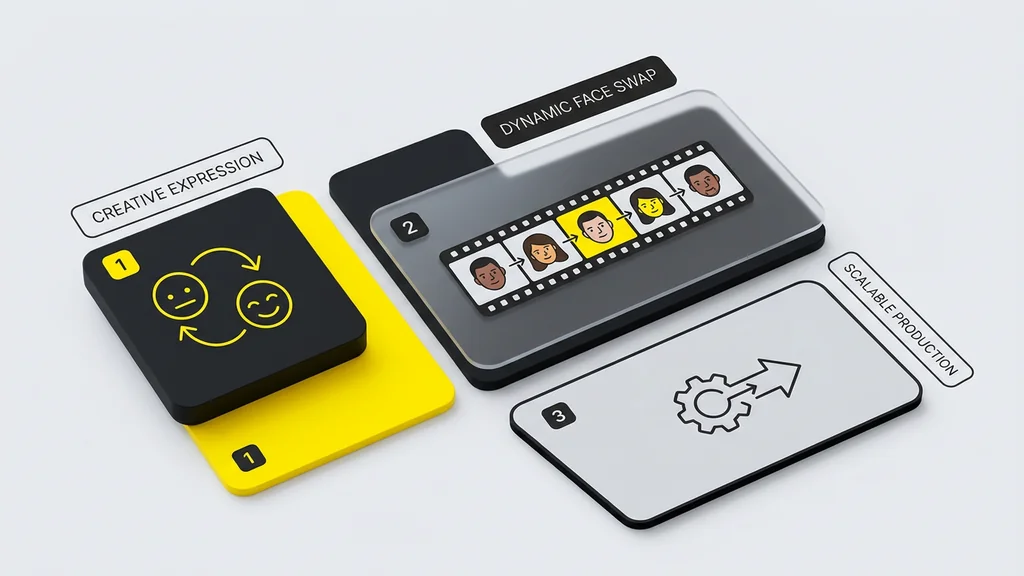
Замена лиц в GIF refers to replacing a face in an animated GIF while preserving the original motion and timing. In practice, it usually means one of three pipelines.
- Video-to-GIF pipeline: swap faces on a video clip, then convert to GIF.
- Frame-by-frame pipeline: split a GIF into frames, swap each frame (or keyframes), then reassemble.
- Hybrid pipeline: swap on keyframes and use interpolation/warping to propagate changes. For intermediate users comparing tools, define success with measurable criteria.
- Identity retention: the swapped face looks like the target person across frames.
- Temporal stability: minimal flicker/jitter between frames.
- Blend realism: edges, skin tone, and lighting match the scene.
- Loop integrity: the first and last frames align smoothly.
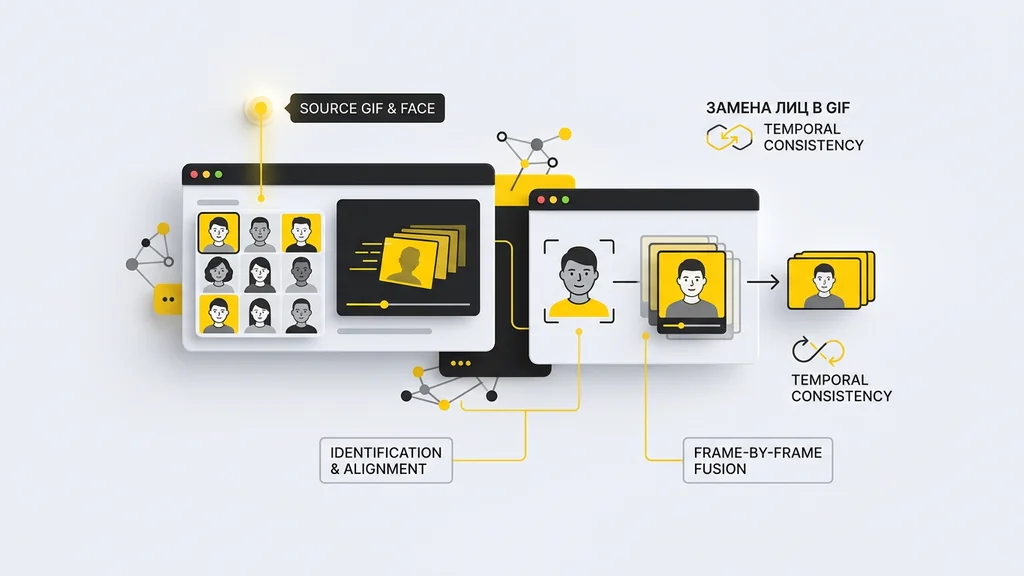
How It Works
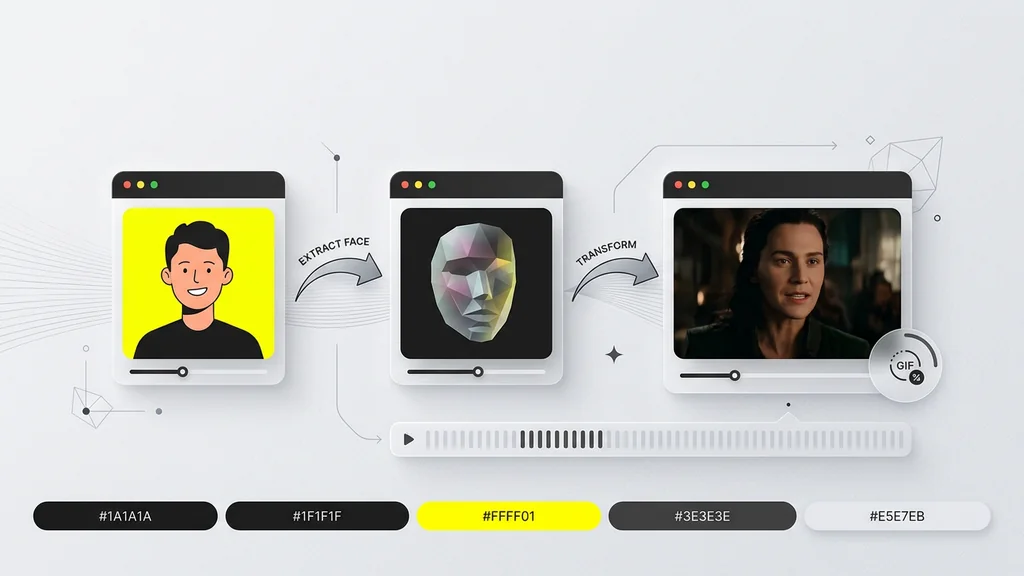
Most modern “ai gif face swap” systems follow a similar sequence, even if the UI looks simple.
- Face detection & tracking: locate faces per frame and track landmarks over time.
- Alignment: normalize pose/scale so the model can map expressions correctly.
- Identity transfer: generate or warp the target identity onto the source expression.
- Compositing: blend the swapped face back into each frame (color match, edge feathering).
- Temporal smoothing: reduce frame-to-frame variation (a major factor in Замена лиц в GIF).
- Export & conversion: render to a high-quality intermediate (often video or PNG sequence), then convert to GIF. Why teams often avoid “direct GIF swapping”: GIFs are palette-limited and prone to dithering artifacts, which can amplify flicker. Many creators render a clean intermediate first, then convert using tuned settings (palette optimization, dithering choice, frame rate control). For background on GIF limitations and palette behavior, reference the W3C GIF89a spec [4].
Features
When evaluating features for Замена лиц в GIF, prioritize what reduces rework and improves consistency. Below are the core feature buckets buyers compare.
Замена Лиц В Gif-Файлах in Замена лиц в GIF
This typically means the tool accepts a GIF as input and outputs a GIF. If a platform doesn’t explicitly support GIF I/O, you can still run a source-first workflow: convert GIF → video/frames, process, then convert back.
Practical advice: always keep the original frame rate and duration notes so your loop timing stays intact.
Множественная Замена Лиц В Gif in Замена лиц в GIF
Multi-face swapping is common in memes and team reactions. Look for.
- per-face locking (Face A always becomes Person A),
- consistent identity across occlusions,
- batch processing for multiple GIFs.
Онлайн-Замена Лиц В Gif in Замена лиц в GIF
Online tools are convenient, but teams should check.
- privacy controls and retention policies,
- watermarking,
- rate limits and queue times.
For organizational guidance on synthetic media responsibility, see [5].
Замена Лиц В Gif-Анимациях in Замена лиц в GIF
This emphasizes animation-specific quality: motion blur, fast head turns, and loop seams. The most useful feature here is temporal consistency (anti-flicker) rather than a single-frame “wow” result.
Actionable evaluation tip: test with three GIF types—(1) static head, (2) moderate motion, (3) heavy occlusion (hand over face). Score each on flicker and edge artifacts.
How To Use
A practical workflow that avoids common quality traps.
- Pick the right source. Start from the highest-quality version of the clip (ideally MP4), not a heavily compressed GIF.
- Extract frames or use video. If you only have a GIF, convert it to a video or PNG sequence first.
- Prepare the target face assets. Use a generator/editor to create consistent, front-facing portraits and variations (neutral, smiling, angled). With Cleep (AI Video & Image Generator), you can generate clean face references and style-consistent images to improve identity consistency—then feed those assets into your face-swap pipeline (internal anchor: AI Video & Image Generator).
- Run the swap and lock settings. Keep the same identity reference and blending parameters across the whole sequence.
- Do a temporal pass. If your tool offers smoothing, enable it; otherwise, reduce flicker by reusing a consistent color grade and avoiding aggressive sharpening.
- Export to a clean intermediate. Prefer a high-quality video or image sequence.
- Convert to GIF last. Tune palette and dithering; verify the loop seam and file size. Quality checklist (fast): zoom to 200% and scrub—look for edge halos, teeth/eye warping, and frame-to-frame “sparkle.”
Use Cases
Замена лиц в GIF is used where speed and repeatability matter more than cinematic realism.
- Marketing & social: localized reaction GIFs with a spokesperson’s face for campaigns; keep brand-safe labeling and approvals.
- Community & creators: meme remixes, streamer reactions, Discord packs—batch swapping helps maintain a consistent persona.
- Product teams: lightweight UI/feature announcements using reaction loops; faster than filming.
- Training & internal comms: role-play scenarios (with consent) to make micro-lessons more engaging.
- A/B testing: swap different faces in the same GIF to test engagement—ensure you follow platform ad policies and disclose synthetic edits where required.
Practical advice: maintain a small “approved faces” library (consented, high-res, consistent lighting) and a “do-not-use” list for protected individuals or sensitive contexts.
Challenges
Teams run into the same production issues repeatedly.
- Flicker and jitter: the #1 complaint in Замена лиц в GIF. Fix by using temporal smoothing, consistent references, and avoiding per-frame auto-exposure changes.
- Occlusions: hands, hair, glasses, microphones. Choose tools that handle masks well, or manually mask difficult frames.
- Lighting mismatch: a bright target face pasted into a dim scene looks fake. Apply color matching and grain.
- Extreme expressions: wide-open mouths and side profiles can break identity. Use better target references (multiple angles) and reduce swap strength slightly.
- Workflow fragmentation: converting GIF ↔ frames ↔ video can introduce timing drift. Keep a single “source of truth” timeline and document frame rate. Operational tip: create a “test GIF pack” (10–15 clips) and use it to evaluate any new ai gif face swap tool before adopting it.
Limitations
Even with strong tools, some limits are structural.
- GIF format constraints: limited colors and dithering can cause banding and shimmering, especially on skin tones and gradients (reference [4]).
- Not ideal for high realism: if you need broadcast-grade results, use video deliverables (MP4/WebM) and only make a GIF as a lightweight preview.
- Identity and consent risk: face swapping can be misused. Follow responsible synthetic media guidance and get explicit permission (reference [5]).
- Tool capability gaps: some platforms may not support direct GIF import/export. In those cases, treat Замена лиц в GIF as a workflow: prepare assets in one tool, swap in another, convert in a third. Recommendation (not a fact claim): if your pipeline is for brand use, standardize on a documented conversion preset and a review step (two-person check) before publishing.
FAQ
What is the fastest way to do Замена лиц в GIF without losing quality?
Start from the original video (or convert the GIF to video), perform the face swap on the video/frames, then convert to GIF at the end. This reduces palette-related artifacts and helps maintain temporal stability.
How do I reduce flicker in ai gif face swap results?
Use temporal smoothing if available, keep one consistent identity reference, and avoid changing enhancement settings mid-sequence. Also convert to GIF with a stable palette strategy to reduce frame-to-frame color shifts (see [4]).
Can I do multiple face swaps in the same GIF?
Yes—look for per-face tracking and identity locking. In practice, test scenes where faces cross or get partially covered; that’s where multi-swap pipelines often fail.
Is online Замена лиц в GIF safe for client work?
It depends on the provider’s retention and privacy policy.