
Part of our Meta Ads Platform guide series.
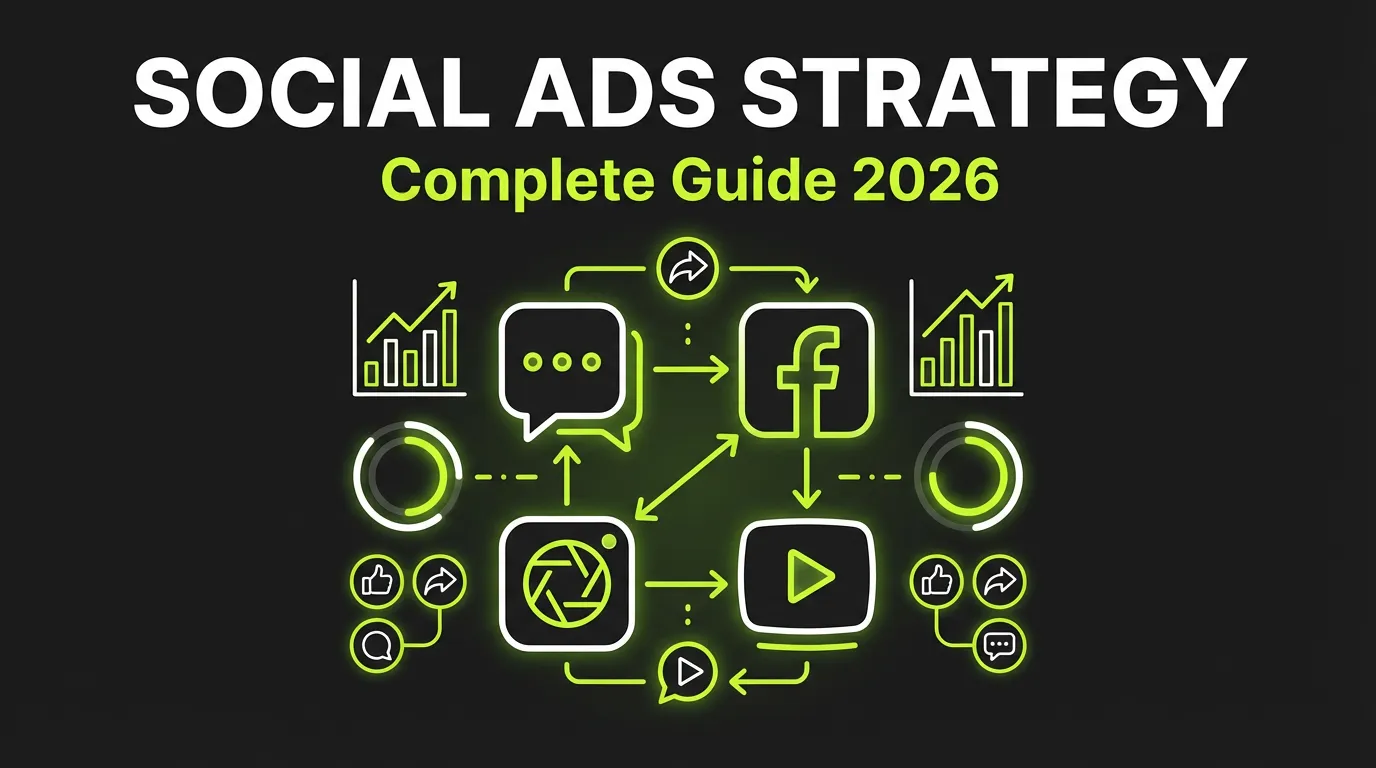
Social Media Advertising Strategy Guide 2026
Global social media ad spend is projected to reach $350 billion in 2026 (Statista). That number alone tells you the channel is mature, crowded, and unforgiving of lazy strategy. AI optimization, short-form video, and creator partnerships have reshaped how paid social actually works. The platforms haven't simply evolved. They've become fundamentally different advertising ecosystems, each with its own rules, costs, and winning formats. This guide breaks down what performs now, platform by platform, and where your budget belongs in 2026.
Key Takeaways
- Global social ad spend is projected at $350 billion in 2026 (Statista).
- Meta rewards broad targeting plus AI optimization, not manual micromanagement.
- TikTok GMV is tracking toward $66 billion in 2025 (Statista).
- Creator content beats polished brand creative across nearly every platform.
- Video-first creative and in-app commerce reduce friction and lift conversions.
What Does the Social Media Advertising Landscape Look Like in 2026?
Social advertising in 2026 is a $350 billion market (Statista), and that scale changes the game. You're no longer competing for attention against other brands alone. You're competing against creators, organic content, and the platform's own AI deciding who sees what. Reach has become cheap; relevance has become expensive.
The biggest shift is structural. Each platform now functions as a distinct ecosystem with its own creative language, commerce tools, and audience expectations. A campaign that wins on TikTok will flop on LinkedIn, and a Meta playbook rarely transfers cleanly to Pinterest. Strategy has to be built platform-first.
Three forces define the year: AI-driven optimization inside every ad manager, the dominance of short-form video, and the merging of content and commerce. Brands that treat social as a one-way broadcast channel keep losing ground. Those that treat it as a place to earn attention are pulling ahead.
If you're building a broader paid playbook, our performance marketing guide for 2026 covers how social fits alongside search, retail media, and other channels.
Which Platform-Specific Strategies Actually Work?
There is no universal social ad strategy in a $350 billion market (Statista). Each major platform rewards different creative, targeting, and bidding behavior. The brands that scale profitably treat Meta, TikTok, and LinkedIn as separate disciplines rather than one channel. Here's what's working on each in 2026.
Meta (Facebook and Instagram)
Meta is still the largest social ad platform, but its role has shifted. It's no longer about reaching everyone. It's about precision targeting and conversion optimization. The winning approach has flipped from manual control to feeding the algorithm clean signals and letting it work.
The current Meta formula rests on four pillars. Use broad targeting paired with AI optimization so the system finds your buyers. Lead with video-first creative, since static assets keep losing ground. Build full-funnel campaigns that move people from awareness to consideration to conversion. And implement the Conversions API for stronger attribution.
The brands doing well on Meta have stopped fighting the algorithm and started feeding it. Broad audiences, strong creative, and robust conversion tracking are the combination that holds up as costs rise and tracking gets harder.
TikTok
TikTok generated around $30 billion in GMV during 2024 (Statista), and it's tracking toward $66 billion in 2025. That growth tells you it's no longer just an awareness platform. It's a discovery-to-purchase engine.
The formats that perform share one trait: they don't look like ads. Spark Ads turn native creator content into paid placements. Shopping ads surface products inside the feed where discovery already happens. Smart+ campaigns hand targeting and bidding to TikTok's AI. Across the board, creator-driven content tends to outperform polished brand production.
The lesson is simple. Invest in creator partnerships, not glossy studio spots. Content that feels organic earns the watch time the algorithm rewards. Our UGC advertising guide breaks down how to source and scale that kind of authentic creative.
For B2B, LinkedIn remains unmatched, but the costs demand discipline. LinkedIn CPCs run several times higher than Meta, so you need certainty that your customer lifetime value justifies the spend. Most B2B products under a few thousand dollars in annual contract value struggle to make LinkedIn ads profitable.
When the economics work, the formats that perform include Thought Leader ads that promote employee voices, Document ads that drive stronger engagement than static images, Conversation ads that build personalized messaging journeys, and retargeting of warm website visitors. Cold prospecting on LinkedIn is expensive; warm retargeting is where the efficiency lives.
Why Is Creator-Powered Advertising Beating Brand Creative?
A net 61% of marketers plan to increase creator content investment in 2026, and 40%+ of brands report better ROI from micro and nano influencers. The era of brand-only creative is ending because audiences trust people more than logos. Creator content carries authenticity that a corporate ad simply can't manufacture.
Four dynamics drive the shift. Creator content feels native, so it performs like organic rather than interruption. Trust transfers from the creator to the brand they feature. Smaller creators deliver strong cost efficiency. And the rise of "deinfluencing" conversation shows consumers actively crave honest, unscripted opinions over staged endorsements.
The practical move is to build a creator roster across tiers rather than chasing a single big name. Nano creators (1K-10K followers) excel at product seeding and UGC. Micro creators (10K-100K) drive performance campaigns. Mid and macro tiers handle awareness and cultural moments. Match the tier to the objective.
For a deeper framework on sourcing and managing these partnerships, see our micro and nano influencer marketing guide.
Building a Creator Partnership Framework
Structure your roster by tier and intended outcome. Nano and micro creators offer the lowest CPMs and the most authentic feel, which makes them ideal for performance and UGC. Mid-tier creators broaden reach for brand awareness. Macro creators command premium rates and suit cultural moments rather than direct response.
The mistake many brands make is paying macro prices for performance goals. Smaller creators usually deliver better efficiency for conversion-focused campaigns, while reserving the big names for moments when reach itself is the objective.
Where Is Social Commerce Actually Working?
Social commerce is expanding fast, and 38% of marketers are increasing retail media network investment to capture it. TikTok Shop is the breakthrough product, but the trend is bigger than one platform. Instagram, Facebook, and Pinterest have all built shopping surfaces that let users buy without leaving the app.
Not every product fits, though. Social commerce converts best for items under $100, visual categories like beauty, fashion, and home, impulse-friendly purchases, and products that benefit from video demonstration. High-consideration or high-ticket items still need a longer journey off-platform.
The advantage of in-app commerce is friction removal. When discovery, decision, and checkout happen in one place, you lose fewer buyers between the ad and the cart. That's why video-first product demos paired with shoppable tags consistently outperform a link sending users to a separate site.
Our social commerce advertising guide covers platform-by-platform setup and the catalog tactics that lift in-app conversion.
How Should You Measure Social Media Success?
Measurement should map to your objective, not a single vanity metric. In a $350 billion channel (Statista), tracking the wrong number wastes budget at scale. Awareness, consideration, conversion, and retention each demand their own primary and secondary metrics.
For awareness, watch reach, frequency, and brand lift, with video views and engagement as supporting signals. For consideration, focus on engagement rate, click-through rate, and video completion. For conversion, ROAS, CPA, and conversion rate matter most, backed by average order value and customer lifetime value.
Retention deserves attention too, since acquiring a buyer is only the start. Repeat purchase rate and ongoing engagement reveal whether your social spend builds lasting customers or one-time transactions. Tie every metric back to the campaign objective, and you'll stop optimizing toward numbers that don't move the business.
Frequently Asked Questions
Which social platform delivers the best advertising ROI in 2026?
It depends on your product and audience. Meta remains the broadest performer for most consumer brands, while TikTok, tracking toward $66 billion in GMV for 2025 (Statista), excels for visual and impulse categories. LinkedIn wins B2B when contract values are high enough to absorb premium CPCs.
Should I use creator content or brand-produced ads?
Lean toward creator content for most campaigns. A net 61% of marketers are increasing creator investment in 2026, and 40%+ of brands see better ROI from micro and nano influencers. Creator content feels native, transfers trust, and tends to perform like organic rather than interruptive advertising across short-form platforms.
What types of products sell best through social commerce?
Social commerce converts best for products under $100 in visual, impulse-friendly categories like beauty, fashion, and home. Items that benefit from video demonstration perform especially well. High-ticket or high-consideration purchases usually still need a longer journey, often moving the buyer off-platform to complete the decision.
How much should I budget for social media advertising?
There's no fixed figure, but the $350 billion projected 2026 market (Statista) shows competition is intense. Start with enough budget to gather meaningful conversion data on one platform, prove ROAS, then expand. Underfunded campaigns rarely give the algorithm the signals it needs to optimize.
Putting Your 2026 Social Strategy Together
Winning at social advertising in 2026 comes down to five moves. Treat each platform as its own discipline. Build creator partnerships instead of relying on brand-only creative. Lead with video, since static assets keep fading. Integrate commerce to cut friction. And use platform AI for optimization while you own the strategy.
The mindset shift matters most. Stop treating social as a distribution channel for ads and start treating it as communities where you earn the right to participate. The best-performing ads don't feel like ads at all. They feel like content worth watching, from voices worth trusting, about products worth buying.
Ready to run this playbook without adding headcount? AdBid's AI Agents Ads Manager helps you plan, launch, and optimize campaigns across every major platform from one workspace. Start building your social strategy today.