
Demand Generation: Complete B2B Strategy Guide for 2025
Demand generation is the engine that drives predictable B2B revenue. Unlike lead generation's focus on capturing existing demand, demand gen creates and nurtures buyer interest through education and value. This guide covers everything you need to build an effective demand gen program.
Once you're ready to scale, AdBid gives you the workflow to plan, launch, and optimize without adding headcount.
What is Demand Generation?
Demand generation is the process of creating awareness and interest in your product or service. It encompasses all marketing activities that drive awareness, consideration, and ultimately, revenue.
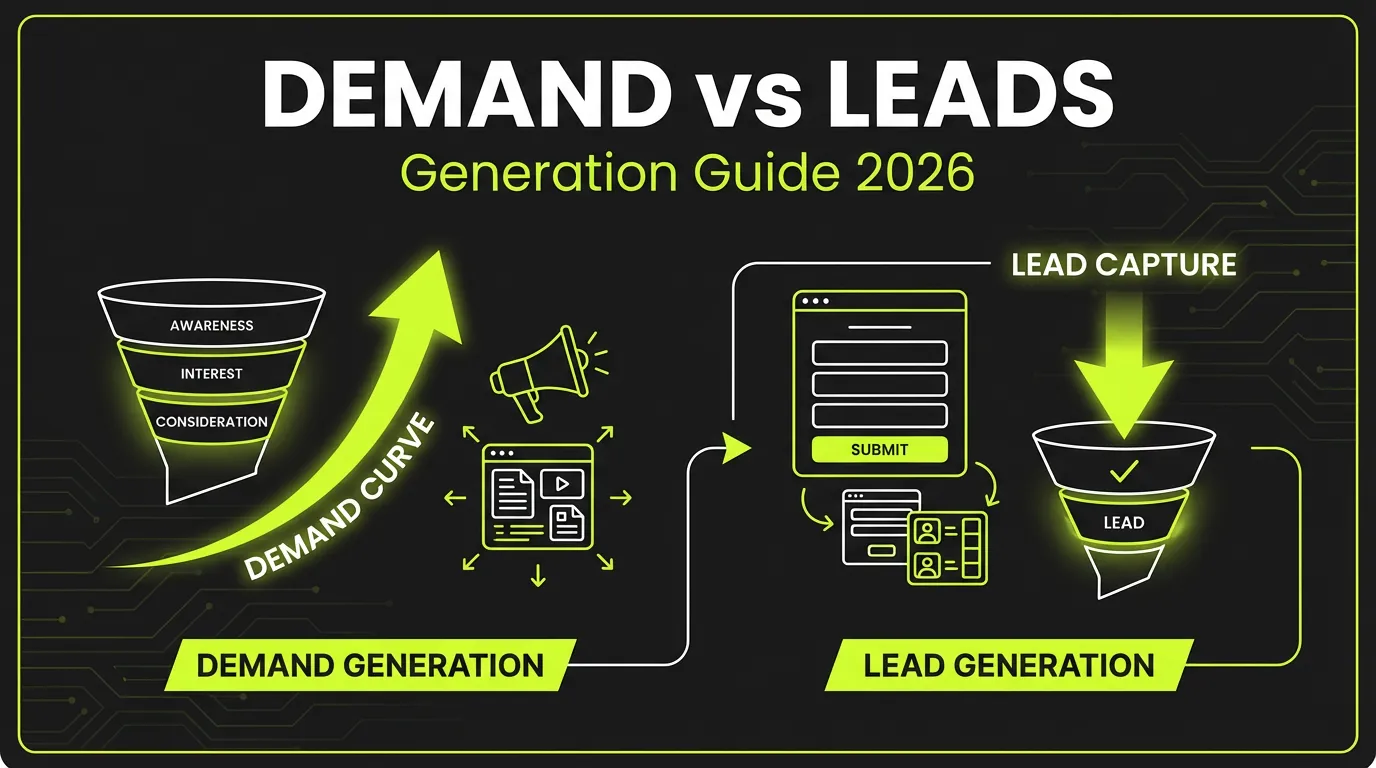
Demand Gen vs Lead Gen
| Aspect | Demand Generation | Lead Generation |
|---|---|---|
| Focus | Creating demand | Capturing demand |
| Metrics | Awareness, engagement, pipeline | MQLs, form fills |
| Timeline | Long-term | Short-term |
| Gating | Minimal (ungated content) | Heavy (forms, gates) |
| Goal | Educate market | Collect contacts |
| Budget | Brand + content heavy | Paid heavy |
Think of it this way:
- Lead gen: Fishing with a net (catching what's there)
- Demand gen: Stocking the pond (creating future demand)
The Demand Gen Funnel
AWARENESS (Top of Funnel)
├── They don't know they have a problem
├── Or they don't know solutions exist
└── Tactics: Content, social, events, podcasts

CONSIDERATION (Middle of Funnel)
├── They're researching solutions
├── Comparing options
└── Tactics: Guides, comparisons, webinars, case studies

DECISION (Bottom of Funnel)
├── They're ready to buy
├── Evaluating vendors
└── Tactics: Demos, trials, ROI calculators, sales enablement

POST-PURCHASE
├── Expand and retain
├── Create advocates
└── Tactics: Customer marketing, community, upsell campaigns
Building Your Demand Gen Strategy
Step 1: Define Your ICP (Ideal Customer Profile)
Start with clarity on who you're targeting:
ICP Template:

COMPANY CHARACTERISTICS:
- Industry: [e.g., B2B SaaS, Manufacturing]
- Company size: [e.g., 100-1000 employees]
- Revenue: [e.g., $10M-100M]
- Geography: [e.g., US, UK, EU]
- Technology: [e.g., Uses Salesforce, AWS]

BUYER PERSONA:
- Title: [e.g., VP of Marketing, CMO]
- Reports to: [e.g., CEO, CRO]
- Goals: [e.g., Increase pipeline, improve efficiency]
- Pain points: [e.g., Manual processes, poor attribution]
- Watering holes: [Where they spend time online]

BUYING COMMITTEE:
- Champion: [Who drives the purchase]
- Decision maker: [Who signs off]
- Influencers: [Who impacts decision]
- Blockers: [Who might object]
Step 2: Map the Buyer Journey
Understand what buyers need at each stage:
| Stage | Buyer Questions | Content Needs |
|---|---|---|
| Unaware | Why does this matter? | Industry trends, thought leadership |
| Problem Aware | How do others solve this? | Educational content, best practices |
| Solution Aware | What options exist? | Comparison guides, reviews |
| Product Aware | Why your solution? | Case studies, demos, ROI proof |
| Decision | Will this work for us? | Technical docs, security info, contracts |
Step 3: Build Content for Each Stage
Content Types by Funnel Stage:
TOP OF FUNNEL (Awareness)
├── Blog posts (thought leadership)
├── Podcast appearances
├── Social media content
├── Industry reports
├── Educational webinars
└── YouTube videos

MIDDLE OF FUNNEL (Consideration)
├── Comprehensive guides
├── Comparison pages
├── Case studies
├── Product webinars
├── Email nurture sequences
└── Interactive tools (calculators, assessments)

BOTTOM OF FUNNEL (Decision)
├── Demo videos
├── Free trials
├── ROI calculators
├── Customer testimonials
├── Technical documentation
└── Sales collateral

POST-PURCHASE (Expansion)
├── Onboarding content
├── Product training
├── Customer community
├── Upsell campaigns
└── Advocacy programs
Step 4: Choose Your Channels
Channel Selection Framework:
| Channel | Best For | Effort | Cost |
|---|---|---|---|
| SEO/Content | Inbound, long-term | High | Medium |
| LinkedIn Ads | B2B targeting | Medium | High |
| Google Ads | High-intent capture | Medium | High |
| Podcasts | Thought leadership | Medium | Low-Medium |
| Events | Relationships, demos | High | High |
| Nurturing, retention | Medium | Low | |
| Social (organic) | Brand, engagement | Medium | Low |
| ABM | Enterprise deals | High | High |
Step 5: Build Your Tech Stack
Essential Demand Gen Tools:
| Category | Tools | Purpose |
|---|---|---|
| CRM | Salesforce, HubSpot | Customer data, pipeline |
| Marketing Automation | HubSpot, Marketo, Pardot | Email, lead scoring |
| Analytics | GA4, Mixpanel | Web/product analytics |
| ABM | 6sense, Demandbase | Account targeting |
| Content | WordPress, Webflow | Content hosting |
| Social | Hootsuite, Sprout | Social management |
| Intent Data | Bombora, G2 | Buyer intent signals |
| Attribution | AdBid, Dreamdata | Marketing attribution |
Core Demand Gen Tactics
1. Content Marketing
The Pillar Content Strategy:
Create one comprehensive pillar page:
└── "The Complete Guide to [Topic]"
    ├── Chapter 1: Introduction → Supporting blog post
    ├── Chapter 2: Deep Dive A → Supporting blog post
    ├── Chapter 3: Deep Dive B → Supporting blog post
    ├── Chapter 4: How-To → Supporting blog post
    └── Chapter 5: Future → Supporting blog post

Each supporting post links back to pillar.
Pillar links out to supporting posts.
= Better SEO + content organization
Content Distribution Framework:
For every piece of content:
- Owned: Blog, email, website
- Social: LinkedIn, Twitter/X, Facebook
- Paid: LinkedIn ads, Google display
- Earned: PR, influencer shares
- Community: Slack groups, forums, Reddit
2. LinkedIn Marketing
Organic LinkedIn Strategy:
Weekly content calendar:
Monday: Educational post (problem/solution)
Tuesday: Company culture/behind-the-scenes
Wednesday: Customer story/case study snippet
Thursday: Founder/employee thought leadership
Friday: Industry news + hot take
LinkedIn Ads for Demand Gen:
| Ad Type | Use Case | CPM Range |
|---|---|---|
| Sponsored Content | Awareness, content promotion | $30-50 |
| Message Ads | Direct outreach | $0.50-1/send |
| Conversation Ads | Interactive engagement | $0.80-1.50/send |
| Video Ads | Brand storytelling | $40-60 |
| Document Ads | Lead gen content | $30-50 |
3. SEO & Search Marketing
B2B SEO Focus Areas:
Keyword strategy by intent:

INFORMATIONAL (Awareness):
"what is [solution type]"
"[problem] guide"
"how to [task]"

COMMERCIAL (Consideration):
"[solution] comparison"
"best [solution type]"
"[competitor] alternative"

TRANSACTIONAL (Decision):
"[product] pricing"
"[product] demo"
"[product] reviews"
4. Account-Based Marketing (ABM)
ABM Tiering Framework:
| Tier | Accounts | Investment | Tactics |
|---|---|---|---|
| 1 | 10-25 | $10K+ each | Custom campaigns, 1:1 |
| 2 | 50-100 | $2-5K each | Industry campaigns |
| 3 | 100-500 | $500-2K each | Programmatic, scaled |
Tier 1 ABM Playbook:
Week 1-2: Research
├── Map buying committee
├── Understand priorities
└── Find content consumption patterns

Week 3-4: Warm-up
├── Connect on LinkedIn
├── Share relevant content
└── Start appearing in their feed

Week 5-8: Engage
├── Personalized outreach
├── Custom content/offers
├── Direct mail/gifts
└── Multi-channel touches

Week 9+: Convert
├── Sales engagement
├── Custom demo
├── Executive alignment
5. Events & Webinars
Event Strategy:
| Event Type | Goal | Follow-up |
|---|---|---|
| Industry conferences | Awareness, networking | 48-hour follow-up |
| Your own events | Lead capture, branding | On-demand + nurture |
| Partner webinars | Audience expansion | Co-nurture sequence |
| Virtual summits | Scale + content | Long-term nurture |
| User conferences | Retention, expansion | Upsell campaigns |
Webinar Best Practices:
Structure (60 minutes):
:00-:05 - Intro, housekeeping
:05-:15 - Hook, context setting
:15-:45 - Main content (value!)
:45-:55 - Q&A
:55-:60 - CTA, close

Post-webinar:
- Send recording within 2 hours
- Follow-up sequence over 2 weeks
- Pass engaged leads to sales
- Repurpose content (clips, blog, social)
6. Email Marketing & Nurture
Lead Nurture Framework:
Nurture Track: Solution Aware Leads

Email 1 (Day 0): Educational content related to their interest
Email 2 (Day 3): Deeper dive + case study
Email 3 (Day 7): Common mistakes/myths
Email 4 (Day 14): Comparison/evaluation guide
Email 5 (Day 21): Customer story
Email 6 (Day 28): Soft CTA (demo, trial)

Track engagement and adjust:
- High engagement → Accelerate to sales
- Low engagement → Different content track
- No engagement → Reduce frequency
Measuring Demand Gen Success
Leading Indicators
| Metric | What It Tells You | Target |
|---|---|---|
| Website traffic | Awareness growth | +20% QoQ |
| Engagement rate | Content relevance | 3%+ |
| Email open rate | List health, subjects | 30%+ |
| Time on page | Content quality | 3+ minutes |
| Content downloads | Consideration interest | Trending up |
Lagging Indicators
| Metric | What It Tells You | Target |
|---|---|---|
| MQLs | Marketing traction | Varies |
| Pipeline generated | Revenue potential | $X/month |
| Pipeline velocity | Sales cycle health | Improving |
| Win rate | Lead quality | 20%+ |
| CAC payback | Efficiency | <18 months |
| LTV:CAC | Unit economics | 3:1+ |
Attribution Models
How to attribute demand gen impact:
| Model | Best For | Limitation |
|---|---|---|
| First-touch | Understanding awareness | Ignores nurture |
| Last-touch | Understanding close | Ignores awareness |
| Linear | Equal credit | Oversimplified |
| Time-decay | Weighs recent | May undervalue top-funnel |
| W-shaped | Key touchpoints | Requires setup |
| Data-driven | Accuracy | Needs volume |
Recommended: Start with multi-touch (linear or W-shaped), then move to data-driven as volume grows.
Demand Gen Budget Allocation
Budget by Funnel Stage
Typical allocation:
├── 40% - Awareness (content, brand, PR)
├── 35% - Consideration (nurture, webinars, comparisons)
├── 15% - Decision (demos, sales enablement)
└── 10% - Experimentation (new channels, tests)
Budget by Channel (Example: $500K Annual)
| Channel | % | Budget | Purpose |
|---|---|---|---|
| Content Marketing | 25% | $125K | Blog, guides, video |
| LinkedIn Ads | 20% | $100K | Targeted demand |
| Events | 15% | $75K | Conferences, webinars |
| Google Ads | 15% | $75K | Intent capture |
| ABM | 10% | $50K | Enterprise targeting |
| SEO | 10% | $50K | Organic growth |
| PR | 5% | $25K | Earned media |
Common Demand Gen Mistakes
1. Too Much Gating
Problem: Requiring email for every piece of content Impact: Lower reach, frustrates buyers Solution: Gate selectively; give value freely
2. Only Bottom-Funnel Content
Problem: Only product content, no education Impact: Missing awareness-stage buyers Solution: Balance with thought leadership
3. Volume Over Quality
Problem: Chasing MQL numbers Impact: Poor lead quality, sales frustration Solution: Focus on pipeline quality, not MQL quantity
4. Ignoring Dark Social
Problem: Not accounting for untraceable sharing Impact: Undervaluing content and community Solution: Include "how did you hear about us?" surveys
5. Short-Term Thinking
Problem: Expecting quick results from brand investment Impact: Cutting programs before they work Solution: Set realistic timelines (6-12 months)
Building Your Demand Gen Team
Team Structure (By Stage)
Startup (1-2 people):
- 1 generalist marketer
- Outsource content, design
Growth (3-5 people):
- Demand gen manager
- Content marketer
- Ops/analytics
Scale (6-10+ people):
- Head of demand gen
- Content team (2-3)
- Paid/growth marketer
- Marketing ops
- Events manager
- SDR/BDR alignment
Key Roles
| Role | Focus | Key Metrics |
|---|---|---|
| Demand Gen Manager | Strategy, execution | Pipeline, efficiency |
| Content Marketer | Content creation | Traffic, engagement |
| Paid Media | Advertising | CAC, ROAS |
| Marketing Ops | Tech, data, process | Data quality, attribution |
| Events | Webinars, conferences | Attendance, pipeline |
How AdBid Supports Demand Gen
AdBid helps demand gen teams with:
- Cross-Channel Campaign Management: Run ads across Google, Meta, LinkedIn, TikTok from one platform
- Attribution Insights: See which channels and campaigns drive pipeline
- AI Creative Generation: Quickly create ad variations for testing
- Budget Optimization: Automatically shift budget to top performers
- Unified Reporting: Single dashboard for all demand gen metrics
Conclusion
Demand generation is a long-term investment in your market presence and pipeline. Key principles:
- Focus on education, not just capture
- Align with sales on ICP and messaging
- Measure what matters (pipeline, not just MQLs)
- Be patient (demand gen compounds over time)
- Stay consistent (intermittent efforts fail)
Ready to amplify your demand generation with AI-powered advertising? AdBid helps you reach the right accounts across every channel. Start your free trial.